32
metronomes, started at different times.
Within minutes, every single one ticks together.
n February 1665, Christiaan Huygens was confined to bed, watching two pendulum clocks hanging on the wall across from him. The clocks were running at different rhythms. Then, about thirty minutes later, both fell into perfect synchrony. The pendulums swung in opposite directions, mirror images of each other. Huygens could not believe what he had seen. He disrupted the clocks, restarted them at different positions, moved them around the room. Every time, the result was the same: within half an hour, l'accord merveilleux — the marvelous accord.
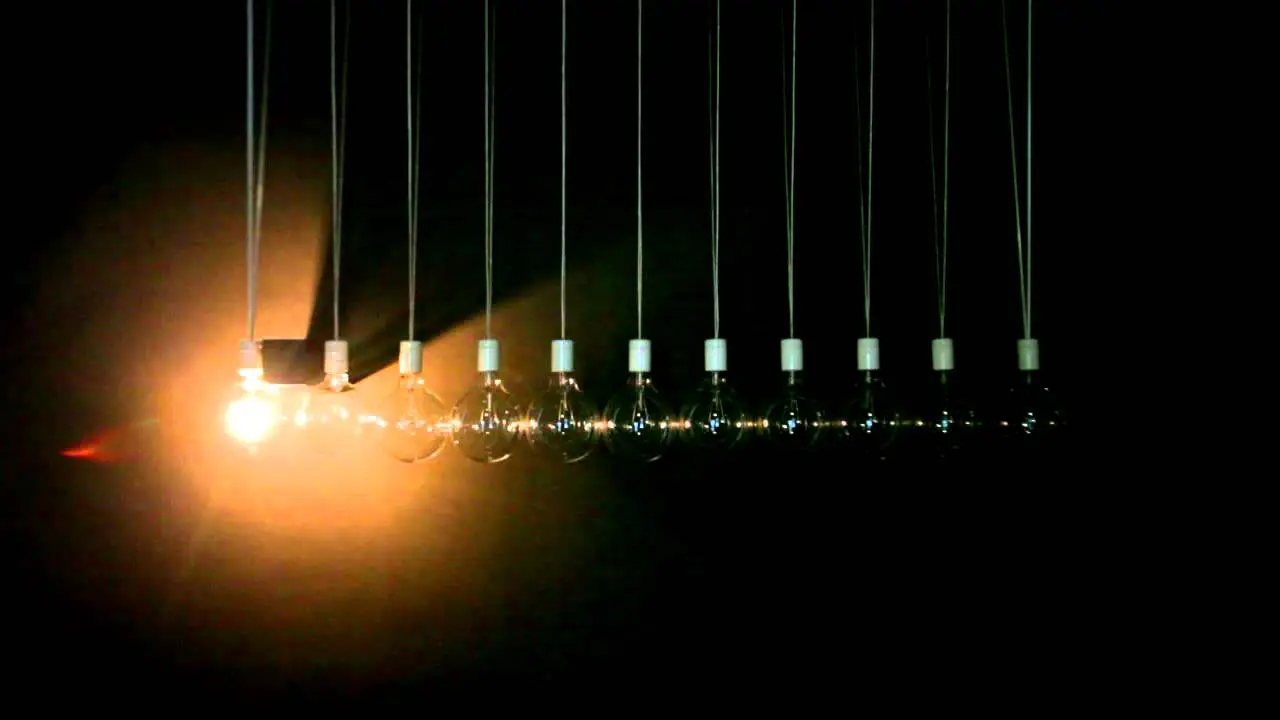
Huygens named the phenomenon “the strange sympathy of clocks.” He reported it first to mathematician R. F. de Sluse on February 22, 1665, then to his father and to Royal Society member Robert Moray; Moray read the letter aloud at a Society meeting on March 1, 1665.1 Huygens initially suspected air currents. He changed rooms, hung the clocks in different positions. The key observation came when he noticed that clocks mounted on the same beam synchronized; clocks on separate walls did not. The connection between them was the beam itself.
“The strange sympathy of two clocks” — Huygens's own phrase for the phenomenon he had just discovered.
— Christiaan Huygens, letter to R. F. de Sluse, February 22, 1665
Three hundred and sixty years later, a four-minute YouTube video demonstrated the same sympathy using 32 metronomes. Colorful metronomes placed on a rolling platform, started at different moments, ticking in apparent chaos. Then groups begin to form. Groups merge. And eventually all 32 click as one. The video has 4.4 million views. That number is not surprising. Watching it happen is genuinely arresting.
The Mechanism: The Platform Connects Everything
The physics is simple and elegant. Each time a metronome arm swings, it pushes the platform in the opposite direction — conservation of momentum. If the platform can move freely, as in the IkeguchiLab video (a wooden board sitting on rollers), that push is transmitted to every other metronome on it. The one swinging faster gets a slight brake; the one swinging slower gets a slight nudge. The system continuously drives frequencies toward each other. Physicists call this process phase locking: the metronomes do not match their frequencies so much as their phases — the precise point each one occupies in its swing cycle.
The critical condition is platform mobility. Place the metronomes on a fixed table and nothing happens. The mechanical link is severed, and each one continues at its own tempo indefinitely. Huygens's wooden beam served exactly this function: a passive bridge carrying energy from one pendulum to the other.
The Kuramoto Model: Order from Chaos
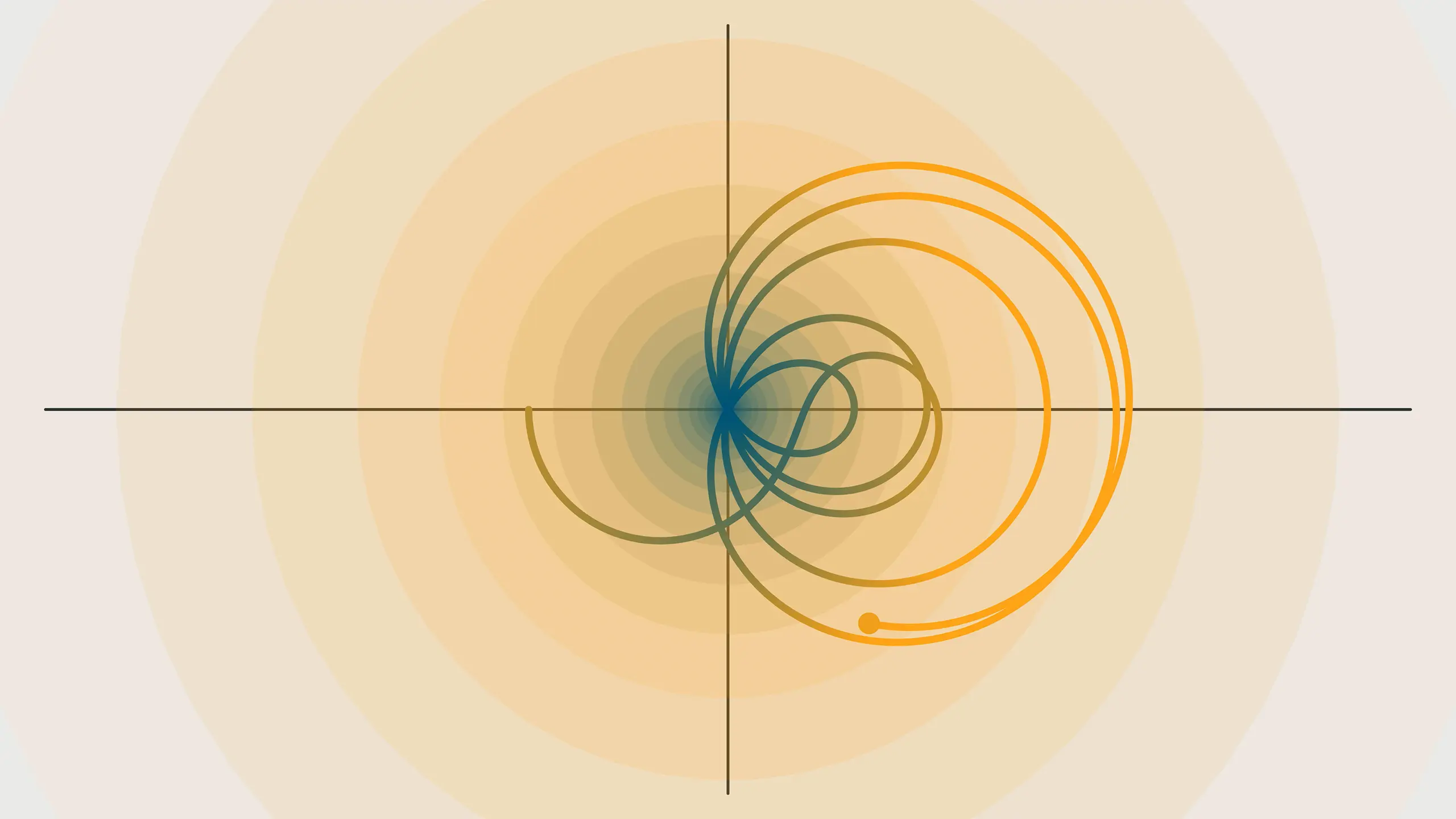
Japanese mathematician Yoshiki Kuramoto proposed a model for exactly these systems in 1975. It describes the behavior of large numbers of weakly coupled oscillators — anything from fireflies to neurons. The central prediction: if coupling is strong enough, all oscillators eventually lock to a single shared frequency. Below a critical coupling threshold, chaos persists. Above it, order is inevitable. The transition is sudden and dramatic — physics calls it a phase transition, and it behaves exactly like a liquid suddenly freezing solid.
The 32-metronome video is a visual proof of the Kuramoto model. The opening scene — independent oscillators ticking in apparent disorder — is the system below threshold. The closing scene — all 32 clicking as one — is the system above it. No metronome decides anything. None of them knows what the others are doing. All they do is push the platform and be pushed by it. Synchronization emerges from that accumulated mutual pushing, without any central coordination.
Sympathy Is Everywhere
Huygens's strange sympathy turns out to be everywhere. Fireflies flashing in unison across tropical forests. Heart pacemaker cells coordinating the pump. Neurons firing in rhythmic bursts. All of it runs on the same mathematical foundation. In 2018, researchers at the University of Virginia showed that the circadian clocks of cells lining the gut wall synchronize through the same mechanism as Huygens's pendulum clocks. The man watching two clocks from a sickbed in 1665 was sensing a principle that governs intestinal biology.
- →Neural networks — Brain waves (gamma, theta) coordinate communication between synchronized regions through phase locking.
- →Cardiology — Pacemaker cells synchronize the heart's pumping rhythm exactly as pendulum clocks synchronize on a shared beam.
- →Power grids — Generators across large electrical networks cannot operate without continuous frequency synchronization.
- →Laser physics — Coupled laser arrays use phase locking to combine output power.
- →Pedestrian traffic — At the opening of London's Millennium Bridge in 2000, hundreds of walkers began moving in rhythmic lockstep, driving the bridge into dangerous oscillation.
The Millennium Bridge episode is the Huygens effect as engineering disaster. The bridge began swaying; pedestrians adjusted their gait to match; their footfall amplified the sway; the sway grew. The bridge was closed within two days. It took two years and five million pounds to fit it with dampers. The mechanism Huygens identified — energy transferring from one oscillator to another through a shared medium — needed a few centuries before it shook a bridge under two thousand people.
Synchronization is not a decision. It is an outcome. The system produces its own order. Nobody is in charge.
The 32-metronome video translates a mathematical concept — coupled oscillators — into something anyone can watch on a kitchen table. Visual proof does something formalism cannot: it builds intuition. Richard Feynman argued throughout his career that a real understanding of physics begins with exactly this kind of direct, tactile intuition — the equations come after the image. Once that intuition is in place, fireflies, heartbeats, the London bridge, and Huygens's sickbed all come into focus through the same lens.
Two Metronomes, More Physics: Bifurcation
IkeguchiLab's 32-metronome video is widely known. Their more instructive experiment is less seen: same lab, same setup, but only two metronomes. In this video synchronization does not always take the same form. Depending on platform conditions, a pair of metronomes locks either in-phase — swinging together in the same direction — or anti-phase — swinging in opposite directions. The transition between these two states is abrupt: slowly vary the platform conditions and at some point the prevailing order collapses and the opposite order takes its place. Physicists call this a bifurcation — the moment a system tips between two stable states.
What Huygens observed in 1665 was anti-phase synchronization: his two clocks swung in opposite directions. IkeguchiLab's 32-metronome experiment produces in-phase synchronization instead. The difference comes down to platform damping — how freely the platform can move. Less friction favors in-phase; more friction favors anti-phase. Huygens's heavy wooden beam constrained the platform considerably, and anti-phase won. The light roller platform allows in-phase to dominate.
メトロノーム同期の分岐 — Bifurcation of Metronome Synchronization
IkeguchiLab · 2 metronomes · In-phase / anti-phase transition
www.youtube.com/watch?v=DKxdtdHExO4 ↗メトロノーム同期の分岐 — IkeguchiLab · In-phase / anti-phase transition
Why It Looks So Intuitive
The mechanism is simple to state: when any two metronome arms hit the side at the same time, the forces they exert on the platform either cancel out or add together, depending on how far out of sync they are. Arms that are out of sync receive a force in the opposite direction that nudges them toward the pack. The system self-corrects. Nobody intervenes.
That explanation is mechanically sufficient. But seeing the underlying mathematical structure requires returning to Kuramoto: synchronization is a threshold phenomenon. Below the coupling threshold the system stays chaotic; once the threshold is crossed, synchronization emerges suddenly and completely. The moment that threshold is crossed is visible in the video. At a certain point the groups start merging, and there is no going back.
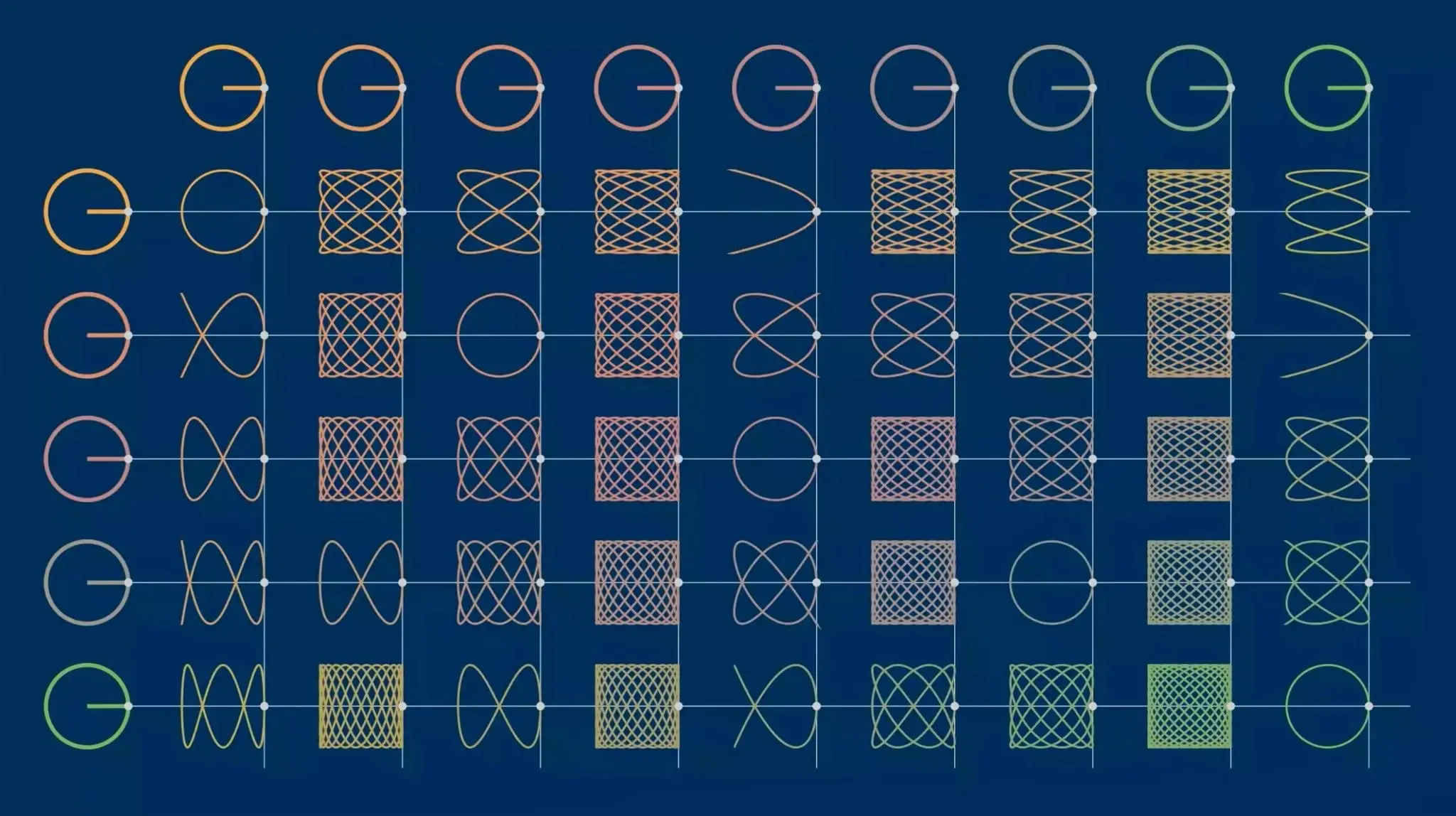
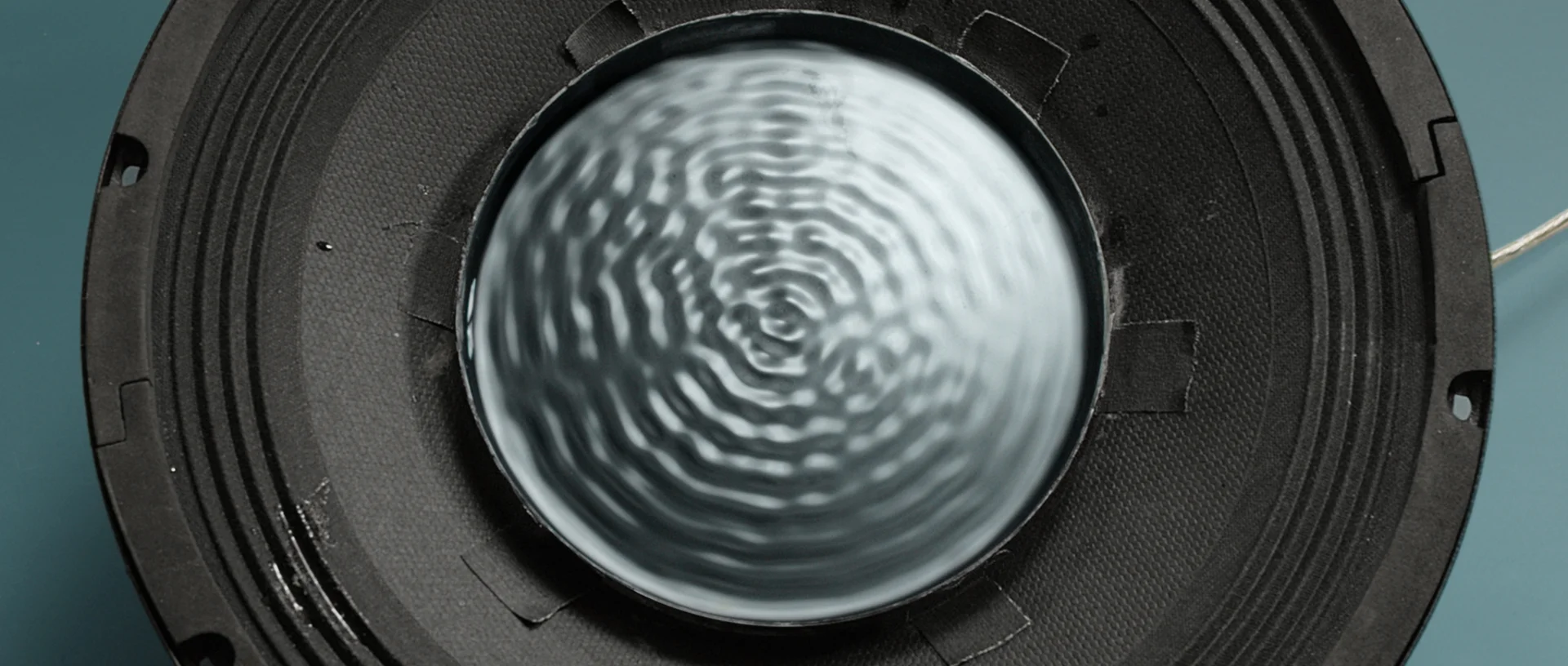
The same threshold effect shows up whenever a physical medium couples oscillators: sand on a vibrating metal plate, driven above a frequency threshold, snaps into perfect Chladni figures — geometric patterns that represent the wave equation made visible. Below threshold, disorder. Above it, crystalline order. Huygens and Kuramoto and Chladni were all observing the same underlying topology from different angles.
Strogatz, Two Undergraduates, and Oscillator Death
Cornell mathematician Steven Strogatz is one of the most recognized figures in synchronization research. His book Sync: The Emerging Science of Spontaneous Order is a classic of science writing; he hosts Quanta Magazine's The Joy of x podcast. A few years ago Strogatz contacted Lars English, a physics professor at Dickinson College. He had been working on capturing mathematically the discontinuity in a metronome's escapement mechanism and wanted to observe the phenomenon in a real experiment. English and two of his students — Emma Behta and Hillel Finder — accepted the offer.
Behta described the core of the experiment: “Coupling means that one device can influence another's motion through means that are not necessarily obvious to an observer. The platform acts as a source of communication between the two pendulums, allowing each one to feel the movements of the other.” Finder says his favorite discovery was a configuration called oscillator death: the two metronomes fight for control of the platform, and the conflict ends with both coming to a complete stop. The opposite of synchronization — but produced by the same physics.
Dickinson College — Metronome Synchronization Experiments
Hillel Finder '22 · Lars English · Steven Strogatz collaboration · Oscillator death included
www.youtube.com/watch?v=4xg4BsBs57I ↗Dickinson College · Strogatz / English / Finder '22 · Oscillator death and bifurcation
The work was published jointly by Strogatz, English, and the two undergraduates. Undergraduate students co-authoring a paper with one of the world's leading mathematicians is, as Finder put it, genuinely rare. But perhaps the more important point is this: metronomes — objects this simple — are still being actively researched, modeled, and surprised by. When Huygens watched two clocks from a sickbed in 1665, the mathematics to describe what he was seeing did not yet exist. Today, undergraduates publish papers on the same phenomenon alongside Cornell professors.
A Short and Tangled History of the Metronome
The metronome was someone else's invention. In 1814, Dutch inventor Dietrich Nikolaus Winkel designed a pendulum-based tempo device. German inventor and entrepreneur Johann Nepomuk Mälzel saw it and tried to buy the design; Winkel refused. Mälzel copied it, added only a graduated tempo scale, and filed for a French patent on September 14, 1815. He named the device by combining the Greek métron (measure) and nomos (rule): métronome. Winkel's legal challenge went nowhere. History remembered Mälzel.5
Mälzel and Beethoven had a strange friendship. Mälzel built hearing trumpets for Beethoven's advancing deafness; Beethoven composed Wellington's Victory for Mälzel's mechanical orchestra invention, the panharmonicon. Then Mälzel tried to claim the copyright. Beethoven sued and described Mälzel in his deposition as “a coarse, uncultivated man.” They reconciled in 1817. Beethoven adopted the new metronome and went back through his first eight symphonies adding tempo markings. Musicians still argue about those markings today: most of them are considered unplayably fast.
What does ♩= 116 mean on a score? 116 beats per minute. The device that made that notation possible is Mälzel's 1815 patent.
The metronome's deep association with the piano is historical. As piano instruction spread through the nineteenth century, the metronome became a fixture of every practice studio. Mälzel reportedly produced an initial run of 200 units and distributed them free to composers and music institutions worldwide — one of the first documented systematic product-launch campaigns on record.
Which Metronome to Buy
If you want a mechanical metronome, the choice is straightforward: Wittner. The German company has been making metronomes since 1895 and sets the quality standard for the market. For the synchronization experiment, a mechanical model is essential — digital metronomes have no physical pendulum movement, so the platform mechanism has nothing to work with.
Two identical units are enough for the synchronization experiment. Either the Wittner 811M or the Taktell Super-Mini is a direct equivalent of what IkeguchiLab used.
Avoid the “Wittner-style” imitations sold on Amazon — gear quality and pendulum balance are not comparable to the originals, and they produce inconsistent ticking at extreme tempos. Buy Wittner from an authorized music retailer or a reliable online source like Thomann.
Sources
- 1.Huygens, C. Letter No. 1333 (to de Sluse, February 22, 1665); No. 1335 (to his father, February 26, 1665); No. 1338 (to Moray, February 27, 1665). Œuvres Complètes de Christiaan Huygens, Vol. V. Moray's reading at the Society: Bennett, M. et al., "Huygens's Clocks," Proc. R. Soc. Lond. A 458 (2002), pp. 563–579.
- 2.Willms, A. R., Kitanov, P. M., Langford, W. F. "Huygens’ clocks revisited." R. Soc. Open Sci. 4:170777 (2017).
- 3.IkeguchiLab. 「メトロノーム同期の分岐.」 YouTube. ↗
- 4.Moore, T. "Dickinson Students Publish Physics Paper With Renowned Mathematician." Dickinson College News, 2022; Strogatz, S., English, L. et al. arXiv:2201.06161 (2022). ↗
- 5.Antique-Metronomes.com. "Maelzel Metronome History."; Classical Music Magazine. "Who invented the metronome?" classical-music.com, 2023.
- 6.IkeguchiLab. 「メトロノーム同期 (32個).」 YouTube, September 14, 2012. ↗
- 7.Ramirez, J. P., Nijmeijer, H. "The secret of the synchronized pendulums." Physics World, September 2023.
Huygens, 1665 — IkeguchiLab, 2012 · Abakcus