A Swiss director starts from his grandfather's bees, takes cameras inside a hive, and tells us what he found there.
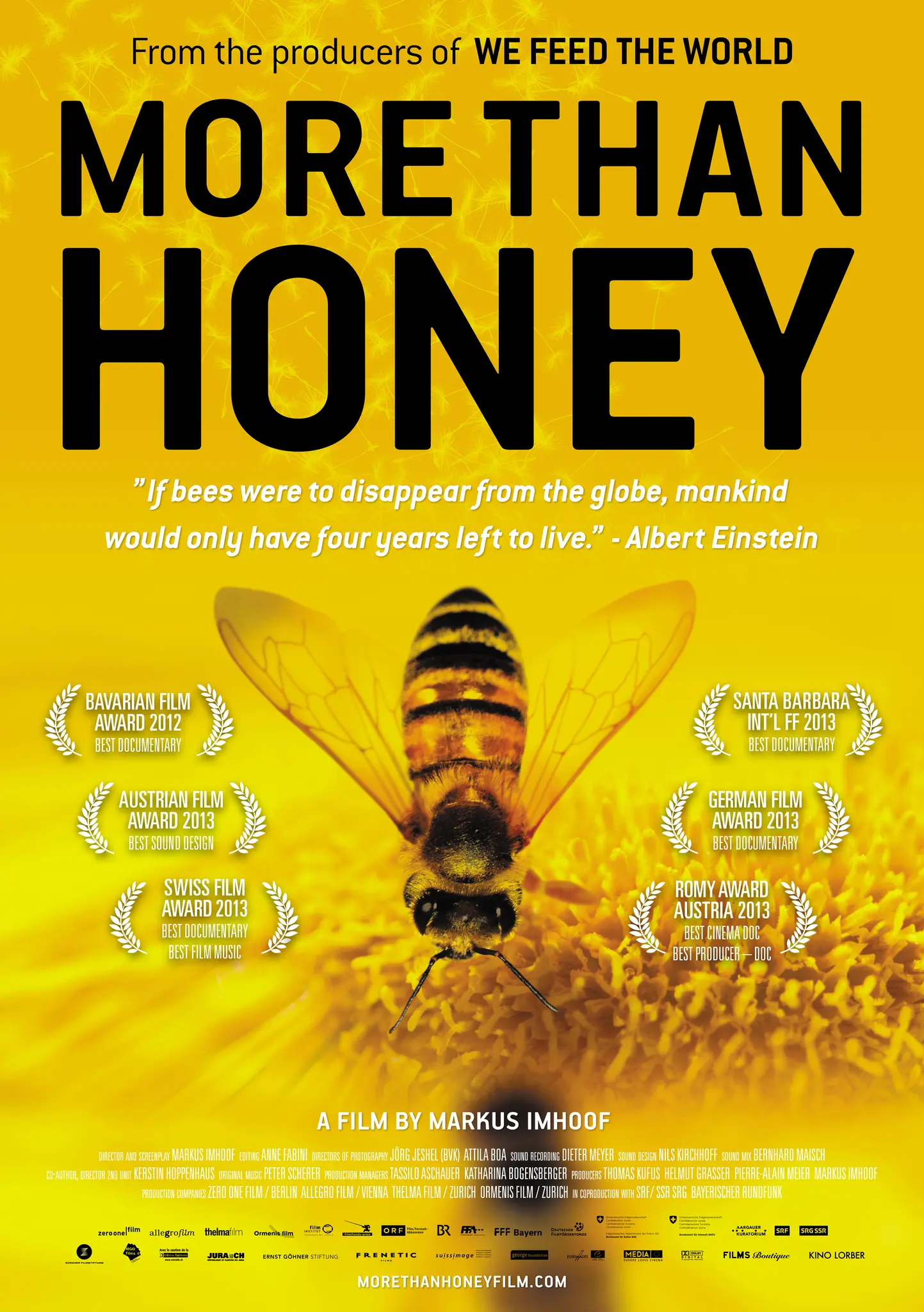
arkus Imhoof's 2012 documentary More Than Honey is about the disappearance of honeybee colonies around the world. The director comes from a family of beekeepers. He recounts in the film that as a child he loved the hum of the hives, and that his grandfather told him flowers could reproduce thanks to bees. Years later he sees that things are going badly for the bees and sets out to find out why.
The film moves across four continents. It opens in the Swiss Alps with an old beekeeper who works without any protective gear. Then it shifts to the vast almond plantations of California, where thousands of hives are trucked from one end of the country to the other, because the pollination of the almond trees needs millions of bees in a single season. Next it goes to China, where in regions the bees have vanished workers pollinate the trees one by one, by hand, with brushes. The film ends in Australia with a biologist raising healthier bees.
In China, workers pollinating trees by hand is like a rehearsal for a world without bees.
At the center of the film is the phenomenon called colony collapse disorder. Over fifteen years, bee colonies have been largely wiped out in many parts of the world. Depending on the region, between fifty and ninety percent of local bees are said to have disappeared. The scenario is the same everywhere. Billions of bees abandon the hive and never return. No bodies are found nearby, and no visible predator can be located. Scientists have given the phenomenon a name to match its scale. They also have good reason to worry, because eighty percent of plant species depend on bees for pollination.
Imhoof refuses to name a single culprit. Mite parasites, pesticides, a monotonous diet, the stress of long-distance transport, and the balance broken by constantly breeding new queens are all in play at once. The director compares his own film to Chaplin's Modern Times. He says bee brokers push the beekeepers, and the beekeepers in turn push the bees for greater yield. The bees have become assembly-line workers expected to function at the press of a button.
The real strength of the film lies in its macro photography. The cinematographer Jörg Jeshel takes the camera inside the hive. He shows a queen laying eggs, workers cooperating to raise a new queen, and a bee in flight at microscopic range. These shots required years of preparation and special optics. The result sits somewhere between a nature documentary and a feat of engineering.
The film also touches on a famous line attributed to Einstein, that if bees disappear humanity has four years left. Whether the line truly belongs to Einstein is disputed, but More Than Honey uses it like a warning sign. Imhoof does not engage in catastrophe-mongering. Instead he shows the bee at the closeness it deserves and quietly leaves the scale of what we have done to the viewer.
In short
Ninety-five minutes from the Swiss Alps to hand-pollinated orchards in China. Macro photography inside the hive, and a quiet case for what we stand to lose.
More Than Honey · Dir. Markus Imhoof · 2012 · IMDb · Sources: Swiss Films, Kino Lorber, official film website · abakcus.com