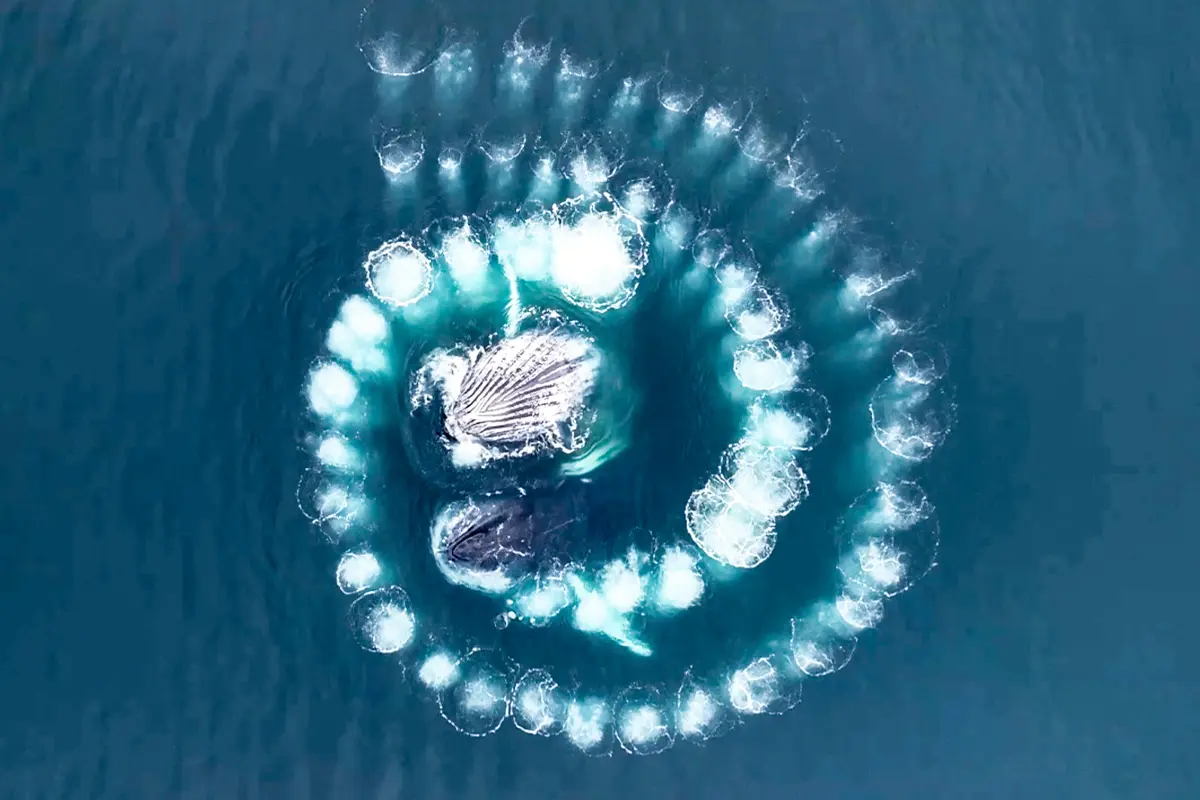
he footage really is beautiful. In the dark green water off Antarctica, two humpback whales dive deep, blow a wall of air bubbles upward through their blowholes, and that wall rises toward the surface tracing a spiral. The fish get trapped inside this bubble net, and the whales surge up through the center with their mouths open, swallowing everything. Dutch photographer Piet van den Bemd captured the scene in a rare moment.
Everyone who saw the footage reached for the same word. When CBS News shared the video, it put that word in the headline: the whales had drawn a Fibonacci spiral. From IFLScience to PetaPixel, dozens of outlets repeated it. Even the photographer himself said in an interview that “this time they drew the shape perfectly.” And they have a point, it really does look like one. It is just worth taking a closer look at what, exactly, it resembles.
What makes a spiral “Fibonacci”?
To see the differences you have to separate three distinct things, because in everyday language they all get thrown into the same bag.
The first is the logarithmic spiral. This is a curve that grows itself by a fixed ratio with every turn. Make one full revolution and the distance from the center is multiplied by the same factor each time. We see it everywhere around us, because proportional growth is mathematically the cheapest way to grow.
The second is the golden spiral. This is a special case of the logarithmic spiral. When the growth ratio is exactly the golden ratio, φ ≈ 1.618, the logarithmic spiral is called golden. So every golden spiral is a logarithmic spiral, but not every logarithmic spiral is golden. The relationship is just like the sentence “every square is a rectangle, but not every rectangle is a square.”
The third is the Fibonacci spiral. This is a piecewise curve, built by drawing squares based on the Fibonacci numbers and adding quarter circles inside them. As the numbers grow it approaches the golden spiral, and the eye easily mistakes one for the other.
The spiral the whales drew most resembles the one in the middle, the continuous, smoothly growing logarithmic family. That is exactly what the eye reads as “Fibonacci”: that familiar curve opening generously outward from the center, widening a little more with every turn. And because the golden spiral is the most famous member of that family, the resemblance brings it straight to mind.
Why we see this curve everywhere
Finding this spiral familiar is no coincidence. We see the same curve in a nautilus shell, in a ram's horn, in the center of a sunflower, in the arms of a galaxy. What they all share is logarithmic growth: if something keeps growing by the same ratio without distorting its proportions, this spiral inevitably appears. It is not because the shape is preferred, but because it is the cheapest way to grow, so the same answer keeps turning up.
The same problem, solved in different places, tends to arrive at the same curve.
And so the whales' bubble wall, for an entirely different reason, falls into the same family. The shell draws this shape as it grows; the whale draws it while hunting. One over millions of years, the other in a few seconds. Yet to the eye they appear as the same familiar curve.
So what is the whale actually doing?
The curious thing is that the real story is far more impressive than any invented mathematics. Bubble-net feeding is a learned behavior. Not every humpback community knows it, and those that do learn it from one another. Usually four or five whales dive deep together, one leads and blows the bubbles, and the others herd the school of fish with a spiral motion, driving them toward the surface. The bubble wall is not a physical barrier; it is an invisible fence that startles the fish and keeps them bunched together.
The spiral shape here is not a mathematical performance but the natural outcome of a solution. To gather a scattered school into a single point, a hunter wants to squeeze them inward along a tightening path, from the outside in. A tightening path inevitably leaves a spiral trace. The spiral here is not the goal itself but the by-product of an efficient encirclement.
To pull a school toward the center you have to curl inward, and any path that curls inward draws a spiral. The whale is not calculating a ratio or aiming at a pattern. It is simply gathering dinner into one place, and the beautiful curve is what is left behind.
What remains
Mathematics really is everywhere. In a pinecone, in the center of a sunflower, in the curl of a shell, and yes, in the wall of bubbles two whales blow into the water. You do not even need to count anything to see it. The same plain rule, proportional growth, brings us to the same shape in wildly different places.
Maybe that is the most beautiful part. The whale knows no formula, holds no spiral in mind. Beneath cold water, with a trick it learned, it works alongside its partner and feeds itself. And in that very moment, without intending to, it draws the curve people have admired for centuries. When the drone looks down from above, we get to see it too.
[1]The logarithmic spiral is the curve Jacob Bernoulli called spira mirabilis, the marvelous spiral. He wanted it carved on his tombstone; the stonemason mistakenly carved an Archimedean spiral instead. That is a story for another piece.
[2]The Fibonacci spiral and the golden spiral grow closer together as the numbers increase. At small numbers, the slight difference between them can be spotted with the naked eye.
[3]Bubble-net feeding is supported by observation as a learned behavior, not seen in every humpback community. A lead whale blows the bubbles while the others encircle the school.
Abakcus · Mathematics & Science · abakcus.com