Biology · Mathematics
Why Do Fireflies Flash in Unison?
Every May, the forests of Tennessee pulse with light for a few weeks. Tens of thousands of insects do this together, with no one in charge.
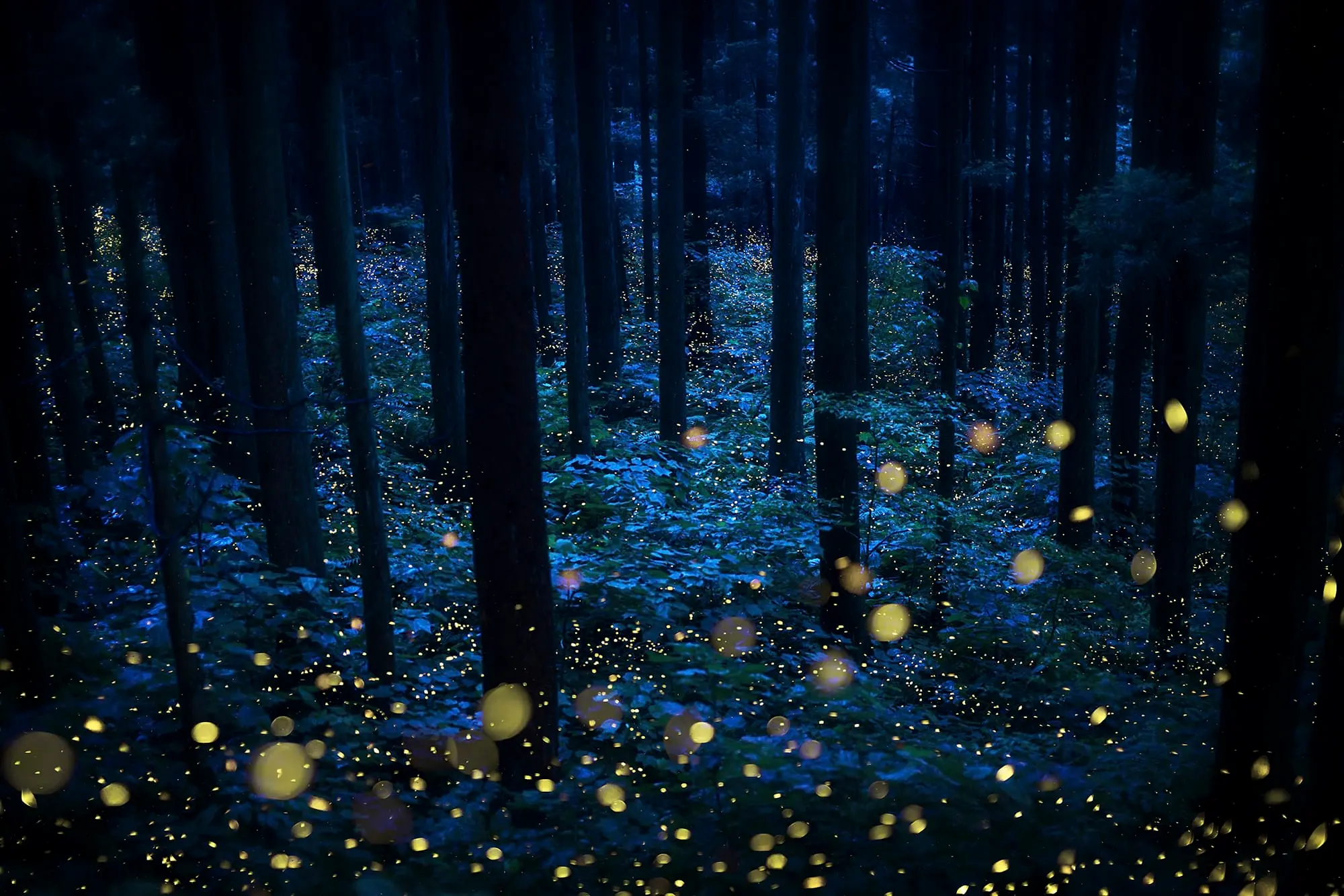
firefly species live in Great Smoky Mountains National Park. Only one synchronizes: Photinus carolinus.
omeone walking into the forest at Great Smoky Mountains National Park on a warm night in late May sees, at first, nothing unusual. Then the flash begins. A single yellow-green pulse, low among the rhododendrons. Then another. Then dozens. Then, across a hillside one hundred metres wide, thousands of lights blink together. They are quiet. They are exact. And nobody has told them to do it.
The Chemistry of Light: Cold Fire
A firefly’s abdomen contains two chemicals: luciferin and luciferase, the enzyme that acts as its catalyst. When the insect opens a valve at the base of its light organ, oxygen from the trachea floods in. Luciferase grabs both luciferin and the oxygen and, in a single enzymatic step, converts them into oxyluciferin plus a photon of light. The reaction produces almost no heat — roughly 96 % of the chemical energy becomes visible light, the most efficient light source known in biology.1
~96 % energy efficiency — effectively zero heat
Each male Photinus carolinus produces a pattern of roughly five to eight rapid pulses over two to three seconds, then goes dark for about five seconds before repeating. Females, perched in the vegetation below, respond with a single pulse timed about two seconds after the last male flash. That exchange—question and answer in light—is how the species finds its mates.
Male flash pattern (schematic)
… cycle repeats
Why Do They Synchronize?
The honest answer, for most of the twentieth century, was: nobody knew for certain. One long-standing hypothesis held that synchronization helped females identify the correct species among nineteen competitors flashing around them simultaneously. If all the males of one species are dark at the same moment, the rhythmic on-off contrast stands out more sharply against the background.
In 2010, biologist Andrew Moiseff and physicist Jonathan Copeland published a field experiment in Science that came close to confirming the hypothesis.3 They used LED arrays to present female fireflies with simulated male displays: one perfectly synchronised, one randomly timed. In controlled trials, females responded to the synchronised display about 80 % of the time, and to the asynchronous display only 10 % of the time.
“The entire forest was flashing together in unison. It was spectacular—I couldn’t believe what I was seeing.”
It is worth pausing on that number: eight times more responses. That is not a marginal advantage. For a male competing with thousands of rivals in the same half-hectare of forest, synchronising with them is, statistically, the difference between finding a mate and not.
The Mechanism: Nobody Is in Charge
There is no conductor. No firefly issues a command. No single individual is the “leader” whose rhythm all the others copy. The synchronization is an emergent property of a large system of weakly coupled oscillators—each one adjusting its own internal timer slightly in response to what it sees from its immediate neighbours, and the global order assembling itself from those millions of local adjustments.
The mathematical framework describing this was developed by Japanese physicist Yoshiki Kuramoto in 1975. The Kuramoto model treats each oscillator as a phase on a circle. When two oscillators see each other, they each nudge their phase slightly toward the other. Given enough oscillators, enough nudges, and a sufficiently narrow spread of natural frequencies, the system spontaneously locks into a single rhythm. The model is agnostic about what the oscillators are: firefly neurons, cardiac pacemaker cells, power-grid generators, or crowd applause.
The firefly’s version of the Kuramoto nudge is simple: if a male sees a flash slightly earlier than he expected, he advances his own timer; if he sees one late, he delays it. After a few cycles of mutual adjustment, males within visual range lock together. Those locked clusters then mutually entrain adjacent clusters. The synchronization spreads outward through the forest like a wave, until the entire visible canopy pulses as one.
Orit Peleg and the Three-Dimensional Map
For decades, scientists watched the synchronization from a single viewpoint—a fixed tripod, a hillside clearing, the naked eye. That gave no information about the geometry of the swarm: how deep it extended into the forest, how the wave of synchronization propagated through three-dimensional space.
In 2021, computer scientist Orit Peleg and her graduate student Raphaël Sarfati at the University of Colorado Boulder placed multiple synchronized cameras throughout the Elkmont forest and used stereo-photogrammetry to reconstruct the three-dimensional positions of individual flashes.4 Their paper, published in Science Advances, was the first to produce a volumetric map of a synchronizing firefly swarm.
The results confirmed what Kuramoto’s equations predict: synchrony begins in small local patches and propagates outward. At any given moment, different areas of the forest are at slightly different phases—there are travelling waves of light moving through the trees. Standing inside the display, a human observer cannot perceive these waves; the scale is too large and the response time of the human eye too slow. But the camera arrays caught them clearly.
Steven Strogatz and Sync
Cornell mathematician Steven Strogatz is the most recognized name in synchronization research. His 2003 book Sync was the first popular account to argue that spontaneous order—the emergence of a single rhythm from thousands of independently-acting units—is not an exotic curiosity but a fundamental feature of the universe, present at every scale from quantum systems to social behaviour.2
Sync: The Emerging Science of Spontaneous Order
Steven H. Strogatz — Hyperion, 2003
The book that introduced spontaneous synchronization to a general audience. Strogatz weaves together fireflies, cardiac pacemakers, power grids, and laser arrays to show that the mathematics of coupled oscillators is universal.
Buy on Amazon →In Sync, Strogatz places fireflies in a long historical arc stretching from seventeenth-century European travellers who dismissed accounts of Southeast Asian synchronizing fireflies as hallucinations, through early twentieth-century American biologist Hugh Smith who first took the phenomenon seriously, through the Kuramoto model, and finally to his own fieldwork in Tennessee.5
Strogatz’s later collaboration with Lars English and two Dickinson College undergraduates—building and publishing a metronome synchronization experiment—draws on the same mathematical root. You can watch that experiment unfold in the 32 Metronomes on a Rolling Surface video, where thirty-two mechanical clocks start in complete disorder and reach perfect unison within minutes, with no information passing between them except vibration through a shared board.
“Fireflies communicate with light. Planets tug on each other with gravity. But all of these systems are obeying the same mathematical laws.”
Why Synchronization Exists at All
The biological answer is mate recognition: synchrony helps females identify the correct species. The mathematical answer is deeper: synchrony is the attractor. Given a large enough population of oscillators with similar natural frequencies, and any mechanism of mutual coupling—however weak— Kuramoto’s analysis shows that synchrony is not one possible outcome. It is the inevitable outcome, if the coupling exceeds a critical threshold. The system falls into phase lock the way a marble falls to the bottom of a bowl.
Fireflies did not choose to synchronize. Natural selection chose the mechanism that leads to synchrony—the neural circuit that adjusts flash timing in response to nearby flashes— because the individuals who possessed it mated more often. The mathematics was already there. Evolution found it.
That is the sentence that tends to stop people who encounter this story for the first time. The universe contains an attractor for rhythmic order. Animals stumble into it, or are steered there by selection, and thereafter produce something that looks purposeful, coordinated, and impossibly choreographed. It is none of those things. It is cheaper than choreography. It is mathematics.
How to See Them
- Location. Elkmont Campground, Great Smoky Mountains National Park, Tennessee. The synchronous display occurs within about a half-mile radius of the campground.
- Season. A two-to-three-week window that typically falls between late May and mid-June. The precise peak shifts by a few days each year depending on temperature.
- Access. The National Park Service runs a lottery for vehicle permits during the display period; walking access from Gatlinburg via a shuttle operates on most evenings.6
- Conditions. The display begins roughly 30 minutes after full dark and peaks in the first hour. A waning-crescent or new moon produces the darkest skies and the most visible synchrony. Stay still, use no white lights, and wait.
Notes & Sources
- 1.Bioluminescence efficiency figure from Bioluminescence: Nature and Science at Work, West Virginia Highland Conservancy educational materials; cross-referenced with Viviani (2002), “Bioluminescence: A Fungal Perspective,” in Photochemistry and Photobiology 76(5): 545–551.
- 2.Strogatz, S.H. (2003). Sync: The Emerging Science of Spontaneous Order. Hyperion. For the Western history of firefly reports, see pp. 1–28. ISBN 9780786868445.5
- 3.Moiseff, A. & Copeland, J. (2010). “Firefly Synchrony: A Behavioral Strategy to Minimize Visual Clutter.” Science 329(5988): 181. DOI: 10.1126/science.1190421
- 4.Sarfati, R., Hayes, J.C., Sarfati, É. & Peleg, O. (2021). “Spatiotemporal reconstruction of emergent flash synchronization in firefly swarms via stereoscopic 360-degree cameras.” Science Advances 7(6): eabg9570. DOI: 10.1126/sciadv.abg9570. See also coverage in Quanta Magazine.
- 5.Strogatz, S.H. (2003). Sync. Hyperion. ISBN 9780786868445. The text is cited multiple times in this article; individual in-text citations refer to specific chapters.
- 6.National Park Service, Great Smoky Mountains: nps.gov/grsm/planyourvisit/fireflies.htm. Lottery information and dates updated annually in early spring.