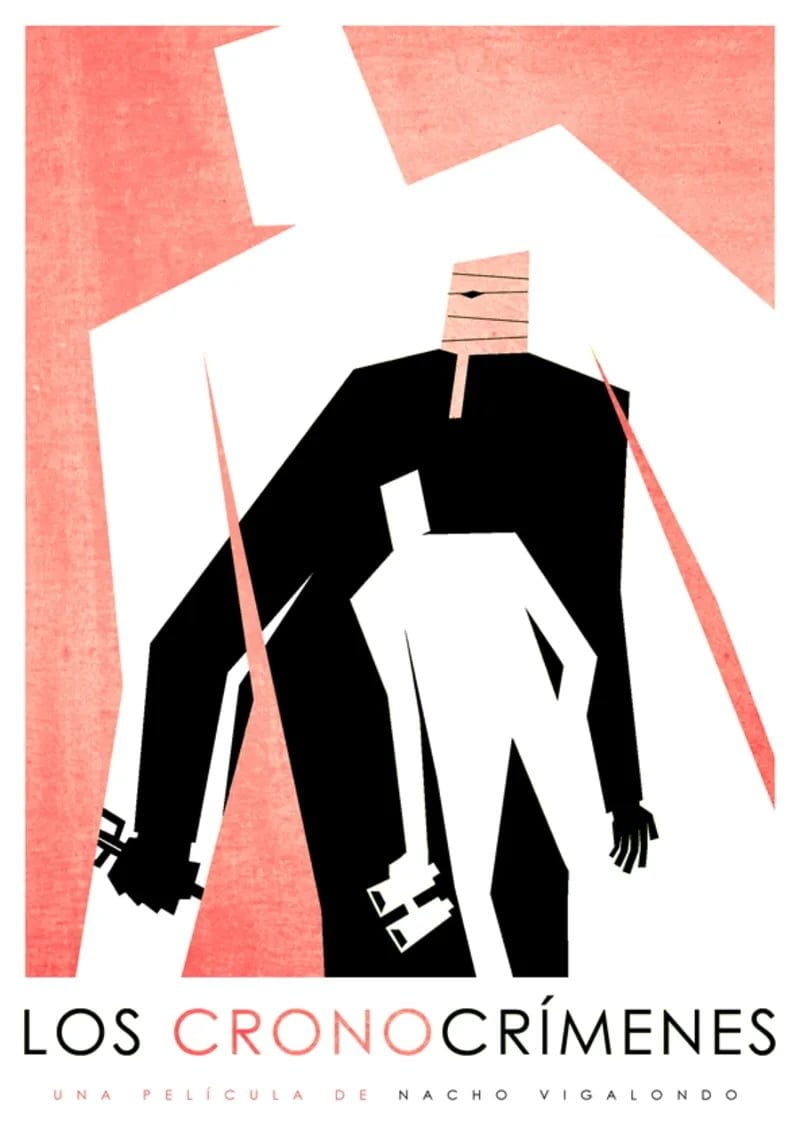
he time machine in this film looks like a bathtub filled with white liquid. There are no glowing panels, no countdown clocks, no dramatic hum of fictional physics. A nervous man in the Spanish countryside climbs in because someone told him it was a safe place to hide — and that is the whole catastrophe, already in motion before you realize it has started.
Los Cronocrímenes is a 2007 Spanish thriller written and directed by Nacho Vigalondo, who also plays a small supporting role with the kind of bewildered energy that suits the film perfectly. It stars Karra Elejalde as Héctor, a middle-aged man renovating a house with his wife when an afternoon of idle curiosity — binoculars, a forest, a woman undressing in the distance — sets off an hour-long causal loop from which there is, structurally speaking, no escape. The loop is not a device. It is the sentence Héctor has already been handed before the film begins.
“In this film, there are no accidents — even if causes have a funny way of following their effects.”
Projected Figures
Vigalondo has cited Alan Moore and Dave Gibbons's one-off comic strip “Chronocops” (2000 AD, 1983) as the film's biggest influence. The budget was $2.6 million. It was shot almost entirely in Cantabria, near Vigalondo's birthplace.
The film earns its reputation not through complexity but through precision. Most time-travel films ask the audience to track multiple timelines, multiple characters, multiple paradoxes. Vigalondo does something harder: he gives you a single timeline, a single ordinary man, and a single hour — and then shows you, methodically, how that one hour contains everything. There are only four speaking parts. The locations fit on a sketch map drawn on a napkin. The plot is airtight in the way that a trap is airtight — the kind of airtight that the Monty Hall problem is airtight: you can feel the walls before you can name what sealed them.
The Structure
Héctor-1 watches the forest. He investigates. He is attacked by a man with a pink bandage wrapped around his head. He flees. He hides in the machine. He emerges as Héctor-2, one hour in the past, and watches Héctor-1 in the forest.
At some point, he must become the man with the pink bandage. He must be both the pursuer and the pursued, both the cause and the effect. The film never cheats this logic. Every scene you watched in the first act returns, slightly shifted, in the second — and you understand, rewatching, that it was already the second act.
What makes Los Cronocrímenes genuinely interesting — rather than merely clever — is what it's actually about underneath the mechanism. A. A. Dowd, reviewing for The A.V. Club, read it as an allegory for adultery: a man whose eye strays, who follows his curiosity into the woods, and who then spends the rest of the film performing increasingly desperate damage control, each attempt to fix the situation making it worse, until the original transgression has metastasized into something that cannot be named out loud. You don't need to accept that reading to feel its weight. Héctor is not a hero or a villain. He is a person who made one small choice and then had to live inside it, replicated.
The inevitable comparison is to Shane Carruth's Primer (2004), another low-budget time-travel film built on rigorous internal logic. But where Primer rewards obsessive diagramming and multiple rewatches with increasingly granular revelations, Timecrimes is comprehensible on a single sitting and unsettling on all subsequent ones. The mechanism is not the mystery. The mystery is Héctor standing at the window at the end, looking out at the same forest, and the question of whether anything has actually changed — or whether he has simply been returned to the beginning of the loop with new information and the same hands.
Vigalondo made this film on a shoestring, in a countryside that looks like it costs nothing to film in, with a cast small enough to fit in a single car. None of that is visible in the result. The cinematography by Flavio Martínez Labiano — Alex de la Iglesia's regular photographer — gives the Spanish hills a texture that feels like latent menace: too quiet, too green, too still. The score by Eugenio Mira is sparse and slightly wrong in the way that scores in films about inevitability should be slightly wrong.
Los Cronocrímenes holds a 90% approval rating on Rotten Tomatoes. It was the closing film of the Sitges Film Festival in 2007. At various points a David Cronenberg remake was announced and then went quiet. It remains a film that is easy to describe, difficult to explain, and impossible to fully shake — much like Salomé Jashi's Taming the Garden, but colder and faster and with no trees. Which is, for a film about a man who cannot escape his own past, exactly the right way to leave an audience.
In short
Ninety-two minutes. Four characters. One hour, looped. Once is not enough — but the second watch is a different film entirely.
Los Cronocrímenes (Timecrimes) · Dir. Nacho Vigalondo · Spain, 2007 · abakcus.com