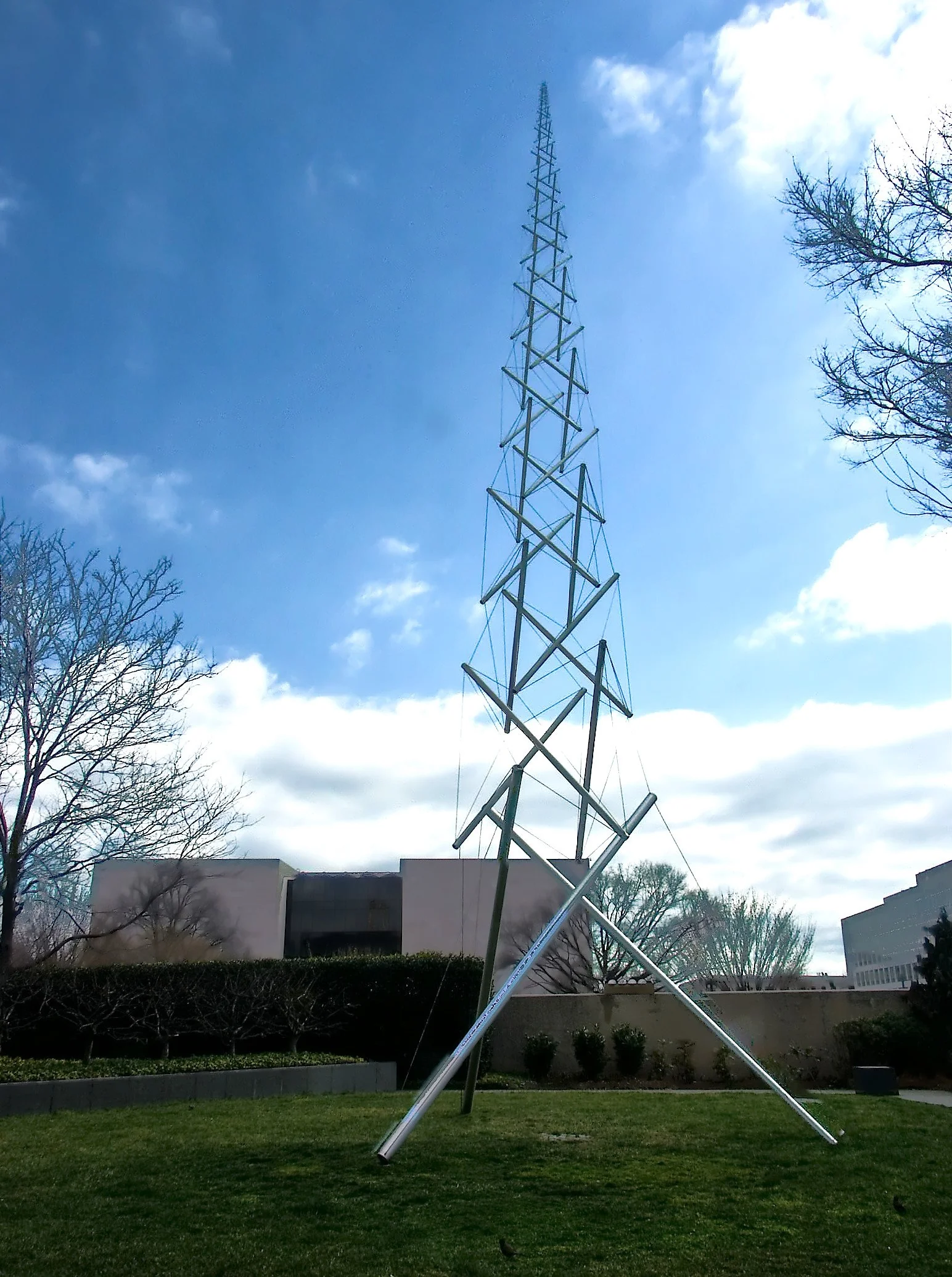
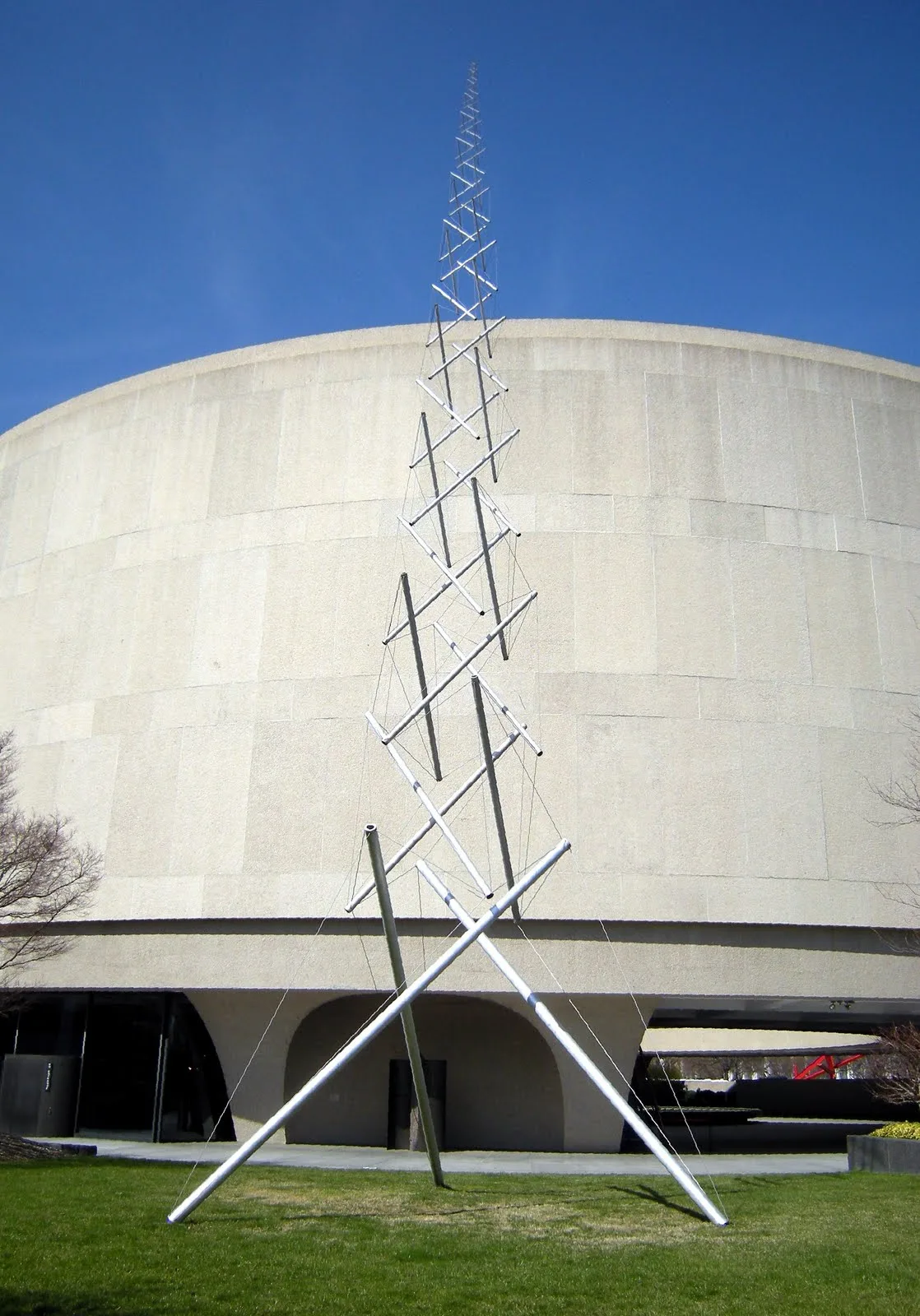
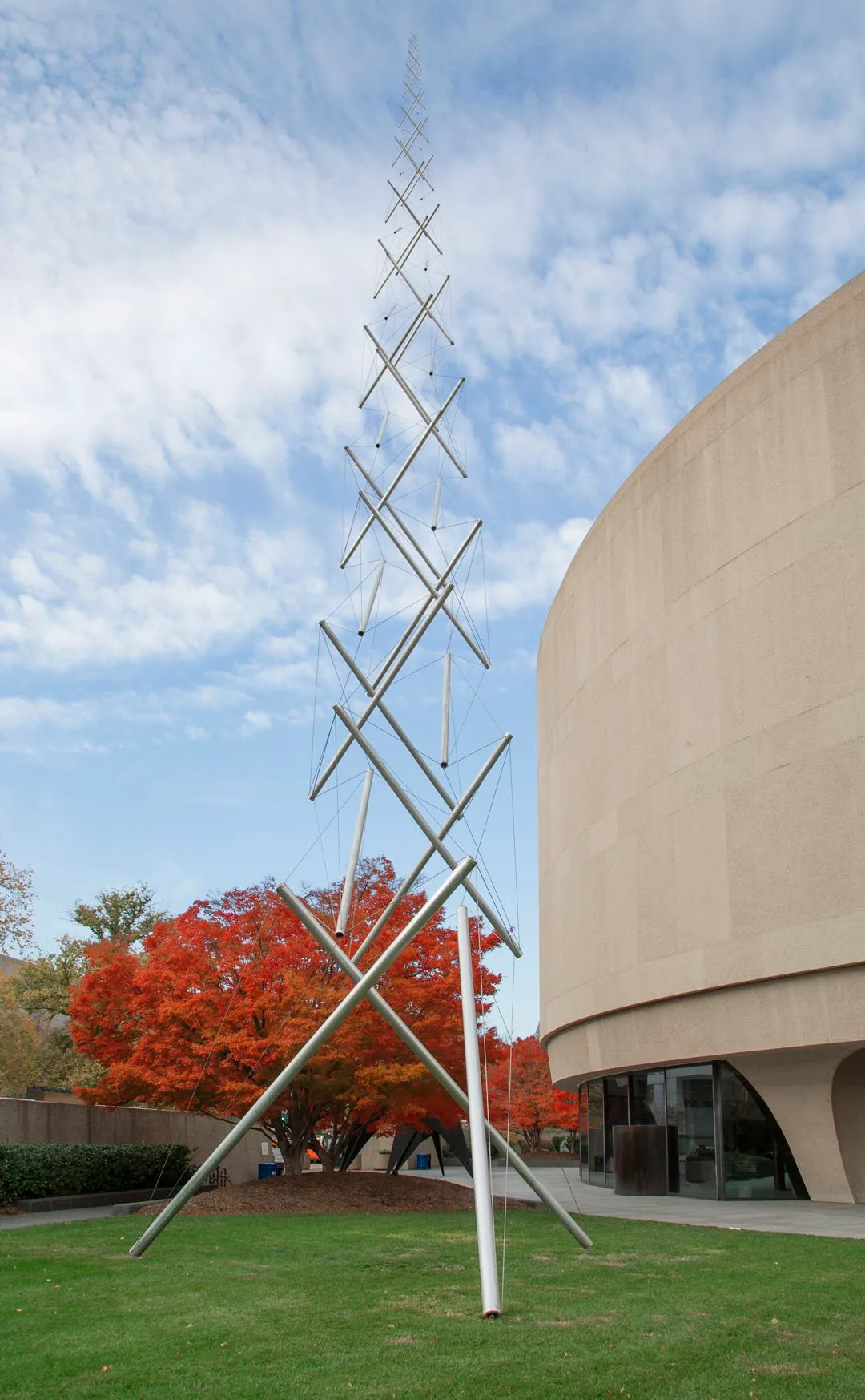
The tower has been standing outside the Hirshhorn Museum in Washington, D.C. since 1968. It tapers as it rises, each layer of tubes slightly smaller than the last, until at a certain height the structure simply appears to dissolve into the sky. People who walk past it on the way from the Air and Space Museum stop. The question they ask is always the same: how does that stay up?
The answer is tensegrity — a word Snelson's teacher Buckminster Fuller coined from “tension” and “integrity,” though Snelson himself preferred a different term: floating compression. The tubes push outward. The cables pull inward. Neither element is connected to a like element. Every tube floats, suspended in a network of wires that hold it precisely where the geometry requires it to be. Remove one cable and the whole system redistributes force. The structure doesn't have weak points in the conventional sense — it has a global equilibrium that either holds or doesn't.
How a Layer Works
Each level of the tower is built from three aluminum tubes arranged symmetrically and held by cables threaded through their ends. Three is not an arbitrary number — it is the minimum required to create a stable closed system under these constraints. Two tubes would collapse into a plane; four would be overconstrained. Three, arranged at 120° to each other and connected to the layer above and below, gives the geometry its rigidity.
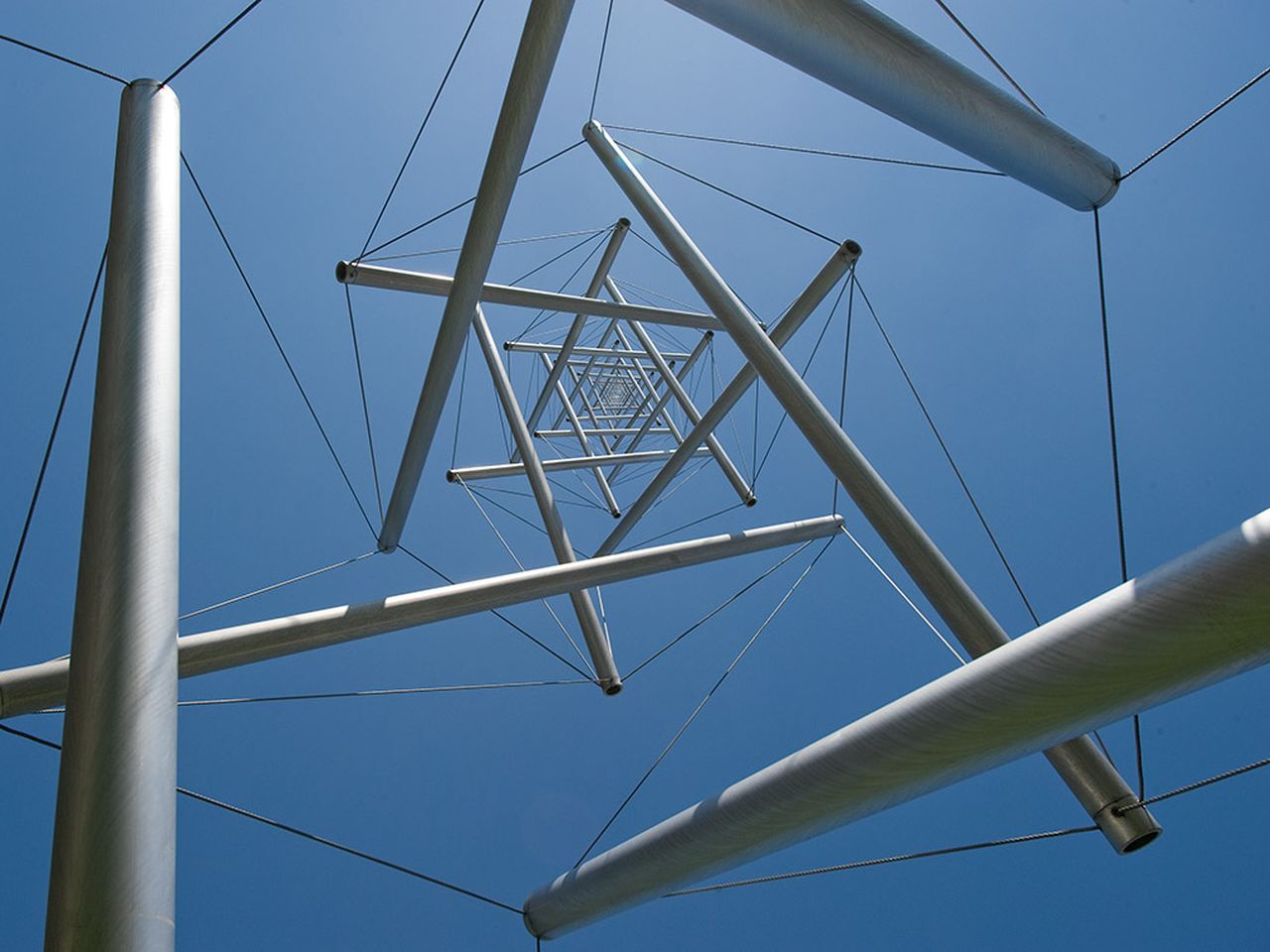
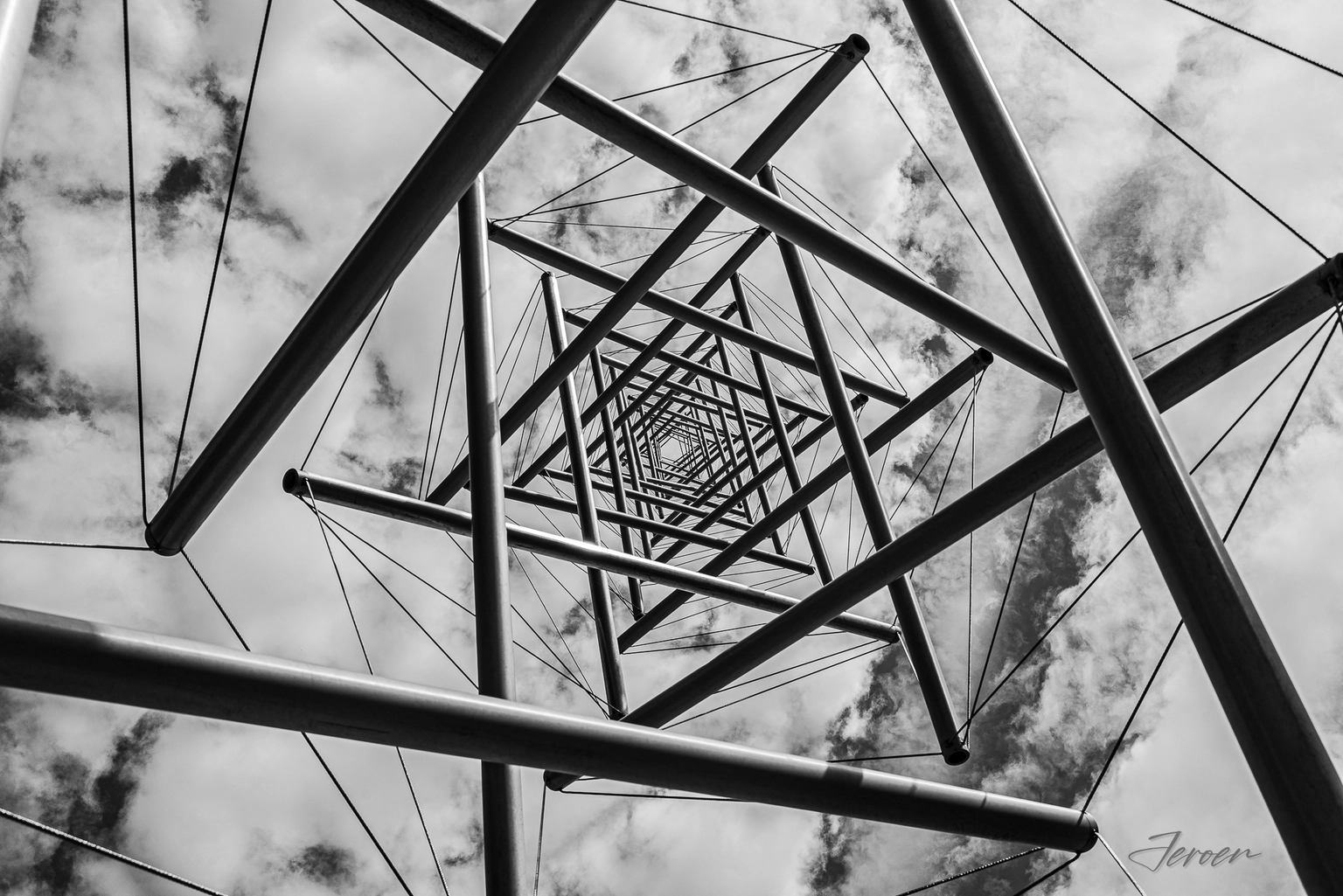
Successive layers alternate direction: one set of three rotates clockwise, the next counterclockwise. This is what produces the six-pointed star visible when you stand underneath and look up. Snelson did not design the star. It is a consequence of the construction — the geometry outputs it, unsolicited.
Detail — aluminum tubes under compression, suspended in their cage of stainless steel cable.
Floating Compression
Snelson arrived at the principle in 1948 as a student at Black Mountain College, where he was studying under Fuller. He built a small prototype — a tabletop model using wooden sticks and thread — that demonstrated the idea. Fuller saw it, recognized what it was, and named it. There is a long dispute about credit that does not need to be rehearsed here. What is not disputed is the physical fact: the structure works.
Snelson's preferred term, floating compression, describes the experience of the tubes more accurately than Fuller's coinage. Each tube is suspended in space by the cables around it. It floats there, under compression, pushing against the network that holds it. The network holds because of the tubes. The tubes float because of the network. The circularity is not a logical problem — it is the mechanism.
“Tensegrity describes a closed structural system composed of a set of three or more elongate compression struts within a network of tension tendons, the combined parts mutually supportive in such a way that the struts do not touch one another, but press outwardly against nodal points in the tension network to form a firm, triangulated, prestressed, tension and compression unit.”
— Kenneth Snelson
Looking up through the tower — the six-pointed star is a structural by-product, not a design decision.
What Happens When It Breaks
For the first several years the tower stood outside the Hirshhorn, nothing required maintenance. Then, gradually, the thin wires connecting nodes began to fray. Wind loads distributed unevenly over time. Individual cables snapped. The museum replaced them piece by piece, not always correctly. Eventually the top portion deteriorated enough that Snelson replaced it himself — partly to fix it, and partly so the museum's staff could watch and learn how it was done. Very few people in the world know how to reassemble a tensegrity structure of this complexity once it is taken apart.
In 2010 the museum started laying the tower on its side whenever wind forecasts approached hurricane strength. The video below shows the conservation crew raising it back into position after the 2010 restoration — fifteen people managing a 60-foot structure that, when lying down, becomes clear just how improbable it is that it stands at all.
The Six-Pointed Star
If you walk up to the tower and look straight up from directly beneath it, you see something that stops people. The alternating three-tube layers, rotated against each other, produce an apparently infinite recession of six-pointed stars shrinking toward a vanishing point. The pattern has no symbolic intent. Snelson was explicit about this: the geometry outputs a Star of David as a side effect of using three tubes per layer with alternating rotation. Any religious or mystical reading is the viewer's contribution, not the sculptor's.
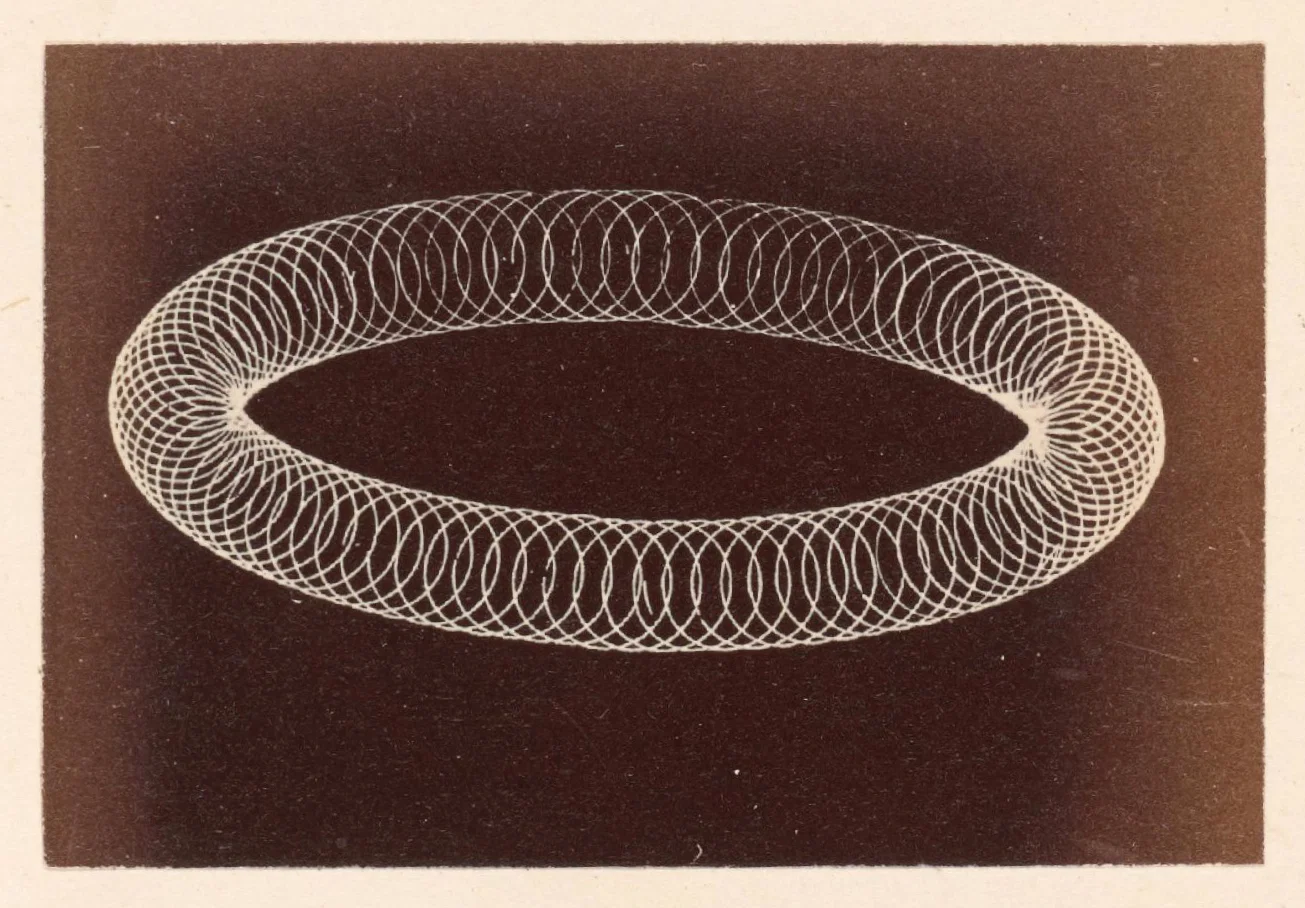
The pattern is mathematically inevitable given the constraints. Three tubes at 120° separation, alternating left and right helical modules — the visual result follows from the arithmetic with no room for variation. You could not build this tower with this method and get a different pattern from below. The same logic governs the ornamental turning specimens of the Victorian era: once you set the parameters, the geometry has only one output. The star is load-bearing.
A second version, Needle Tower II, completed in 1968 and standing 30 meters tall, has been in the sculpture garden of the Kröller-Müller Museum in Otterlo, the Netherlands since 1971. The two towers are not identical — the proportions differ — but the structural logic is the same. Both are still standing. The same question — how does a structure carry load with almost nothing? — is what makes the bridge design challenge so useful on a Bambu Lab P2S: print it, add weight until it fails, revise.
Needle Tower II (1968) — Kröller-Müller Museum, Otterlo, Netherlands.
Photo: zoom.nl
Object Information
- Artist
- Kenneth Snelson (American, 1927–2016)
- Title
- Needle Tower
- Year
- 1968
- Material
- Aluminum tubes, stainless steel cables
- Height
- 26.5 m (approx. 60 ft)
- Location
- Hirshhorn Museum and Sculpture Garden, Washington, D.C.
- Acquired
- Gift of Joseph Hirshhorn, 1974