
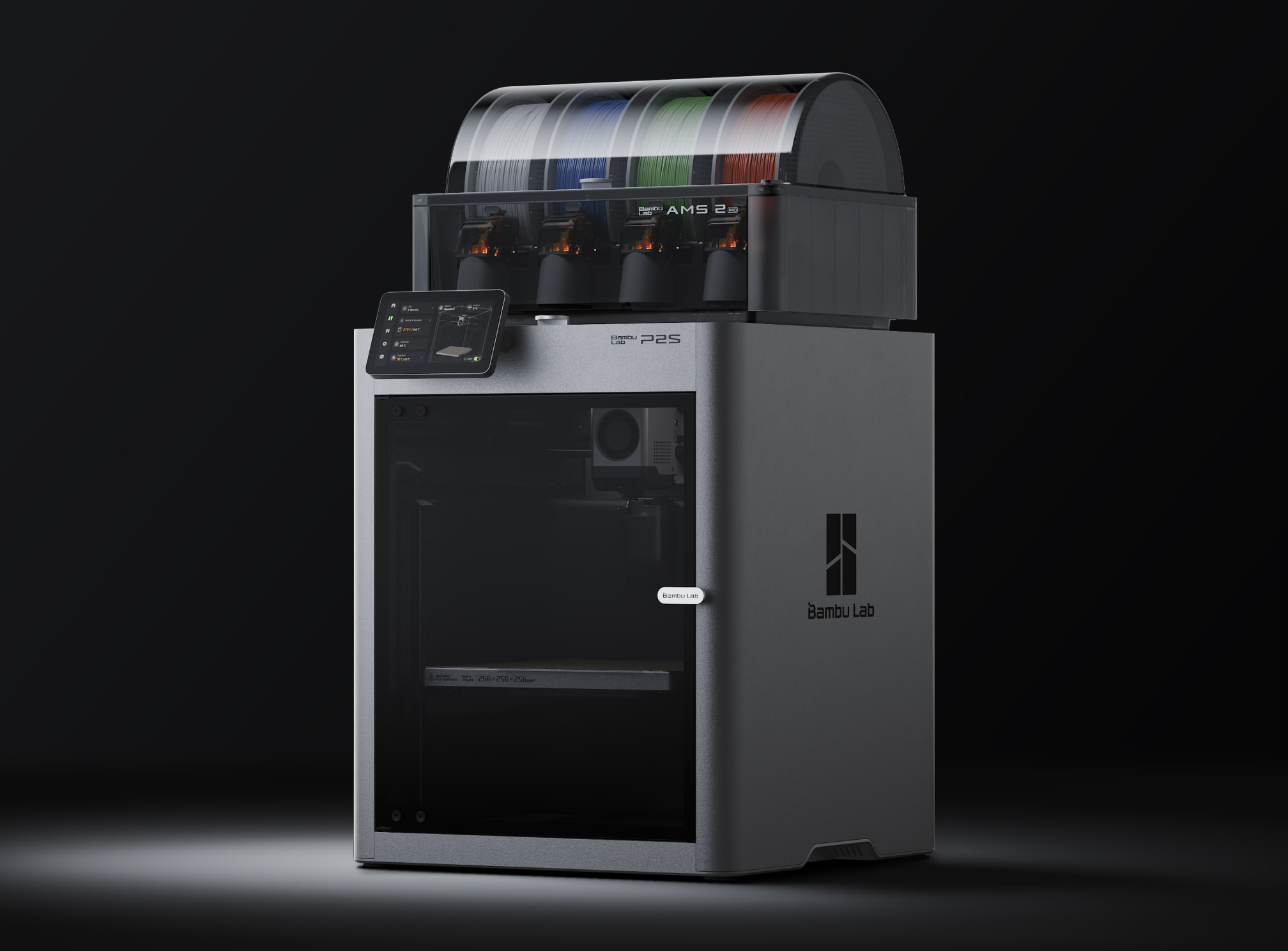
Explaining the Pythagorean theorem is one thing. Handing a child the three squares built on each side of a right triangle is another.
What gets printed
Mathematics
Platonic solids, fractals, Voronoi diagrams, hyperbolic surfaces. Everything that lives on a chalkboard becomes something you can pass around the room.
Engineering
Design a bridge, add weight until it fails. Which infill pattern holds the most load? Make a prediction with your kid, print it, test it, break it.
Science
Solar system to scale, molecular structures, crystal lattices, cross-sections of bones. The diagram in the textbook becomes an object in a hand.
Research consistently shows that children retain concepts significantly longer when they experience them both visually and physically — not just by reading. A 3D printer fills exactly that gap. The P2S makes that possible without requiring any engineering background from the person running it.
From unboxing to first print
More extrusion force than the P1S
With AMS 2 Pro — LiDAR and touchscreen included
Thingiverse and Printables have hundreds of thousands of free files. But the real power isn't there — it's in a child designing something and watching it exist. TinkerCAD is free, runs in a browser, and gives an eight-year-old enough tools to model their own name in three dimensions in under ten minutes. Sending it to the P2S is one click. Something happens in that process: the child produces a result. They aren't watching, they aren't completing a worksheet — something comes into being. That distinction is not small.
The bridge design challenge is a classic engineering activity: find the structure that carries the most load using the least material. With the P2S, the iteration cycle shrinks from days to minutes. Predict, print, test, revise.
One of the harder abstractions in middle school math is the relationship between surface area and volume — why two objects with identical volumes can have completely different surface areas. Putting a sphere and a cube of equal volume in a student's hands and asking them to measure dissolves the abstraction. Holding a Fibonacci spiral is different from seeing one. Understanding why Voronoi patterns appear on a giraffe's coat, in atomic structure, and in the cross-section of a bone becomes a different kind of question when the pattern is a physical object rather than a slide.
The machine itself teaches things too. The P2S's LiDAR sensor maps the print surface by measuring the reflection angle of light — that alone is a lesson: how distance can be calculated from a beam, how robotic vehicles navigate their environments, how the Mars rovers see the ground beneath them. The servo extruder samples filament resistance twenty thousand times per second, detecting jams in real time. These are printer features, yes — but they are also control systems, feedback loops, real-time data processing. Engineering thinking is built on exactly these concepts, and here they are running in a box on your desk.
Note
In January 2025, Bambu Lab pushed a firmware update that restricted third-party software from communicating directly with the printer. Tools like OrcaSlicer were affected. If you're working with Bambu Studio — which is more than sufficient for STEM activities with kids — this doesn't touch you. Worth knowing before buying if your workflow depends on open-source tooling.
Verdict
The P2S is the most capable tool available at this price for hands-on STEM learning at home or in a classroom. Setup is fifteen minutes, first-layer calibration is automatic, and the software ecosystem is mature. Go in knowing the firmware situation and the chances of regret are low.
↑ Makes the abstract physical
Math and science concepts become objects. From the Pythagorean theorem to molecular geometry — if it can be described, it can be printed.
↑ Setup is genuinely easy
Fifteen minutes. No engineering knowledge required. The touchscreen and new UI are a substantial improvement over the P1S.
↑ LiDAR on the first layer
Automatic calibration keeps failure rates low. When every print attempt succeeds, children stay motivated to keep iterating.
↓ Multi-color waste
Every color change purges filament. In complex multi-color prints with kids, material consumption adds up fast.
↓ Closed ecosystem
Working outside Bambu Studio is increasingly difficult. The firmware tension with the open-source community is ongoing.
↓ Filament cost
Frequent activity sessions burn through material quickly. Budget for ongoing filament as part of the total cost.
Standalone $799 · AMS 2 Pro Combo ~$849
Also on Abakcus
If the P2S builds things up, the xTool F1 Ultra marks them — 20W fiber plus 20W diode, research-grade precision on metal and wood from one desk. And for the structures that come off the printer: Kenneth Snelson's Needle Tower is the same question the bridge challenge asks — how does a structure carry load with almost nothing?