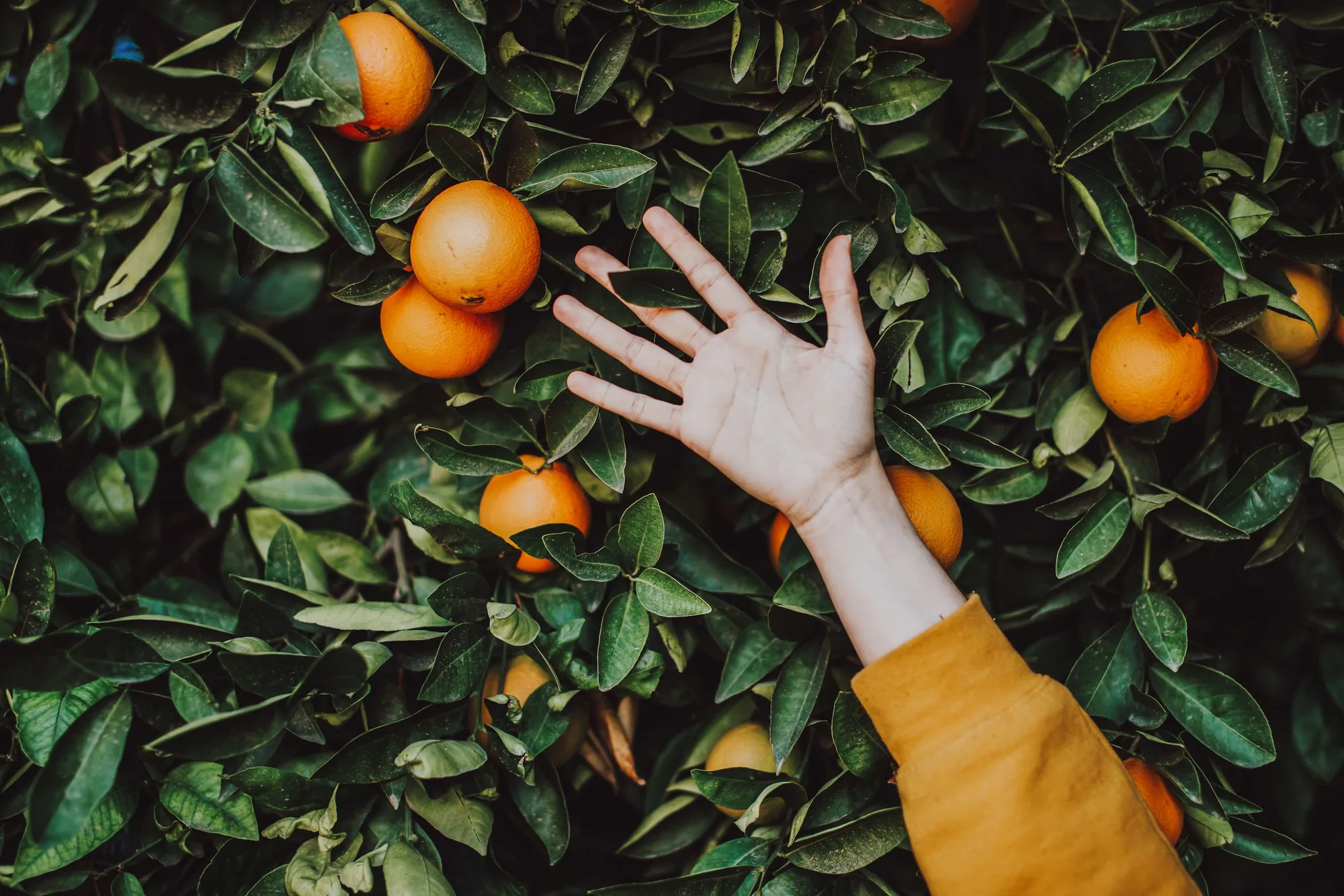
Last summer in Los Angeles a woman stopped in front of a house, looked at the nectarine tree in the front yard, met the eye of the owner sitting behind the window, then snapped off the two largest fruits and walked away. The owner of the tree was a garden writer, and she turned that moment of astonishment into a question, asking her readers when it is acceptable to pick fruit from someone else’s tree. 855 people wrote back and no majority came out of it, only a large crowd saying it depends.
The question looks like a matter of manners at first. Scratch it a little and underneath there is a two and a half thousand year old legal argument, a piece of simple arithmetic nobody has bothered to do, and the most cited article in economics. I found it worth following, because four legal systems solve the same physical situation — a branch, a boundary, a fruit — in four different ways, and not one of them is stupider than the others. Law is at its strangest when it meets a physical object it cannot argue with, which is how a legislature once came within one vote of fixing the value of π by statute.
The survey
855 answers, three questions
Let me start with the survey and then get to why it should not be trusted too far. Readers were asked three separate questions, and since more than one option could be ticked in each, the percentages add up to more than 100.
Where readers think picking is legitimate
855 responses · multiple choice · informal survey
When is it OK to pick fruit from someone else’s tree?
- Branches full of fruit hang over a public street or sidewalk50
- Branches full of fruit hang into my own yard49
- It hangs into a public alleyway and is easy to reach34
- Never19
When is it OK to pick up fallen fruit?
- It fell from a neighbour’s tree into my yard62
- It is lying in a public street or gutter51
- It is under the tree but easy to reach from the sidewalk30
- Never8
There is a laden tree nobody is harvesting. What now?
- Knock on the door and ask if you can take some60
- Nothing, the fruit belongs to the owner28
- Take one or two you can easily reach21
- It is a shame to let it rot, take what you can reach11
This is not a measurement of public opinion. It is a sample drawn from the readers of a gardening newsletter, and out of those readers only the ones who cared enough to write back, which means the group selected itself. Somebody who has never thought about picking fruit does not take the survey; somebody whose fruit was stolen runs to take it. The numbers should be read as a list of arguments rather than a distribution. Even so the list is instructive, because ordinary people rediscover in one afternoon exactly the distinctions legal systems have been arguing over for centuries.
Five zones
Where the fruit is standing changes everything
To talk about the problem properly the scene has to be cut up. Everything hangs on the trunk — the trunk is what fixes whose tree it is, which is why a tree can be sold, dug up and carried off whole across a sea while the argument about its fruit stays behind. The fruit of a tree whose trunk stands on one parcel can be in five different places, and each one is a separate legal situation.
One tree, five zones, five legal systems
pick a system and watch the zones change colour
- AThe tree owner’s. The tree owner’s; picking it counts as theft in principle.
- BThe picker’s. A neighbour with cultivated or built land who tolerates it may pick.
- CThe picker’s. The neighbour acquires ownership the moment he picks it up.
- DThe tree owner’s. Article 740 does not reach public land, so picking is not lawful.
- EUnsettled. No express rule; the weight of opinion leaves it with the tree owner.
Turkish law treats the overhanging branch as a burden and gives the benefit to the neighbour who bears it. A street is not a neighbour, so it falls outside that protection.
450 BC
Rome solved it with a calendar
The oldest answer we have sits in the Twelve Tables, cut into bronze around 450 BC, and as Pliny records it the rule is that acorns falling onto a neighbour’s land may be gathered. The word acorn should not mislead us, because the praetorian edict as preserved in the Digest defines the term to cover all fruit.
The elegance is not in the rule itself but in its shape. Rome does not answer the question of who owns the fruit, it answers the question of when you may go in. The fruit stays the tree owner’s, the owner may enter to collect what has fallen on the neighbour’s field, the neighbour may not use force to stop him, and the right operates every third day. Both sides are put in place by a timetable, without the ownership argument ever being opened. It is an answer to a boundary problem given in the form of a calendar, and twenty four centuries later it still looks less likely to start a fight than most of what came after it.
1788 – 1919
England never lets go of the fruit
The English solution sits at the opposite end. In 1894 the court held in Lemmon v Webb that a neighbour may cut back branches hanging over his land without giving notice, since the overhang itself counts as an encroachment. So far so reasonable. Twenty five years later the question moved to what was on the branch.
In 1919 Brooker picked the apples off his neighbour’s overhanging branches and sold them. In Mills v Brooker the court granted him the right to cut the branches but held that the fruit remained the tree owner’s, whether it was still hanging on the branch or had been blown down by the wind. In English law the boundary line does nothing at all to the fruit. Even the branch you cut off has to be offered back to its owner unconverted, apples and all.
To see where that hardness comes from you have to go back thirty one years. A woman called Mary Houghton gathered the barley left in a field after harvest in the village of Timworth, Suffolk. The landowner James Steel sued her for trespass, and in 1788 the court held that no person has a right at common law to glean in the harvest field. This was not a small dispute about one field, because gleaning was a real line of income for labouring families in England, and lawyers up to and including Blackstone traced the custom to Leviticus 19, which commands that the corners of the field and the fallen ears be left to the poor and the stranger.
For Lord Loughborough, who gave the judgment, feeding the poor was not a legal obligation but a religious duty.
Steel v Houghton, 1788
So we know the exact date on which a right turned into charity. Landowners started clearing villagers off their fields on the strength of that judgment, and villagers went on gleaning for a long time afterwards, because a three thousand year old habit does not disappear with a single decision.
Article 740
The Turkish Civil Code says the opposite
To the same physical situation, a fruit-laden branch reaching over into the neighbour’s yard, Turkish law gives the exact opposite answer to the English court.
A neighbour who tolerates branches overhanging land that is cultivated or built upon acquires the right to gather the fruit growing on those branches.
Turkish Civil Code, article 740
The logic is plain. Putting up with an overhanging branch is a burden, and whoever bears the burden also takes the benefit. The neighbour does not have to wait for the fruit to fall and does not have to prove any damage, he can pick the fruit straight off the branch that crossed the line. The tree and the fruit on it count as integral parts of the land, so ownership stays with the tree owner, but the branch that crosses the boundary falls outside that rule.
The interesting part is the street. Article 740 is a piece of neighbour law, and a street is not a neighbour, it belongs to the municipality. So fruit on a branch hanging over the sidewalk is not covered by the article, and picking it is not lawful. Remember that half the readers in the survey said it is fine if you can reach it from public space. The place where the intuition is strongest is exactly the place where the law says no most clearly.
Turkish has its own word for this too. Göz hakkı, roughly the share owed to the eye that saw, is defined in the Turkish dictionary as the portion given to those who see food they are tempted by, and it is used in everyday speech as if it were a right, which legally it is not. It obliges nobody to share anything. Criminal law, on the other hand, leaves the custom a wide berth. In 1987 the Court of Cassation treated picking and eating a few apples off a garden tree as an expression of long-standing custom and held that no punishment was called for, and the small value of the thing taken and the defence of necessity are separate grounds for reduction or for no sentence at all. The system works in layers: the fruit stays the owner’s, taking it counts as theft in principle, then quantity and custom pull the penalty down to zero.
Allemansrätten
Sweden measures it in metres
The fourth answer comes from somewhere else entirely. Allemansrätten, which comes down from the middle ages and entered the constitution in 1994, gives everyone in Sweden the right to walk, camp and forage in forest and open country regardless of who owns the land. Its whole rule is two words: do not disturb and do not destroy.
The European system most generous about land turns out to be one of the strictest about the garden. Wild berries, mushrooms and flowers belong to everyone, but cultivated land, gardens and the roughly seventy metres of private ground around a dwelling are outside the right. The Swedish answer is not a boundary line, it is a radius. It never asks who owns the fruit, it asks how close to the house you are standing.
The history of one question
ordered, not to scale
The arithmetic
How much surplus does one tree make
The reason this argument never ends is not in the law, it is in the arithmetic. An extension bulletin written for backyard citrus in California puts it in one sentence: a household has no use for 900 oranges, which is roughly the ceiling for a mature tree in full sun. Even a typical mature orange tree carries between 200 and 400 fruits in a season.
Those numbers mean nothing on their own, they start meaning something when a household’s consumption is put next to them. The fruit ripens inside about two months and it does not ripen evenly, there is a peak of a few weeks in the middle. That is where the daily surplus runs highest, and no amount of goodwill on the owner’s part is going to keep up with it.
What the tree gives and what the house eats
60 day ripening window · one fruit per person per day
Coase, 1960
The economics of knocking on the door
The answer that scored highest in the survey was to ask the owner. You can read that as advice about manners, but there is a better reading. Ronald Coase’s 1960 paper, the most cited piece of writing in legal scholarship to this day, deals with exactly this kind of neighbour dispute, and its claim is that when the cost of bargaining is close to zero it makes no difference to the outcome who the law gives the right to, because the parties will trade their way to the efficient point anyway.
The fruit problem is almost the laboratory version of this. Fruit that is going to rot on the tree is worth close to nothing to its owner and clearly worth something to whoever wants it. The bargaining cost between them is one knock on one door. In a setup like that agreement is nearly inevitable, and indeed one forager who wrote in for the survey says most owners are glad to see the fruit put to use and that he has never once been turned away.
The real subject is the cases where the bargaining cost is not zero. Nobody is home, the gate is locked, the language does not come, the person is shy, or afraid of being caught by the doorbell camera and named on a neighbourhood app. The moment the cost of asking rises above the value of two nectarines, people stop asking, and that is exactly the point at which it starts to matter who the law gave the right to. This was Coase’s actual argument: the allocation of rights matters in proportion to how expensive bargaining is. Since the four systems above hand the right to four different parties, the same peach belongs to four different people depending on your longitude.
2013 onwards
The people who mapped it
There is a third kind of answer, from people who skip the rule entirely and go pick the fruit. Falling Fruit, started in 2013 by Ethan Welty and Caleb Phillips, merges municipal tree inventories with user contributions to put the world’s edible plants on one map, and that map now marks more than 1.6 million locations and over three thousand kinds of edibles. Redrawing the city as a resource map does not dissolve the legal question, but it does make it visible, because the map also flags whether a tree stands on private property.
The operational solution to the same problem started in Los Angeles in 2009. Rick Nahmias saw fruit rotting on the trees in his neighbourhood, posted an ad on Craigslist, went into a single backyard with a few volunteers and donated the 800 pounds of oranges and tangerines they picked that day to a food pantry. The same organisation distributed 94 million pounds of fresh produce in 2024 and passed 500 million pounds in total in June 2025.
This work has its own constraints and all of them are physical. Volunteers do not use ladders, they only take what they can reach with poles with baskets on the end, they cannot come the same day you call, and fruit fly quarantines shut the whole thing down in some areas. So even the most practical answer to the question of who owns the fruit on the tree comes down in the end to the length of a pole.
When you add a new tree to Falling Fruit the site makes you mark whether it stands on private property, and the first line of its picking code is to ask permission.
Sources
- The reader survey — Los Angeles Times, 2024.
- The Twelve Tables and Digest 43.28.1.
- Steel v Houghton and Mills v Brooker.
- Göz hakkı and the Turkish case law, overhanging plants under Turkish law.
- Allemansrätten, the Swedish right of public access.
- The backyard citrus bulletin and orange tree yields.
- Coase, The Problem of Social Cost, 1960.
- Falling Fruit and Food Forward.