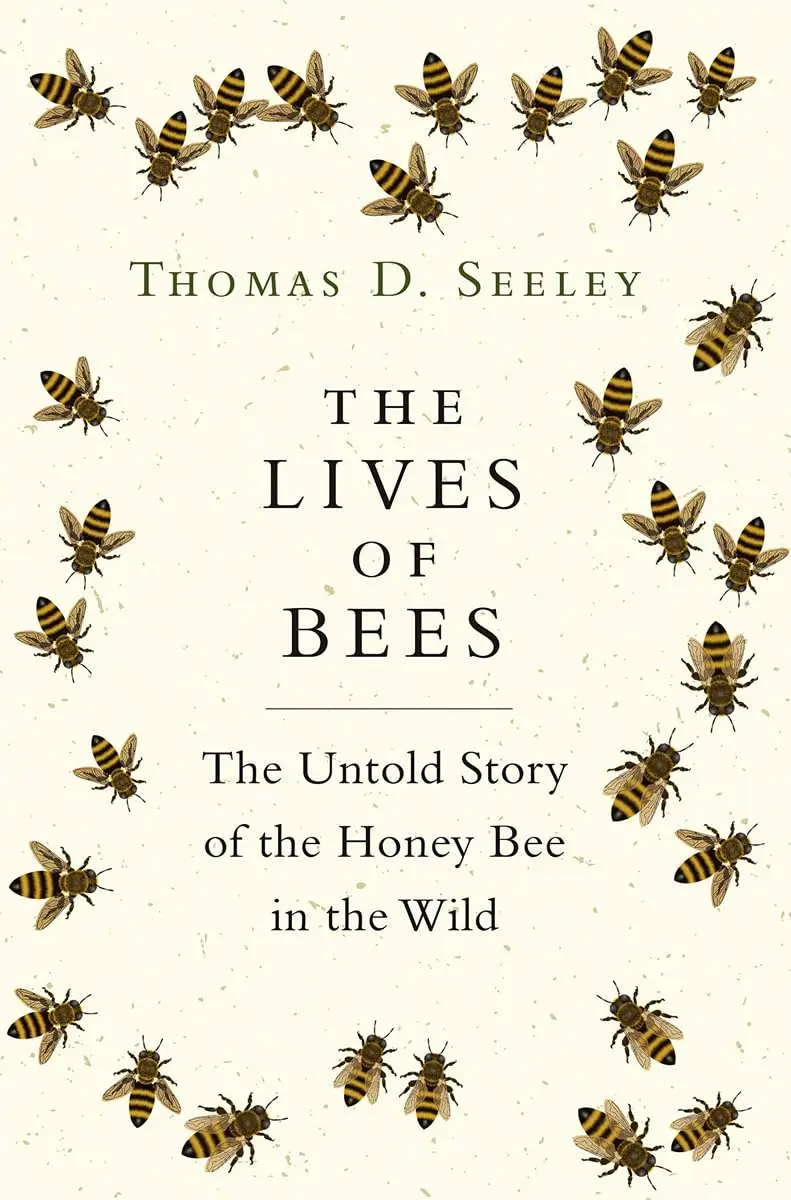
n the summer of 1963 a boy living in a wooded valley east of Ithaca saw a cloud of bees the size of a truck around the old walnut tree beside the house, and watched from a distance as the cloud pulled itself into a cavity in the trunk and settled there. The boy was not even eleven yet, and the question that stuck with him was simple enough: why did these bees choose that particular cavity? Thomas Seeley never let go of it. Sixty years later he is still in the same valley, in the same woods, looking for bees.
The Lives of Bees is the book of that fieldwork, forty years and more of it. What interests Seeley is not the bee in the hive but the bee nobody is looking after. The whole book chases a single question: how does the honey bee live when no human interferes at all, and why is it doing better than the one in the hive?
There is something serious under the question. Roughly forty percent of the colonies beekeepers look after die every year, while the colonies in the woods of the same region — the ones nobody treats or feeds or prepares for winter — are still where they were. If you have watched a camera go inside a commercial hive, you already know the first half of that picture. Seeley's book puts the second half beside it and goes looking for where the difference comes from.
Forty years of counting in the Arnot Forest
Seeley's laboratory is Cornell's 1,700-hectare research forest south of Ithaca. He surveyed it first in 1978, then ran the same survey again in 2002 and in 2011. Something very bad happened in between: in the nineties the parasitic mite called Varroa destructor arrived from northern Asia and mowed through the apiaries of the Finger Lakes, and Seeley's own hives were part of that mowing. While beekeepers were trying to keep what was left alive with miticides, nobody touched the colonies in the forest.
The expectation, obviously, was that the forest ones would be wiped out. Instead, three surveys spread over thirty years showed that the mite did not permanently lower the colony density in the forest. The population took the hit, pulled itself back together, and returned to its old number.
That number is one of the most striking figures in the book. In the forest there is roughly one colony per square kilometre, and the average distance between two neighbouring colonies reaches 800 metres. In an apiary the hives sit twenty centimetres apart, lined up side by side. This is the first and maybe the biggest difference between the arrangement a wild colony picks for itself and the one a beekeeper builds for it.
Between two colonies in the forest there are 800 metres. Between two hives in an apiary there are 20 centimetres.
Following a bee all the way home
So how do you find a colony sitting inside a cavity ten metres up a trunk in a forest that size? Seeley uses the method hunters have used for centuries, bee lining, and it looks less like searching for honey than like solving a geometry problem.
You put sugar syrup in a small box and catch a worker off a flower in open ground. Once the bee has filled herself and left the box she circles a few times to get her bearings and then flies straight home. You note two things: the compass angle where she vanished, and how long she takes to come back. The angle tells you which way the nest lies and the time tells you how far. Since a bee flies at around fifteen miles an hour and spends about two minutes unloading at the nest, halving what is left of the round trip gives you the distance roughly. Two to four minutes and the nest is almost in front of you; five to nine minutes and it is somewhere around a kilometre; past fifteen minutes and it is too far to walk to.
One line is not enough, of course — it only gives you a ray. So you pick the box up and carry it a few hundred metres away, catch a new bee there and draw a second line. The tree is where the two lines cross. On the map below you can move the angle and the return time of both stations yourself.
Interactive · Bee line triangulation
Where the lines from the two stations cross is the bee tree. The dashed rings are the distance estimated from the return time, and when the estimate and the crossing point to the same place the tree is confirmed.
Station A
Station B
The difference between a cavity and a hive
The backbone of the book is the measurements of the wild nests Seeley cut open over the years. The cavities he found around Ithaca average forty litres, and that figure happens to be almost the same as the volume of the hive body Langstroth settled on in the 1850s for purely practical reasons. The resemblance ends there. The moment the beekeeper puts a second and a third box on top of that body, the colony's home doubles or triples and its urge to swarm is suppressed.
The entrance of the cavity is small, between ten and forty square centimetres, and close to the floor. As soon as the bees move in they coat the walls with resin, and this thin layer we call the propolis envelope plays a real part in the colony's immunity — while most beekeepers treat propolis as a sticky nuisance and scrape it off. Seeley also reports that in the eight nests he cut open, an average of eighteen percent of the comb was drone cells. In a hive run on worker foundation that share stays under five percent.
Then there is the thickness of the walls. In a tree trunk the wood around the colony is fifteen or twenty centimetres thick and it does not let the winter heat out, whereas the wall of the pine hive the beekeeper uses is two centimetres. Same winter, same region, two completely different thermostats — the kind of plain physical accounting Steven Vogel applies to every living structure.
| Colony in the forest | Colony in an apiary | |
|---|---|---|
| Distance to neighbour | 800 metres on average | 20 centimetres |
| Nest volume | Around 40 litres | 80 to 120 litres |
| Entrance | 10 to 40 sq cm, at the floor | Wide, across the hive front |
| Wall | 15 centimetres of wood | 2 centimetres of pine |
| Height above ground | Mostly several metres up | Half a metre off the ground |
| Propolis | Walls coated throughout | Scraped off |
| Drone comb | 18 percent of the comb area | Under 5 percent |
| Swarming | Once a year, unhindered | Prevented |
How these differences connect to the mite is the most satisfying part of the book. When colonies sit 800 metres apart, bees drifting from one hive to another and robbing between them almost disappear, so the mite finds no road across to the neighbour. When a colony swarms every summer, the broodless stretch that follows cuts the mite's breeding chain. A small cavity keeps the colony small. None of these is a miracle on its own, but stacked on top of each other they are enough to hold up a forest population that gets no treatment at all. It is the same shape of argument as a pattern falling out of a plain rule rather than out of anything clever.
Who the book is for
In the last chapter Seeley turns all these measurements into beekeeping advice. Put your hives as far apart as you can, keep the body small, narrow the entrance, do not scrape the propolis, leave the drone comb alone, leave the colony its winter honey, and let it swarm. He also says plainly that the list is not a manifesto against commercial beekeeping, because Seeley has kept bees himself for sixty years and knows whose back pollination runs on.
The swarm itself gets its own book elsewhere — how a few hundred scouts argue their way to one cavity is the subject of Honeybee Democracy, and it is the closest thing in biology to a crowd agreeing without anyone in charge. Here it appears only as one line in a table, which tells you how much ground this book covers.
I read this book without being a beekeeper and never felt out of place in it. At the centre of the story there is a method: walking through a forest and measuring an insect. Seeley writes down how many colonies he found, which tree each one was in, how many litres the cavity held, what percentage of the comb was drone cells — and reading all that you also see how a scientist spent forty years. The first ten chapters are there to lay the ground for the last one, and because the ground is that solid the advice at the end does not float. If you want the same attention paid to the shape of an organism rather than its household, Haeckel's plates are the companion volume.
Details
- Author
- Thomas D. Seeley, Cornell University
- Edition
- Princeton University Press, 2019
- Subtitle
- The Untold Story of the Honey Bee in the Wild
- Drawings
- Margaret C. Nelson
- Field site
- Arnot Forest, 1,700 hectares
- Companions
- Honeybee Democracy · Following the Wild Bees
If you keep bees, this book will probably make you ask uncomfortable questions about your own hives. If you do not, you still get to see what it means to watch one forest with the same eye for forty years.
Thomas D. Seeley — The Lives of Bees: The Untold Story of the Honey Bee in the Wild
Princeton University Press, 2019 · ISBN 978-0-691-16676-6 · abakcus.com