Author
Steven Vogel
Publisher
Princeton University Press
Year
1988
Pages
367
Field
Comparative biomechanics
Illustrations
Rosemary Anne Calvert
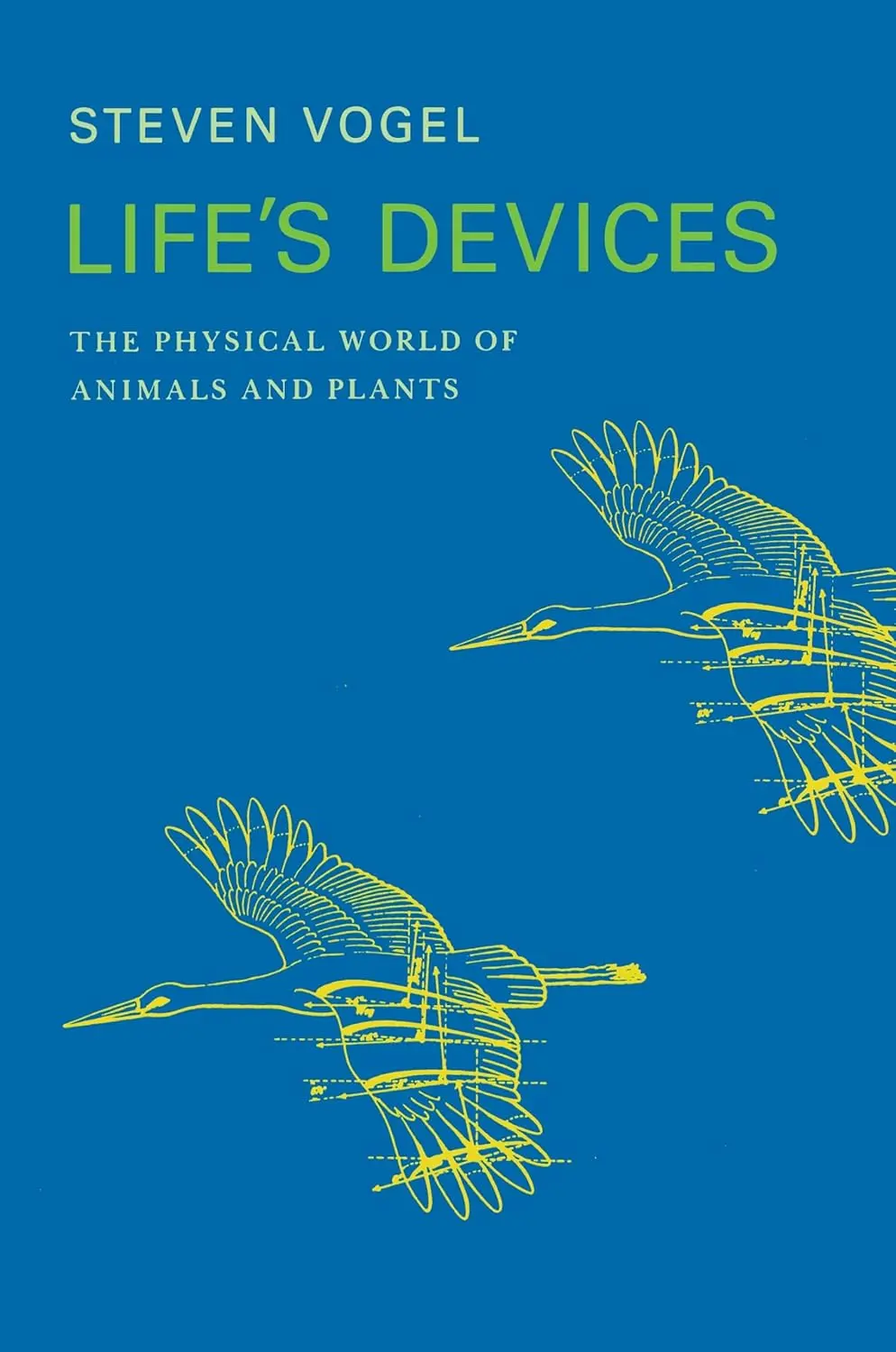
rabbit sits under a raspberry bush. That is where Marston Bates once said he would begin if he wanted to understand living things — not with a grand theory, but with one animal and its immediate, physical predicament. Steven Vogel borrowed that rabbit for the opening of Life's Devices, and then spent the rest of the book asking a deceptively simple question about it and everything else that breathes, swims, stands, or falls: how does a body get along with the laws of physics it can never repeal?
Vogel's stated ambition was modest only in the way a magician's is. His aim, he wrote, was to change how you look at your own surroundings. The promise of the book is that after reading it you cannot watch a tree bend in a storm, a fish dart past a paddling duck, or a mouse drop unharmed from a shelf without seeing the silent arithmetic underneath.
“My immodest aim is to change how you view your immediate surroundings.”
Steven Vogel, Life's Devices
The world sets the rules; life only gets to answer
The framing of the book is austere and clarifying. An organism cannot alter the pull of gravity, the density and stickiness of water, the springiness of air, or the patient drift of diffusing molecules. These are fixed terms. What varies is the response — the shape of a wing, the taper of a trunk, the thinness of a leaf. Vogel treats every physical constant as both a wall and a doorway: a constraint that any successful design must respect, and an opening that a clever design can exploit.
This is the core insight of biomechanics, the field Vogel helped build, and it reframes biology as a long correspondence with mechanical engineering. A body is not just a bundle of cells and instincts; it is a structure under load, a pump moving fluid, a beam resisting a bending moment, an object dragging itself through a resistant medium. The same logic that makes a tensegrity tower stand without rigid joints governs how a shark holds its shape — once you adopt that lens, the questions multiply on their own.
Why a fish beats a duck, and why trees prefer to fall over
The pleasure of Life's Devices lives in its catalogue of puzzles, each one a small detective story. Why does a fish swim faster than a duck can paddle? Because the fish is immersed in a single medium while the duck works at the boundary between water and air, paying a constant tax in wave-making that the submerged fish never sees.
Why do healthy trees more often uproot than snap in a gale? Because wood is a remarkably good material in bending, and the failure tends to migrate to the root-soil connection rather than the trunk itself — the structure is tuned so the cheapest part gives way last. How does a shark hold its shape with such a flimsy, cartilaginous skeleton? And why can a mouse fall from any height onto any surface and simply walk away, while a horse cannot? The answer to the last one is pure scaling: a small animal's surface area is enormous relative to its mass, so air resistance dominates and terminal velocity stays gentle.
The scaling argument, in one line
As a body shrinks, surface area falls with the square of length while mass falls with the cube. Drag, which depends on area, grows huge relative to weight. The mouse is saved not by toughness but by geometry — it never accelerates enough to be hurt.
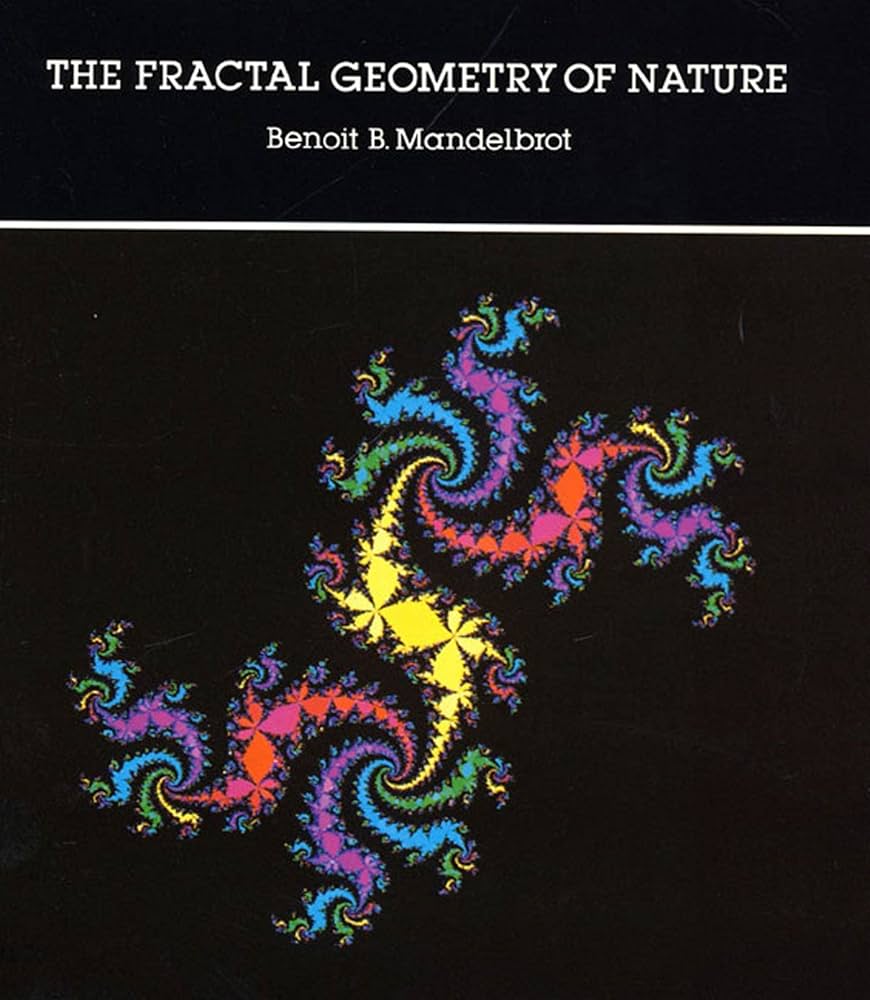
Vogel's recurring lesson is that size is destiny. A change in scale is never just a change in size; it rewrites which forces matter. It is the same humbling arithmetic that runs through Mandelbrot's geometry of coastlines and clouds — measure a living thing at a different scale and you are measuring a different problem.
Size is destiny. A change in scale is never just a change in size; it rewrites which forces matter.
Wind tunnels built from spare appliance parts
Vogel was a James B. Duke Professor of Biology at Duke University, where he taught for forty years and became, alongside Stephen Wainwright and R. McNeill Alexander, one of the founders of comparative biomechanics. His earlier Life in Moving Fluids had already introduced a generation of biologists to the strange behavior of organisms in flow. His curiosity ranged from the ventilation of prairie-dog burrows to airflow through the feathery antennae of moths, from jet propulsion in squid to the way leaves streamline themselves in a gust — the same fascination with how living forms negotiate moving air that animates the silent flight of the owl.
He had a particular reputation worth mentioning, because it shows in the book's spirit. Vogel often declined the usual grant machinery, funding his experiments out of his own salary because he thought chasing money narrowed what a scientist would dare to ask. He built flow tanks and wind tunnels out of scrap wood and salvaged appliance parts in the departmental machine shop. That homemade, follow-your-curiosity ethic is exactly the temperament that makes Feynman's adventures so contagious; Life's Devices carries the same one. Its experiments are designed around materials you already own, and its math asks only that you be willing to follow an argument, not that you arrive fluent.
A book that answers questions you never thought to ask
What makes Life's Devices last — the Princeton Science Library reissued it with a foreword by Rob Dunn — is that it never lets the physics become an end in itself. The equations are scaffolding for wonder. Vogel includes worked problems and household experiments not to drill you, but because he believed understanding a force means feeling it in your hands: the surface tension that lets an insect stand on a pond, the drag that shapes a seed's fall, the no-slip condition that means the layer of fluid touching any surface is, astonishingly, never moving at all. It is the same eye for the hidden order of nature that runs through Haeckel's radiolarians and Feynman's ode to a flower.
Read it slowly. It is the rare science book that improves your eyesight. The tree outside the window, the spider's thread, the way water beads and runs — each becomes a small demonstration of constraints met with elegance. That rabbit under the raspberry bush turns out to be sitting inside an entire physics problem, and so, it turns out, are you.
In short
No creature ever escaped gravity, water, or air. Vogel takes that hard fact and turns it into the most generous kind of science writing — one that hands the laws back to you and dares you to watch the living world a little more closely.
Steven Vogel — Life's Devices: The Physical World of Animals and Plants
Princeton University Press, 1988 · abakcus.com