n December 1611, crossing a bridge in Prague, Johannes Kepler looked at the snow landing on his sleeve and noticed that every flake had six corners. The imperial treasury was not paying him at the time and he had no money for a present, so he decided to write his friend Wackher von Wackenfels a New Year's booklet about nothing at all. Twenty-four pages. The question in them is simple: why always six? He knocks down every explanation he comes up with, and closes by writing that the answer belongs to whoever comes after him.
Ian Stewart's book begins from exactly that question. Kepler's guess was that the smallest particles of water stack themselves as tightly as they can, the way seeds sit in a pomegranate or the way bees pack a comb. That is a sentence written two centuries before atoms, and the booklet now counts as the first written record of the sphere-packing problem. Kepler never found the answer. He asked the question properly, which turned out to be the harder half.
Stewart is not after the pattern itself. He is after whatever is doing the arithmetic behind it.
Each chapter takes up a different machine for making patterns. Ripples on sand dunes, a spider's web, the stripes of a tiger, the spirals in a sunflower head, the roughness of a mountainside. Two hundred and twenty-four pages, and not one equation in them, which is the thing Stewart is best at. The book first appeared in 1998 as What Shape Is a Snowflake?, and the edition on the shelf now is the revised version of it.
The tiger's stripe, the leopard's tail
The best chapter in the book is the one on animal markings. In his 1952 paper on morphogenesis, Alan Turing set up a system of two chemicals that trigger and suppress each other and spread at different speeds, and that much alone is enough for a smooth, uniform surface to break out in markings. The fast-spreading suppressor clears the ground around the slow-spreading trigger, and what is left behind is spots at regular intervals. It is the same logic that turns an invisible vibration into a visible figure when sand settles on a resonating plate: the pattern is not painted on, it falls out of the wave.
What comes next is the good part. When the mathematical biologist James Murray applied the system to the skin of the big cats, he found that the thing settling the pattern is geometry more than chemistry, because the wavelength of the pattern stays fixed while the width of the surface it sits on does not. The body is wide and there is room for spots. The tail narrows until a spot no longer fits, and the pattern turns into rings. What follows is a prediction sharp enough to check at the zoo: a spotted animal can have a striped tail, while a striped animal cannot have a spotted one. That is why the cheetah and the leopard carry ringed tails, and the tiger too. You will not find the reverse anywhere.
The slider below changes the wavelength of the pattern. The spots run out somewhere along the tail, and the wider the wavelength gets, the further that boundary slides back toward the body.
9 waves fit around the body and the skin is spotted. The spots run out 67% along the tail, where the rings begin.
Why a sunflower counts in steps of 137.5 degrees
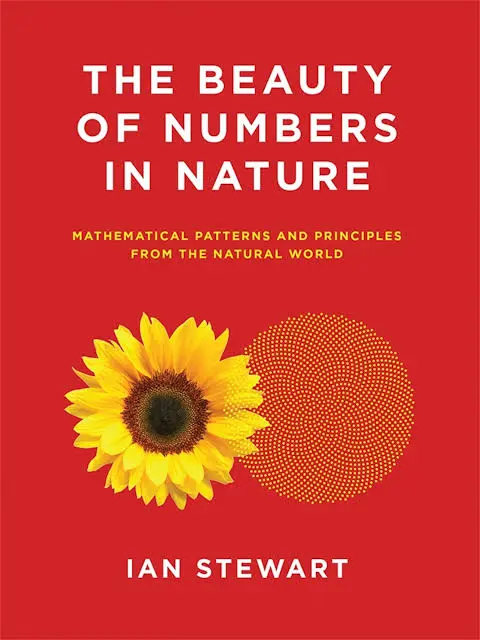
Everyone has heard that Fibonacci numbers turn up in nature — in a sunflower head above all. What the book does is refuse to stop there. The seeds behave like particles that push each other away and drift outward from the centre, each new seed settling into the emptiest angle left to it, and that plain rule converges on the golden angle of 137.5 degrees. The spiral counts coming out as consecutive Fibonacci numbers is a consequence of it, not the cause.
There is an experiment showing this has nothing to do with seeds or genes. Stéphane Douady and Yves Couder produced the same patterns in a laboratory in 1992. They dripped ferrofluid at regular intervals into the middle of a dish of silicone oil and used a magnetic field to pull the droplets outward. The droplets pushed one another apart, and the dish turned out the same spirals a sunflower does. Nothing alive is involved, only repulsion and timing — which is worth remembering the next time you look at a shell drawn by hand along golden-ratio construction lines.
Details
- Author
- Ian Stewart, University of Warwick
- Edition
- MIT Press, 2017
- Pages
- 224
- First title
- What Shape Is a Snowflake?, 1998
- Equations
- None
Who I would hand it to, and my one complaint
You can hand this book to someone who tells you they do not like mathematics, because Stewart never assumes the reader knows any, and everything he describes is something you could see out of a window. It sits on the same shelf as Strogatz on calculus and Vogel on the physics of living things — books that explain a mechanism instead of decorating it.
My one complaint is real. The first edition was full of pictures, and losing pictures in a book about patterns is a loss you feel on nearly every page. If you want the plates, you want Haeckel beside it. And if you have read Stewart's other books, some chapters will feel familiar. The man has written more than two hundred, and he repeats himself in places.
It stays on my shelf for one reason. Most popular books show you the pattern and leave it there, while this one goes looking for the rule that produces the pattern and keeps finding that the rule is far plainer than we assume. Two chemicals and a narrowing tail. A seed taking the emptiest angle left to it. The answer to the question in Kepler's twenty-four-page booklet arrived three centuries later, and it was a question about stacking.
Ian Stewart — The Beauty of Numbers in Nature: Mathematical Patterns and Principles from the Natural World
MIT Press, 2017 (revised from What Shape Is a Snowflake?, 1998) · abakcus.com