Do not trust me. Check it yourself.
Drag the gold shape onto the blue one
They are the same shape, rotated. The measurements below never change no matter where you drag it. Only your certainty changes.
The bottom shape almost always looks larger. Swap them and the larger one is still on the bottom. The shape did not change. The neighbour did.
The story usually starts with Joseph Jastrow, and it starts a little wrong. The illusion he is named for was first set down in 1889 by the German psychologist Franz Müller-Lyer, buried in a collection of size illusions. Jastrow arrived three years later, in 1892, with his own variant, two arcs tapering to a point at one end, published while he was building the first psychology laboratory in the United States. His name stuck to the whole family of shapes. The earlier claim did not.
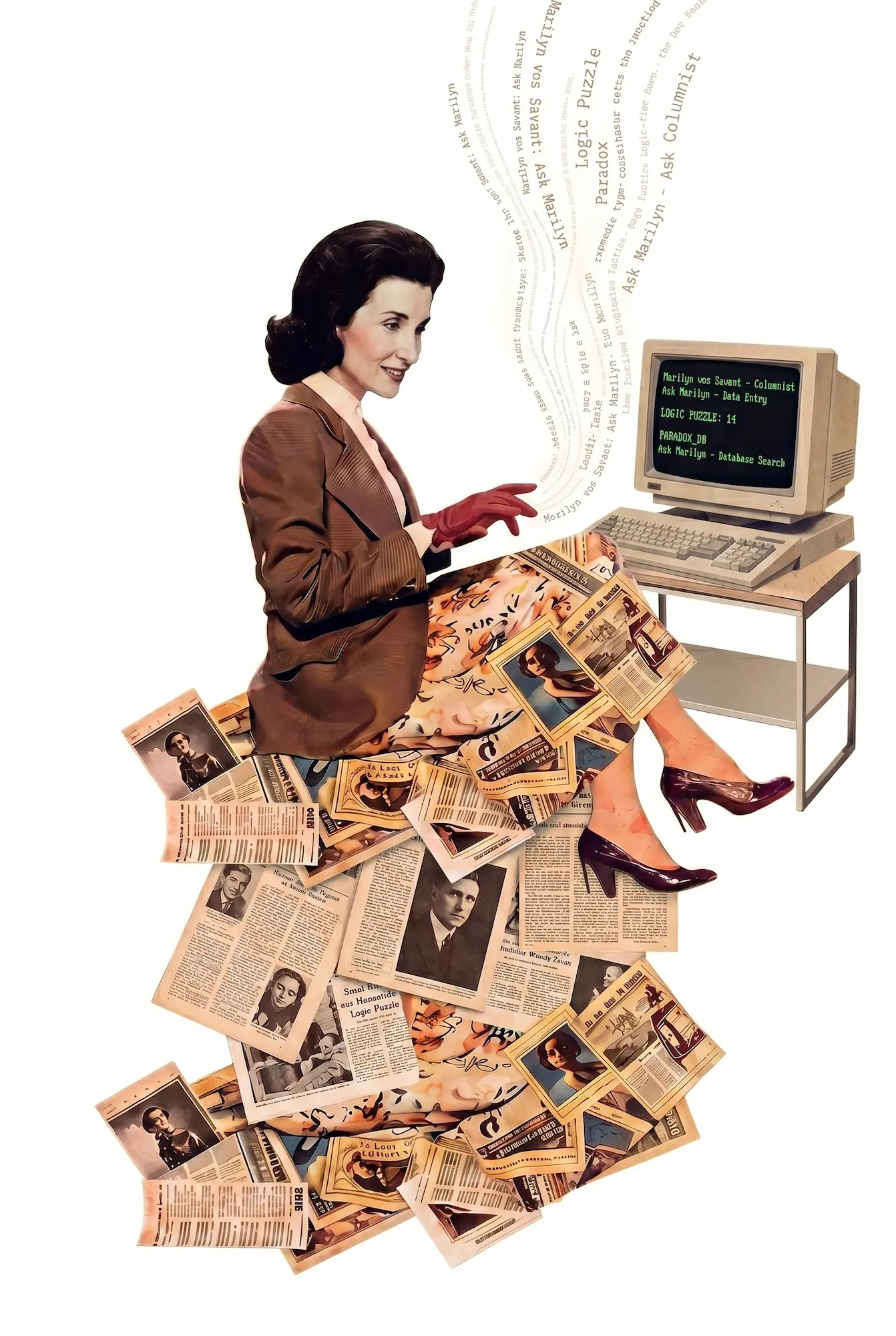
Whoever drew it, the effect is the same and it is unforgiving. Cut two of these arcs from one template. Stack them, curved sides nested like two rails of toy train track. The lower one looks plainly bigger. Measure them and they are equal to the millimeter. Jastrow's other famous drawing is the duck that is also a rabbit, and it is the lesser puzzle. The duck-rabbit only shows a picture can be read two ways. The arcs show something worse. Here nothing is ambiguous. There is a single correct answer, a fixed number, and the eye still misses it, and misses it with full confidence — the same stubborn confidence that made thousands of readers insist Marilyn vos Savant had her probability wrong when she did not.
01What actually happens
Set two congruent fan-shaped arcs one above the other, aligned at one end. The short inner edge of the top shape sits directly against the long outer edge of the bottom shape. Your visual system, asked to judge size, cannot help but compare the two edges that touch. A short line next to a long line makes the short line's owner look small and the long line's owner look large. The contrast leaks from the edges into your sense of the whole area.
This is the plain-contrast account, and it is the one that survives scrutiny best. There are richer stories. Some argue the brain reads the nested arcs as depth, treating the outer curve as nearer and therefore larger, borrowing the logic it uses to keep a coffee cup the same size as you carry it across the room. What is agreed is narrower and more unsettling than any single mechanism. More than a century on, the illusion is still not fully understood.
“We judge relatively, even when we most desire to judge absolutely.”
— Joseph Jastrow, 1892
That single sentence is the whole essay compressed. Jastrow had noticed that we do not measure areas the way a ruler does. We measure them against their neighbours, against the lengths of the lines that bound them, and we cannot switch the comparison off. The desire to judge absolutely is real. The ability is not there.
02Why it will not go away
The most humbling part of the Jastrow illusion is not that it fools you once. It is that it keeps fooling you after you have proven it false. You can drag one shape onto the other, watch the outlines vanish into a single silhouette, slide them back apart, and the bottom one will swell up again like nothing happened. Knowledge does not reach the machinery that does the seeing. The part of you that reads a page and the part of you that measures an arc are not on speaking terms.
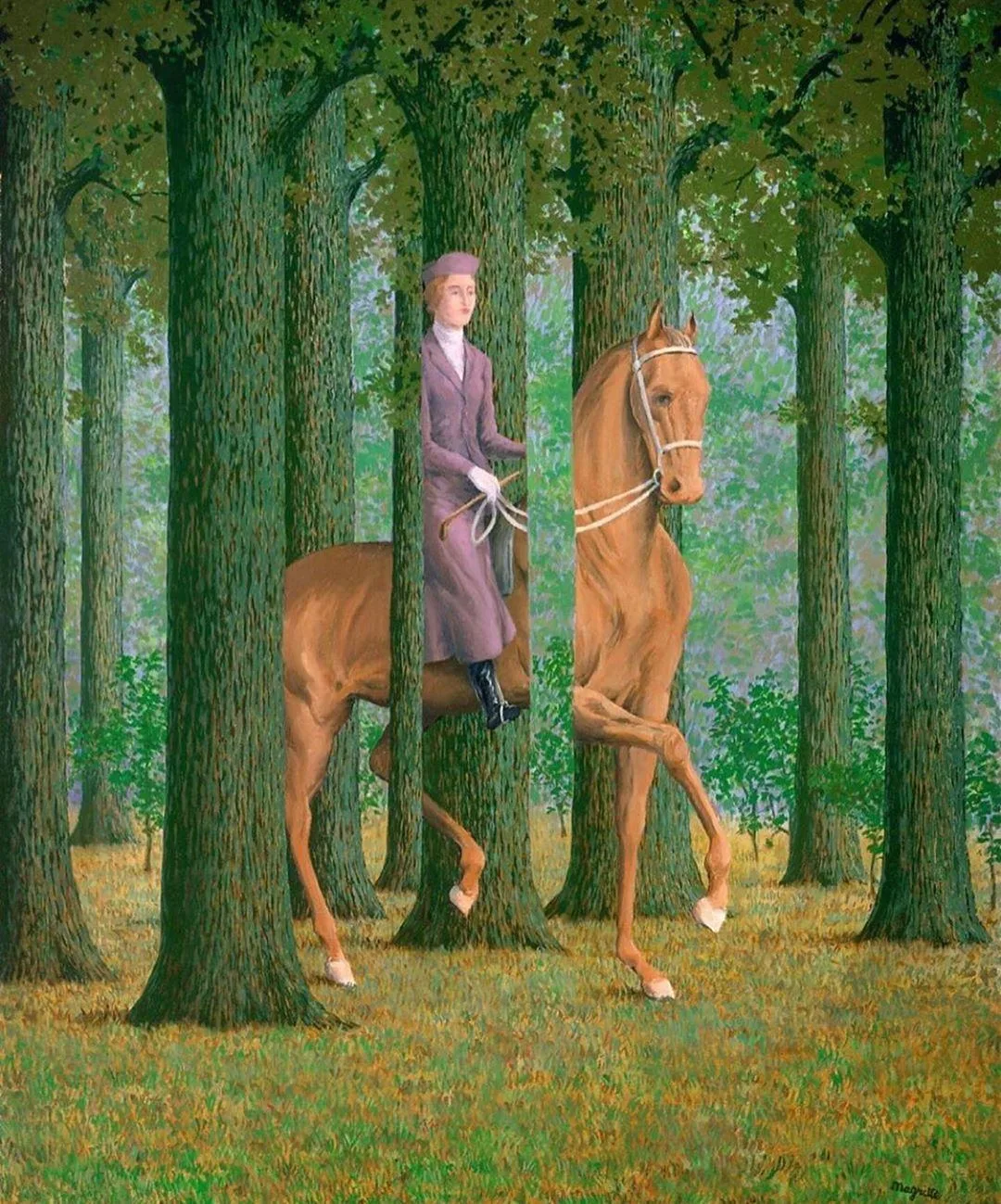
Curiously, some minds are immune. When the illusion was tested on rhesus monkeys, they were not fooled. Neither, it turns out, are human hands. Ask someone to grasp the two shapes rather than compare them by eye, and the fingers open to exactly the right width for each, untouched by the illusion. The hand knows the truth the eye refuses. We carry two rival estimates of the same object, and only one of them makes it to consciousness. It is the same quiet gap Magritte exploited on canvas — a scene where everything is real and nothing is possible, and the eye accepts it anyway.
03The recipe for the strongest one
Because the illusion depends entirely on geometry, you can tune it. In 1960 the Japanese psychologist Shogu Imai did exactly that, showing people the arcs at many different proportions and asking each time how much larger the lower shape looked. He was hunting for the settings that fool the eye hardest.
The answer is a short list of numbers. The inner radius should be three-fifths of the outer radius, a ratio of 3 to 5. The arc should open across roughly eighty degrees. The straight cuts at each end work best pointed at the center of the circle, so the whole figure reads as a clean segment of a ring. Lay the two arcs horizontally, one directly above the other, close but not touching. Get all of this right and the lower shape looks about ten percent larger than the upper. That ten percent is the ceiling. It is also, for a shape that is literally the same shape, a great deal.
There is an honesty in this. The fact that you can write down a recipe for the illusion is proof that it is mechanical, not mystical. It is not that some arcs are magic. The eye applies a fixed, predictable bias, and once you know the formula for that bias you can dial it up or wash it out on command — the same way a single equation dictates the shape of a Pringle.
04It escapes the page
Jastrow's arcs were a laboratory curiosity, but the effect lives anywhere two congruent curves lie fan to fan. Once you know it, you start catching it in the ordinary world, which is the pleasure of the thing.
On the floor
Toy train tracks
Two identical curved rails, nested on a rug. The one on the outside looks stretched. It is the cleanest real-world version, a size illusion you can build from a train set.
On the table
Sliced bundt cake
Stack two equal curved slices and the lower one looks like the more generous portion. A quiet way to lose an argument at dinner.
On the screen
Nested UI arcs
Concentric progress rings and fanned card stacks inherit the same bias. Designers ship it without meaning to.
None of these is a special material or a trick of light. They are all the same geometry, repeated: a short edge parked beside a long one, and a brain that cannot stop comparing them.
05What it is really about
It is tempting to file the Jastrow illusion under fun facts and move on. But it argues for something larger, and it argues cleanly, with a proof you can hold in your hands. It says that perception is not a window. It is a verdict, reached by comparison, delivered before you are consulted, and unwilling to be revised by mere fact.
Mathematics exists partly as a corrective for exactly this. A ruler does not care what sits next to the thing it measures. A number is a promise of the absolute in a mind built for the relative. It is the same instinct that drives a proof like the one showing √2 can never be a fraction: distrust the confident feeling, and follow the argument instead. The arcs are a small monument to why we needed to invent measurement at all, and to why we should distrust the confident feeling that we can see the answer without it.
The takeaway
One template, cut twice. The eye says one is larger. The ruler says they are equal. Trust the ruler.