Art · Surrealism · Perception · 1965
René Magritte's The Blank Signature
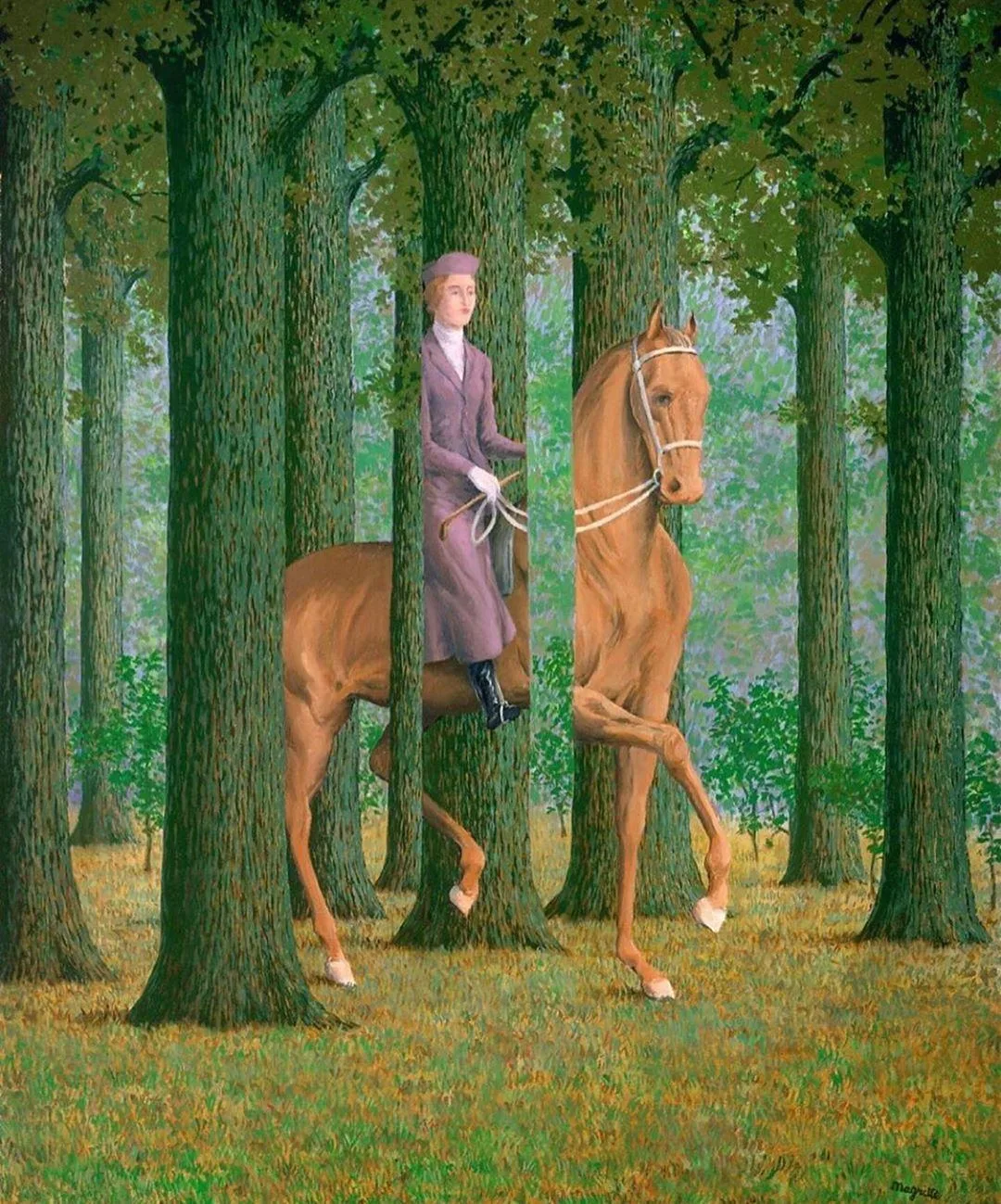
A woman on horseback moves through a forest. Everything you see is painted with photographic calm. Nothing you see is physically possible.
Most optical illusions announce themselves. They are puzzles that wear their strangeness on the surface, demanding to be solved. Magritte's The Blank Signature does the opposite. It presents itself as a perfectly ordinary afternoon in a forest — and only slowly, almost reluctantly, reveals the impossibility it has been hiding all along.
The scene is straightforward enough: a woman in a purple riding habit sits astride a chestnut horse. She holds the reins with gloved hands. The horse trots through a stand of tall oaks, sunlight filtering through the canopy above. The grass is autumnal. The air is still. There is nothing obviously wrong.
And then the eye catches it. The horse is simultaneously in front of one tree and behind another — but the two trees are in the same plane. A segment of the rider's body disappears where it should be visible and reappears where the forest should occlude it. One of the horse's rear legs exists in a spatial position that cannot be reconciled with any coherent three-dimensional reading of the scene. The painting is not a dream. It is something stranger: a waking scene that has been quietly, carefully broken.
“In La Carte Blanche, the rider is hiding the trees, and the trees are hiding her. But our powers of thought grasp both the visible and the invisible — and I make use of painting to render thought visible.”— René Magritte, on The Blank Signature
The Mechanics of the Impossible
What Magritte achieved in this painting was a precise dismantling of the perceptual rules that normally allow us to read a flat surface as a three-dimensional world. Vision is not passive reception — it is active inference. The eye takes in raw visual data and the brain constructs a spatial model from it, using a set of learned assumptions: objects nearer to us partially cover those further away; scale diminishes with distance; parallel lines converge. These rules are so deeply ingrained that we apply them instantly, automatically, without awareness.
Magritte exploited three of these rules simultaneously, setting them in contradiction to each other. A 2023 study in the Journal of Vision by Russell D. Hamer identified the exact locations of the three surreal violations — what Hamer calls “impossible tree no. 3,” the impossible left rear leg of the horse, and the impossible occlusion of the horse's midsection by open background space — and traced precisely how each one hijacks a different visual processing mechanism. The painting is, as Hamer put it, a virtual course in perception science.
Occlusion
Normally, a nearer object blocks a more distant one. Here, occluding relationships are deliberately contradicted: the horse is in front of tree A and simultaneously behind tree B, which is in the same spatial plane as tree A.
Closure
The brain automatically fills in missing parts of a recognizable shape. Magritte's painting forces closure to construct a spatially impossible horse — a single object whose parts cannot be reconciled with any consistent three-dimensional position.
Size & depth
We read the size of objects as a cue to distance. Magritte's tree no. 3 appears as a larger, more distant tree — but its base is positioned in front of the horse. The two readings cannot both be true, and yet the brain insists on holding both.
The critical insight — the one that separates this painting from a mere visual trick — is that the illusion requires Magritte's photorealistic execution to function. The forest is rendered with the patient accuracy of a nineteenth-century landscapist. The horse's coat reflects light correctly. The leaves have individual weight. It is precisely this fidelity to realistic depiction that arms the impossibility with its force. If the painting were loosely sketched or stylized, the spatial contradictions would be easier to dismiss. It is the very persuasiveness of the world Magritte builds that makes its violation so disorienting. The same principle governs the physics of Pinocchio's nose: the more faithfully you apply the real rules, the more sharply the impossible result lands.
The painting uses a technique comparable to the impossible trident — the classic figure that has three prongs at one end and only two at the other. Both work by building spatial expectations locally that contradict each other globally. The mind constructs a coherent whole from the separate fragments; it is the completion that produces the impossibility.
What the Title Signs
The French title is La Carte Blanche — literally, a blank card. In French, the phrase carries the meaning of unconditioned authority: a blank document signed in advance, authorizing whatever the bearer chooses to fill in. An open warrant. An unsigned contract.
The English translation, “The Blank Signature,” preserves some of this resonance while shifting the emphasis. A signature is the mark of a specific person at a specific moment — it commits the signer to something. A blank signature is paradoxically both definitive and empty. It is a completed gesture that authorizes nothing determined.
Applied to the painting, the title offers a proposition: the image is signed — it presents itself as a record of a real scene — but what it authorizes, what it certifies as real, has been deliberately left blank. The painting is a contract with reality that has been signed before the terms were written. Or perhaps: the terms are there, but they are written in a language the eye reads one way and the mind reads another.
Magritte Against the Surrealists
By 1965 — the year he painted this — Magritte was sixty-seven and had spent four decades establishing a quiet but decisive distinction between his own practice and the mainstream of Surrealism. Where Dalí and Ernst went to the unconscious for their imagery — mining dreams, hallucination, and sexual symbolism for their visual matter — Magritte was interested in something colder and, in its own way, more radical: the mechanics of normal, waking perception.
He was not painting what the mind invents when the rational guard is down. He was painting what the mind does when it is fully alert. The Blank Signature is not a dream. The rider is perfectly awake. The horse is real. The forest is real. The rules of depiction have simply been arranged so that they contradict each other — not in the way dreams contradict reality, but in the way a rigorous logical paradox contradicts itself. One thinks of the proof that 0.999… equals 1: every step follows by the rules, and the conclusion feels impossible, yet it cannot be refused.
Magritte described his method as painting “the image of resemblance” — not the thing itself, not a symbol of the thing, but an image that resembles the way thought encounters the thing. In The Blank Signature, what thought encounters is the moment when the visual evidence refuses to assemble into a coherent world, and the mind — which has no option but to continue constructing — produces an impossibility it can feel but cannot resolve. It shares that quality with a proof by infinite descent: the argument is valid, the conclusion unavoidable, and the discomfort is part of the point.
The painting is now at the National Gallery of Art in Washington, a gift from Paul Mellon. It was first exhibited in 1965 alongside Magritte's first full American retrospective at the Museum of Modern Art in New York — the show that cemented his reputation in the United States and introduced his work to the generation of artists and thinkers who would carry it forward into pop art, conceptual art, and the philosophy of mind.
He died two years later. The last image he completed was a painting of a table — which he painted as a fresco on a wall, deliberately invoking Leonardo's Last Supper, minus the figures. The thought that becomes visible is of the structure of a meal from which everyone has already left. It was, characteristically, a painting about what the eye sees when the evidence is insufficient for certainty — and about the mind that keeps looking anyway.
Source
René Magritte, The Blank Signature (La Carte Blanche), 1965. Oil on canvas, 81 × 65 cm. National Gallery of Art, Washington D.C. For the scientific analysis of the painting's perceptual mechanisms, see: Russell D. Hamer, “Surreal space in René Magritte's Le Blanc-Seing” , Journal of Vision, 2023.