Drawings
Santiago Ramón y Cajal
Publisher
Abrams
Year
2017
Plates
About eighty
Commentary
Eric A. Newman
Originals
Instituto Cajal, Madrid
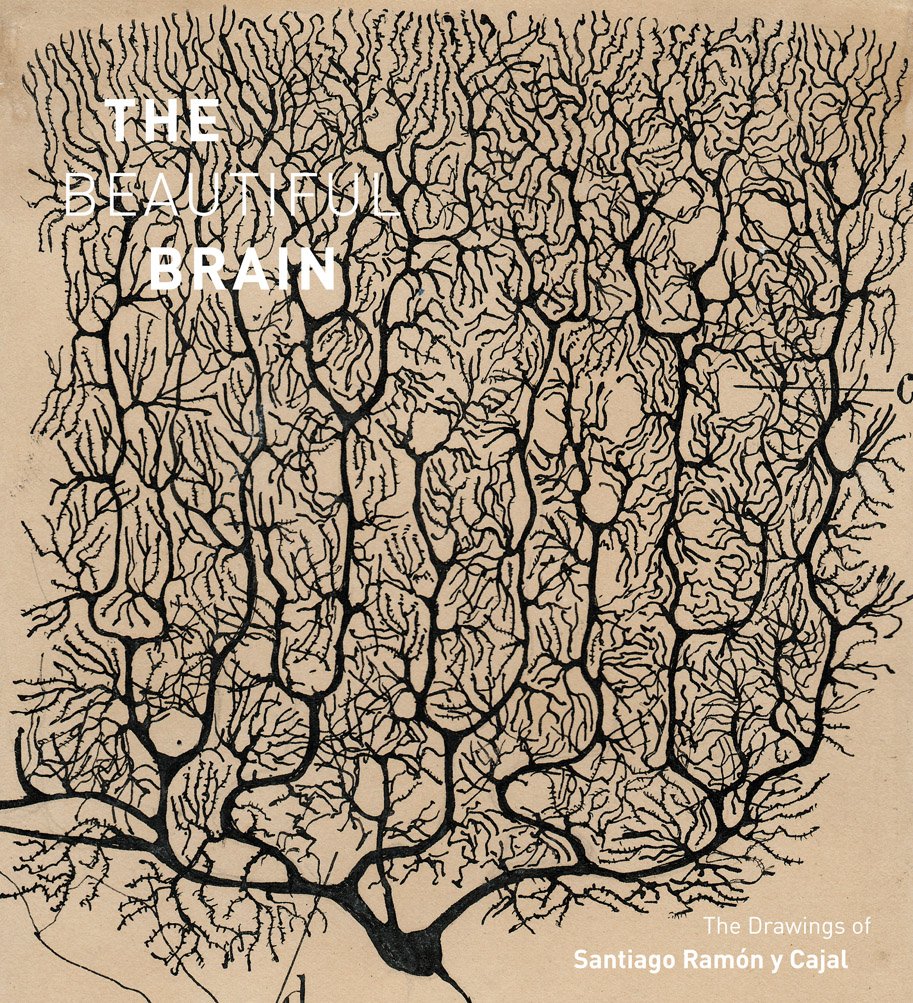
ook at the cover before you open it. A trunk rises from the bottom of the page, splits, splits again, and keeps splitting until the branches are finer than the pen should allow — a winter tree, black ink on paper the colour of old cream. It is not a tree. It is one cell from the cerebellum of a pigeon, a Purkinje neuron, drawn by Santiago Ramón y Cajal in 1899. A single one of those branches is thinner than a hair. You have about fifteen million of these cells at the back of your skull, and every time you catch a ball or climb a stair without thinking about it, they are the ones thinking.
Cajal was born in 1852 in a village in Aragón, the son of a country surgeon who later taught anatomy. The boy wanted to paint. He drew on walls, on fences, in the margins of every book he was given; he was, by his own cheerful account, a terrible student and an accomplished vandal — at eleven he was jailed for blowing up a neighbour's gate with a homemade cannon. His father decided art was not a career and made him a doctor. What the father could not have known is that he was handing his son the one subject in the nineteenth century where being a draughtsman was the whole job.
A forest you can only see a few trees of
The problem with the brain, in 1880, was that you could not see it. Under a microscope a slice of nervous tissue is a grey felt, so densely packed with fibres that nobody could tell where one cell ended and the next began. Many of the best anatomists of the day concluded that it did not end — that the nervous system was a single continuous net, a plumbing of protoplasm through which nervous force simply flowed. It was called the reticular theory, and its most distinguished champion was the Italian Camillo Golgi.
The irony is that Golgi had invented the tool that would destroy his own theory. In 1873 he found that if you harden brain tissue in potassium dichromate and then soak it in silver nitrate, a few cells turn completely black, down to their last twig, against a clear amber background. Nobody knows, even now, exactly why the reaction picks the cells it picks. What matters is that it picks so few.
Cajal saw his first Golgi preparation in 1887, in the Madrid flat of a colleague, and later wrote that it was like being shown a forest where all but a few trees had been made invisible. He went home and made the method his own. He impregnated the tissue twice to make the stain more reliable. He worked on embryos and young animals, whose neurons are smaller and not yet wrapped in the fatty myelin that blocks the silver, so that a whole cell, from the tip of its dendrites to the end of its axon, could fit inside a single section. The next year, 1888, he called his año cumbre, his summit year. Looking at the cerebellum of birds, he followed fibre after fibre to its end and found that every one of them stopped. They came close to the next cell, they wrapped around it like ivy, they touched it. They never fused with it.
The brain is not a net. It is a crowd — billions of separate cells, each one a whole thing, talking across gaps too small to see.
That is the neuron doctrine, and it is the foundation of everything we now know about the brain. In 1906 Cajal and Golgi shared the Nobel Prize in Physiology or Medicine, and in Stockholm they used their lectures to contradict each other; Golgi defended the net with Cajal sitting in the audience. The gap Cajal insisted on — the synapse, as Charles Sherrington named it — was too narrow for any light microscope to show. It took the electron microscope, in the 1950s, twenty years after Cajal's death, to photograph it and prove him right.
Why the drawings are better than photographs
Cajal was a serious photographer — he wrote a book on colour photography, and he could have photographed his slides. He drew them instead, and this is the point the book makes most beautifully. A microscope slide is a slice, a few dozen microns thick. A neuron is not. Any one section holds only a piece of a cell, and the focus sits on only one plane of that piece. So Cajal would study a preparation for hours, turning the focus up and down, then do the same with another, and another, and then sit down at a clean sheet and draw what all of them together had shown him. Each drawing is not a record of one slide. It is a conclusion.
You can see the conclusions on the page, because he drew them in. Many of the plates carry small arrows, threaded along the fibres like traffic signs. They are his second great idea, the law of dynamic polarization: a neuron is not a two-way pipe. Signals come in through the branching dendrites, pass through the cell body, and leave along the single long axon, always in that order. Nobody could measure that in his lifetime. He inferred it from shapes — from noticing, in the retina, in the olfactory bulb, in the spinal cord, which way the cells were facing.
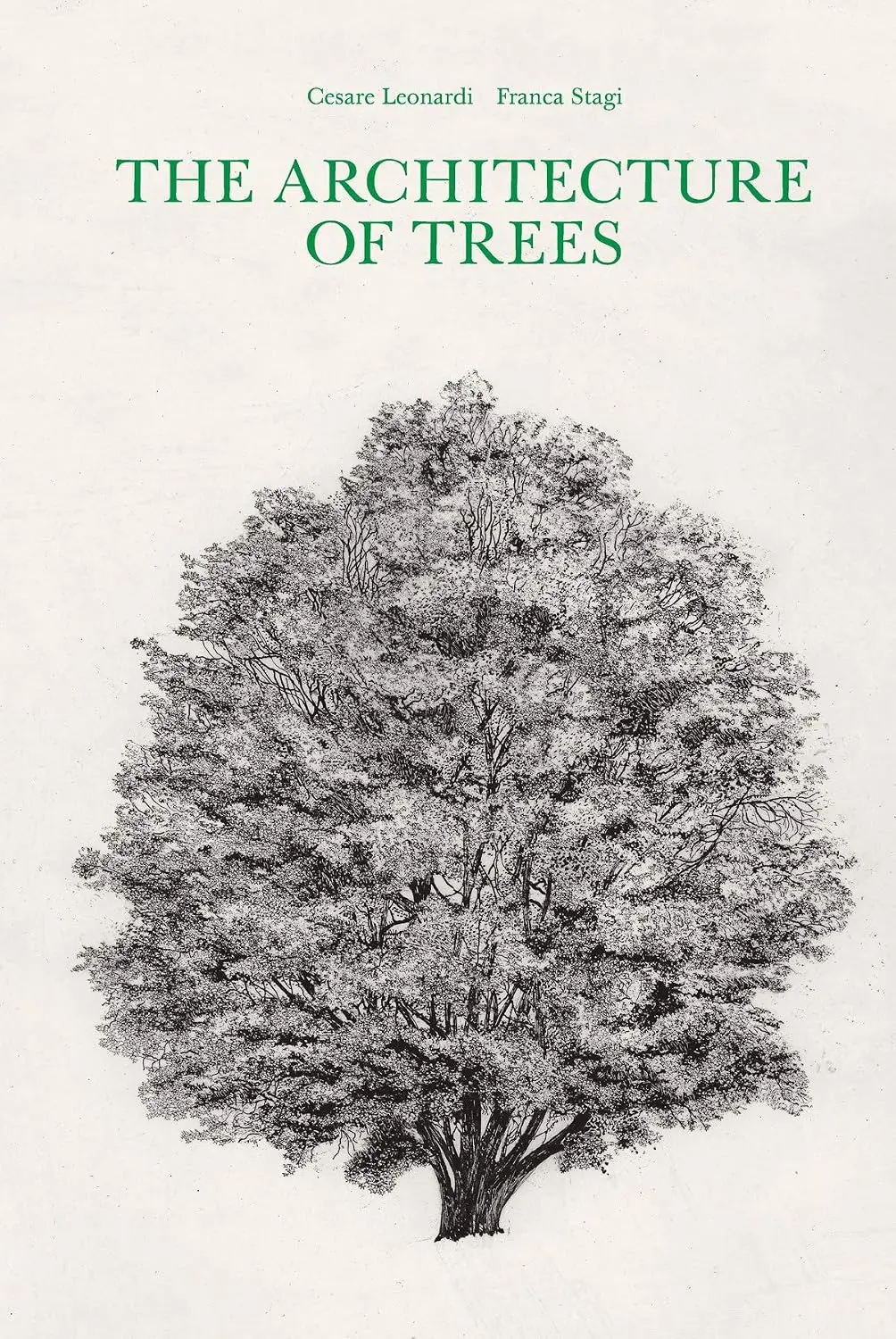
The drawings work as science because they work as drawings. A photograph shows everything with equal weight; a drawing has a point of view. Cajal leaves out the fog and keeps the structure. He thickens a line where the eye should go, lets a background cell fade to a pale outline, places a dozen neurons of the hippocampus in a sweeping curve so that the circuit reads at a glance, left to right, like a sentence. It is the same discipline Cesare Leonardi and Franca Stagi brought to 212 species of trees: twenty years of looking, distilled into a line that tells you how the thing is built. The resemblance is not only a metaphor. Cajal himself described the grey matter as a garden, and some of his cells — the pyramidal neurons of the cortex — he called, in a phrase that has followed him ever since, “the mysterious butterflies of the soul.”
What is in the book
Abrams published The Beautiful Brain in 2017 as the companion to a touring exhibition organised by the Weisman Art Museum at the University of Minnesota — the first time many of these sheets had been shown outside Spain. The originals belong to the Instituto Cajal in Madrid. Around eighty of them are reproduced here at generous size, on cream stock that keeps the ink black and the paper warm, and they are grouped the way Cajal's career moved: the cells one by one, then the brain's regions, then the circuits that join them, then development, injury and repair.
The texts come at the drawings from several directions. Larry W. Swanson, a neuroscientist at USC, opens with Cajal's place in the history of the field. Lyndel King and Eric Himmel write about the artist — the boy who wanted to paint, the man who taught himself to draw from nature, the composer of plates. Eric A. Newman gives each drawing a short commentary that tells you what you are looking at, which way the signal runs, and what has been confirmed or corrected since. And Janet M. Dubinsky closes with how neuroscientists image the brain today, with fluorescent proteins and lasers, a hundred years after a man with a pen got most of it right.
Newman's captions are the book's quiet engine. They are short, plain and never condescending, and they turn a beautiful page into a page you understand — which, it turns out, makes it more beautiful, not less. That is exactly the argument Richard Feynman made about a flower: knowing what goes on inside only adds to the wonder. Read one caption about the retina, look back at the drawing, and the layered rows of cells stop being an ornament and become the first three steps of seeing.
Art, then science, then art again
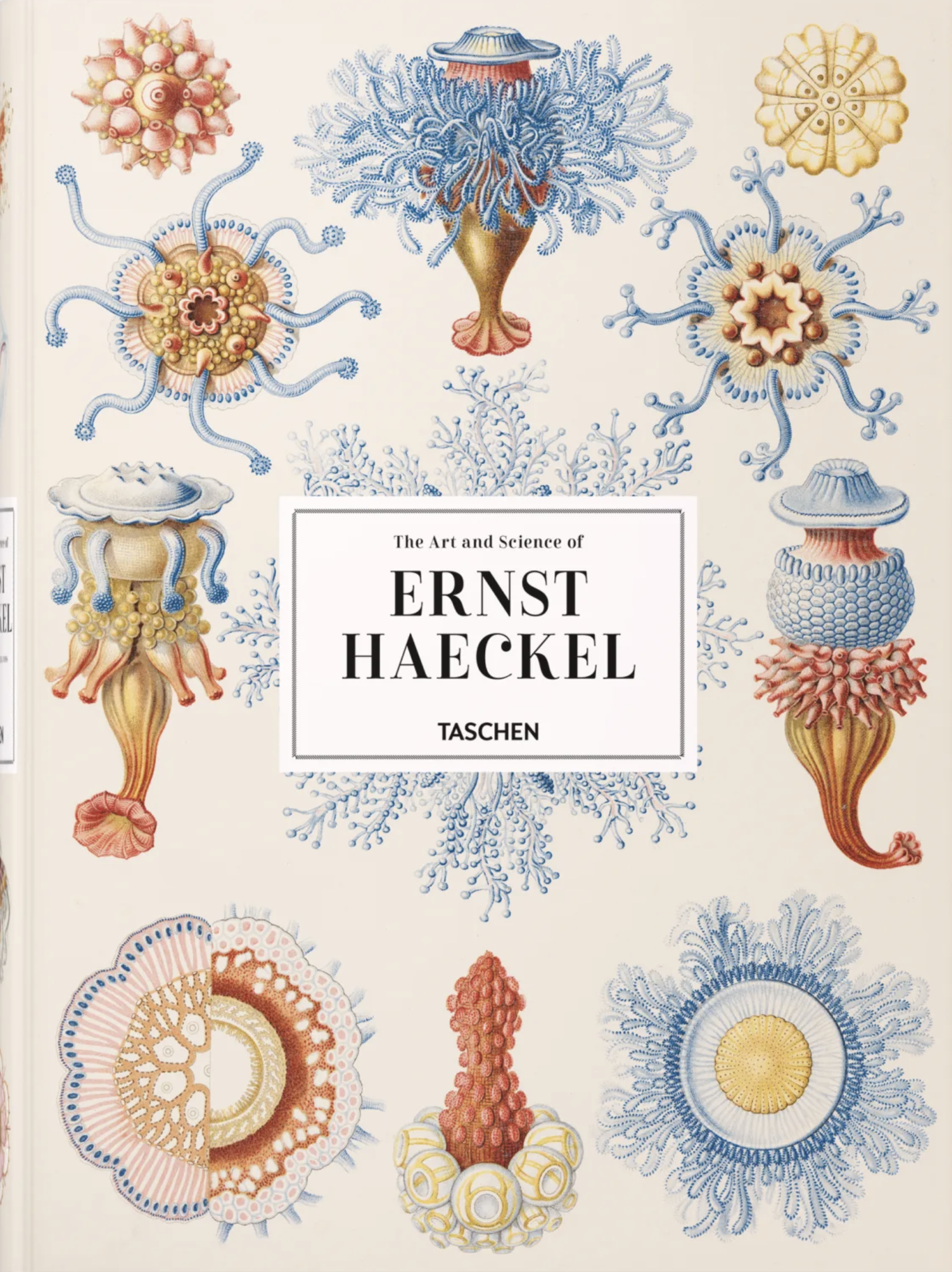
There is a long tradition of scientists who drew because drawing was how they thought. A few decades earlier Ernst Haeckel filled plate after plate with radiolarians and jellyfish, and there too the line between illustration and argument was thin. Cajal belongs in that company, but his drawings have a strange quality Haeckel's do not. Haeckel drew creatures you could, in principle, hold in your hand. Cajal drew the thing that is doing the looking. When you turn the pages of this book you are using several billion of the cells it shows you, arranged in precisely the circuits he traced, to recognise them.
The drawings have not aged. Neuroscience textbooks still reproduce them, not as history but as diagrams, because many are still the clearest picture of their subject anyone has made. They also look, unmistakably, like art: the bare-tree silhouettes of the Purkinje cells, the starbursts of astrocytes, the long parallel strokes of the cerebellar fibres crossing a page like rain. The New York Times called them among the world's greatest scientific illustrations. It is hard, after a few evenings with this book, to disagree with any part of that sentence.
Details
- Drawings
- Santiago Ramón y Cajal (1852–1934), Nobel Prize 1906
- Authors
- Larry W. Swanson, Eric A. Newman, Alfonso Araque, Janet M. Dubinsky
- Essays
- Lyndel King, Eric Himmel
- Edition
- Abrams, 2017 · hardcover
- Originals
- Instituto Cajal, Madrid · touring exhibition from the Weisman Art Museum
If this book speaks to you, these will too
In short
The drawings that proved the brain is made of cells, printed large enough to get lost in, with a scientist beside each one telling you what you are seeing. A coffee table book in which the pictures are the argument — and the argument won.
Larry W. Swanson, Eric A. Newman, Alfonso Araque & Janet M. Dubinsky — The Beautiful Brain: The Drawings of Santiago Ramón y Cajal
Abrams, 2017 · ISBN 978-1-4197-2227-1