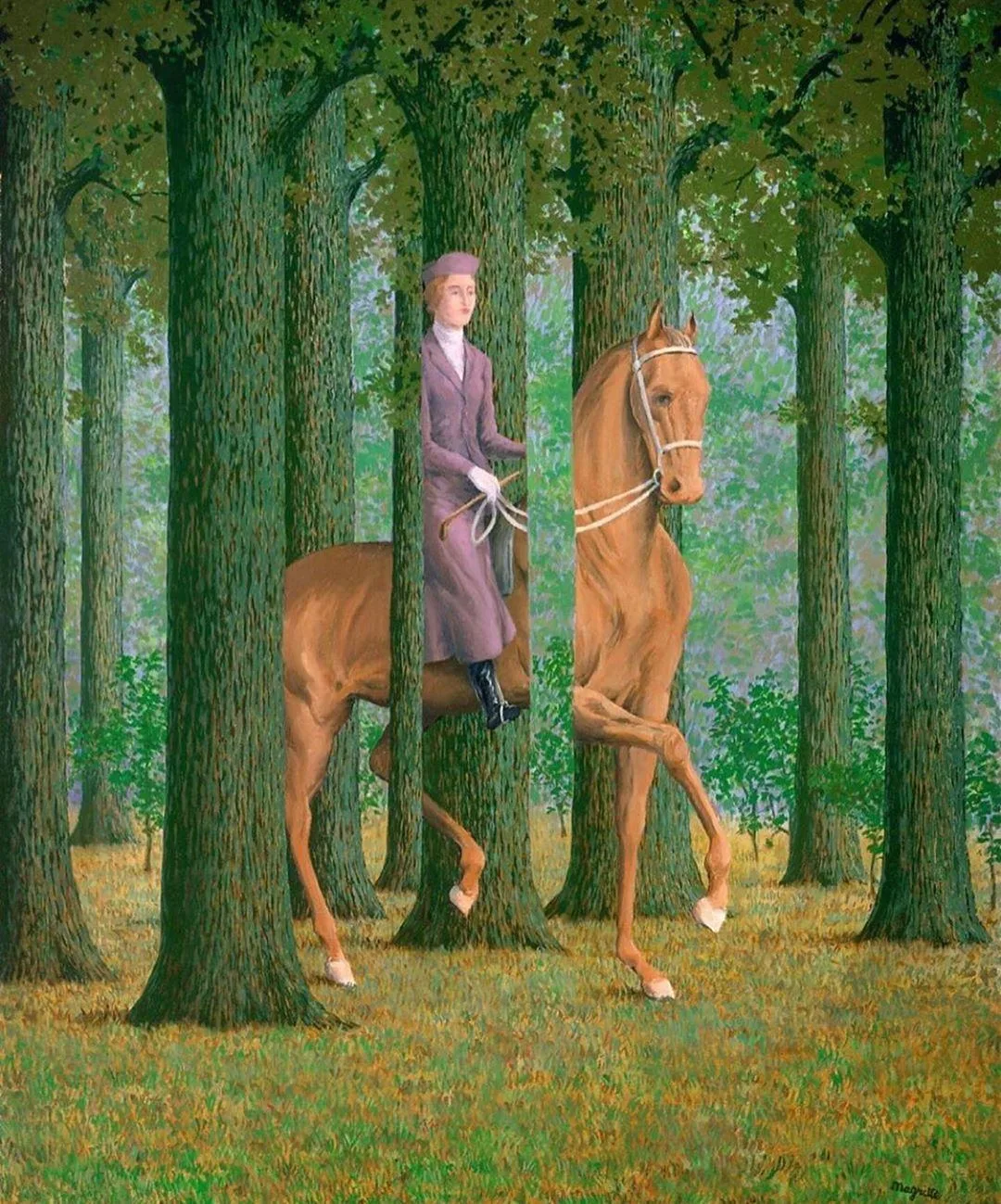
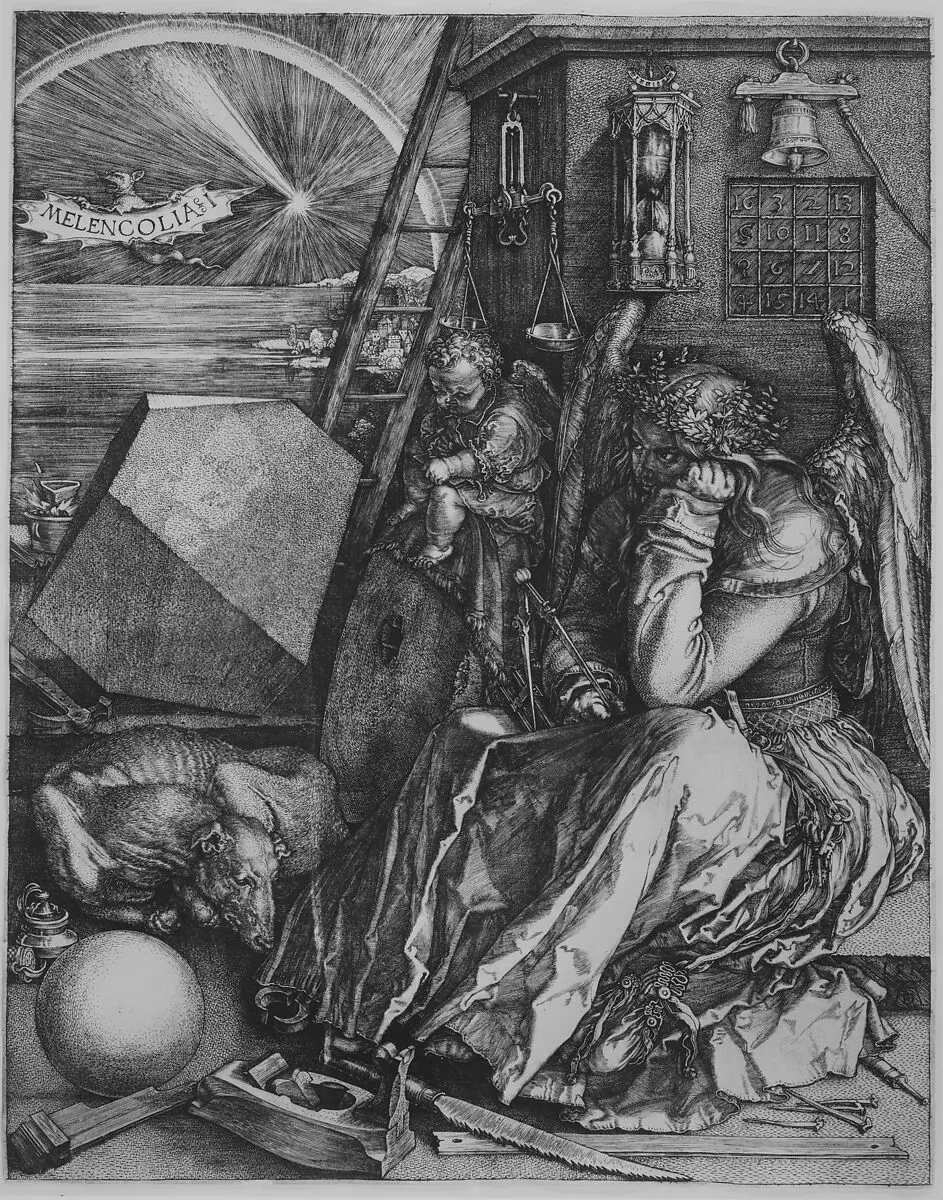
The front of a room. A winged, heavyset figure has slumped to the ground; cheek propped on a fist, an open compass in hand yet drawing nothing. The gaze is sharp — not drowsy, quite the opposite, too awake. Tools surround the figure: a saw, a plane, pincers, a hammer, nails, a ruler. All on the floor, all unused. This is not the picture of idleness but of being blocked. The portrait of a mind that knows everything and, at that moment, can do nothing.
Albrecht Dürer cut this copper plate in Nuremberg in 1514 and wrote his title on the scroll carried by the bat-like creature at upper left: MELENCOLIA I. For five centuries art historians have written volumes on this engraving, because nearly every object in the scene is a riddle. But the riddle that interests us most at Abakcus is the sixteen numbers in the upper right corner, hanging on the wall.
First, let's take inventory of the scene
Dürer places no object at random. Every square centimeter of the engraving is loaded with a reference to the Renaissance doctrine of melancholy:
Winged figure
Melancholy herself. She has wings but does not fly; the watercress wreath on her head is an old "moist" remedy against dry melancholy. Keys and a purse hang from her belt. Dürer left a note in his own hand: the keys signify power, the purse wealth.
Compass
In her hand, open but idle. The instrument of measurement, of geometry — that is, of Dürer's entire theory of art — is, in this moment, useless.
Putto
A winged child perched on the millstone, scribbling something on a tablet. The large figure is not the only one who cannot produce while thinking; at least the small one is writing.
Dog
Skin and bone, curled up asleep. In the medieval tradition the dog is the animal of Saturn and of the melancholic temperament.
Polyhedron
The great stone block at the center of the scene. A truncated rhombohedron — now known in the literature as “Dürer's solid.” Papers are still written on its face angles today; some researchers claim a faint skull can be made out on its front face.
Sphere
The other pole of perfect geometry: cornerless, smooth, complete. It simply rests on the ground.
Ladder
A ladder with seven visible rungs, running off past the frame so that where it leads is unclear. The ascent is unfinished.
Scale, hourglass, bell
Side by side on the wall: measure, time and summons. The sand in the hourglass sits almost equal above and below — the hour is exactly at the midpoint.
Sky
Above the sea a comet or meteor glows, and a rainbow arcs over it. A sign of catastrophe and a sign of hope share the same frame.
Magic square
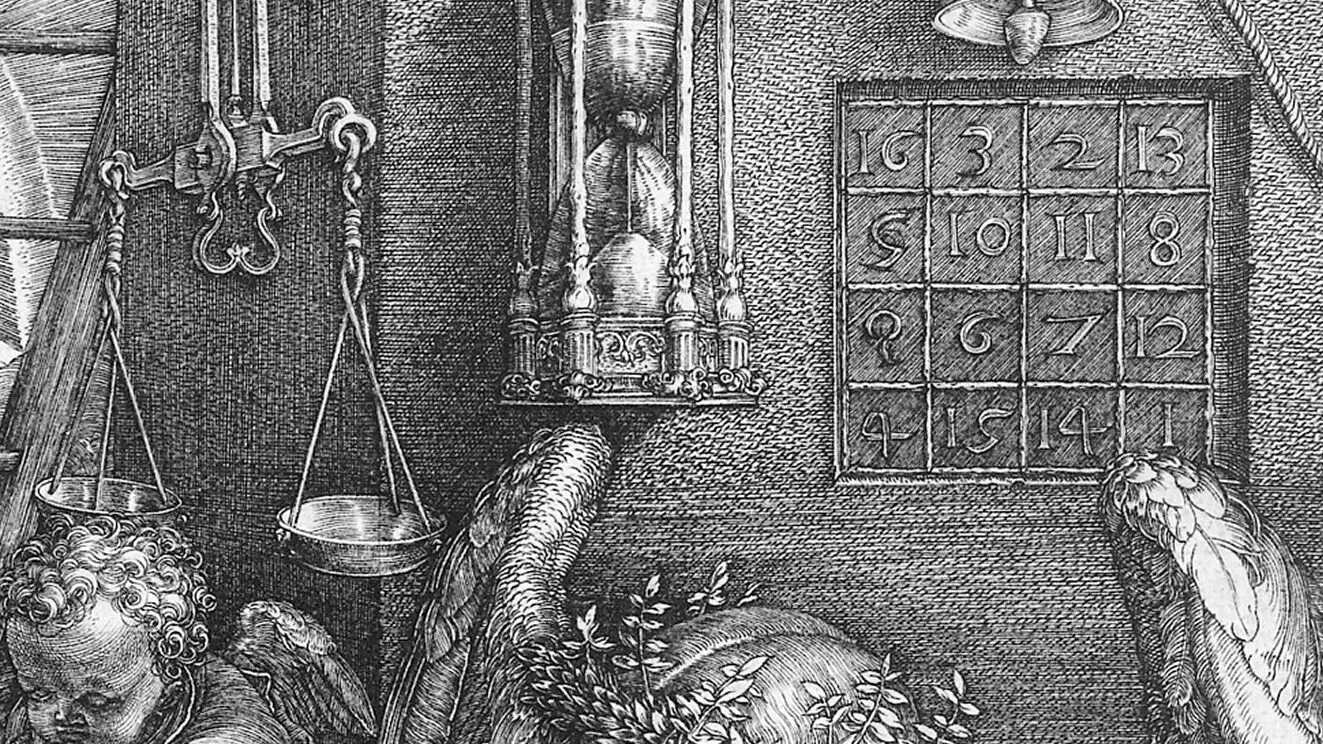
And just beneath the bell, a 4×4 table of numbers carved into the wall. Our real subject.
The eighty-six ways to reach 34
The square uses every number from 1 to 16 exactly once. The sum of each row, each column and both diagonals is 34 — that much is the minimum requirement of a magic square. But Dürer's does not settle for the minimum. Each of the four quadrants sums to 34. The four center cells sum to 34. The four corners sum to 34. Take one clockwise step in from each corner and those four numbers sum to 34; step counterclockwise and those four sum to 34 too. The middle pairs of the top and bottom edges, the middle pairs of the left and right edges — all of them, 34.
You can see the patterns one by one in the square below. Pressing a button repeatedly cycles through the patterns in that family:
Dürer's Square · Interactive
Select a pattern
The layout matches the engraving exactly: it begins with 16 · 3 · 2 · 13 and ends with 4 · 15 · 14 · 1.
If you wonder how many different ways there are to reach 34: scanning every possible quadruple of the sixteen numbers in the square, exactly 86 of them sum to 34. Of course not all of these trace a handsome pattern in the square; but Dürer's chosen layout houses a surprising share of the geometrically meaningful ones at once.
One more subtlety: the square is symmetric about its center. Every pair of numbers that falls opposite each other around the center — 16 with 1, 3 with 14, 2 with 15, 10 with 7 — sums to 17. And the total of the square is 136; that is, the sum of the numbers from 1 to 16, or eight seventeens.
The signature in the bottom row
Now look at the bottom row: 4 · 15 · 14 · 1. Read the two middle numbers side by side and you get 1514 — the year the engraving was made. Rather than tuck the date into a corner, Dürer buried it inside the mathematics.
But the row does not end there. Look at the numbers at the two ends: 4 and 1. The fourth letter of the alphabet is D, the first is A. So the bottom row places Dürer's famous AD monogram on either side of the date. For an artist who spent his entire career using that monogram like a brand, this is a highly deliberate choice.
This arrangement is no accident, because Dürer did not invent the square from scratch. In Agrippa's De occulta philosophia, the reference work of Renaissance occultism, a magic square is assigned to each planet, and the 4×4 square is the square of Jupiter. Dürer's square is that traditional Jupiter square turned upside down with its two middle columns swapped. These two moves have a single purpose: to bring 15 and 14 to the middle of the bottom row, exactly where the year would be read. The lovely property of magic squares is that such reflections and column swaps do not break the magic; Dürer knew this and “tuned” the square to his own date.
How did magic squares reach Nuremberg?
The oldest known example of a magic square is the 3×3 square in China's Lo Shu legend: as the story goes, the pattern was seen on the shell of a turtle emerging from the Lo River. From there the squares passed to the mathematicians of the Islamic world; in the Arabic literature they were studied with great subtlety under the name wafq, as a genre both mathematical and talismanic. Their arrival in Europe came late: the treatise of the Byzantine scholar Manuel Moschopoulos, around 1300, is among the first texts to carry the subject into the Greek written tradition.
Dürer's square is the first great stop of this long journey in European art: the first known appearance of a magic square in a Western work of art. For the next most famous example, one must wait roughly four centuries — Gaudí's square on the Passion façade of the Sagrada Família in Barcelona, tuned to 33 (the age of Christ at the crucifixion), for which it accepts the repetition of two numbers.
So what is the "I" in the title?
Melencolia I — that “I” has been debated for five centuries. The most established reading rests on Agrippa's division of melancholy into three grades: the first grade, melencolia imaginativa, is the melancholy of the imagination and belongs to artists and craftsmen; the second to men of reason, the third to theologians. On this reading Dürer's figure is the allegory of the first grade, that is, of the melancholy of the artist: she holds geometry in her hand, all the tools lie before her, yet she cannot climb that final step between imagination and comprehension. This is why Erwin Panofsky, who studied the engraving in the century's defining work, calls the piece “Dürer's spiritual self-portrait.”
There is a second, less-supported but charming reading: in Latin, i is the imperative of the verb “to go.” In that case the scroll is not a label but a banishing spell: “Melancholy, go!” Considered together with the Jupiter talisman on the wall, the whole engraving turns into a line of defense mounted against melancholy.
One biographical detail weighs on these readings: Dürer's mother, Barbara, died in May of that same year, at the end of a long illness. Dürer recorded his mother's death in his diary with a shattering clarity. That Melencolia I is a product of that year is of course no proof on its own; but the hourglass sand sitting exactly at the midpoint begins to look different.
“You can paint a picture of sorrow. Dürer went one step further: inside the picture of sorrow, he hid sorrow's cure.”
Abakcus
The most restless of the three master engravings
Art historians count Melencolia I as one of the three Meisterstiche — master engravings — that Dürer cut in succession in 1513–1514. Knight, Death and the Devil shows the moral life in action; Saint Jerome in His Study shows the serene contemplation devoted to God. Melencolia I is the restless one of the trio: the portrait of secular genius striving to grasp the world through measure, number and geometry — and the weight of knowing that this grasp has a limit.
Perhaps this is why the engraving has passed from hand to hand for five centuries. The square on the wall is a flawless order that yields the same number when summed in every direction; the figure before it sits, compass in hand, unable to draw a thing. The existence of order and the difficulty of reaching it stand side by side in the same frame. In 1514 Dürer called this melancholy. Today, at the start of every blank page, we give the same thing other names.