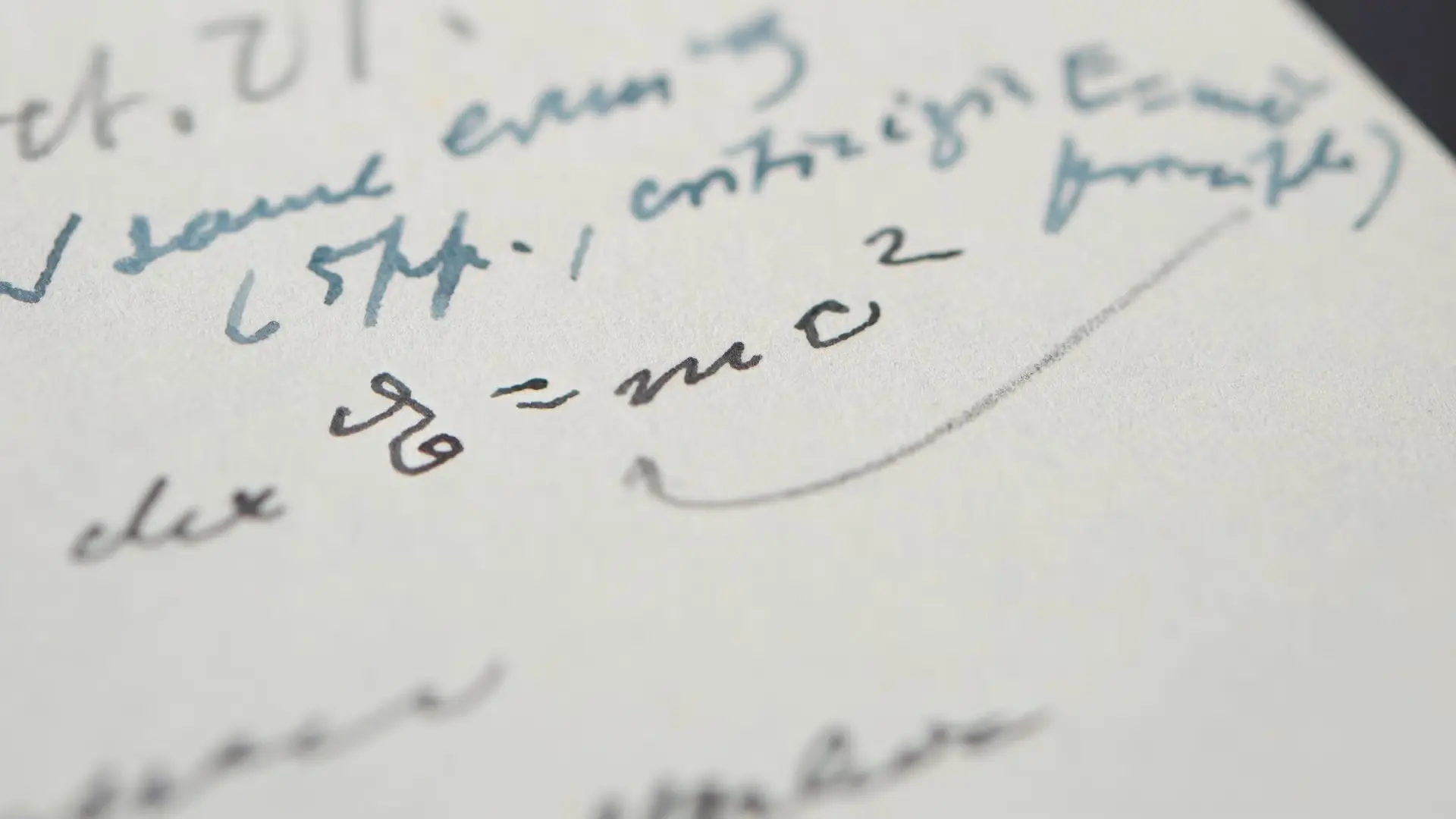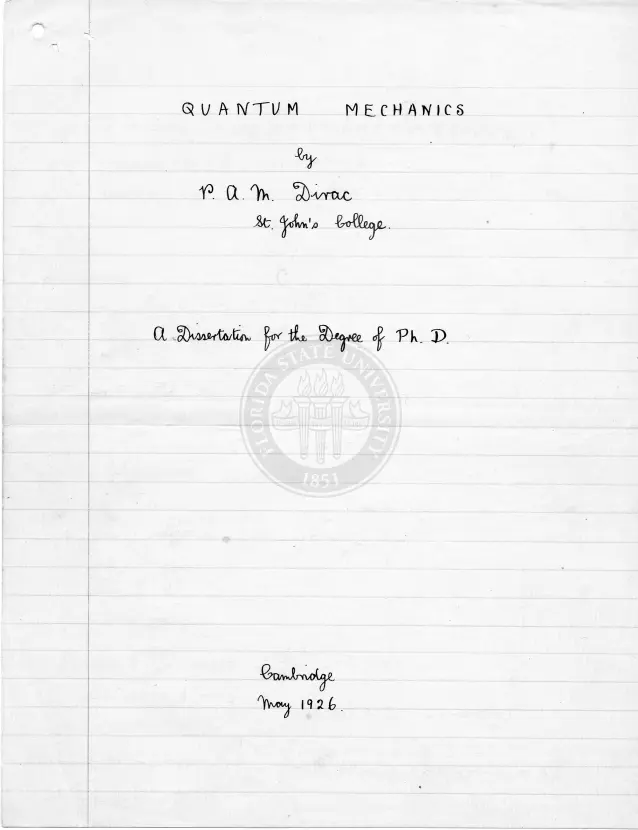
We know the founding documents of modern physics in their printed form. Journal pages, neatly set equations, references at the bottom. Yet most of those documents sat on a desk first, at the tip of somebody’s pen, and Paul Dirac’s doctoral thesis is the finest example of that. There is no typesetting in the scans we have. There are lines running crooked down the page, equations that outgrow the space they were given, and expressions the author thought better of and struck out.
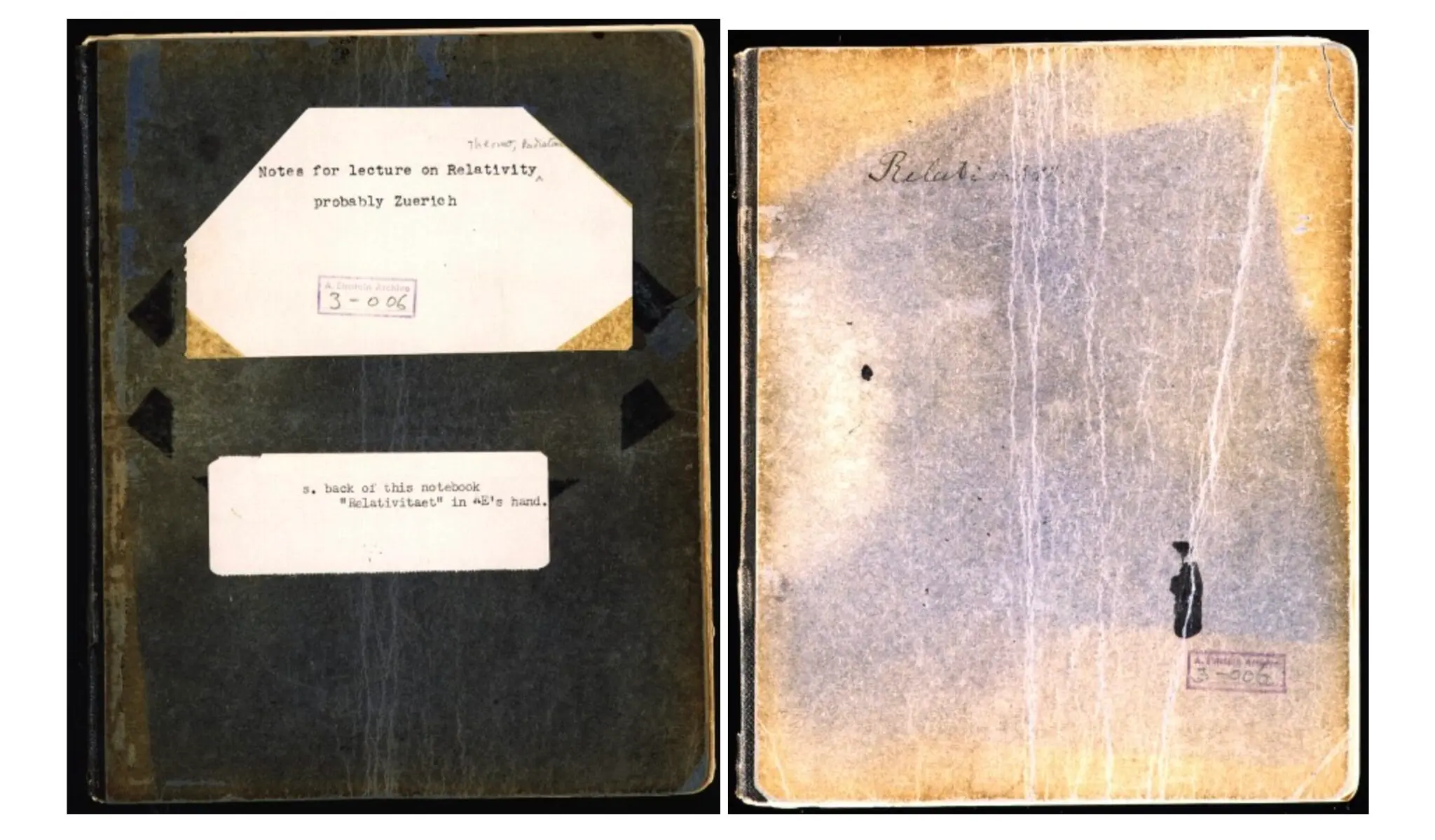
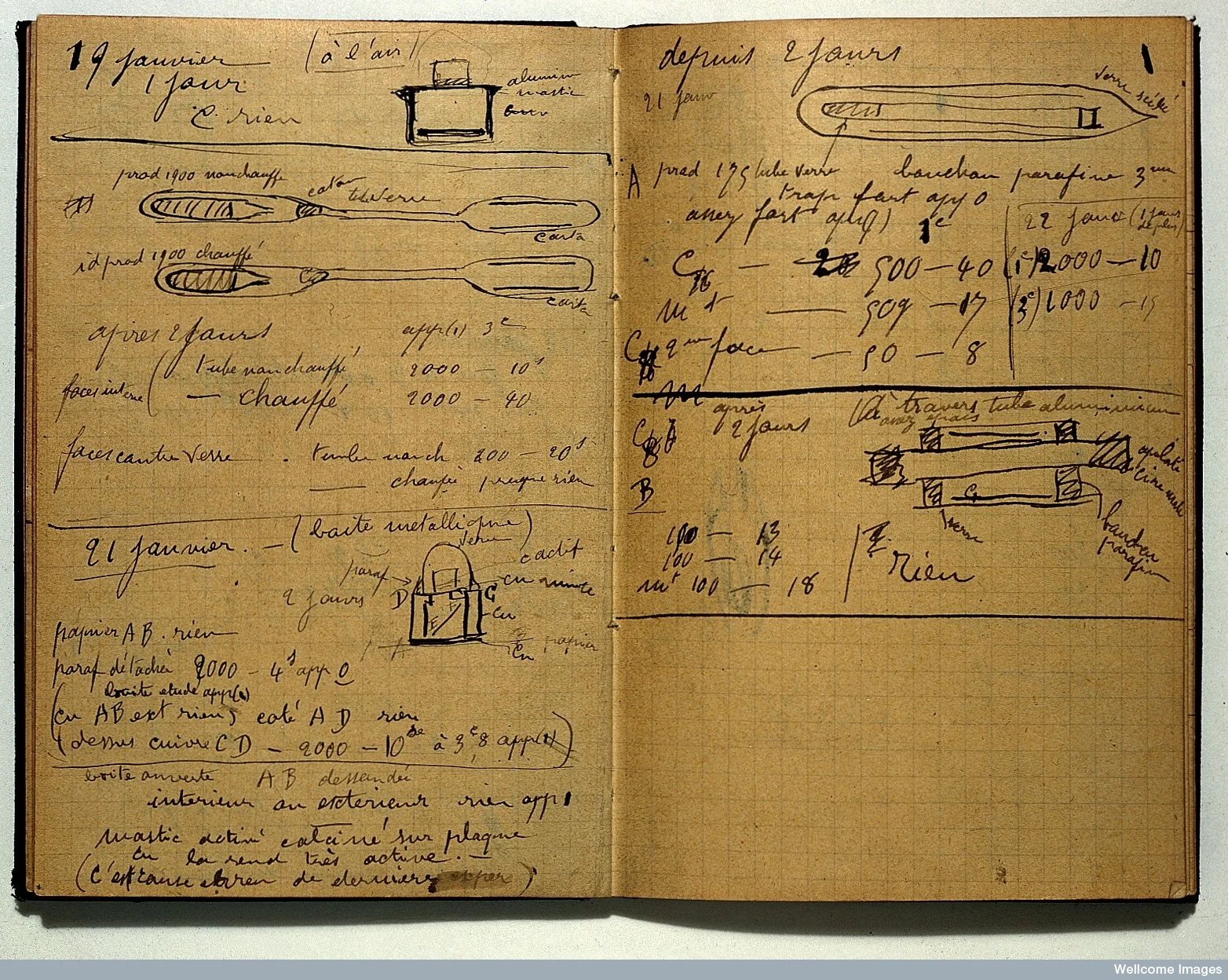
It is the same pleasure you get from Einstein’s Zurich Notebook, or from the pages Marie Curie left behind in her laboratory. A finished paper shows you a result. A working manuscript shows you a person deciding what the result is going to be.
September 1925
It starts on a Sunday walk
In September 1925 his supervisor Ralph Fowler sent Dirac the proofs of Heisenberg’s new paper and asked what he made of it. Dirac was still a research student at the time, and the significance of the algebraic structure of Heisenberg’s commutators struck him while he was out walking in the country. Recalling the moment years later, Dirac said he had been turning the expression uv − vu over in his mind when the Poisson brackets of classical mechanics came to him, that the idea arrived like a flash, and that the reaction which followed it was immediate, “no, this is probably wrong”.
What happens next is one of my favourite details in the history of physics. Cambridge libraries were closed on Sundays, so Dirac could not reach the book that would confirm the idea of his life until Monday morning. When the doors opened he found the resemblance was genuinely there, and within weeks he had written the paper that reached the Royal Society in November 1925. He was twenty-three.
The whole point is seeing that the equations of classical mechanics are not at fault. What is at fault is the way we draw results out of them.
§2 — Algebraic Axioms
The single idea at the heart of it
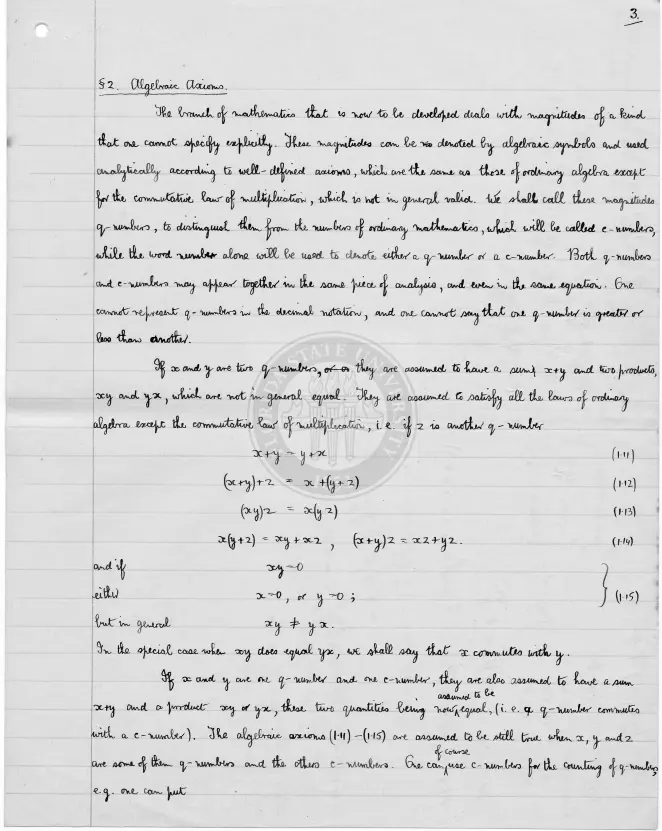
The ground for it is laid on page three of the thesis, under the heading §2 Algebraic Axioms. Dirac announces that he will be working with magnitudes that cannot be specified explicitly and calls them q-numbers, setting them apart from the numbers of ordinary mathematics, which he calls c-numbers. He then writes that two q-numbers have two separate products, xy and yx, and that these are not in general equal. The line he drops in below the numbered axioms stands on its own, xy ≠ yx.
The bridge Dirac built can be stated in one sentence. Whatever the Poisson bracket of two quantities does in classical mechanics, the commutator of those two quantities does in quantum mechanics. Click through the three rows below to see the same expression on both banks of the river.
Dirac’s bridge
Classical
{ q , p } = 1
Quantum
qp − pq = iħ
The classical Poisson bracket of position and momentum comes out as one, while on the quantum side swapping the same pair changes the answer, and the difference is exactly iħ.
The correspondence is taught in the opening weeks of every quantum mechanics course today, but in 1925 it had occurred to nobody. That odd multiplication rule which had unsettled Heisenberg turned out to sit perfectly on top of one of the most elegant corners of classical mechanics. It is the kind of move that earns a line of its own on any list of the equations that changed the world, and like Maxwell’s four equations on a wall in Warsaw, it is short enough to carry in your head.
xy ≠ yx
Page 3 · §2 Algebraic Axioms
May 1926
So what is inside the thesis
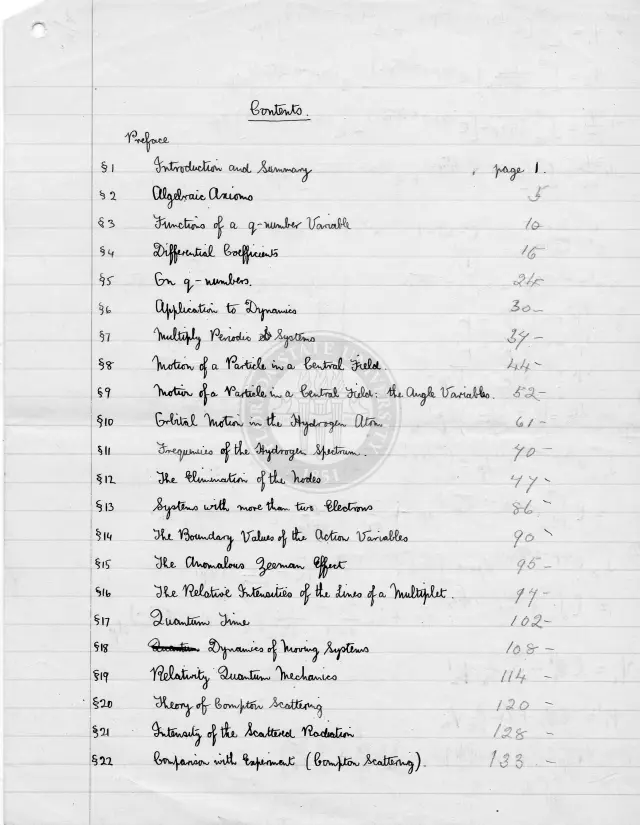
Dirac submitted the thesis to the University of Cambridge in 1926 and gave it the plainest possible title, Quantum Mechanics. The table of contents is just as unadorned. It runs through algebraic axioms, quantum numbers and the motion of a particle in a central field, and the text opens with a preface. The scans also carry separate sections on developments in Heisenberg’s theory and on the calculation of the Bohr lines of hydrogen.
The preface is nine lines long. In it Dirac names the papers the work grew out of — Heisenberg’s in Zeitschrift für Physik volume 33, then Born and Jordan, Born, Heisenberg and Jordan, Pauli, Kramers — and then, with no ceremony at all, marks off what is his own by calling himself “the present author”. There is no acknowledgements page, no dedication, no thanks. A twenty-three year old opens the first thesis on quantum mechanics with a bibliography and closes the paragraph.
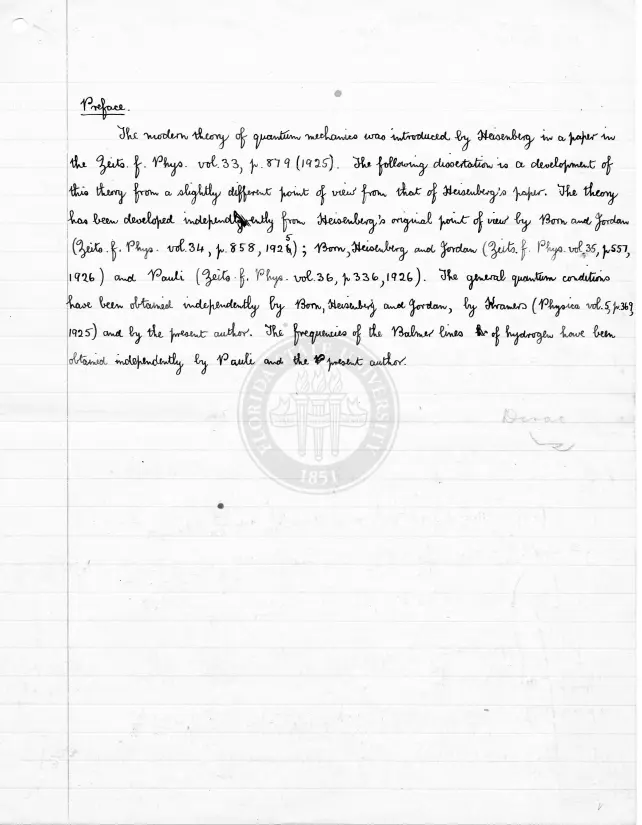
One detail is worth not glossing over. The seventy-two page bundle held at Florida State University and put online is not the bound final thesis, but a mixture of the draft pages and calculations that led to it. What we have is less a fair copy than a working desk. Equations slide down the page, some derivations break off and start again, and short notes are dropped into the margins.
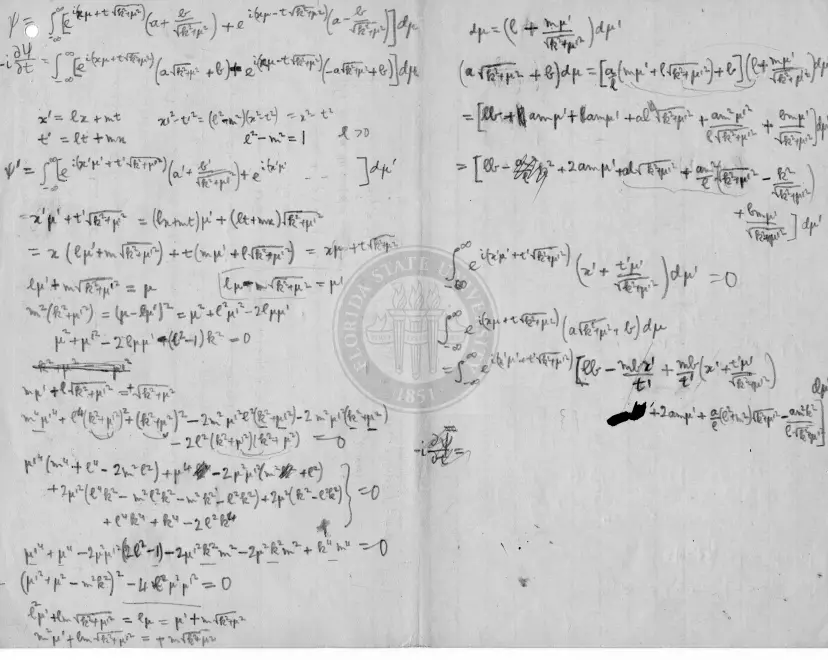
So looking at the scan you are not seeing quantum mechanics. You are seeing quantum mechanics being written. A doctoral thesis today is set in LaTeX and uploaded as a PDF, and the fact that the first thesis on quantum mechanics never even met a typewriter has always struck me as both strange and lovely. The same is true of Roger Penrose’s notebooks, where the drawing usually arrives before the argument does.
Today
Where to look
The whole scan sits open on the Internet Archive page by page, and you can download it as a PDF if you want it. One thing to keep in mind while you turn the pages. The young man behind this thesis sent the Royal Society another paper on quantum theory that same August, and the foundation of what we now call Fermi-Dirac statistics is sitting inside it.
Two years after the thesis he would write down the equation that carries his name and, more or less by accident, predict antimatter. The distance from a Sunday walk with no library open to that is about three years, and the whole of it fits in a bundle of unruled handwriting. Physics does not usually let you watch it happen this closely — which is exactly why the question of when Einstein first wrote E = mc² is still worth asking of the manuscripts rather than the textbooks.
Sources
- Scans from the Paul A. M. Dirac collection, Florida State University Libraries.
- P. A. M. Dirac, Quantum Mechanics, PhD dissertation, University of Cambridge, 1926.
- P. A. M. Dirac, “The Fundamental Equations of Quantum Mechanics”, Proc. R. Soc. A 109 (1925).
- Graham Farmelo, The Strangest Man: The Hidden Life of Paul Dirac.
- MacTutor History of Mathematics Archive, University of St Andrews. Further links are in the text.