I learned most of the big results in mathematics from textbooks, too, which means I learned them rewritten dozens of times, with the notation cleaned up and the edges sanded down. Open the original papers and the first thing that catches your eye is how short they are, because the paper where Nash introduced his equilibrium is two pages, the one where Riemann squeezed in the hypothesis nobody has proved yet is nine, and Cook’s paper that started the whole P versus NP business is eight.
This list has 22 original papers you can read online, legally and for free. Under each one I wrote which journal it appeared in, what language it was written in and how many pages it runs, and for the German ones I linked an English translation wherever I could find one. If you want the rewritten versions too, I keep a list of free math textbooks, and the long road that leads to these papers is in the history of mathematics, written in the margins.
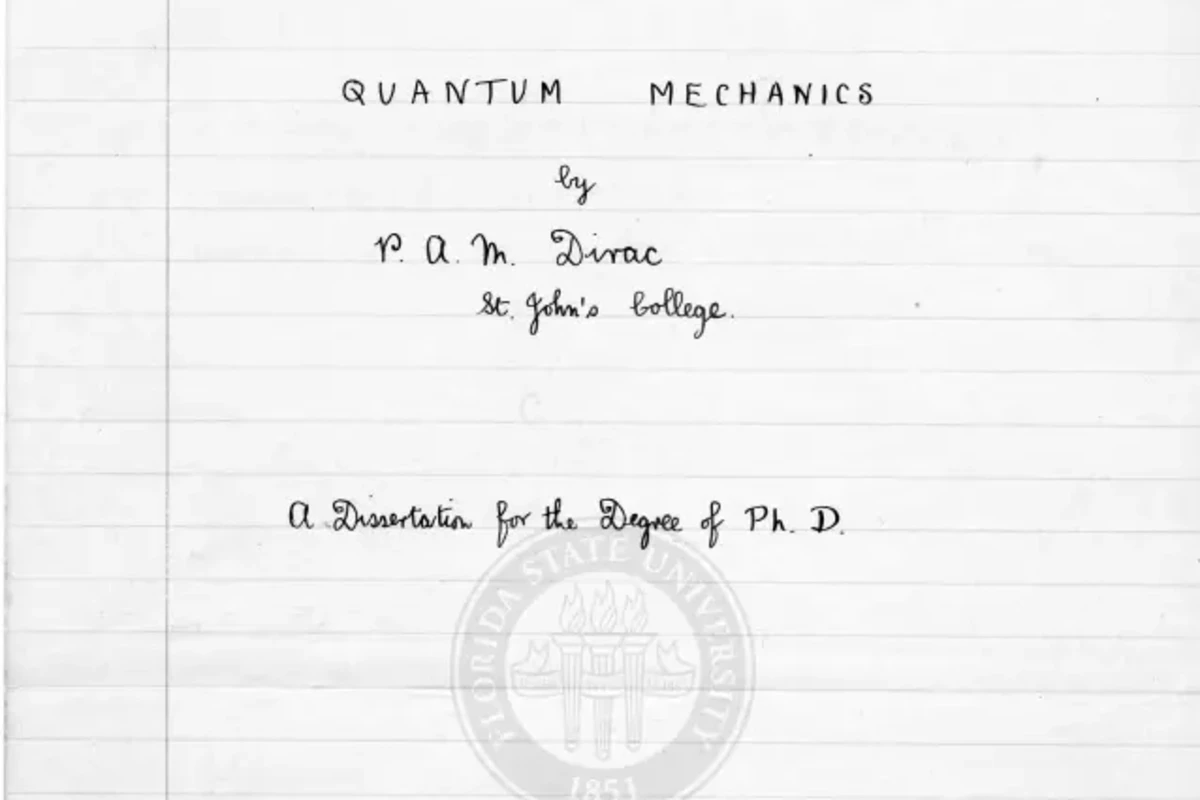
Rather than trying to read an original paper from start to finish, I suggest reading the introduction and the last page first. Then look at how the author named an idea that everyone uses today for the very first time, because the hesitation in that first version is something no textbook will ever show you, the same way Dirac’s handwritten thesis shows what the printed page hides.
2
pages: Nash's equilibrium, the shortest paper here
79
pages: Shannon's theory of communication, the longest
167
years Riemann's hypothesis has been waiting for a proof
Shelf 01 · 4 papers
Chasing the primes
From Euler's π²/6 to the gaps between primes.
- 1740 · Euler, the Basel problem
- 1859 · Riemann, the primes
- 2004 · Green and Tao, prime progressions
- 2013 · Maynard, prime gaps
1740
De summis serierum reciprocarum
Leonhard Euler
- Commentarii academiae scientiarum Petropolitanae
- Latin
- 12 pages
The sum 1 + 1/4 + 1/9 + 1/16 + … had been keeping the best mathematicians in Europe busy since 1650 when the 28-year-old Euler showed it equals π²/6. By today’s standards his method doesn’t count as a full proof, because he factors the sine function by its roots as if it were a polynomial of infinite degree and never explains why that works, but that nerve is exactly what makes the paper worth reading.
The scanned Latin original sits in the archive, and even without Latin you can follow the formulas.
1859
Ueber die Anzahl der Primzahlen unter einer gegebenen Grösse
Bernhard Riemann
- Monatsberichte der Berliner Akademie
- German
- 9 pages
When Riemann is elected a corresponding member of the Berlin Academy he sends this short paper as a thank-you, and it turns out to be the only paper he ever wrote on number theory. He says he finds it very likely that all the nontrivial zeros of the zeta function have real part 1/2, adds that after a few attempts he put the search for a proof aside, and moves on. That sentence has been open for 167 years, and Riemann checks the first few zeros by computing them by hand. I wrote about what the Riemann hypothesis actually says in a separate piece.
The manuscript kept in Göttingen, its German transcription and the English translation are gathered together on a single page, or you can open the English translation directly.
2004
The primes contain arbitrarily long arithmetic progressions
Ben Green, Terence Tao
- arXiv
- English
- later in Annals of Mathematics (2008)
This is the paper showing that evenly spaced runs of primes like 3, 5, 7 or 5, 11, 17, 23, 29 exist as long as you want them. Green and Tao don’t study the primes directly to get there, they place them inside a better-behaved set that contains the primes densely enough and apply a version of Szemerédi’s theorem to that set.
That intermediate set is the real trick of the proof, and the whole paper is free on arXiv.
2013
Small gaps between primes
James Maynard
- arXiv
- English
- later in Annals of Mathematics (2015)
In the spring of 2013 Yitang Zhang proves there are infinitely many pairs of primes no more than 70 million apart, and a wall that hadn’t moved in a hundred years comes down. In November of the same year Maynard, a postdoc at the time, brings that bound down to 600 with a much shorter and simpler method. For the twin prime conjecture that number has to come down to 2 and the road is still long, but this is one of the cleanest texts you can read to see how questions like this are attacked.
Maynard receives the Fields Medal in 2022, and his paper is open on arXiv.
Shelf 02 · 5 papers
The limits of proof
What a proof can and cannot reach.
- 1900 · Hilbert, 23 problems
- 1931 · Gödel, incompleteness
- 1936 · Turing, computable numbers
- 1963 · Cohen, the continuum hypothesis
- 1971 · Cook, P versus NP
1900
Mathematical Problems
David Hilbert
- Bulletin of the American Mathematical Society (1902)
- English translation from German
- 43 pages
In 1900, at the International Congress of Mathematicians in Paris, Hilbert lists the problems the new century will have to deal with. In the talk itself he covers only 10 of the 23, and the full set appears in the printed text. First on the list is the continuum hypothesis, eighth is the Riemann hypothesis, tenth is the search for a general method that decides whether an equation has integer solutions, and many of the papers on this page are in fact answers given to that talk later on.
Mary Winston Newson’s English translation from 1902 is free.
1931
Über formal unentscheidbare Sätze der Principia Mathematica und verwandter Systeme I
Kurt Gödel
- Monatshefte für Mathematik und Physik
- German
- 26 pages
While Hilbert believes all of mathematics can rest on a consistent and complete set of axioms, the 25-year-old Gödel shows that every consistent system containing arithmetic has statements that can be neither proved nor disproved inside it. To do this he turns formulas and proofs into numbers, then builds, in the language of arithmetic itself, a statement that says it cannot be proved.
The original is heavy going and the notation is very different from today’s. If you want to start somewhere I suggest Martin Hirzel’s translation with updated notation, knowing that it skips the footnotes and doesn’t cover the whole paper.
1936
On Computable Numbers, with an Application to the Entscheidungsproblem
Alan Turing
- Proceedings of the London Mathematical Society
- English
- 36 pages
Turing writes this paper to answer Hilbert’s decision problem, the question of whether there is a mechanical method that decides if any mathematical statement is true or false. The answer is no, but on the way there he describes the abstract machine we now call a Turing machine and the universal machine that can imitate every other machine. Every computer, your phone included, is an instance of that universal machine.
The paper has a few mistakes, too, and Turing publishes a short correction the following year. The full text is available as a PDF.
1963
The Independence of the Continuum Hypothesis
Paul J. Cohen
- Proceedings of the National Academy of Sciences
- English
- 6 pages
The first problem on Hilbert’s list asks whether there is an infinity bigger than the natural numbers but smaller than the real numbers. In 1938 Gödel shows the continuum hypothesis can’t be disproved from the standard axioms, in 1963 Cohen shows with this paper that it can’t be proved either, and the question becomes unanswerable with those axioms. The method he builds for it, forcing, turns into the most powerful tool in set theory, and Cohen receives the Fields Medal in 1966.
1971
The Complexity of Theorem-Proving Procedures
Stephen A. Cook
- Proceedings of the Third Annual ACM Symposium on Theory of Computing
- English
- 8 pages
The question of whether every problem whose solution is easy to check is also easy to solve, the P versus NP problem, takes its first shape in these eight pages. Cook shows that a single problem about logical formulas is as hard as every problem in that class, so anyone who solves that one problem fast has solved them all fast. Leonid Levin reaches the same result independently in the Soviet Union.
It is still one of the six unsolved Millennium Problems, and a scan of Cook’s paper survives in its two-column typesetting.
Shelf 03 · 5 papers
Circuits, information and codes
Switches, bits, thinking machines and secret keys.
- 1937 · Shannon, relay circuits
- 1948 · Shannon, communication theory
- 1950 · Turing, thinking machines
- 1976 · Diffie and Hellman, key exchange
- 1978 · Rivest, Shamir and Adleman
1937
A Symbolic Analysis of Relay and Switching Circuits
Claude E. Shannon
- MIT master's thesis
- English
- 69 pages
At 21, Shannon shows that the relay circuits in telephone exchanges can be written in Boolean algebra and simplified that way. Thinking of open and closed switches as 0 and 1 feels completely natural today, but before this thesis digital circuit design was done largely by trial and error.
The scanned thesis can be downloaded with its typewritten pages and hand-drawn circuit diagrams.
1948
A Mathematical Theory of Communication
Claude E. Shannon
- Bell System Technical Journal
- English
- two parts, 79 pages
How much information a message carries, how fast you can send data without errors over a noisy line, and how far a file can be compressed at most, the answers are all in this paper. The word bit also appears in print here for the first time, and Shannon notes that he owes it to John Tukey.
It is the longest paper on the list but one of the most readable, especially the first part, where he approaches English step by step with random strings of letters and asks for almost no background. The typeset full text is a single PDF.
1950
Computing Machinery and Intelligence
Alan Turing
- Mind
- English
- 28 pages
It opens with the question of whether machines can think, and instead of wrestling with definitions Turing turns the question into a game. An interrogator talks to a human and a machine through written messages, and if he can’t tell which one is the human, the machine is taken to have passed. Turing predicts that by the year 2000 an average interrogator will have no more than a 70 percent chance of guessing right after five minutes of conversation.
For me the most enjoyable part is the section where he lists the objections one could raise against a thinking machine and answers them one by one, and there is even one devoted to telepathy. A scan of the first printing in Mind is free.
Alice
sends 5a mod 23 = 8
key = 19a mod 23
Bob
sends 5b mod 23 = 19
key = 8b mod 23
On the open line anyone sees p = 23, g = 5, 8 and 19, never the key.
1976
New Directions in Cryptography
Whitfield Diffie, Martin E. Hellman
- IEEE Transactions on Information Theory
- English
- 11 pages
For thousands of years, two people who wanted to talk in code first had to share a key in secret. Diffie and Hellman show that two parties who have never met can produce a shared secret key over a line anyone can listen to, and the method rests on modular exponentiation being easy while undoing it is hard.
Behind the lock in your browser’s address bar, descendants of this idea are still at work today, and the PDF of the paper is free.
1978
A Method for Obtaining Digital Signatures and Public-Key Cryptosystems
Ronald L. Rivest, Adi Shamir, Leonard Adleman
- Communications of the ACM
- English
- 7 pages
Diffie and Hellman say a public-key encryption system is possible but don’t give a working encryption method. Rivest, Shamir and Adleman find the first working system, built on how hard it is to factor large numbers. Alice and Bob also make their first appearance in this paper, and cryptography has been explained through those two ever since.
Shelf 04 · 4 papers
Bridges, chance and games
Seven bridges, a posthumous essay, two pages and a giant cluster.
- 1741 · Euler, the bridges of Königsberg
- 1763 · Bayes and Price
- 1950 · Nash, equilibrium
- 1960 · Erdős and Rényi, random graphs
1741
Solutio problematis ad geometriam situs pertinentis
Leonhard Euler
- Commentarii academiae scientiarum Petropolitanae
- Latin
- 13 pages
The question of whether there is a walk that crosses each of Königsberg’s seven bridges exactly once reaches Euler in a letter. Euler finds the question trivial in itself but finds it interesting that the answer has nothing to do with lengths and everything to do with what connects to what, and he solves it by giving the land masses capital letters and the bridges lowercase ones.
There isn’t a single graph drawn in this paper, which counts as the beginning of graph theory, and what Euler draws is the city itself. The Latin original is scanned in the archive.
1763
An Essay towards solving a Problem in the Doctrine of Chances
Thomas Bayes, Richard Price
- Philosophical Transactions of the Royal Society
- English
- 49 pages
Thomas Bayes never publishes this paper. After his death in 1761 his friend Richard Price finds it among his papers, edits it and presents it to the Royal Society two years later. The question of what you can say about the probability of an event after seeing how many times it happened in so many trials is the first form of Bayes’ theorem, which is used everywhere today from spam filters to medical tests.
The long introduction Price wrote at the front is worth reading too, and the 1763 printing is free and open.
1950
Equilibrium Points in n-Person Games
John F. Nash Jr.
- Proceedings of the National Academy of Sciences
- English
- 2 pages
The shortest paper on the list. At 21, Nash shows in two pages that every finite game has an equilibrium in which no player can gain by changing his own strategy while the others keep theirs fixed. The proof rests on Kakutani’s fixed point theorem and is nearly a single paragraph.
This is the idea that brought him the Nobel in economics in 1994, and the story around it is the backbone of A Beautiful Mind. Both of the two pages are free.
1960
On the Evolution of Random Graphs
Paul Erdős, Alfréd Rényi
- Publications of the Mathematical Institute of the Hungarian Academy of Sciences
- English
- 45 pages
Picture n points and start adding random lines between them. Erdős and Rényi show that the moment the number of lines passes n/2, a giant component covering a fixed fraction of the points suddenly appears inside what until then was a scattered structure of little trees. This is the graph version of what physicists call a phase transition, and a large part of network science, from social networks to epidemic models, comes out of it.
A scan of the paper sits in the archive that collects Erdős’s publications.
Shelf 05 · 4 papers
Field, symmetry and shape
Light, symmetry, oranges and the shape of space.
- 1865 · Maxwell, the electromagnetic field
- 1918 · Noether, symmetry and conservation
- 1998 · Hales, the Kepler conjecture
- 2002 · Perelman, Ricci flow
1865
A Dynamical Theory of the Electromagnetic Field
James Clerk Maxwell
- Philosophical Transactions of the Royal Society
- English
- 54 pages
Maxwell ties electricity and magnetism into a single system of equations, then computes the speed of the waves that come out of those equations, and when he sees the result is almost exactly the measured speed of light he concludes that light is an electromagnetic wave too.
The Maxwell equations we write in four lines today, one of the 17 equations that changed the world, stand here as 20 separate equations, because vector notation doesn’t exist yet and Heaviside is still 20 years away from putting them in their present form. The 1865 printing is free to read.
1918
Invariante Variationsprobleme
Emmy Noether
- Nachrichten von der Gesellschaft der Wissenschaften zu Göttingen
- German
- 23 pages
Every continuous symmetry of a physical system has a conserved quantity that goes with it. Symmetry under shifts in time gives conservation of energy, symmetry under shifts in space gives conservation of momentum, symmetry under rotation gives conservation of angular momentum. Noether finds this in Göttingen while working on the energy problem in general relativity, and since she isn’t a member of the society, Felix Klein presents the paper for her.
1998
An Overview of the Kepler Conjecture
Thomas C. Hales
- arXiv
- English
- first in a series of six papers
In 1611 Kepler guesses that stacking spheres the way oranges are stacked at the grocer’s is the tightest way to pack them in three dimensions. Hales proves it 387 years later, but because the proof involves hundreds of pages of text and gigabytes of computer calculation, the referees can only say they are 99 percent sure even after years of checking. Hales then starts the Flyspeck project to translate the proof into a formal language a computer can check line by line, and finishes it in 2014.
The overview paper of the series gives the plan of the proof in its clearest form.
2002
The entropy formula for the Ricci flow and its geometric applications
Grigori Perelman
- arXiv
- English
- first in a series of three papers
Perelman never sends his proof of the Poincaré conjecture to a journal. In 2002 and 2003 he uploads three papers to arXiv, lets a few colleagues know, leaves the rest to the mathematical world, and experts spend several years checking the proof line by line and confirming it. Perelman turns down the Fields Medal in 2006 and the Clay Institute’s million-dollar prize in 2010.
It is the hardest read on the list and the only paper here that went into history without ever being published in a journal. The first paper of the series is on arXiv.
The whole shelf
22 papers, one click each
- 1740Euler, the Basel problem12 pages
- 1741Euler, the bridges of Königsberg13 pages
- 1763Bayes and Price49 pages
- 1859Riemann, the primes9 pages
- 1865Maxwell, the electromagnetic field54 pages
- 1900Hilbert, 23 problems43 pages
- 1918Noether, symmetry and conservation23 pages
- 1931Gödel, incompleteness26 pages
- 1936Turing, computable numbers36 pages
- 1937Shannon, relay circuits69 pages
- 1948Shannon, communication theory79 pages
- 1950Turing, thinking machines28 pages
- 1950Nash, equilibrium2 pages
- 1960Erdős and Rényi, random graphs45 pages
- 1963Cohen, the continuum hypothesis6 pages
- 1971Cook, P versus NP8 pages
- 1976Diffie and Hellman, key exchange11 pages
- 1978Rivest, Shamir and Adleman7 pages
- 1998Hales, the Kepler conjecturearXiv
- 2002Perelman, Ricci flowarXiv
- 2004Green and Tao, prime progressionsarXiv
- 2013Maynard, prime gapsarXiv