
Feature · A long read in eleven chapters
From a student’s clay tablet to the prize Perelman turned down, and on to the machines that now write proofs: four thousand years of mathematics, copied from hand to hand.
In the Babylonian collection at Yale there is a round clay tablet, about 8 centimeters across, catalogued as YBC 7289. On it is a slightly lopsided square, the square’s two diagonals, and three numbers in cuneiform. Beside the edge it says 30, on the diagonal there is a sexagesimal number that reads 1, 24, 51, 10, and below that 42, 25, 35. The middle number is the square root of two correct to five decimal places and the bottom one is that root multiplied by 30, in other words the length of the diagonal of a square whose side is 30. The tablet dates from somewhere between 1800 and 1600 BCE, and because of its round shape and its clumsy handwriting it is read as a student’s exercise.
There are many ways to tell the history of mathematics and in this piece I want to look at the margins as well as the big names, because a surprising amount of this history sits in homework tablets, in papyri passed from copyist to copyist, in parchment scraped clean and covered with prayers, in proofs that would not fit in the margin of a book, and in letters written the night before a duel. The piece is long, because I want to tell every period in detail, and it moves in chronological order. The small marks that open each section show its place in the sequence the way the Babylonians wrote numbers, in cuneiform, and each chapter writes in its own ink. If you want the whole road before walking it, it is right below, chapter by chapter and then on a single line.
Contents
Every chapter writes in its own colour, and every figure inside it picks up the same ink.
Chronology · 58 moments
Four thousand years on one line
The word mathematics comes from the Greek máthēma, which means what is learned, the knowledge one has to learn. The first to use it in something close to today’s sense are the Pythagoreans in the 6th century BCE, and it settles into written texts with Plato in the 4th century. Before that the word doing the same job is geometry, measuring the earth, and that word carries inside it one of the oldest answers to the question of where mathematics comes from, and what it is for.
Antiquity gives two different answers to that question. According to Herodotus geometry begins in Egypt, with the Nile flooding every year and wiping out the boundaries of the fields. In Egypt the land fit for farming is a narrow strip on either side of the Nile plus the delta, so that land is precious, and tax is levied according to the size of the field. As Herodotus tells it, when the river takes a piece of someone’s field the king’s officials come and measure the land again and the tax is reduced in proportion to what was lost. Aristotle, on the other hand, writes in the Metaphysics that mathematics was born in Egypt because the priestly class had leisure, since they are the only class whose living is provided by the people and the state and who have time to sit and think. I don’t think the two answers exclude each other. A state that wants its land measured and a class with time to think about the rules of measuring live side by side in the same country, and whoever first worked out how to compute the area of a triangular or trapezoidal field was most likely standing where the two overlap.
Counting itself is much older than writing. On a baboon bone about 43,000 years old, found in the Lebombo Mountains on the border between South Africa and Eswatini, there are 29 notches, and the fact that this number is close to a lunar cycle invites us to read the bone as a calendar. The Ishango bone, found on the shore of Lake Edward in the Congo, is about 20,000 years old and its notches are arranged in groups in three columns. In one column groups of 11, 13, 17 and 19 notches sit side by side, which is every prime between 10 and 20. This reading is very tempting but nobody knows what went through the carver’s head, and since four of the five odd numbers between 11 and 19 are prime anyway, four small odd numbers turning out prime is not as rare a coincidence as it looks. What we can say for certain from these two bones is that the need to record what people counted starts tens of thousands of years before writing.
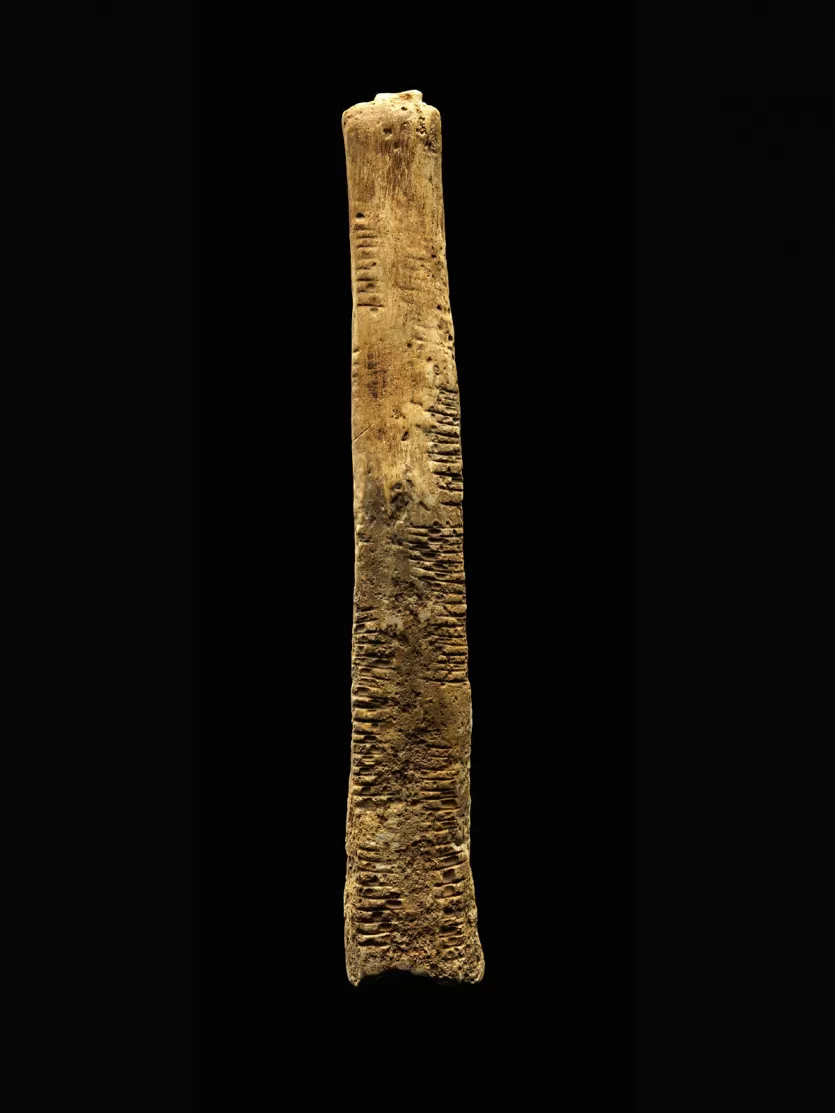
The Ishango bone · c. 20,000 BCE
If we look at written documents clear enough to need no interpretation, the traces of mathematics begin between 3000 and 2000 BCE in Mesopotamia and Egypt. The reason far more text survives from Mesopotamia than from Egypt is the material. Signs pressed into wet clay with a reed stylus last thousands of years once they dry in the sun or are baked in a kiln, and excavations turn up hundreds of thousands of tablets. A large collection of them sits today in the tablet archive of the Istanbul Archaeology Museums, about 75,000 cuneiform documents, and the rest are in the collections of Berlin, London, Paris, Yale, Columbia and Pennsylvania. Within this heap the tablets with mathematics on them number a few hundred, and in them is the arithmetic of a chain that runs from the Sumerians to the Akkadians, from the Babylonians to the Assyrians, passed from hand to hand.
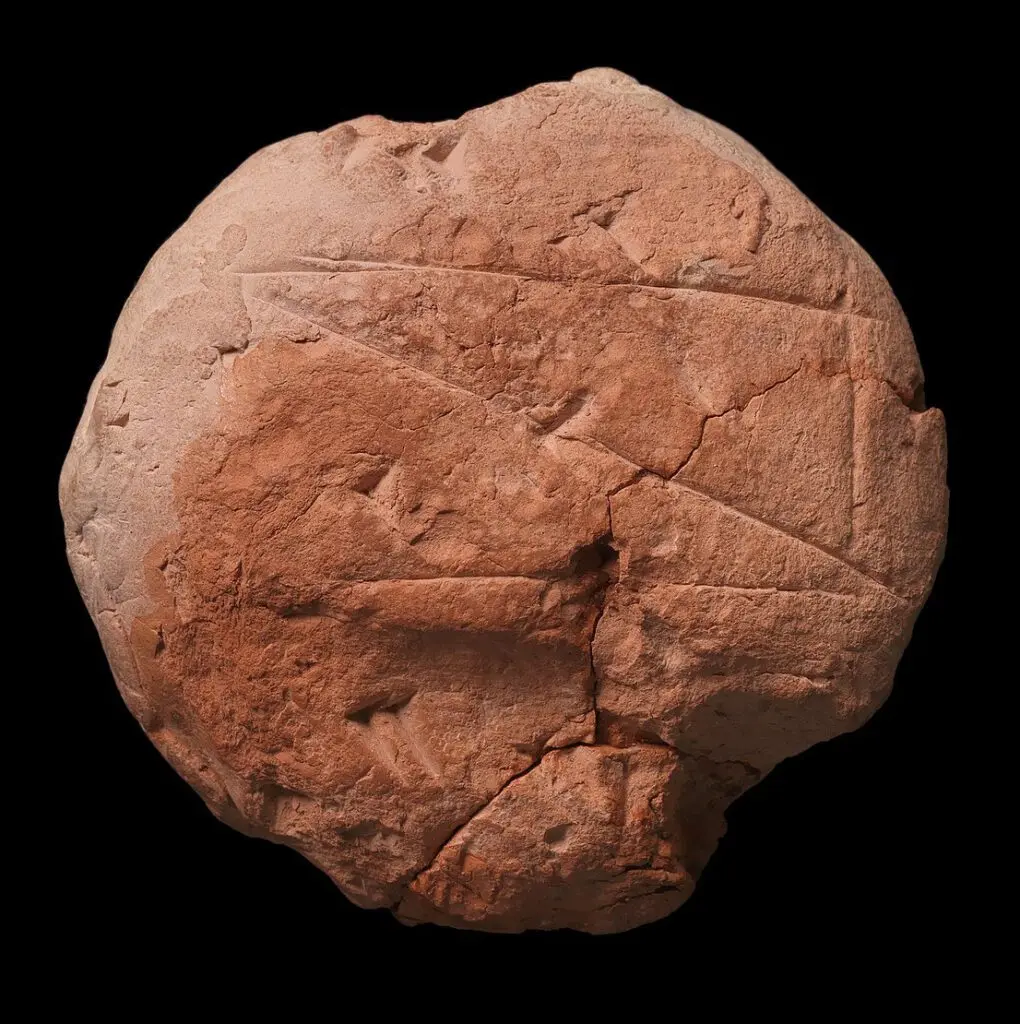
YBC 7289 · c. 1800–1600 BCE
The homework that outlived its empire
In Mesopotamia numbers are written in base sixty. 60 has 12 divisors, which is why fractions like 1/3, 1/4 and 1/5 become short, terminating numbers in sexagesimal, while in decimal 1/3 runs on forever. There is no definite answer to the question of why 60 and three explanations are put forward. The first is exactly this divisibility, the fractions of daily accounting coming out clean in base sixty. The second is that communities in the region that had used base 10 and base 12 met, and 60, the least common multiple of the two, was chosen to merge two systems of measure. The third is a finger count. The four fingers of one hand, thumb excluded, have 12 joints, and someone who counts those joints with the thumb and holds each dozen on a finger of the other hand can count to 12 times 5, which is 60. Until a tablet turns up that explains the choice, all three explanations will go on living.
Try it · why sixty
Cut an hour into equal parts
The 60 minutes of an hour, the 60 seconds of a minute and the 360 degrees of a circle are what this system leaves us today. The Babylonians also use positional notation, so the same sign means 1, 60 or 3,600 depending on its place, but for a long time they have no sign for an empty place and the reader works out the size of the number from context. The mathematics that comes out of the tablets is a step ahead of Egypt’s. The Babylonians solve quadratic equations and systems of two equations in two unknowns step by step like a recipe, but since they have no idea of negative numbers they only care about the positive root. They know the relationship between the sides of a right triangle, the theorem that will carry Pythagoras’s name, more than a thousand years before him. They usually take the circumference of a circle as 3 times the diameter, while a tablet found at Susa raises the ratio to 3 1/8.
We don’t know how the number on YBC 7289 was reached. One of the most commonly proposed guesses is the iterative calculation known today as the Babylonian method. You start with a guess, divide the number by your guess, and make the average of the two your new guess. Starting from 1, on the third step you reach the fraction 577/408, and the first four places of its sexagesimal expansion are exactly the number on the tablet. You can try the same calculation with other numbers in the box below.
Try it · the Babylonian method
Guess, divide, average, repeat
The Plimpton 322 tablet at Columbia University belongs to the same period and holds a table of 15 rows. The numbers in the rows correspond to right triangles with whole-number sides, the first row has 119 and 169, and together with the 120 between them they satisfy 119² + 120² = 169². The table is written at least 1,000 years before Pythagoras and why it was written is still argued over, some say it is a trigonometric table, others that it is a list teachers used to make up problems.
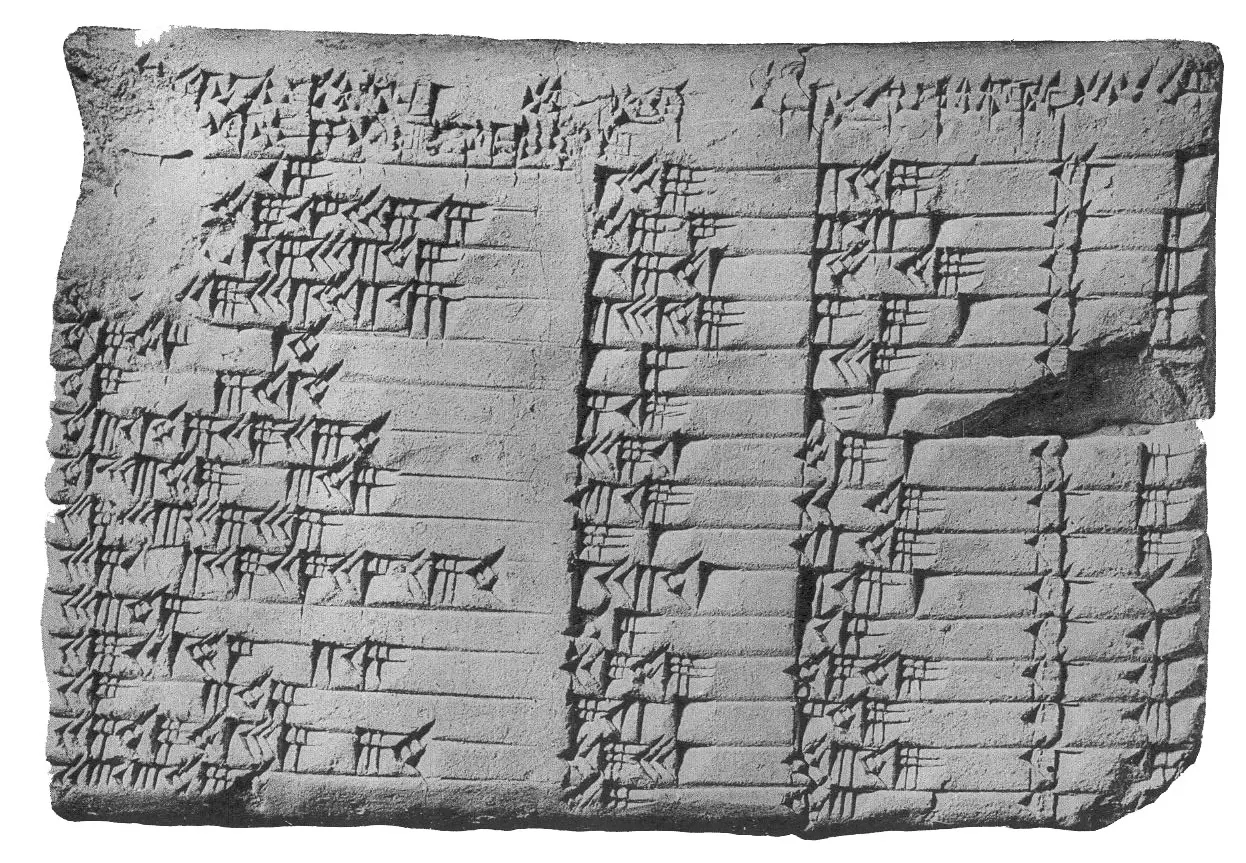
Plimpton 322 · c. 1800 BCE
A spreadsheet in clay
The reason so little mathematics survives from Egypt is also the material. Papyrus is made from the stem of a reed-like plant that grows in the Nile delta. The stem is split into thin strips, the strips are laid crosswise in two layers, beaten and dried, and the sheets that result are joined and rolled. The English paper and the French papier come from it. Unlike a clay tablet, papyrus slowly flakes apart in damp and heat, and only two important mathematical papyri reach us, preserved under exceptional conditions.
The larger of them is the Rhind papyrus. The Scottish antiquarian Alexander Henry Rhind buys it in Luxor in 1858 and it passes to the British Museum in 1865. It is about 5 meters long and 33 centimeters wide. The scribe Ahmose copies the text around 1550 BCE and notes in the opening lines that he took it from an original more than two hundred years older. It is written in hieratic, the handwritten adaptation of hieroglyphs, and it is plainly made for teaching, first come exercises that teach working with fractions, then 84 problems with their solutions. The problems ask how to divide bread and beer among workers, the volume of grain stores, the area of triangular and trapezoidal fields, the slope of pyramids. Roughly the level of middle school mathematics today.
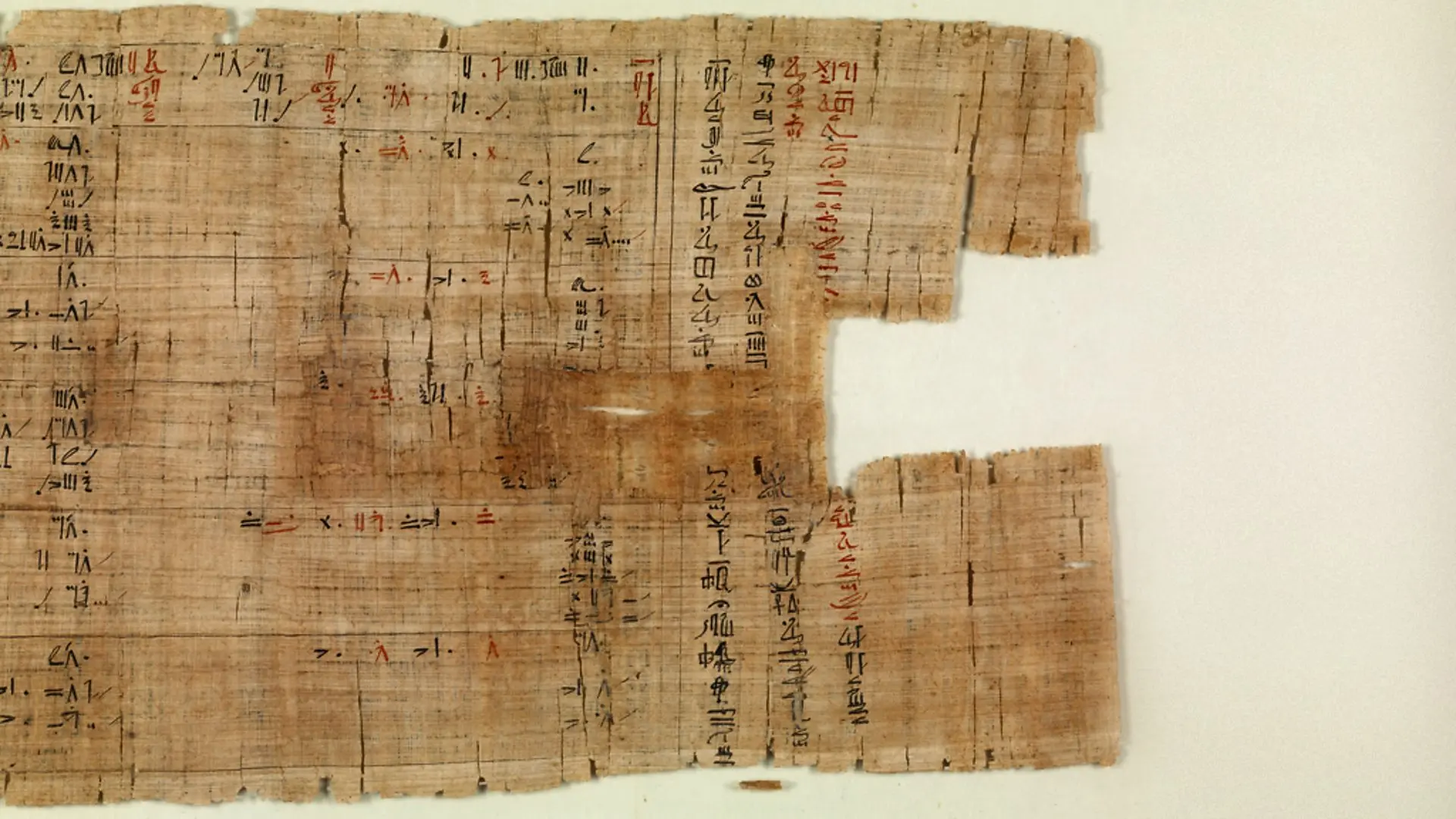
Rhind papyrus · c. 1550 BCE
Ahmose’s copybook
The Egyptians write every fraction except 2/3 as a sum of fractions with numerator 1, and 3/4 for them is 1/2 + 1/4. The long table at the start of the papyrus puts 2/n into this form for every odd n from 3 to 101, and why the scribe chose each decomposition is still debated. There are infinitely many ways to split the same fraction into unit fractions and the preferences that come out of the table are clear, keep the denominators from getting big, keep the number of terms low, make the denominators even where possible. In the box below you can compare the papyrus’s decomposition with the greedy method, which at every step takes the largest unit fraction that fits. The greedy method always finishes 2/n in two terms but the denominator of the second term grows fast, while Ahmose’s table uses up to four terms when it has to and keeps the denominators small.
Try it · the 2/n table
Ahmose against the greedy method
Rhind’s problem 50 takes the area of a circular field 9 units across to be equal to the area of a square with side 8. That means 256/81 for π, about 3.1605, a little more than half a percent off the true value. The Egyptian number system is base ten but not positional. There are separate signs for 1, 10, 100 and 1,000, a number is written by repeating these signs side by side, and for a million the sign is a man kneeling with his arms raised. Calculating in this notation is not easy, as anyone who has tried multiplying in Roman numerals knows, and the Egyptians multiply by doubling the number over and over and adding up the right multiples. Some historians see this clumsy notation as one reason Egyptian mathematics stays at the same level for two thousand years.
The Moscow papyrus is older, from around 1850 BCE, and the Russian Egyptologist Vladimir Golenishchev buys it in the early 1890s. Now in the Pushkin Museum in Moscow, it has 25 problems and all but two resemble the problems in Rhind. One of the two that stand apart, problem 10, asks for the area of a curved surface, and whether that surface is a hemisphere or a basket shaped like half a cylinder is still argued about. The other, problem 14, finds the volume of a truncated square pyramid with a base of 4, a top of 2 and a height of 6 to be 56, and to get there it uses exactly the formula we use today, a third of the height times a² + ab + b². These two problems are considered the summit of Egyptian mathematics.
In Egyptian and Mesopotamian mathematics there are no theorems, formulas or proofs. Knowledge is passed on in words, a rule is given through an example, and the student follows the steps of a recipe that goes “take this, multiply by that, subtract this.” In a mathematics told in words a general proof is not impossible but it is very hard. Mathematics is done for the calendar, for accounts, for building and for dividing inheritances, and an accurate calendar for fixing religious days, sowing time and sea voyages is its most important customer. When the Persians take Babylon in 539 BCE and Egypt in 525 BCE, the independent history of both traditions closes.
By the 550s BCE the Persians rule most of the eastern Mediterranean from Anatolia to Mesopotamia. Between 492 and 479 they send three expeditions against Greece, take and burn Athens in 480, and a year later, in 479, are beaten at Plataea and withdraw from the peninsula. Athens’s brilliant age starts after this victory, but Greek mathematics is born before it, in the Ionian cities on the Anatolian coast, and at its birth it has the arithmetic it took from Egypt and Mesopotamia.
One of the two men tradition calls the father of Greek mathematics, Thales of Miletus, is born around 624 BCE in Miletus, near today’s Söke. He goes to Egypt, stays there a while, and as the story goes finds the height of the Great Pyramid by multiplying the pyramid’s shadow by the ratio of his own height to his own shadow. That ratios of sides are preserved in similar triangles is taught in Turkish schools today as Thales’s theorem. Back in Miletus he gathers a group around him and, according to tradition, gets them to accept that a diameter cuts a circle into two equal parts and that the base angles of an isosceles triangle are equal not by measuring but by giving reasons. The idea of an abstract proof resting on reasoning instead of experiment starts with Thales, who is also counted as history’s first philosopher, but not a single written line of his reaches us.
The other father, Pythagoras, is born around 569 BCE on the island of Samos. The story goes that he goes to Egypt on Thales’s advice, is taken prisoner when the Persians conquer Egypt in 525 BCE and carried off to Babylon, and is said to learn mathematics, music and religious lore in his years there. He returns to Samos and founds a school, then around 518 BCE settles in Croton in southern Italy and founds a half-scientific, half-religious community that looks a lot like a sect. The members who form its inner circle, called the mathematikoi, live together, own no personal property, eat no meat and are bound to each other by oath. For them everything can be reduced to numbers, the harmony between numbers is too perfect to be chance, and that harmony is the reflection of a divine order. At that point number means whole numbers like 1, 2, 3 that count things and fractions like 1/2, 3/4 that give a part’s ratio to a whole.
Their own theorem shakes that belief. By the Pythagorean theorem the diagonal of a square with side 1 is a number whose square is 2, and when it becomes clear that this number cannot be written as a ratio of two whole numbers, mathematics enters its first great crisis. Legend has it that Hippasus of Metapontum, who told outsiders about it, drowns at sea. The story comes from sources written centuries after him and is most likely untrue, but it is the Greeks who first show that the number the student on YBC 7289 settled for at five places never ends. The community’s end is violent too. A crowd stirred up by Cylon, one of the notables of Croton, raids the house where the school meets, most of the members are killed, and Pythagoras is said to escape and die a few years later. Pythagorean thought lives on for centuries in other cities under other names.
Of the hundreds of known proofs of the Pythagorean theorem my favourite is the one with four triangles. You place four identical triangles with legs a and b and hypotenuse c inside a square of side c so that a small square hole of side b − a is left in the middle. The big square’s area is c², the four triangles together are 4 × ab/2 = 2ab, the small square in the middle is (b − a)² = b² − 2ab + a², and when you add them the 2ab terms cancel and a² + b² is left. One drawing and two lines of algebra.
Pythagoras in one drawing
Systematic mathematical education in Athens starts with Plato. After his teacher Socrates is put to death with hemlock in 399 BCE, Plato wanders for years in Egypt, Sicily and southern Italy and learns mathematics from the Pythagoreans there. When he returns to Athens in 387 BCE he opens his school at a place called the Academy, after Akademos, the legendary hero who gave the grounds their name. It is said that an inscription over the door asked those ignorant of geometry not to enter, but the sources that mention it are written centuries after Plato. Philosophy, geometry, the theory of harmony and gymnastics are taught at the Academy, geometry is considered the basic tool for learning to think correctly, and Plato acts like a research director, handing out problems to his students and asking them to solve them. The school stays open until 529 CE, more than 900 years.
The greatest mathematician the Academy produces is Eudoxus, born in Knidos at the tip of today’s Datça peninsula. Eudoxus builds a theory of proportion that treats a number as the ratio of two lengths, and this theory, which we find in Book V of the Elements, closes the Pythagorean crisis by making it possible to work consistently with magnitudes that cannot be written as fractions. We also owe Eudoxus the approach called the method of exhaustion. You fill a shape of unknown area or volume more and more tightly with shapes of known area and show that the difference can be made smaller than any given number, and the thinking behind the integral begins here. He is the first to prove that the volume of a cone is a third of the cylinder with the same base and height, and the one who builds the first mathematical model of the universe, made of spheres turning inside each other. Not one work of Eudoxus reaches us, and the first place we see his method documented is in the books of Archimedes.
From 334 BCE Alexander of Macedon takes the whole Persian Empire in the short span of eleven years and dies in Babylon in 323. After his death the bloody power struggle among his generals splits the empire, Egypt goes to Ptolemy, the Asian lands to Seleucus, Macedonia to the line of Antigonus, and the three regions where Greek culture will spread appear. For mathematics the most important is Alexandria. There the Ptolemies found the Mouseion, dedicated to the Muses, and the salaries of the scholars working in it are paid from the state treasury. The institution has a large library, a botanical garden and an observatory, scholars come from all over the Greek world to work there, and the word museum comes from it.
The first great mathematician to teach at the Mouseion is Euclid, and around 300 BCE he writes the Elements. Thirteen books, 465 propositions. In that period a book is the length of one papyrus roll, and each corresponds to a book of 20 to 50 pages by today’s measure. What Euclid does is collect the geometry known before him, but the real importance lies in how he presents it. Book I opens with 23 definitions of things like point, line and plane, five common notions that common sense will accept, such as if A = B and B = C then A = C, and five postulates. By the first postulate a line passes through two points, by the second a line segment can be extended as far as you like, by the third a circle can be drawn with a center and a distance, by the fourth all right angles are equal. The fifth is longer than the others. If a line crossing two lines makes the interior angles on one side add up to less than two right angles, those two lines, extended far enough, meet on that side. Euclid derives the rest from this foundation by logic, proposition by proposition, and the method of today’s mathematics and science takes shape with this book. As the story goes, King Ptolemy asks him for a shorter way to learn geometry and Euclid tells him there is no royal road to geometry.
There is no royal road to geometry.
Euclid to King Ptolemy, as the story goes
Not a single line from Euclid’s own hand reaches us. The oldest pieces are scraps of papyrus, like the one found at Oxyrhynchus in Egypt and written around 100 CE, and the oldest complete manuscript we have is a copy made in Byzantium in 888 and now in the Bodleian Library in Oxford, and the first printed Elements comes off Erhard Ratdolt’s press in Venice in 1482. The book is estimated to have gone through more than a thousand editions since, among them Henry Billingsley’s first English Euclid of 1570, whose paper solids fold up off the page, and Oliver Byrne’s 1847 edition, which turns the proofs into coloured figures. The fifth postulate does not look as self-evident as the other four, and for two thousand years mathematicians struggle to derive it from the rest. I will come to how that struggle ends further down. A large part of what we know about the geometry of this period comes from the commentary on Book I of the Elements written by Proclus, who lives in Athens in the 5th century CE, because Proclus quotes from books he had in hand and that are lost today.
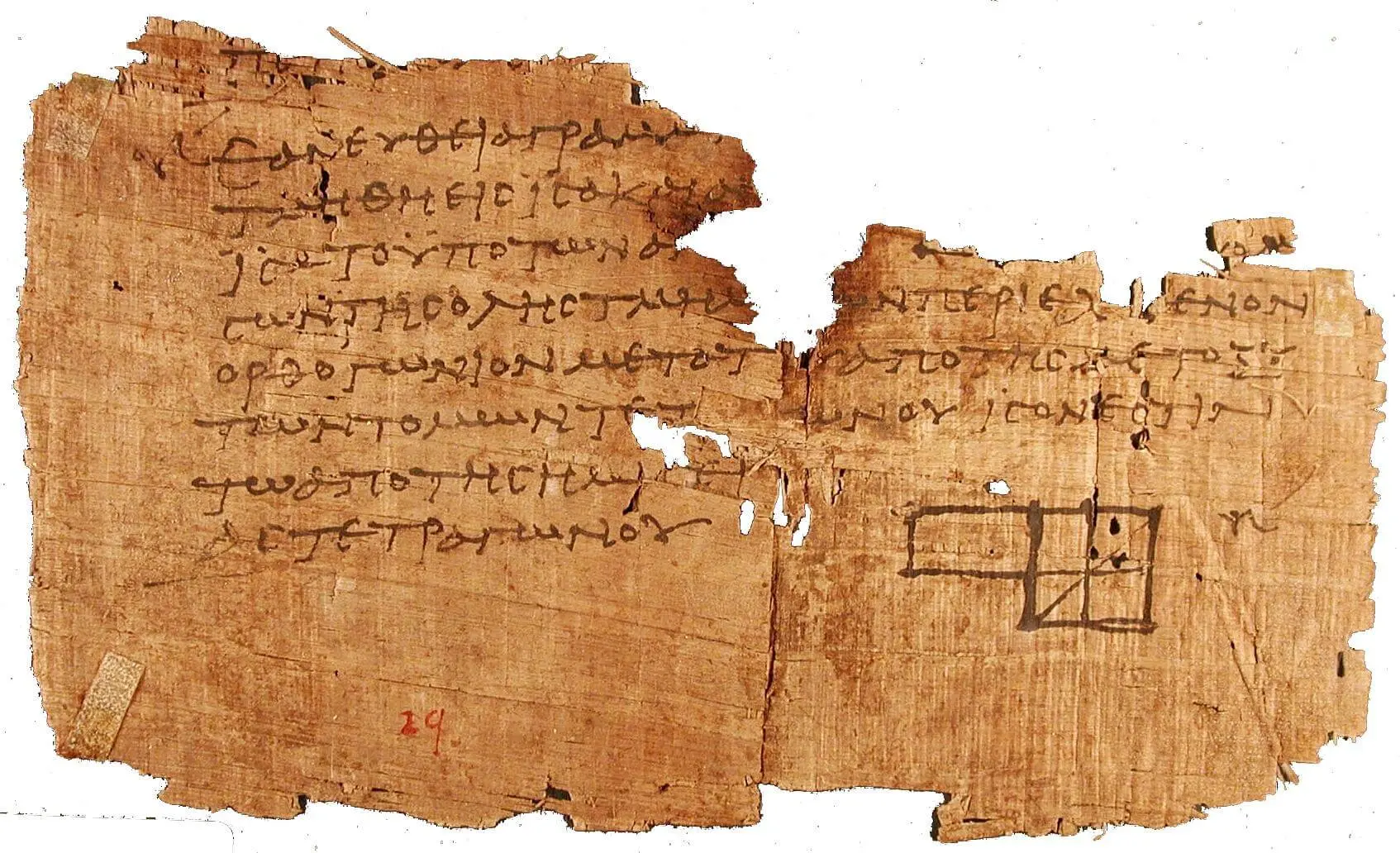
Oxyrhynchus, c. 100 CE
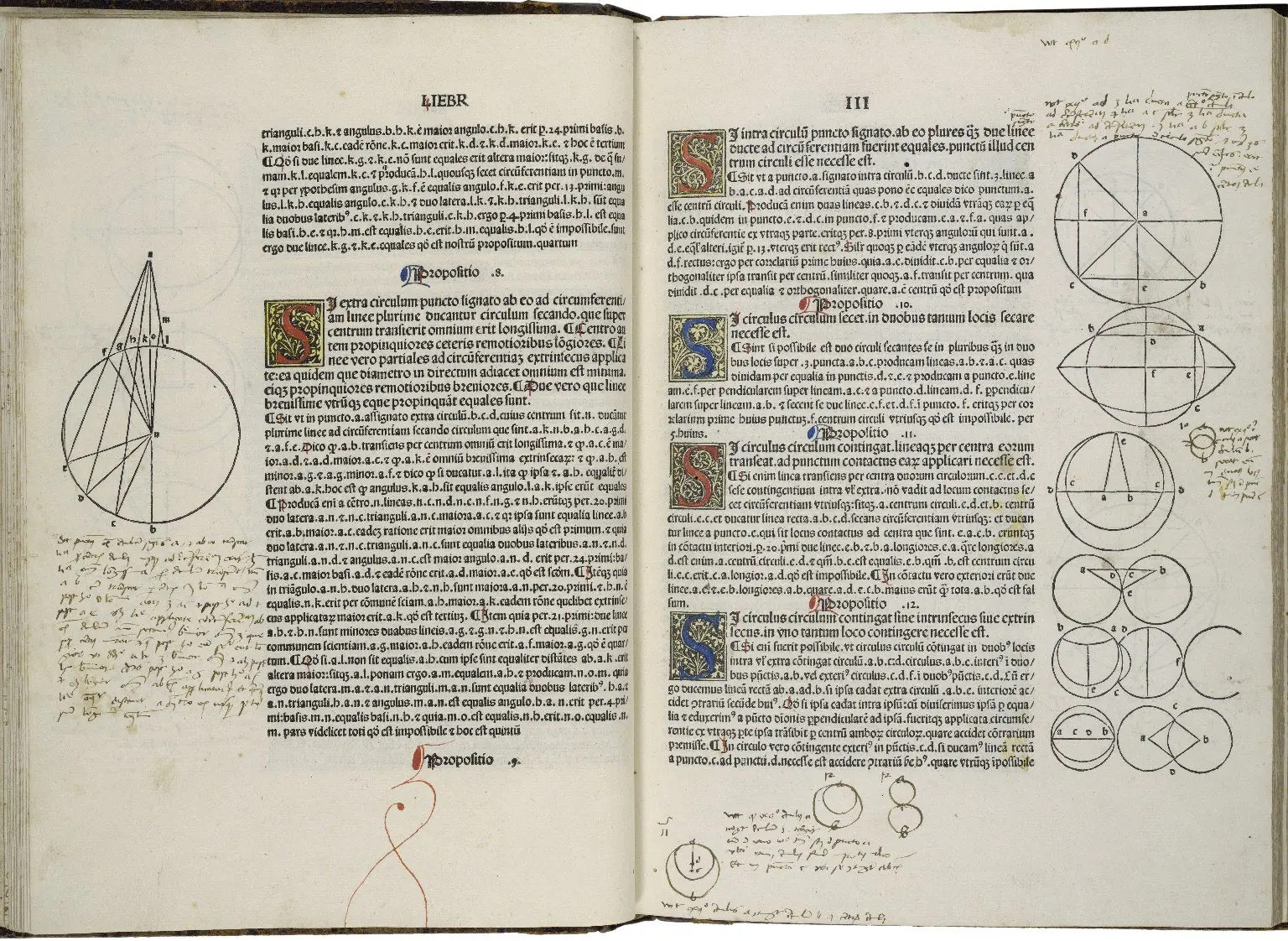
Venice, 1482
Euclid’s Elements · 1,400 years apart
From a scrap to a printed book
Another great name of the Mouseion’s circle is Apollonius, born in Perge near Antalya. In his eight-book Conics he studies the curves that come out of cutting a cone with a plane, and he is the one who gives those curves the names ellipse, parabola and hyperbola. The first four books survive in Greek, the fifth, sixth and seventh only in Arabic translation, and the eighth is lost. When the three great mathematicians of antiquity are counted, Apollonius’s name is written next to Euclid and Archimedes.
Archimedes is born in 287 BCE in Syracuse in Sicily and spends some time in Alexandria. With his machines and the principles he lays down for the lever and floating bodies he tries to do for mechanics and hydrostatics what Euclid did for geometry. Using Eudoxus’s method of exhaustion he computes the areas and volumes of many shapes, and for π he draws regular 96-gons inside and outside a circle and squeezes the value between 3 10/71 and 3 1/7, that is between 3.1408 and 3.1429. Until then the values known for π were found by measurement, and this is the first interval found by calculation and proof. He shows that the volume of a sphere is two thirds of the volume of the cylinder that encloses it and asks for that sphere and cylinder to be carved on his tombstone. In 212 BCE, when the Romans take Syracuse, he is killed by a Roman soldier.
Try it · Archimedes’s squeeze
Trap a circle between two polygons
The best part of Archimedes’s story, to me, starts after his death. In 10th-century Constantinople seven of Archimedes’s works are copied onto parchment. In 1229 a monk takes the pages apart, scrapes off the ink, folds the leaves in half and writes a prayer book over them. In 1906 the Danish philologist Johan Ludvig Heiberg, examining this prayer book in a library belonging to the Patriarchate of Jerusalem in Istanbul, realizes that the faded lines underneath are Archimedes. The book then disappears, is sold at auction in New York in 1998 for more than 2 million dollars, and its new owner entrusts it to the Walters Museum in Baltimore. In the text of the Method, read through years of multispectral imaging and X-ray scanning, Archimedes finds the volume of a solid by cutting it into thin slices and balancing the slices on an imaginary scale, in other words he is working with the idea behind the integral some 1,900 years before Newton and Leibniz. The same parchment holds a 14-piece puzzle known as the Stomachion, and in 2003 it is calculated that the pieces can form a square in 17,152 different ways.
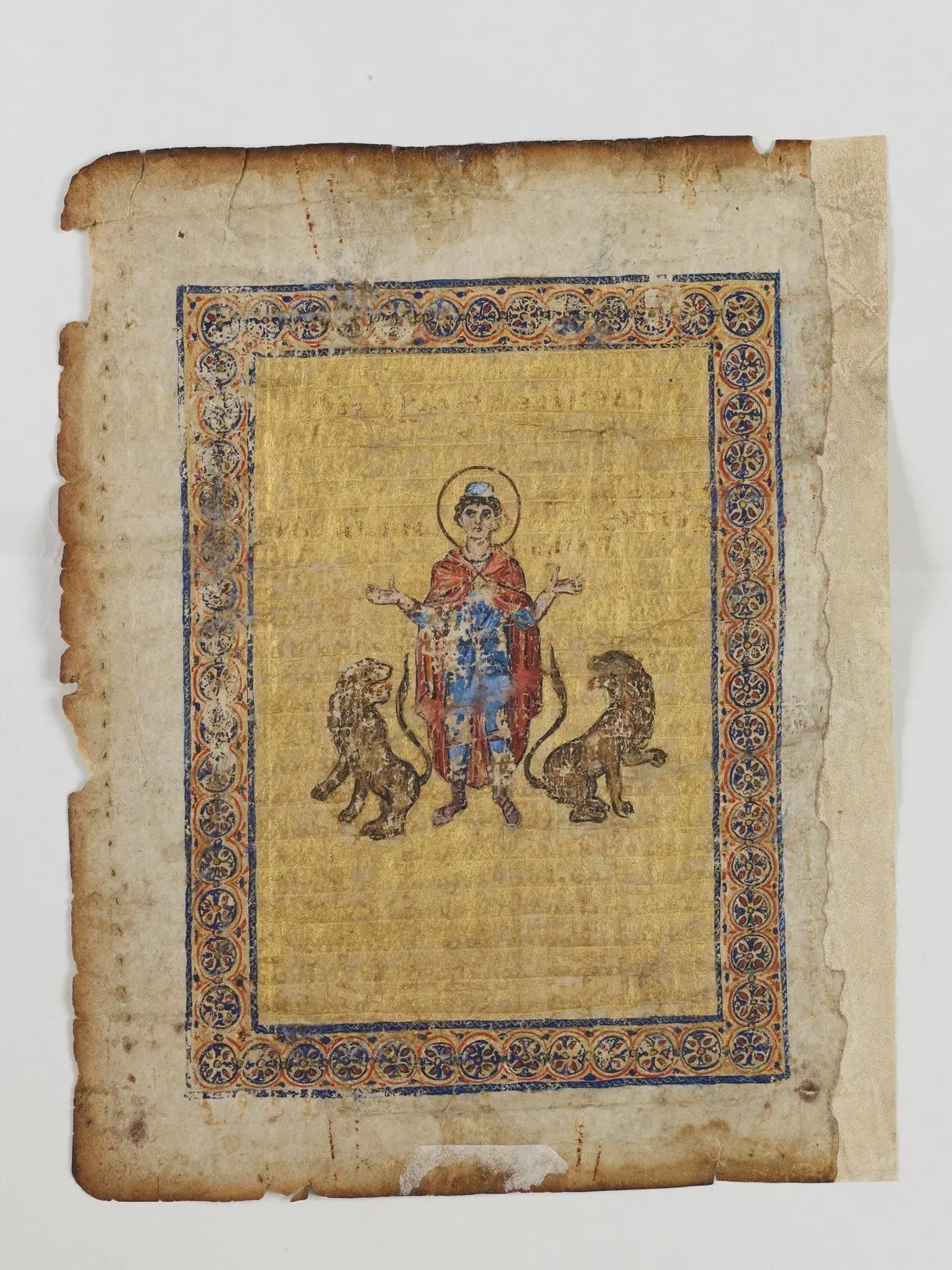
The Archimedes Palimpsest
Painted over, twice
The Method is in fact a letter Archimedes writes to a colleague in Alexandria, and that colleague is Eratosthenes of Cyrene. Eratosthenes uses the fact that at noon on the summer solstice the sun stands directly overhead at Syene (today’s Aswan), while at the same moment in Alexandria the shadow of an upright stick makes an angle of exactly one fiftieth of a circle, and from that he finds the circumference of the earth to be 250,000 stadia. Because the length of the stadion is disputed, the result reads as somewhere between 2 and 16 percent off today’s 40,075 kilometers, which for a measurement made with two cities, a stick and a shadow is not bad at either end.
Eratosthenes · the earth from a shadow
In the 2nd century CE in Alexandria, Claudius Ptolemy, also drawing on the observations of earlier astronomers like Hipparchus, builds a consistent model of the universe in which the earth stands at the center and the sun, the moon and the planets turn around it on circles. His thirteen-book work, whose Greek title is Mathematike Syntaxis, passes into Arabic as al-Majisti, the greatest book, and reaches Europe by that route under the name Almagest. It contains a catalogue of 1,022 stars and a table of chords that counts as the ancestor of trigonometry, and for fourteen centuries it stays the bedside book of everyone who deals with astronomy.
In the 3rd century CE, again in Alexandria, Diophantus works in his thirteen-book Arithmetica with equations whose whole-number or fractional solutions are sought, and by using abbreviations for the unknown and its powers takes one of algebra’s first steps from words toward symbols. Six of the thirteen books survive in Greek and four in an Arabic translation found in Iran in 1968. It is also the book in which Fermat writes his famous margin note. The Greeks write numbers with the letters of their alphabet, α means 1, β 2, ι 10. The system is more orderly than Roman numerals but not positional, and since Greek mathematics moves forward mostly through geometry, nobody feels much need for anything better.
The number of mathematicians from this period whose names and some of whose work reach us is more than a hundred. With Greek mathematics, mathematics stops being a craft, whether it is useful in daily life drops to second place, and depth and rigour move to the front. Greek mathematics is modern in today’s sense, they do mathematics the way we do it today, and although the idea of proof changes over time, most of Euclid’s proofs still hold.
Two things close the period, the rise of Rome and Christianity becoming the empire’s official religion. Rome expands from the 2nd century BCE and when it takes Egypt in 30 BCE all three Greek regions are under its rule. Though it dominates them administratively and militarily, Rome stays culturally under Greek influence, leaves the Academy, the school at Pergamon and the Mouseion alone, and the salaries of the Mouseion’s scholars go on being paid from the Roman treasury. In 313 Constantine lifts the ban on Christianity, moves the capital to Constantinople, and in 380 Christianity becomes the empire’s official religion. In 391, under Theophilus, bishop of Alexandria, the Serapeum temple and the library inside it are destroyed. One of the last great names of Greek mathematics in Alexandria, Hypatia, writes commentaries on Diophantus’s Arithmetica and Apollonius’s Conics and works with her father Theon on a corrected edition of Ptolemy’s astronomy. In 415 she is lynched by a mob.
In 529 the Byzantine emperor Justinian closes the Academy in Athens and seven philosophers from it take refuge at the court of the Persian king Khosrow. Some of the scholars of Alexandria and Athens take their books and move east, to Harran, to Urfa, to Gundeshapur, and go on teaching among Syriac communities close to the Greek language. A few centuries later a large share of the Greek texts in the hands of Baghdad’s translators arrives by this road.
In the same centuries a completely different mathematics is being done in China with bamboo and counting rods. The Jiuzhang Suanshu, the Nine Chapters, which takes its final form around the 1st century CE, holds 246 problems. The eighth chapter solves systems of linear equations by setting up a table with counting rods and subtracting rows from each other, and this is exactly the operation that in Europe, about two thousand years later, will be named Gaussian elimination. In the same chapter positive and negative numbers are told apart by red and black rods. In 263 Liu Hui writes a commentary on the book and, fitting a polygon of 3,072 sides inside a circle, reaches 3.1416 for π. In the 5th century Zu Chongzhi finds the fraction 355/113 for π. It is correct to six decimal places, and no better value for π is computed anywhere for about 900 years.
On the other side of the Atlantic the Maya keep their calendar with a base-twenty number system and mark an empty place with a shell sign. This zero appears with no contact whatsoever with the Old World. In late Babylon too a sign made of two slanted wedges is used for an empty place, but that sign never stands at the end of a number, and telling 1 from 60 is still left to the reader.
In 711 the Islamic state reaches past North Africa into Spain by way of Gibraltar in the west and into Central Asia in the east, and the Umayyad state ruled from Damascus, because it treats Arabs and non-Arabs differently, soon faces large revolts. The revolt that begins in Khorasan joins the Abbasid movement and in 750 brings down the Umayyad dynasty. Science enters the Islamic world with the Abbasids. The closeness to the court of the Mu’tazila, a school of thought that puts reason and argument first, prepares the intellectual ground for that entry, and in 762 the caliph al-Mansur founds Baghdad on the bank of the Tigris.
Under al-Mansur, Harun al-Rashid and al-Ma’mun, Greek, Syriac and Persian scientific texts are translated into Arabic at the House of Wisdom in Baghdad, and an institution that recalls the Mouseion in Alexandria takes shape. Most of the first translators come from regions close to the Greek language and culture, from Gundeshapur and from southeastern Anatolia, Syriac Christians and Sabians of Harran. Euclid’s Elements is translated into Arabic twice by al-Hajjaj ibn Yusuf ibn Matar, once under Harun al-Rashid and once under al-Ma’mun. Because of the variety of these translations, the mathematics of the Islamic world is less a straight continuation of the Greek tradition than a meeting of Greek geometry with the arithmetic and algebra that come from Mesopotamia.
The greatest of these translators is Thabit ibn Qurra, born in 826 in Harran, near today’s Şanlıurfa. Thabit corrects al-Hajjaj’s translation of the Elements and revises the translation of books five, six and seven of Apollonius’s Conics, and he has a large share in the fact that those books exist today only in Arabic. My favourite of his own work is on amicable numbers. The divisors of 220, excluding itself, add up to 284, and those of 284 add up to 220, and to find new pairs beyond this one the Pythagoreans knew, Thabit gives a general rule. Centuries later, in 1636, that same rule is what lets Fermat find the pair 17,296 and 18,416.
In the same circle al-Khwarizmi, who comes from the Khwarazm region, the land that today lies between Uzbekistan and Turkmenistan, works at the House of Wisdom from the 810s and writes four books, one on geography, one on astronomy, one on arithmetic and one on algebra. In the title of the book he writes around 820, al-Kitab al-mukhtasar fi hisab al-jabr wa’l-muqabala, al-jabr means restoring what is missing and al-muqabala means balancing the two sides. Al-Khwarizmi sorts quadratic equations into six types according to the signs of the coefficients, because he does not use negative numbers and thinks of a number as a length. He solves each type first in words, with a step-by-step recipe, then confirms the result with a drawing. His most famous example is “a square and ten of its roots make 39”, that is x² + 10x = 39. You attach two rectangles measuring 5 by x to two sides of a square of side x, and when you fill in the 5 by 5 square missing at the corner, the big square of side x + 5 makes 39 + 25 = 64, its side comes out as 8, and x = 3. The last part of the book applies the method to dividing inheritances.
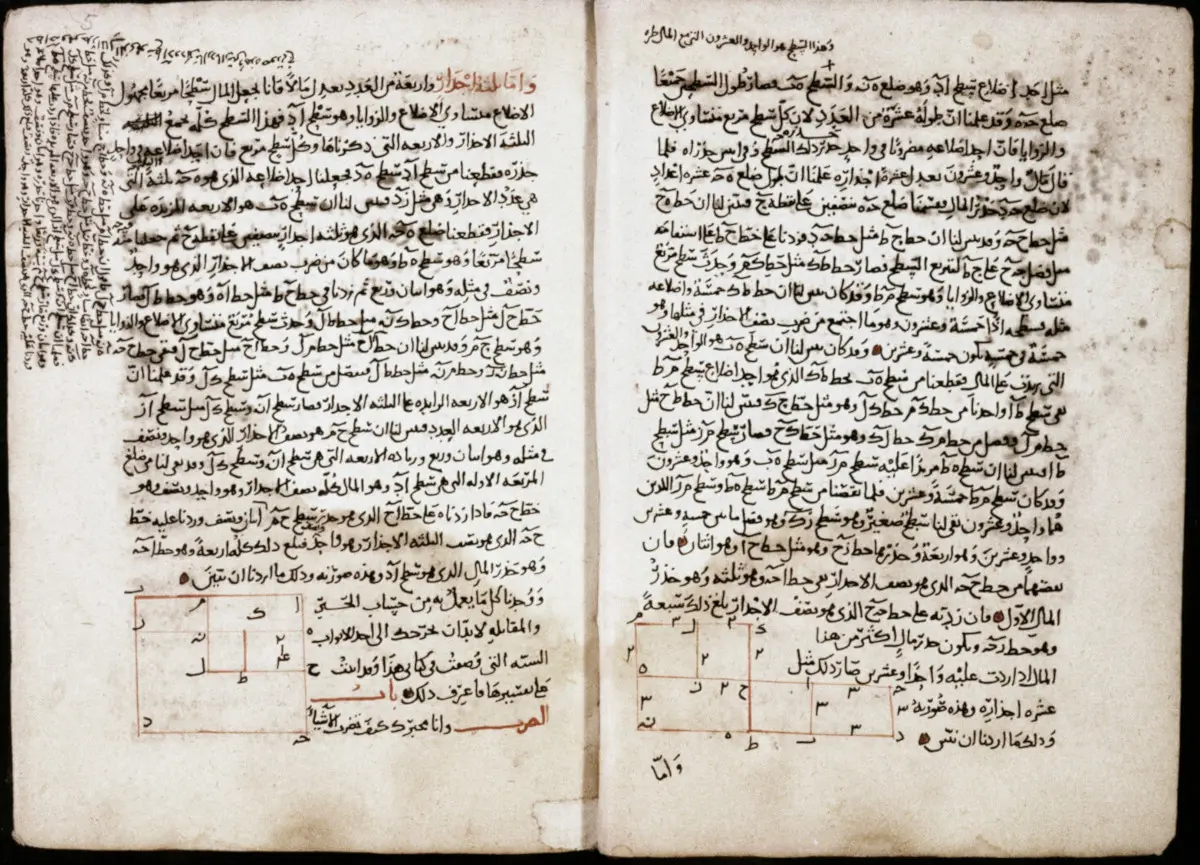
Al-Khwarizmi · al-jabr
The square, in red ink
Al-Khwarizmi · a square and ten roots make 39
The book is translated into Latin in 1145 by Robert of Chester and is taught in European schools until the 1600s. The word algebra comes from its title, and algebra appears as a separate branch of mathematics after this book. There are those who say al-Khwarizmi’s algebra is not much ahead of the Babylonian tablets and that the true father of algebra is Diophantus, but al-Khwarizmi’s order, moving through general types, is new. The Arabic of his book on arithmetic is lost and only a Latin translation remains. At the start of that translation the author’s name appears as Algoritmi, and from there the word algorithm turns into the name for step-by-step methods of calculation.
Abu al-Wafa Buzjani, born in Khorasan in 940, adds important results to spherical trigonometry, and in an arithmetic book written for clerks he treats a debt like a negative number. He is almost the only name in the Islamic mathematics of this period who works openly with negative numbers.
Omar Khayyam, born in Nishapur in 1048, is better known today for his quatrains, but the Seljuk sultan Malik-Shah puts him in charge of the observatory founded in Isfahan in the 1070s. In his book on algebra Khayyam classifies cubic equations and solves each one as the intersection of two conic sections. In the equation x³ + ax² + bx + c = 0, for instance, setting x² = 2dy gives a hyperbola, and the points where that hyperbola meets the parabola y = x²/2d give the roots of the equation. Khayyam sees that a cubic can have more than one root, and the work shows how thoroughly he commands Apollonius’s Conics. While preparing the Jalali calendar at the observatory he calculates the solar year as 365.24219858156 days. The value known today is 365.242190 days.
The one who carries algebra a step past Khayyam, Sharaf al-Din al-Tusi, teaches mathematics in Damascus, Aleppo, Mosul and Baghdad in the second half of the 12th century. He sorts cubic equations into 25 types, and to know whether an equation like x³ − ax = b has a solution in a given interval he sees that b must lie between the largest and smallest values of the expression x³ − ax. What he does to find the largest value looks a great deal like what today we call setting the derivative to zero, and some historians count it as the first trace of the derivative. The value of this idea is not understood at the time, and the derivative appears again in 1636 in Fermat’s hands.
Nasir al-Din al-Tusi, also called the Great Tusi, is born in Tus in 1201 and spends a large part of his life in the fortress of Alamut, known for its good library. When Hulagu Khan takes the fortress in 1256 Tusi enters his service, and in 1259 he takes charge of the observatory founded on Hulagu’s order at Maragheh near Tabriz. There he prepares the astronomical tables called the Zij-i Ilkhani. A zij is a set of tables for computing the positions of the planets, with tables of sines among them. Tusi’s astronomy counts as one of the most important bodies of work between Ptolemy and Copernicus, and his greatest contribution to mathematics is taking plane and spherical trigonometry out of its role as a helper of astronomy and setting it up as a branch of mathematics in its own right.
Ulugh Beg, the grandson of Timur, founds a madrasa and an observatory in Samarkand in the 1420s and some sixty of the best scholars of the day teach there. At the head of the madrasa is Qadizada al-Rumi, born in Bursa around 1364 and Ulugh Beg’s own teacher, best remembered for his commentary on al-Jaghmini’s astronomy textbook. Jamshid al-Kashi, born in Kashan, also works here from 1420 until his death. In 1424 al-Kashi calculates π correct to 16 decimal places using a polygon with 805,306,368 sides. Zu Chongzhi’s record is broken only here, and al-Kashi’s record in turn holds for more than 170 years. The Key to Arithmetic, which he finishes in 1427, is counted for the richness and clarity of its content among the best arithmetic books of the Middle Ages, and it lays out systematically how to do the four operations with decimal fractions.
π, chased across four thousand years
In the tables Ulugh Beg prepares at the observatory, drawing also on Tusi’s tables, sine values are given to eight places for every minute of every angle from 0 to 90 degrees. That is 90 times 60, 5,400 separate values. After al-Kashi’s death, Ali Qushji, a student of al-Kashi and Qadizada, helps complete the tables and write their explanations. In 1449 Ulugh Beg is killed on the order of his son Abd al-Latif, on the grounds that he left the business of state for science, and the madrasa and observatory soon fall apart.
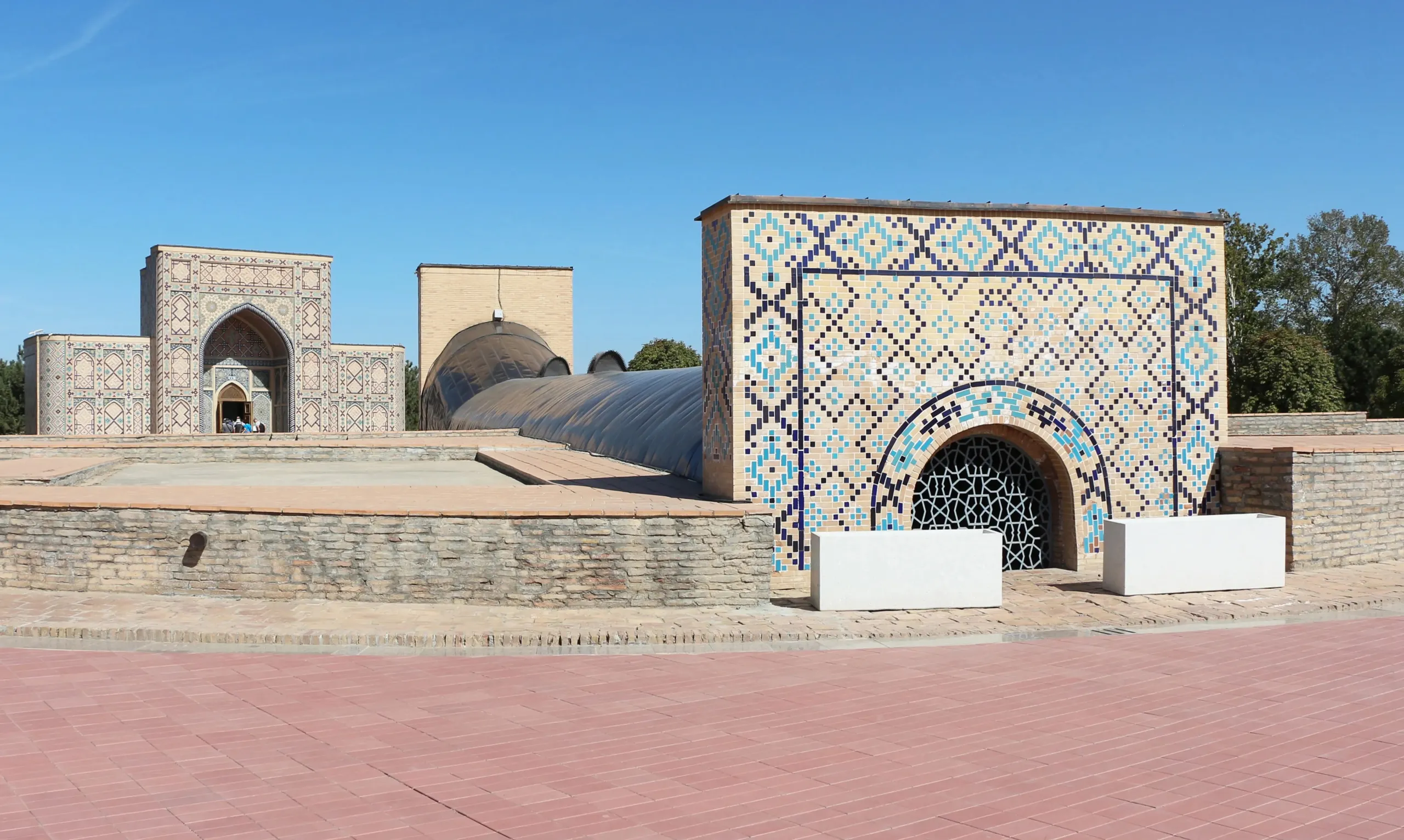
Samarkand · 1420s
The arc under the roof
The road from Samarkand to Istanbul passes through here too. Ali Qushji leaves the city after his teacher is killed and in 1472 comes to Istanbul at the invitation of Mehmed the Conqueror. He teaches mathematics and astronomy at the Hagia Sophia madrasa, and his treatises on arithmetic and astronomy remain textbooks in Ottoman madrasas for a long time. About a hundred years later Taqi al-Din founds the Istanbul observatory on the slopes of Tophane in 1577. The observatory is demolished in 1580, only three years after it opens.
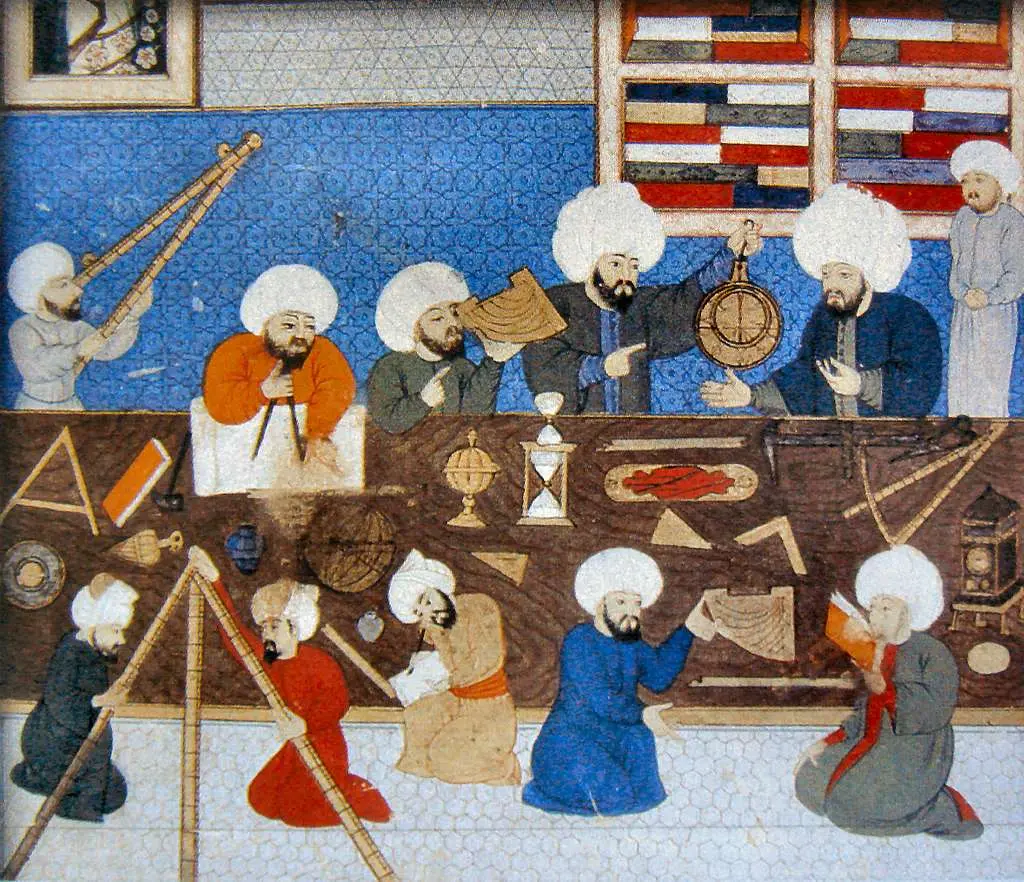
Istanbul observatory · c. 1581
Three years of work in one picture
Mathematics enters Europe through three doors. The first is the Crusaders, who stay in the eastern Mediterranean for about two hundred years and found four kingdoms, the second is European students who study in the madrasas of the Islamic world, the third and largest is al-Andalus. No great mathematician comes out of al-Andalus but education is widespread and fields like medicine, philosophy and chemistry are advanced. In the 10th century the library of the caliph al-Hakam II in Córdoba is said to hold 400,000 volumes, and Christian and Jewish students can study in the city’s madrasas too. When Toledo falls to the kingdom of Castile in 1085 the city turns into a centre of translation, and the translators of Toledo, with the help of Jewish scholars, most of whom know Arabic, render hundreds of scientific works from Arabic into Latin. The most productive of them, Gerard of Cremona, translates about 87 works on his own, and the Latin Almagest of 1175 comes from his hand.
Until the 12th century the schools in Europe are monastery and cathedral schools giving a religious, scholastic education. From the middle of the century students in Italy come together in associations they call universitas and hire teachers, and the core of the first universities forms this way, Bologna first of all, which has been teaching without a break since 1088. The institutions in Paris, Oxford and Cambridge follow the model. The court of the Holy Roman Emperor Frederick II, open to science, and the Franciscan order founded at the start of the 13th century also play a part in bringing the positive sciences into Europe in this period. Between 1200 and 1500 Europeans’ scientific sources are Arabic works and the questions they work on are the questions the mathematicians of the Islamic world worked on, geometry, cubic equations, number theory.
Leonardo of Pisa, that is Fibonacci, spends his youth in Bugia on the coast of today’s Algeria, where his father works as a trade representative, and there he learns the base-ten positional numerals from Arab teachers. Liber Abaci, the book of calculation he writes in 1202, introduces these numerals and the four operations done with them to Italian merchants. In Europe the numerals do not spread much in daily life until the 16th century, and are even banned from time to time in official records. The rabbit problem in the book, which asks how many pairs there will be after a year if each pair produces a new pair every month, gives the sequence that today carries Fibonacci’s name, and Fibonacci himself gives the sequence no more weight than the solution of one problem. In the same book he also describes the method of splitting a fraction into unit fractions by taking, at each step, the largest unit fraction that fits, and the second row in the Rhind box is exactly that method.
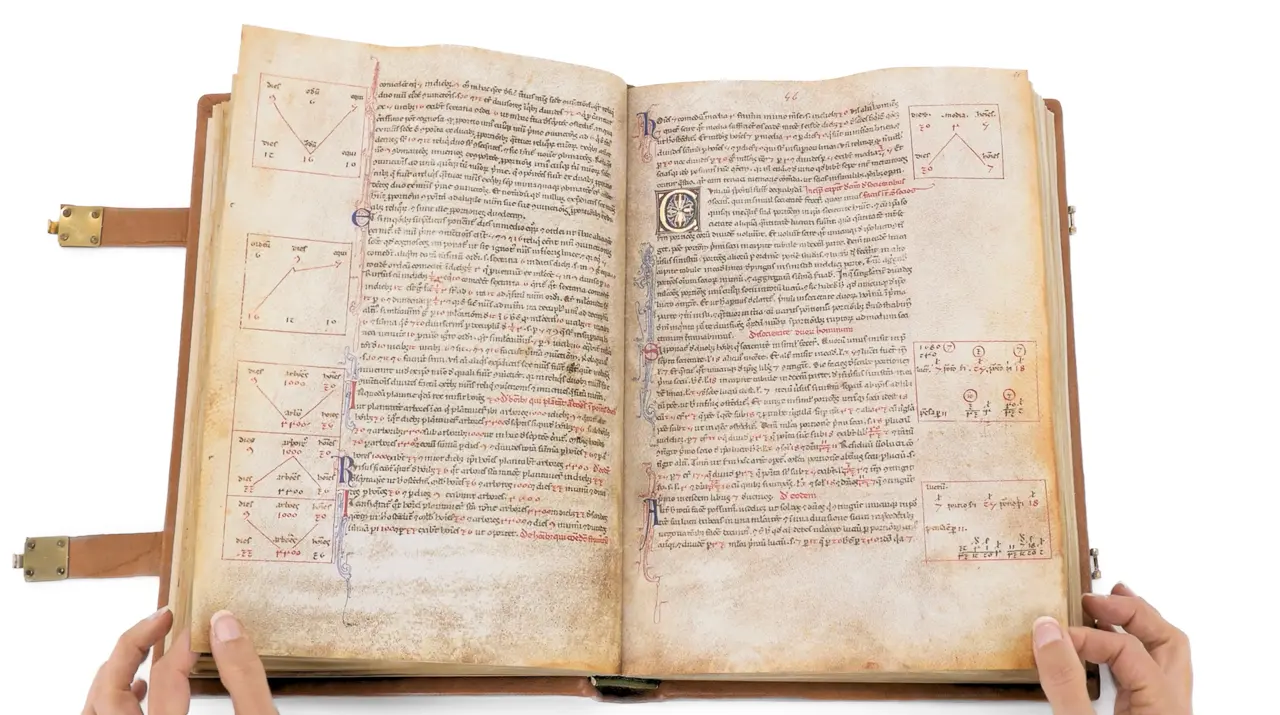
Liber Abaci · 1202
Sums in the margin boxes
After 1453 the scholars and manuscripts that go from Constantinople to Italy take Europe straight to the Greek sources of mathematics, and after the 1600s the Arabic sources are largely set aside. Europe’s original contributions to mathematics begin after the 1500s. In 16th-century Italy mathematicians go into public problem duels for posts and money. In 1535 Niccolò Tartaglia, in a duel against Antonio Fiore, solves all thirty of his opponent’s questions because he knows how to solve one type of cubic equation. Gerolamo Cardano gets the method from him in 1539 by swearing to tell no one, and Tartaglia gives it to him in the form of a poem. In 1543, when Cardano sees that the same method was already in Scipione del Ferro’s notebook before Tartaglia, he no longer considers himself bound by the oath and publishes the method in Ars Magna in 1545. The same book also holds the solution of the quartic equation found by his student Lodovico Ferrari.
These formulas sometimes require passing through the square root of a negative number to reach a real root, and in 1572 Rafael Bombelli writes down the rules for calculating with these strange numbers. Complex numbers come into mathematics not through the door but down the chimney. In 1591 François Viète publishes the book that moves algebra from words to symbols, and he uses vowels for unknowns and consonants for knowns. Today’s order, giving unknowns the letters from the end of the alphabet, x, y, z, and knowns the letters from the start, a, b, c, comes a few decades later with Descartes.
All three great developments of the 17th century change mathematics in a way it will never come back from. The first is analytic geometry. In 1637 René Descartes writes geometric curves as equations in La Géométrie, published as an appendix to his Discourse on the Method, and the idea of locating a curve against two lines is called Cartesian coordinates today, after him. In the same years Pierre de Fermat, working in Toulouse as a lawyer and councillor, does mathematics in his spare time and reaches the same idea independently. The second development is the derivative. Around 1636 Fermat develops a method for finding a curve’s largest and smallest values and its tangent, and five centuries after Sharaf al-Din al-Tusi the derivative appears for good, because the mathematical world is now mature enough to understand it.
In the margin of a page of the 1621 edition of Diophantus’s Arithmetica, Fermat writes that for n greater than 2 the equation xⁿ + yⁿ = zⁿ has no solution in positive whole numbers, that he has found a marvellous proof of this, but that the margin is too narrow to hold it. The note comes to light in the edition his son Samuel publishes in 1670, after Fermat’s death, and the proof waits 358 years for Fermat’s Last Theorem to be settled. In 1654 Fermat and Blaise Pascal, through letters, solve how the money on the table should be divided in a game of chance that is broken off halfway, and probability begins in those letters.
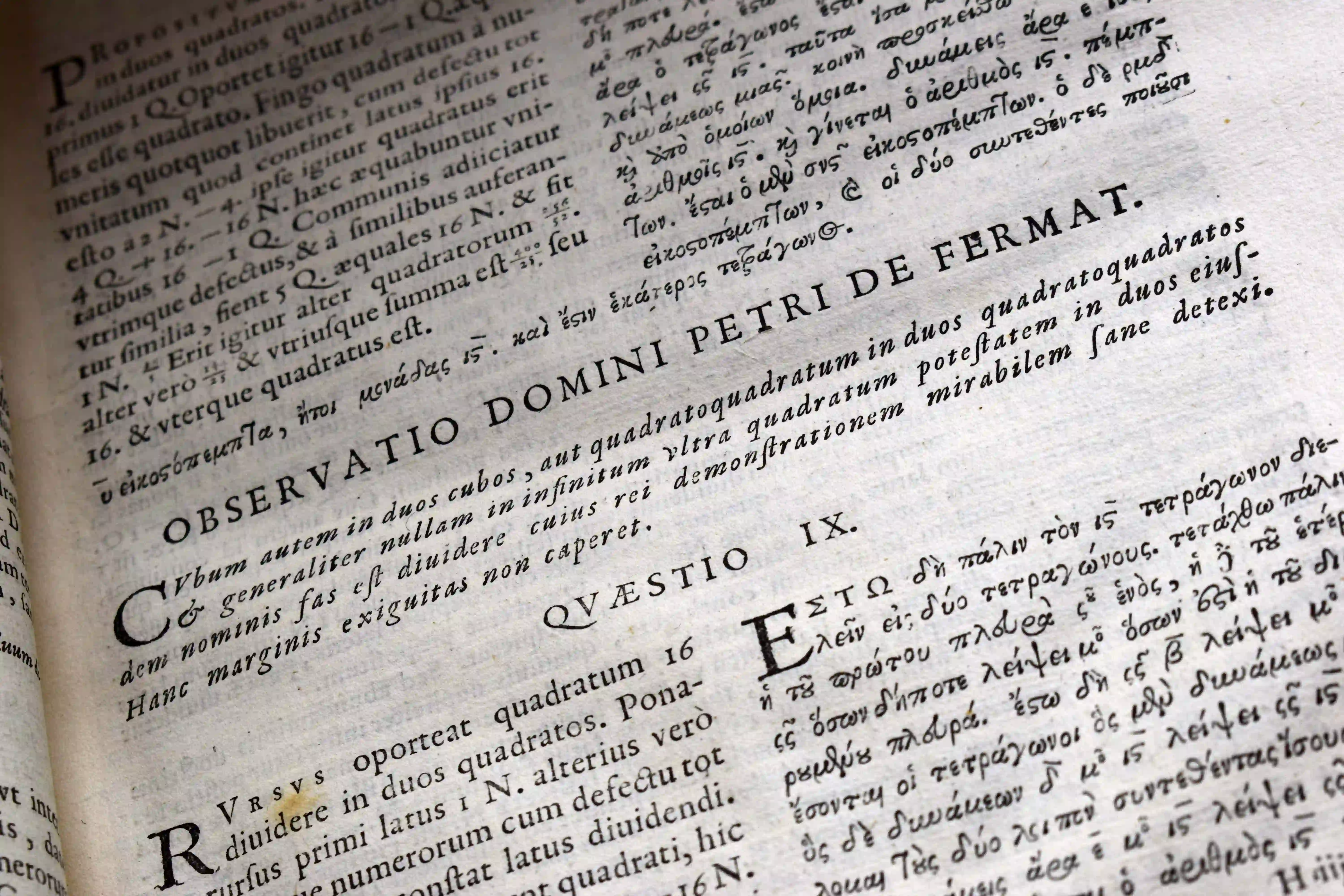
Diophantus, Toulouse, 1670
The margin, set in type
I have found a truly marvellous proof of this, which this margin is too narrow to contain.
Fermat, in the margin of Diophantus, c. 1637
The third and greatest development is the link between the derivative and the integral, what we call today the fundamental theorem of calculus. When Cambridge closes because of the plague, Isaac Newton spends 1665 and 1666 at the family farmhouse in Woolsthorpe and develops the method he calls fluxions there, but does not publish it. Gottfried Leibniz publishes the differential calculus he developed independently in 1684, and the dy/dx and ∫ signs we use today are his. I taught calculus for years and every time I wrote dy/dx on the board I was using the signs Leibniz chose. In the priority quarrel that follows the Royal Society sets up a committee in 1712, and the report that finds for Newton is written, without his name appearing anywhere, by Newton himself. With calculus come differential equations, a physical event written in mathematics, and with them theoretical physics and the engineering sciences.
The years from 1700 to 1900 are remembered as mathematics’ golden age, and the greatest name of the 18th century, by a wide margin, is Leonhard Euler. Born in Basel in 1707, Euler spends his whole career at the academies of St. Petersburg and Berlin, carries what calculus made possible everywhere, from number theory to differential equations and from there to engineering problems, and with him mathematics turns into a universal language. If Eudoxus and Archimedes are the grandfathers of analysis, its father is Euler. In 1736 he shows that it is impossible to walk around Königsberg crossing each of its seven bridges exactly once, and putting the map aside to count only the land masses and the connections between them is taken today as the start of graph theory. Euler loses the sight of one eye in 1738, goes almost completely blind in 1771, and in 1775 writes on average one paper a week, doing the calculations in his head and dictating them to assistants. Publication of his accumulated papers goes on for fifty years after his death, and his collected works, whose publication starts in 1911, pass 80 volumes.
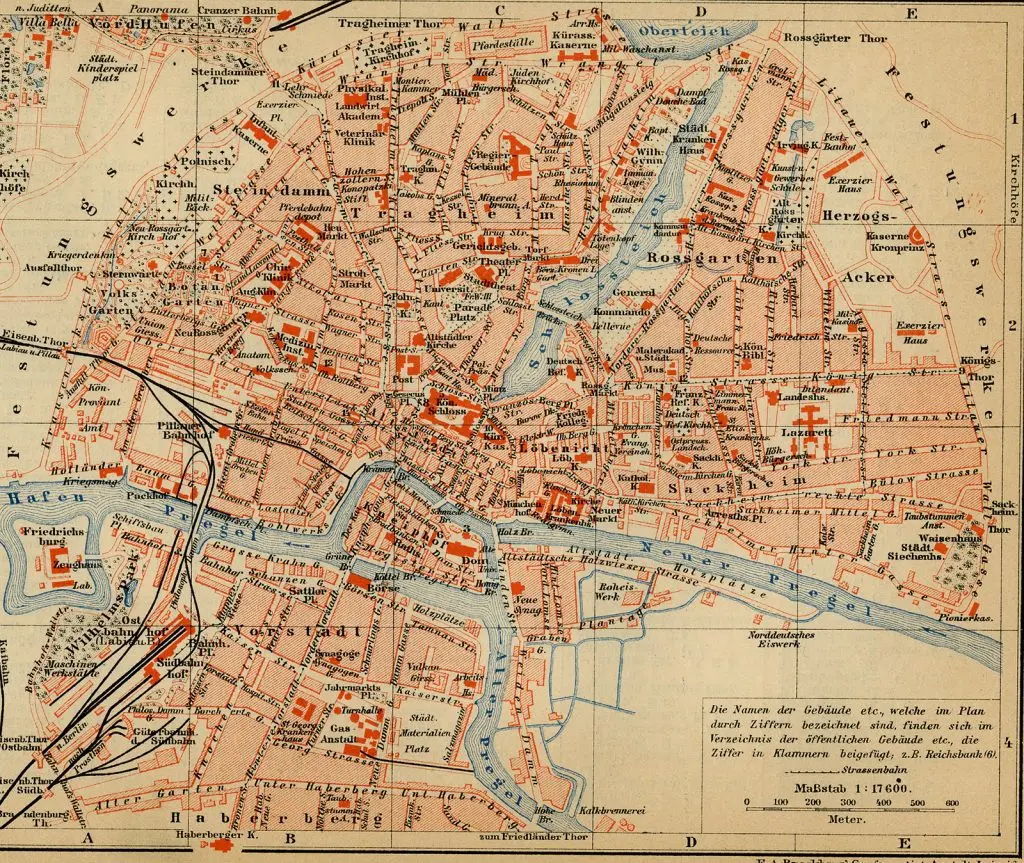
Königsberg · late 19th century
The city Euler never had to visit
Euler · 1736
Seven bridges, forget the map
In the same century Jean le Rond d’Alembert is one of the first to study partial differential equations, and he writes almost all the mathematics entries of the Encyclopédie, which he edits together with Diderot and which counts as the founding work of the Enlightenment. Joseph-Louis Lagrange, born in Turin and working in Berlin and Paris, makes basic contributions to the solvability of equations, to mechanics and to the calculus of variations, and in the preface to his Analytical Mechanics of 1788 he points out specifically that there is not a single figure in the book and everything is explained through algebraic operations alone. Pierre-Simon Laplace of Normandy applies Newton’s mechanics to the solar system in the five volumes of his Celestial Mechanics, and his Analytic Theory of Probabilities of 1812 is the first great work of probability theory. The mathematics of this century is rich in ideas, but its weak point is rigour. Judged by today’s standards most of its proofs are half-done, flawed or incomplete.
The price of that is paid at the start of the 1800s with a crisis. The derivative is defined not with limits but with infinitesimals, which nobody quite knows the nature of, and mathematicians use the idea inconsistently. As early as 1734 the philosopher and bishop George Berkeley mocks these infinitesimals in a pamphlet called The Analyst and calls them the ghosts of departed quantities. Although the idea of a function has been in use for a hundred years, not everyone understands it the same way, continuity and the convergence of series are not properly defined, the integral is seen only as the inverse of the derivative, and the theory of complex functions, structures like group, ring, field and vector space, matrices, differential geometry and topology do not exist yet.
The first big step out of the crisis comes in 1821. Augustin-Louis Cauchy defines the limit the way we use it today and builds the derivative, continuity and the integral of continuous functions on the limit. The theory of complex functions is also born in Cauchy’s hands and, with the contributions of Riemann and Weierstrass, turns into one of the most fundamental theories in mathematics. In 1807, studying how heat spreads, Joseph Fourier claims that every function can be written as an infinite sum of sines and cosines, and Fourier series become the subject that feeds the growth of analysis more than any other through the century. The arguments around these series settle down in 1837 when Peter Gustav Lejeune Dirichlet defines the function in the sense we understand it today, as a rule assigning exactly one output to each input. After the 1850s Karl Weierstrass and his students set up the notions of uniform continuity and uniform convergence, and in 1872 Weierstrass shows a function that is continuous everywhere but differentiable nowhere, proving how misleading intuition can be in analysis.
On March 30, 1796, at the age of 18, Carl Friedrich Gauss shows that a regular seventeen-sided polygon can be constructed with ruler and compass. In the two thousand years since Euclid could construct the regular pentagon and Archimedes could not construct the heptagon, there is no progress on the question. That day Gauss makes the first entry in his mathematical diary and settles his choice between languages and mathematics in favour of mathematics. In 1801 he closes the question completely. For a regular polygon with a prime number of sides to be constructible, the number of sides has to be a prime of the form 2 to the power 2ᵏ plus one, and these primes are 3, 5, 17, 257 and 65,537. It is said he asked for a seventeen-gon on his tombstone and the stonemason refused, saying it would be indistinguishable from a circle. In his doctoral thesis of 1799 Gauss gives the first serious proof of the fundamental theorem of algebra, which says every non-constant polynomial has a root in the complex numbers, and his contributions to number theory, differential geometry, astronomy and physics make him the deepest mathematician of the century.
The construction problems left over from ancient Greece are closed in this century too. In 1837 the French mathematician Pierre Wantzel proves that with ruler and compass it is impossible to find the side of a cube with double the volume of a given one, and impossible to divide an angle into three equal parts. The impossibility of drawing a square with the same area as a circle becomes clear when Ferdinand von Lindemann proves in 1882 that π is transcendental, that is, not a root of any polynomial with whole-number coefficients.
Sophie Germain gets hold of the lecture notes of the École Polytechnique, which does not admit women, from others and sends in her assignments under the name Monsieur Le Blanc. From 1804 she corresponds with Gauss too under the same pseudonym. Gauss learns the truth in 1806 when, as the French army enters Braunschweig, Germain asks a general she knows to look after his safety.
At the start of the 1800s it is still unknown whether the roots of a fifth-degree equation can be found by radicals. In 1824 Niels Henrik Abel shows they cannot. Abel dies of tuberculosis in 1829 at the age of 26, and the offer of a professorship from Berlin arrives two days after his death. Évariste Galois solves the same question completely by looking at the structure of the group formed by permutations of an equation’s roots. On the morning of May 30, 1832 he is shot in a duel and dies the next day at 20. In the letter he writes to his friend Auguste Chevalier the night before the duel he sums up his results and asks that Gauss and Jacobi be asked for their opinion not on whether they are true but on their importance. In the margin of one of his manuscripts there is a note. Galois’s work is published only in 1846, thanks to Joseph Liouville, and the idea of a group is born from it.
There is something to complete in this proof. I do not have the time.
Évariste Galois, in the margin of a manuscript · 1832
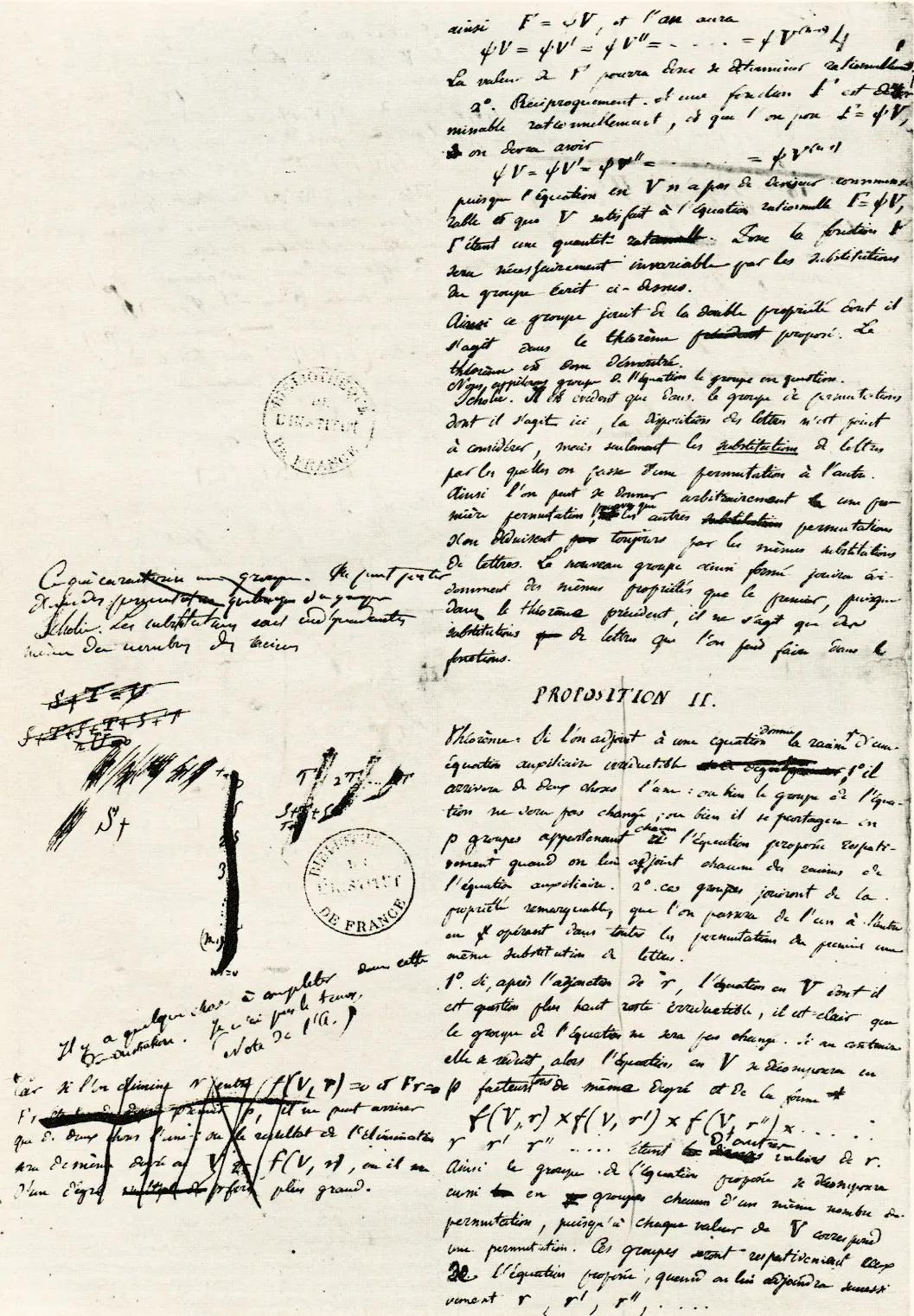
Galois · 1832
The note, in his own hand
Back to the parallel postulate. For the problem to be solved, mathematicians have to accept that logical consistency and physical reality are not the same thing. Farkas Bolyai writes to his son János telling him to stay away from the subject, that it used up his own life too. János doesn’t listen, and in a text of twenty-odd pages published in 1832 as an appendix to his father’s book he shows that when the fifth postulate is replaced by its opposite, the result is a geometry as consistent as Euclid’s but different from it. In Kazan Nikolai Lobachevsky publishes the same result in 1829. In a letter to Farkas, Gauss says that praising János would be praising himself, because he reached the same ideas years earlier, and after that letter János largely withdraws from mathematics. In 1854, in his habilitation lecture at Göttingen, Bernhard Riemann lays out a third geometry in which there are no parallel lines at all and a general theory of curved spaces, and sixty years later Einstein’s general relativity is built on that theory.
In his short life Riemann starts or deeply changes a dozen subjects. The Riemann integral, defining the area under a curve by trapping it with rectangles from below and above and showing the two sums approach the same number, Riemann surfaces, Riemannian geometry and the analysis situs that will later be called topology are a few of them. In the eight-page paper he writes in 1859 on his election to the Berlin Academy he ties the distribution of prime numbers to the zeros of a function and finds it “very probable” that all those zeros lie on a particular line. This conjecture, the Riemann Hypothesis, is still open today, and the Clay Mathematics Institute offers a million dollars for its solution. In 1843, meanwhile, Ada Lovelace, translating from Italian a paper on Charles Babbage’s never-finished Analytical Engine, adds notes about three times the length of the original, and in Note G gives a step-by-step method for the machine to compute Bernoulli numbers.
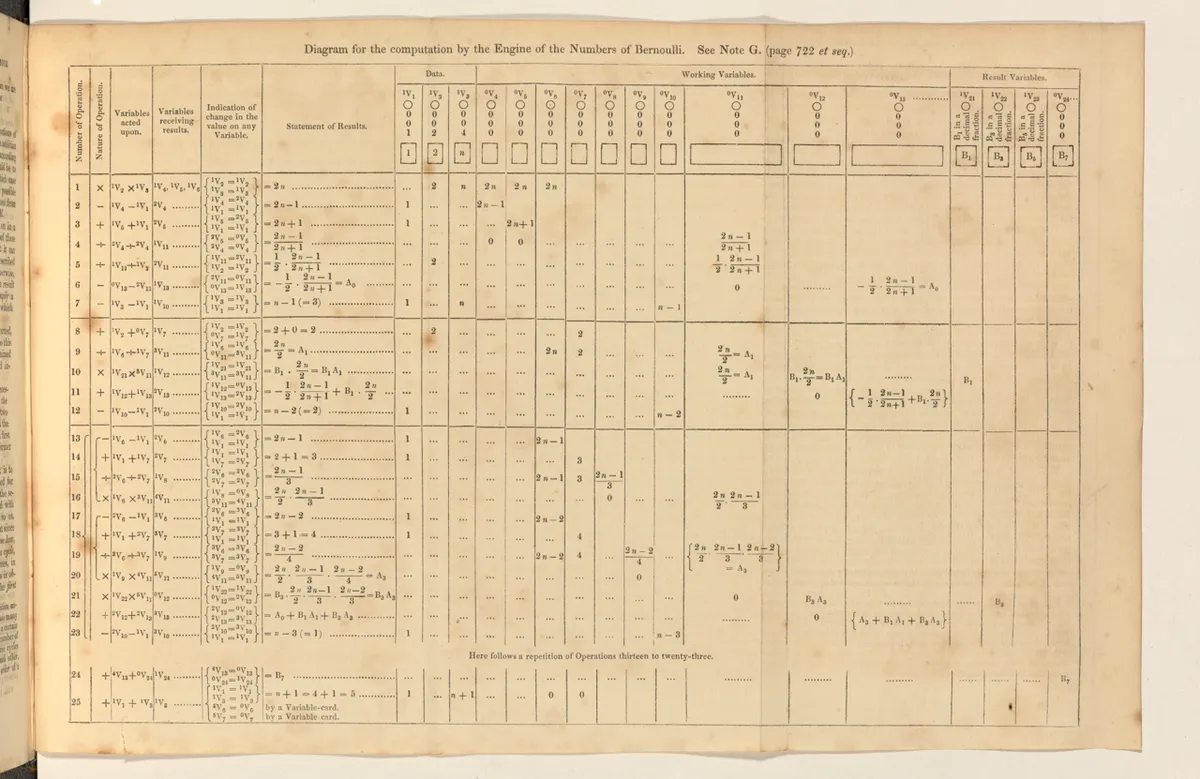
Ada Lovelace · Note G · 1843
A program before there was a machine
In the second half of the century algebra takes on its present face. Ernst Kummer and his students, trying to prove Fermat’s Last Theorem, arrive at the idea of ideal numbers, and the theory of rings and ideals comes out of that effort. In 1872 Richard Dedekind defines the real numbers as cuts of the rational numbers, and field theory takes shape through his work. In 1858 Arthur Cayley publishes his work treating matrices as algebraic objects in their own right and builds matrix algebra together with James Joseph Sylvester. Hermann Grassmann, trying in his 1844 book to go from three dimensions to many, arrives at the idea of a vector space, but almost nobody reads the book and its value is understood only after his death. With these ideas a structural view comes into mathematics. What is studied now is less individual calculations than the structures lying under them.
The golden age closes with a crisis, and at its centre stands Georg Cantor, the founder of set theory. Cantor finishes his doctorate in number theory in Berlin in 1869 as a student of Kummer and moves to the University of Halle, where he will spend his whole life. His colleague there, Eduard Heine, asks him a question. If a trigonometric series sums to zero everywhere on an interval, must all its coefficients be zero, that is, can a function be written as a trigonometric series in only one way? Cantor answers this question, which Dirichlet, Riemann and Heine himself worked on and could not solve, in the affirmative in 1870. While working on it he starts thinking about the size of infinite sets, and in 1874 he shows that a one-to-one correspondence can be set up between the rational numbers and the natural numbers but not with the real numbers. In 1891 he publishes the short proof of this known today as the diagonal argument.
Cantor’s diagonal · 1891
From Aristotle to Cantor the infinite is seen as something like the horizon, a notion that does not exist but makes talking easier. If something can pass any limit set in advance, that thing goes to infinity, so Aristotle’s infinite is a potential infinite. For Cantor infinite sets are objects that really exist and there is an order of size among them, some infinities are bigger than others. The idea meets a harsh reaction, Leopold Kronecker refers to Cantor as a corrupter of youth, Henri Poincaré keeps his distance from set theory, and mathematicians split into those who see the infinite like Cantor and those who see it like Aristotle.
Once the idea of a set is used in its dictionary sense, without a definition, the theory soon runs into paradoxes. On June 16, 1902 Bertrand Russell writes a letter to Gottlob Frege, who is trying to build arithmetic on logic, and asks whether the set of all sets that do not contain themselves as members contains itself. Both answers lead to a contradiction. The second volume of Frege’s book is at the printer at that moment, and in a note he adds to it Frege admits that the foundation of his building has been shaken. This is Russell’s paradox. On top of it comes the question of what a mathematical proof is. Does a mathematician who says something exists have to construct it concretely, or is it enough to show that it exists starting from certain principles? Since there are no experiments in mathematics, leaving the last word to an experiment is not an option either.
These three questions push mathematics into a period called the foundations crisis, and the way out is to set mathematics on a constitutional foundation. Ernst Zermelo states the disputed axiom of choice openly in 1904 and publishes the first axiom system for set theory in 1908. Modern mathematics can be defined, briefly, as classical mathematics rebuilt on an axiomatic ground like this. From now on what is valid and what is not can be argued within this framework. Meanwhile an old wound closes too. The infinitesimals Berkeley mocked are set on solid logical ground in the 1960s by Abraham Robinson’s nonstandard analysis, and the dy and dx in dy/dx become real mathematical objects for the first time.
At the International Congress of Mathematicians in Paris in 1900 David Hilbert presents a list of 23 problems for the new century, and in the talk itself reads out only 10 of them. Hilbert’s dream is to set mathematics, arithmetic and geometry first of all, on an axiom system such that every statement of that branch can be decided true or false starting from the axioms. On September 8, 1930 he ends a talk broadcast on the radio in Königsberg with the words we must know, we will know. The day before, in the same city, at the closing session of a conference held at the same time, the 24-year-old Kurt Gödel announces in a few sentences the result that shows this dream cannot come true.
We must know. We will know.
David Hilbert, Königsberg radio · September 8, 1930
In the paper published in 1931 Gödel shows that every consistent formal system strong enough to contain arithmetic has statements that are true but cannot be proved inside that system. Whatever axioms are chosen, it is always possible to build a statement whose truth and falsity we cannot prove without stepping outside the axioms. The problem is that true and provable are not the same thing. By classical logic a statement is either true or false, but the same principle does not hold for provability. Before Gödel there is a deep belief that the truth or falsity of every statement will one day be proved, and Gödel destroys it. In the last years of his life he refuses food not prepared by his wife for fear of being poisoned, and when his wife is taken to hospital he starves to death in 1978, down to 29 kilograms.
In 1936 the 24-year-old Alan Turing, to answer Hilbert’s decision problem, defines an imaginary machine that reads and writes symbols on a paper tape and shows that some questions cannot be decided by any mechanical method. Every computer we have today is an instance of that imaginary machine. Emmy Noether comes to Göttingen in 1915, but because she is a woman the university does not grant her the right to teach, and for years her courses are announced under Hilbert’s name. Noether’s theorem, published in 1918, ties the conservation laws of physics to continuous symmetries, and in the 1920s Noether brings abstract algebra, rings and ideals, into the form in which they are taught today.
In the 20th century, as in the 19th, new theories are born one after another. Maurice Fréchet defines metric spaces in his 1906 thesis, Felix Hausdorff defines topological spaces in his 1914 book, Stefan Banach publishes the first great book of functional analysis in 1932, Laurent Schwartz receives the Fields Medal in 1950 for the theory of distributions, and René Thom puts forward catastrophe theory in the 1960s. At the end of 1934 a group of young French mathematicians meeting in a café in Paris invent an imaginary author named Nicolas Bourbaki to rewrite the whole of mathematics from scratch on set theory, and this author’s books decide for decades how mathematics is to be written. The mathematics of the century is more abstract, conceptual and structural than in any period before, and so are the amount and variety of what is produced. With every field having its own language, knowing mathematics as a whole stops being something a single person can do.
The name from Turkey that fits this line best, to me, is Cahit Arf. Arf, who does his doctorate in Göttingen with Helmut Hasse, defines in 1941 the notion known today as the Arf invariant, and it later turns up in topology and knot theory. On the back of the 10 lira banknotes printed in 2009 there is Arf’s portrait and a formula related to this invariant, and seeing an identity about quadratic forms on a banknote is not something that happens every day.
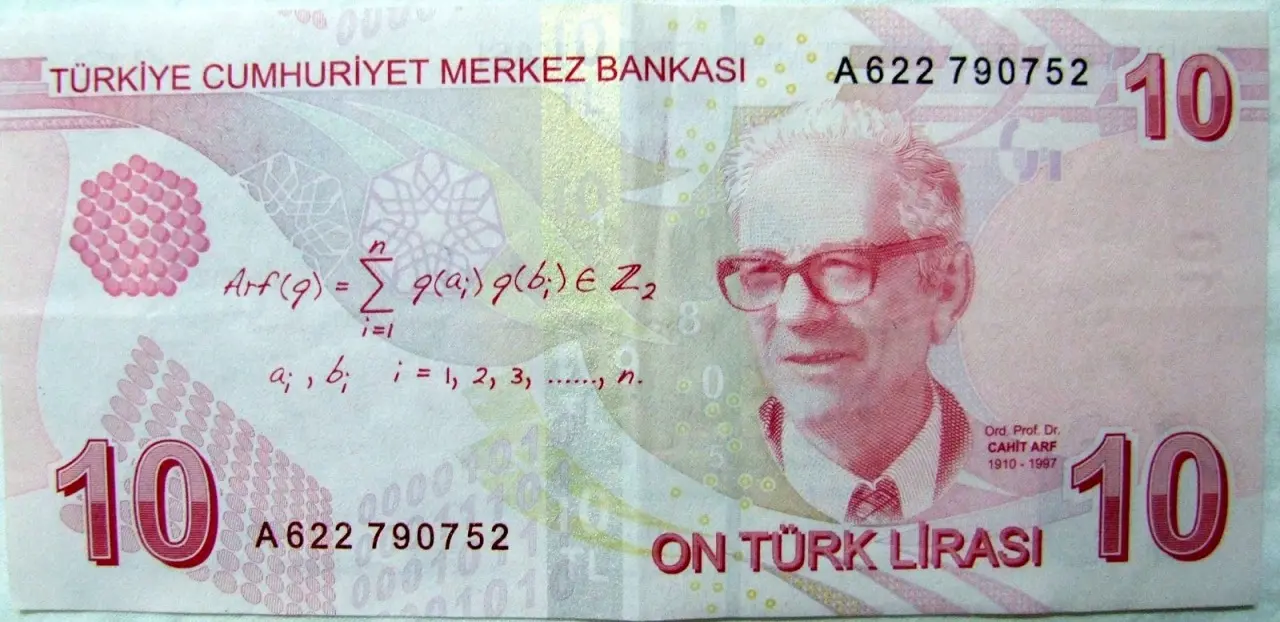
10 Türk Lirası · 2009
An invariant in your wallet
The machine Turing imagined on paper is built within ten years. In 1945 John von Neumann writes the report that describes a computer keeping its program in memory next to its data, the design almost every computer since has followed, and in Philadelphia ENIAC, finished the same year, fills a room with nearly 18,000 vacuum tubes. Over a long weekend in 1949 ENIAC computes π to 2,037 decimal places in about 70 hours, more than anyone had ever worked out by hand. In 1948 Claude Shannon, working at Bell Labs, publishes A Mathematical Theory of Communication, measures information in bits and shows how much of it a noisy channel can carry. Every file, every phone call and every streamed film today is counted in his unit.
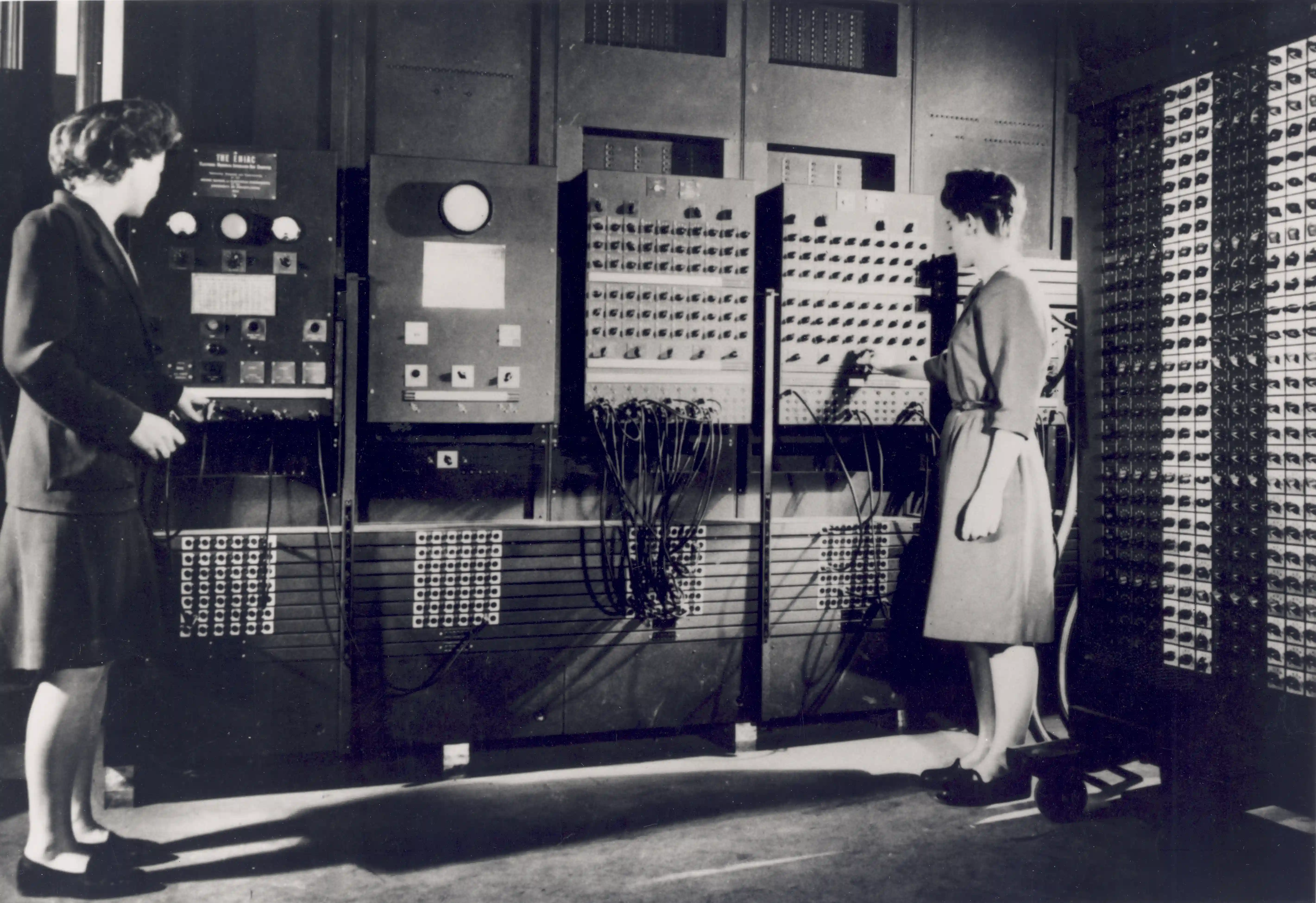
ENIAC · Philadelphia, c. 1946
Programming with cables
In 1950 John Nash, 21 years old, writes a 28-page doctoral thesis at Princeton about games in which every player picks the best response to everyone else, and the equilibrium that carries his name brings him the Nobel Prize in economics in 1994. The 2001 film about his life, A Beautiful Mind, gets the mathematics of its most famous scene wrong, but it puts a mathematician’s inner life on cinema screens around the world.
In 1940, in A Mathematician’s Apology, G. H. Hardy is proud that number theory, his own field, has no use in war or anywhere else. In 1977 Ron Rivest, Adi Shamir and Leonard Adleman at MIT turn that useless theory into the lock of the modern world. Multiplying two primes a few hundred digits long takes a computer a fraction of a second, and getting the two primes back from their product takes, with every method known, longer than the age of the universe. RSA rests on that asymmetry, and the padlock in your browser’s address bar rests on theorems of Fermat and Euler.
In 1980, at IBM’s research centre in Yorktown Heights, Benoit Mandelbrot has a computer draw the numbers c for which repeating z → z² + c, starting from zero, never runs off to infinity. The shape that appears has an edge that keeps producing new detail however far you zoom, and Mandelbrot’s 1982 book The Fractal Geometry of Nature finds the same rough, self-similar shapes in coastlines, clouds and lungs. For the first time a computer is not checking mathematics but showing mathematicians something they would never have seen on their own.
Try it · z → z² + c
Click anywhere on the edge to zoom in
In 1976 Kenneth Appel and Wolfgang Haken prove the four color theorem by having a computer check 1,936 separate configurations one by one, and the check takes about 1,200 hours. Whether a proof no human can read from start to finish counts as a proof has been argued over ever since.
The four color theorem is not the last proof of its kind. In 1998 Thomas Hales proves the Kepler conjecture, Kepler’s 1611 claim that the way grocers stack oranges is the densest way to pack spheres, with gigabytes of computer calculation, and after years of checking the referees say they are 99 percent sure. Hales does not settle for 99, starts a project called Flyspeck to have every step checked by a proof assistant, and in 2014 the check is complete. In 2016 Marijn Heule, Oliver Kullmann and Victor Marek show that the numbers from 1 to 7,824 can be coloured red and blue so that no Pythagorean triple a² + b² = c² is all one colour, but the numbers from 1 to 7,825 cannot. The proof file is 200 terabytes long.
In June 1993, at the end of a three-day series of lectures at the Isaac Newton Institute in Cambridge, Andrew Wiles announces that he has proved Fermat’s Last Theorem. Wiles, who first read the problem at 10 in a library, works on the proof for seven years without telling anyone. A gap turns up in the proof, Wiles and his former student Richard Taylor close it in September 1994, and the proof is published in Annals of Mathematics in 1995. The text that closes Fermat’s margin note runs past a hundred pages and uses tools from nearly every century named above, from Kummer’s ideals to Riemann’s complex analysis.
In 2002 and 2003 Grigori Perelman uploads his proof of the Poincaré conjecture, open since 1904, to arXiv as three papers instead of sending it to a refereed journal. He turns down the Fields Medal in 2006 and the Clay Institute’s million-dollar prize in 2010. In 2014 Maryam Mirzakhani becomes the first woman to receive the Fields Medal. She carries out her work on hyperbolic surfaces by drawing on big sheets of paper spread on the floor, and her small daughter, looking at the drawings, thinks her mother is painting. Mirzakhani dies in 2017 at 40.
The oldest questions keep moving too. In April 2013 Yitang Zhang, a lecturer at the University of New Hampshire who had spent years outside academic jobs, proves that there are infinitely many pairs of primes less than 70 million apart. Within months James Maynard finds a different route, and an open online collaboration called Polymath, started by Terence Tao, brings the gap down to 246. The twin prime conjecture asks for 2, and it is still open. In 2016 Maryna Viazovska proves that a structure called the E8 lattice is the densest way to pack spheres in eight dimensions, and a week later, with four co-authors, settles 24 dimensions as well. In 2022 she becomes the second woman to receive the Fields Medal.
In March 2023 David Smith, a retired print technician from Yorkshire who cuts out shapes as a hobby, finds a 13-sided tile nicknamed the hat. It covers the plane, but only in patterns that never repeat, and it answers the einstein problem, “one stone” in German, that mathematicians had been chasing since the 1960s. In 2024 an online community of amateurs and professionals called bbchallenge proves that the fifth Busy Beaver number is 47,176,870: the most steps any five-state version of Turing’s machine can take before it stops. They check the proof in the proof assistant Coq. In October of the same year Luke Durant, a former Nvidia engineer, finds the largest known prime, 2¹³⁶²⁷⁹⁸⁴¹ − 1, a number 41,024,320 digits long, on graphics processors rented in the cloud.
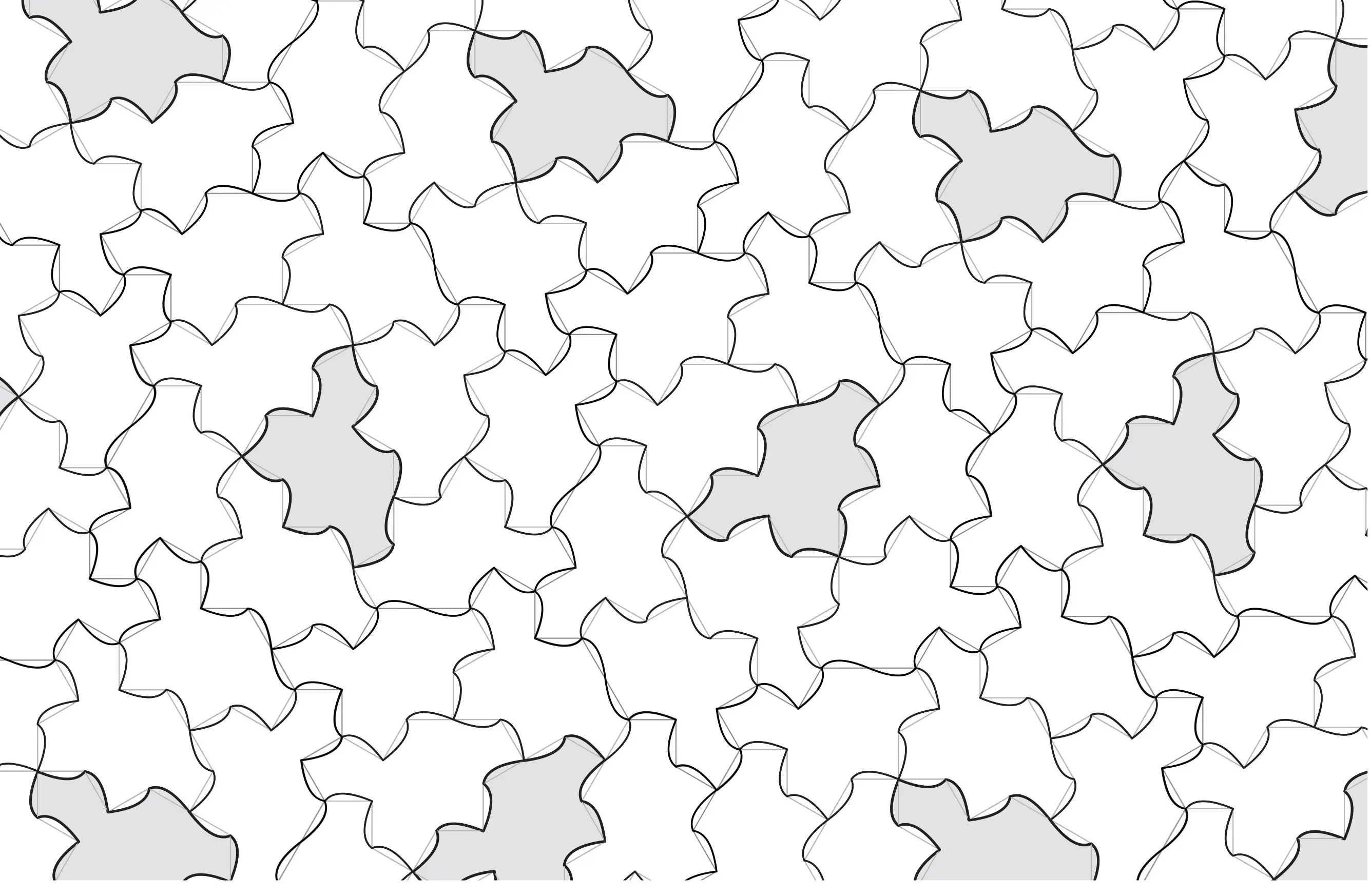
Aperiodic monotiles · 2023
One shape, no repeats
Proof itself is changing hands. In 2020 Peter Scholze, one of the deepest mathematicians of his generation, says he is not completely sure of a theorem he proved with Dustin Clausen and asks for it to be checked in the proof assistant Lean. The Liquid Tensor Experiment, carried out by volunteers, finishes in 2022 and the theorem holds. In 2024 Kevin Buzzard starts a project to check Fermat’s Last Theorem line by line in Lean. In July 2025, at the International Mathematical Olympiad, systems from Google DeepMind and OpenAI solve five of the six problems within the time limit, write their proofs in plain language, and reach a score that would earn a gold medal. What this will mean for mathematics, nobody knows yet.
The race for π goes on as a sport. On Pi Day in 2019 Emma Haruka Iwao, an engineer at Google, announces 31.4 trillion digits computed in the cloud, and in 2025 the record passes 300 trillion. NASA needs about 15 of them to navigate a spacecraft between planets.
The race for π · decimal places, log scale
From 2 digits to 300 trillion
The margins have moved. Fermat’s note today would be an arXiv preprint, a repository of Lean files or a thread on a chat server where a retired print technician, a volunteer with a laptop and a Fields medallist argue about the same problem. The hat was found by an amateur, the fifth Busy Beaver by volunteers, and Fermat himself was a lawyer doing mathematics in his spare time. Mathematics still travels the way it did on clay: copied, corrected and passed from hand to hand.
We know nearly every name in this piece, but we don’t know the name of the student who wrote YBC 7289. The tablet is still in the collection at Yale and the 1, 24, 51, 10 above the diagonal is still correct to five decimal places.
Keep wandering
A few more pieces in the same spirit — math, design, and slow attention.

How to Learn Mathematics: A Self-Study Roadmap
A course-by-course, book-by-book roadmap for learning undergraduate mathematics on your own, with a prerequisite map, a readiness check and a study planner.
Open
Math Symbols: Meaning, How to Read Them and LaTeX Code
62 math symbols with their names, meaning, an example read aloud, LaTeX code, Unicode code point and who first put each one on paper.
Open
29 Historic Math Books You Can Read for Free
From the Rhind Papyrus to Principia Mathematica, 29 historic math books that libraries have scanned and opened to everyone, each with a free link.
Open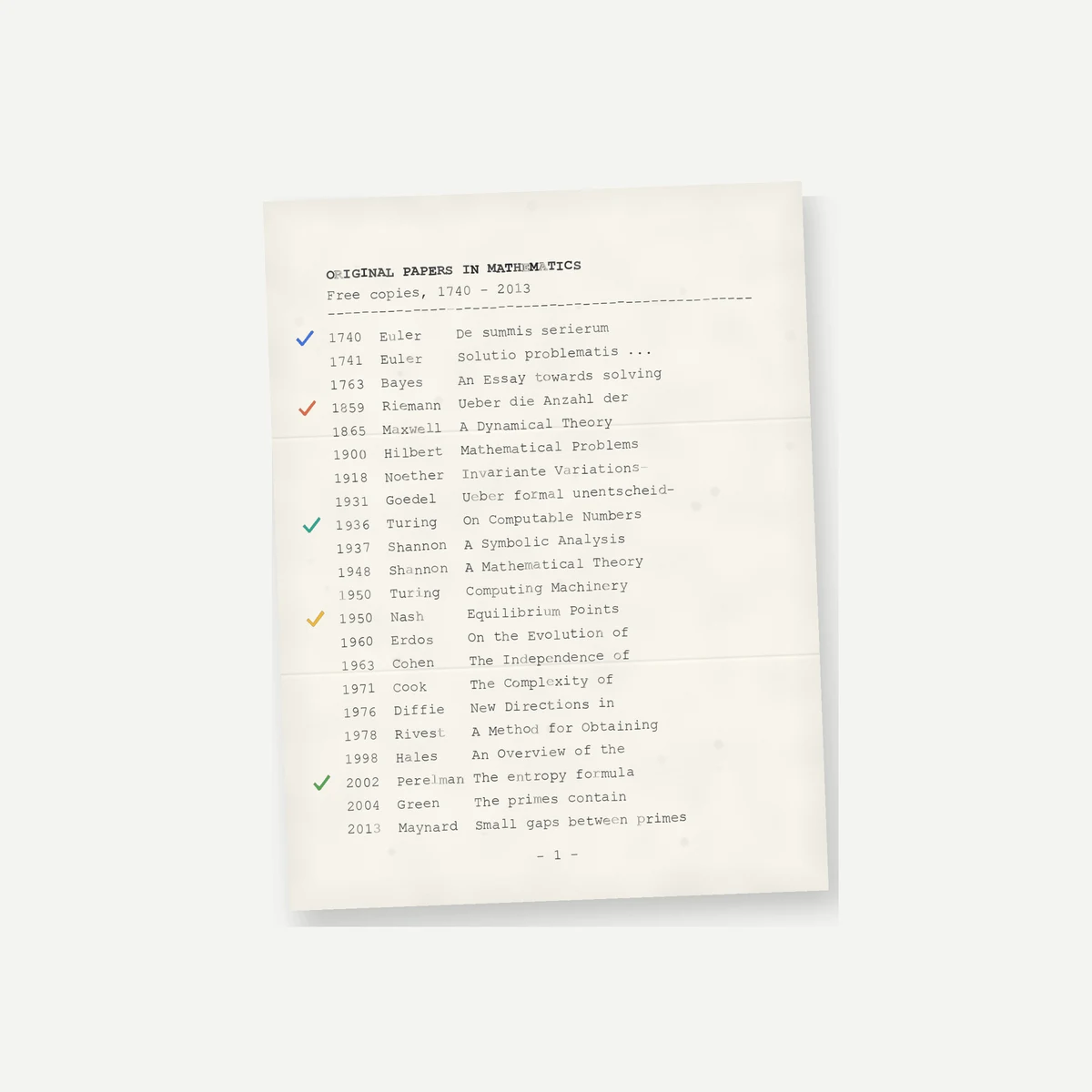
22 Original Math Papers You Can Read for Free
From Euler to Perelman, 22 papers that changed mathematics, each with its journal, language, page count and a free link to the original.
Open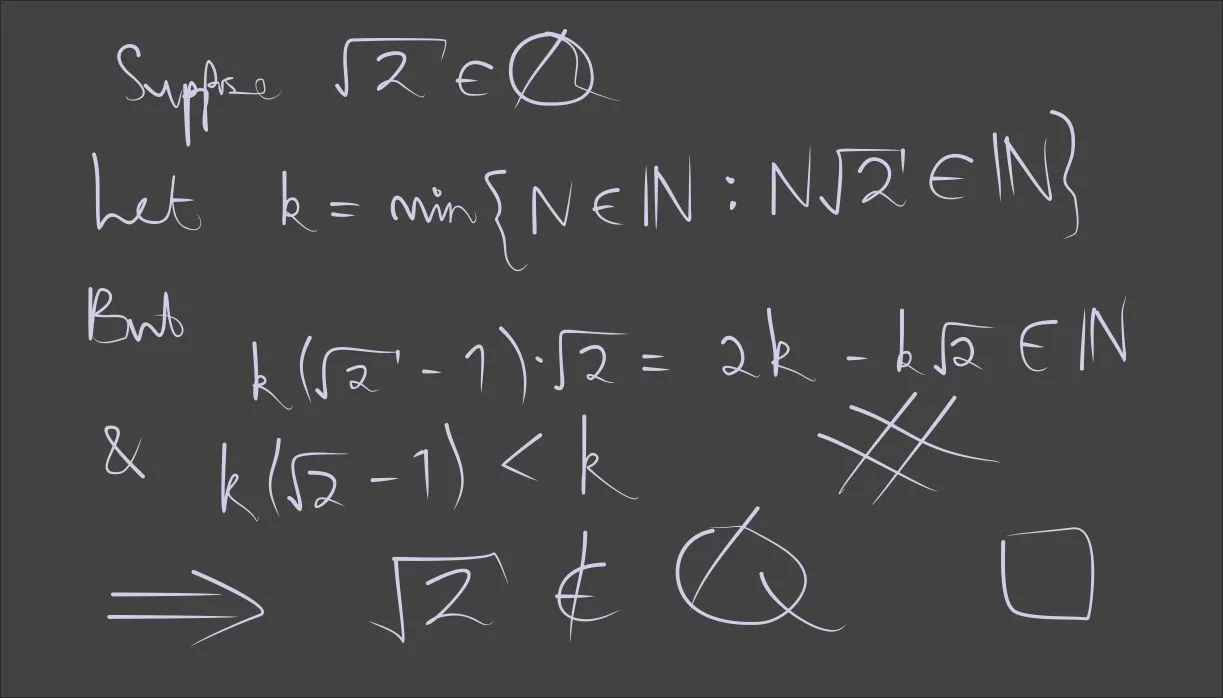
A Number That Cannot Be the Smallest
Most proofs that √2 is irrational use prime factorization. This one uses something simpler: if a smallest natural number witnessing rationality existed, you could always find a smaller one.
Open
James Garfield's Proof of the Pythagorean Theorem
In 1876, a congressman from Ohio proved a 2,400-year-old theorem in a hallway of the Capitol using nothing but a trapezoid. Five years later he was president.
Open