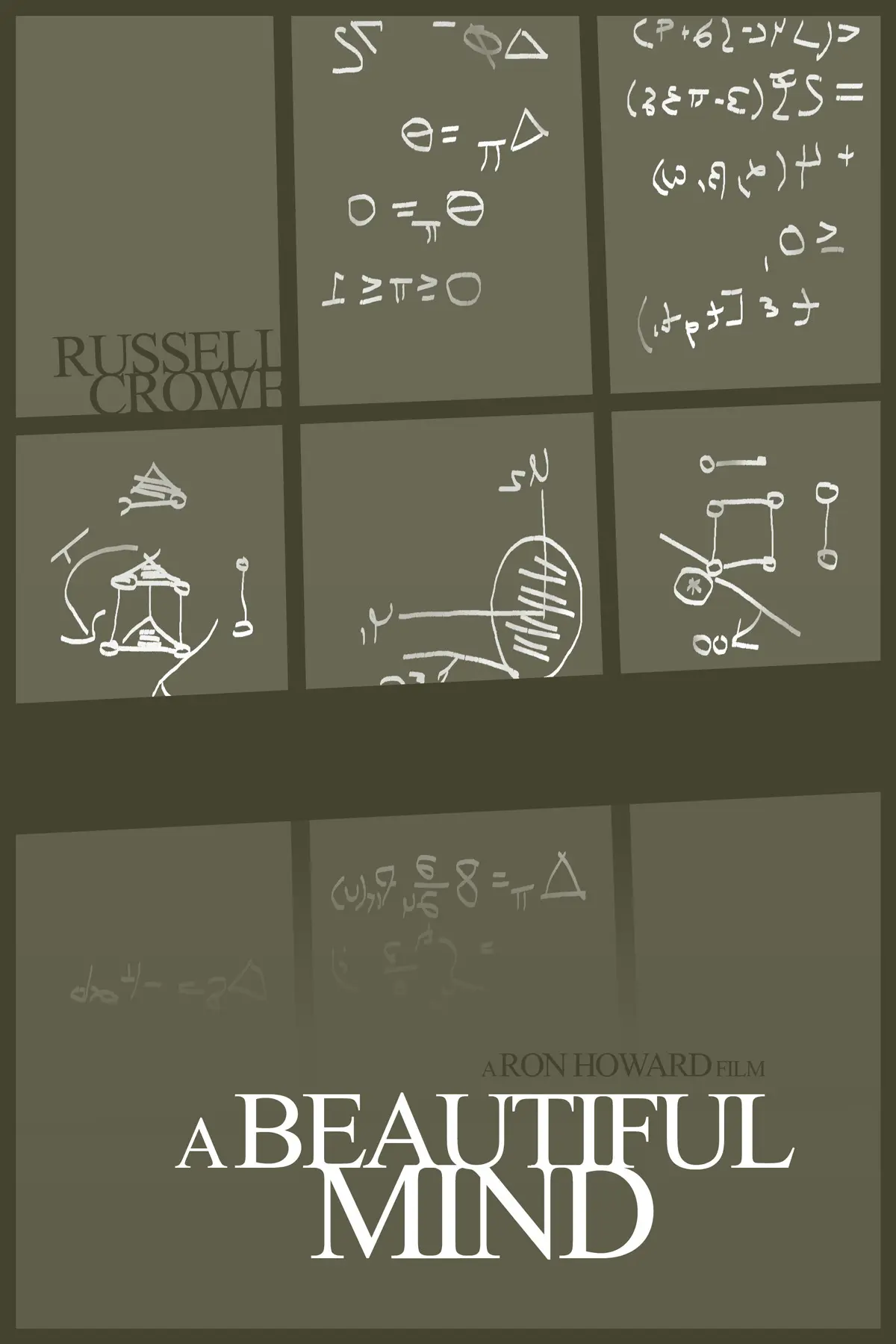
on Howard’s film took four Oscars, introduced John Nash to millions of people and softened the way audiences look at mental illness. While doing all of that it missed exactly one thing, which is Nash’s idea. There is a single scene in the film that shows how the mathematics works, and the solution in that scene is not a Nash equilibrium.
You will remember the scene. Nash and three friends are in a bar, five women walk in, one blonde and four brunettes, and every man in the group wants the blonde. Nash argues that if they all go for the blonde they will block one another and none of them will get her, and that when they turn to the brunettes afterwards they will be turned down as well, since nobody accepts being a second choice. So no one should go for the blonde and each of them should talk to a brunette. Nash says this, runs out of the bar and sits down to write his twenty-seven-page thesis.
The trouble is that everyone going for a brunette is the one arrangement the definition of equilibrium rules out.
A Nash equilibrium is a situation in which no player can raise his own payoff by changing his choice alone, given what everyone else is doing. The single-player deviation sits at the center of the definition. Look at the film’s arrangement with that in mind. Your three friends are heading for the brunettes, the blonde is standing there and looking straight at you. Walking over to the blonde is precisely a profitable deviation, and you have no reason at all to hold back. So the arrangement is not an equilibrium, it is only a pleasant outcome for everybody. This is where the film’s game theory breaks, because the scene is actually running a critique of Adam Smith and putting Nash’s name on it.
Change the four men’s choices on the board below and see which arrangements hold as equilibria.
This arrangement is not an equilibrium. Nash, Sol, Bender, Hansen each score more by switching alone.
Play with the board for a minute and what the film turns upside down comes out. Everyone going for a brunette is not an equilibrium, and everyone going for the blonde is not one either, since there a single man moves to a brunette and climbs from zero to five. The equilibria are the four arrangements in which exactly one man goes for the blonde, and none of them is the moral conclusion the film argues for. A Nash equilibrium promises no fair outcome, it describes an outcome nobody can walk away from on his own.
A twenty-seven-page thesis
Princeton, 1950
The film’s truest instinct is showing how short Nash’s idea was. The text of the doctoral thesis titled Non-Cooperative Games runs twenty-six pages and its bibliography holds two entries, and one of those two is a paper of his own. The other was the von Neumann and Morgenstern book, and what Nash did was lift that book’s solution out of the narrow case of two-person zero-sum games and open it to any number of players with any preferences. A thesis that short is rarer than it sounds.
The proof itself is elegant. Nash showed that every finite game has at least one equilibrium using Kakutani’s fixed point theorem, which makes it an existence theorem. He shared the 1994 Nobel in economics with Harsanyi and Selten, and the prize went to a thesis he had written forty-four years earlier.
The illness on screen
Charles, Marcee, Parcher
This is the most argued-over part of the film. Nash’s hallucinations were auditory, while the ones on screen are visual. The roommate Charles, the little girl Marcee and the agent in the hat, Parcher, were invented so that the audience could stand inside Nash’s head. Howard made that choice because he did not think an auditory delusion could be carried in a film, and he wanted the delusions to begin as sound before turning into images.
Two more things come from the same place. The pen ceremony at Princeton is entirely made up, and so is the line in the 1994 scene about taking the newer medications. Nash took no medication after 1970 and the line was added later, because the team worried the film would be read as saying schizophrenia can be beaten without treatment. These are the film’s two most honest interventions, one made to give the audience a sense of closure, the other made to protect a viewer who is ill.
The Nash the film never shows
The embedding theorem and Hilbert's nineteenth problem
The work that earned Nash his real standing among mathematicians is missing from the film. The embedding theorem he wrote during his MIT years says that an abstract Riemannian manifold can be placed isometrically inside ordinary Euclidean space, meaning it goes in with its curvature intact and nothing distorted. That body of work, which the film never touches, together with his solution to Hilbert’s nineteenth problem, brought him the Abel Prize in 2015. Ask Nash and game theory was a small corner of what he did.
Sylvia Nasar’s 1998 biography covers all of it, and the film took very little from the book. Dave Bayer worked on the production as its mathematics consultant, the formulas written across the windows came from his hand, and the logic of the bar scene stayed in the screenplay.
The film still holds value for me. It gets wrong what a mathematician does and gets right where a person doing mathematics stands. Chalk on the glass, a corner of the library to sit in alone, pages nobody reads for years. Nash received the Abel Prize in Norway on 19 May 2015, and on the way back, in a taxi from the airport, he was killed in a crash.
- Director
- Ron Howard
- Screenplay
- Akiva Goldsman, from Sylvia Nasar's book
- Cast
- Russell Crowe, Jennifer Connelly, Ed Harris, Paul Bettany
- Oscars
- Picture, director, supporting actress, adapted screenplay
- Running time
- 135 minutes
In short
It gets wrong what a mathematician does and gets right where a person doing mathematics stands. The one scene built to explain the idea explains something else — and the work Nash is actually revered for never appears.
Also on Abakcus
For the other films that started from a real life and then rearranged it, see five math movies that actually happened. For a mathematician who is also coming apart, but whose film knows exactly when it leaves the mathematics behind, there is Pi. And for the gentler version of the same question — what to do with a mind nobody knows how to place — Good Will Hunting.