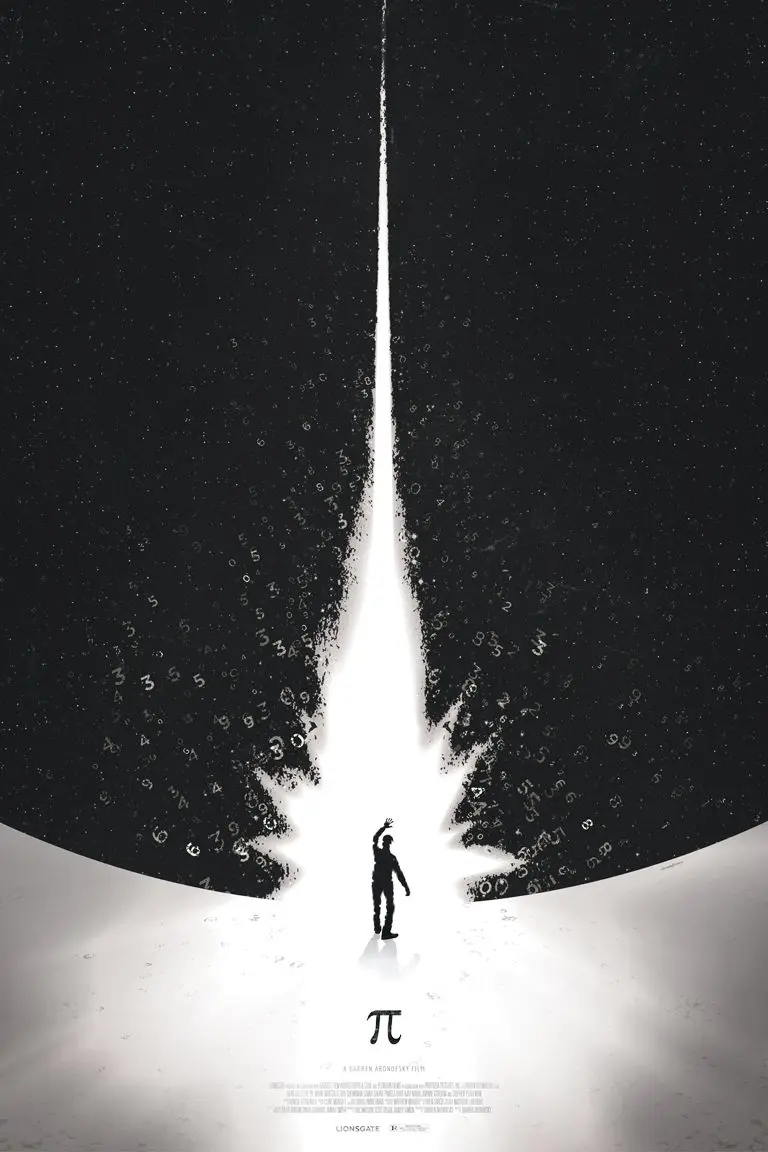
he first sound in the film is a man announcing the time. Max Cohen turns to the camera, says the hour out loud and starts his assumptions over from the top, because starting over is the only method he has left. Aronofsky’s debut takes place entirely inside the head of a number theorist hunting for a hidden order in the stock market, and the inside of that head, like the high-contrast stock the film was shot on, is either all white or all black.
The assumptions arrive in the first minute of the film, and the next eighty-four minutes take them apart one at a time.
Max Cohen’s assumptions
- Mathematics is the language of nature.
- Everything around us can be written down in numbers and understood that way.
- Graph the numbers of any system and patterns come out.
Therefore, patterns are everywhere.
The first two are beyond argument. The third one looks that way too, which is where the whole trouble sits. Plot the numbers of any system for long enough and a pattern will show up, true, but nobody ever established that the pattern belongs to the system. What Max is sick with is not mathematics, it is something else wearing mathematics as a coat.
The 216-digit number
Euclid crashes
In an apartment in Chinatown, Max runs a machine he calls Euclid and tries to see the market before it moves. One day the machine prints a 216-digit number and a single stock pick, then shuts itself down. Max throws the printout in the trash, learns the next morning that the pick was right, and never quite comes back to himself after that.
One of the best moments in the film is the change in his old teacher Sol’s face the second he hears how many digits it has. The same number had come to him years earlier. Soon after, Max meets Lenny, who does numerical work on the Torah, and learns that the 216 digits line up with the 216-letter name of God in the kabbalistic tradition. Seventy-two names, three letters each, 216 in total. The number carries a quiet joke of its own, since 216 is also six cubed.
From that point on the film walks out of mathematics and into numerology, and it does so on purpose. Sol’s warning to Max names the move exactly.
The moment you set scientific rigor aside, you stop being a mathematician and become a numerologist.
Sol Robeson’s warning to Max
Does π actually hide a pattern
The question underneath the film
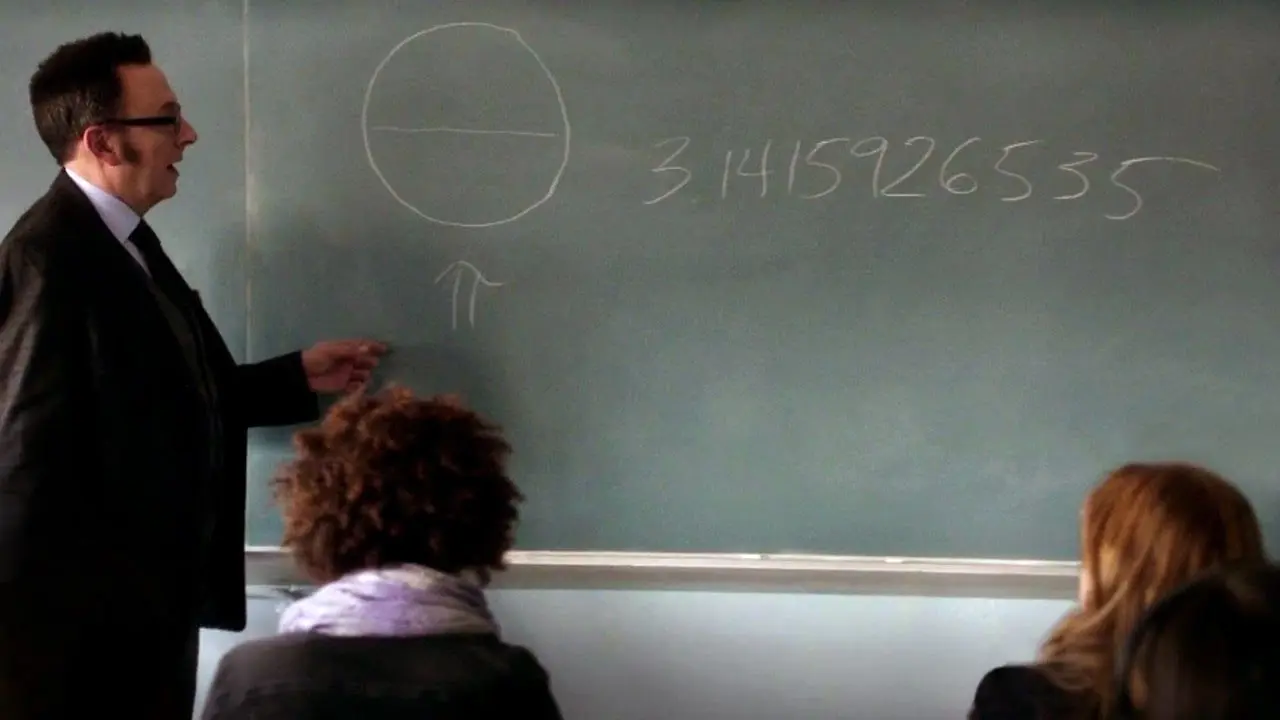
The thing Max is after has a name in mathematics. A number whose digits contain every digit and every string of digits with equal frequency in the long run is called normal, and whether π is normal is still an open question. Across the trillions of digits computed so far, the statistical tests have turned up no meaningful departure from randomness, so the number behaves as if it were normal, and nobody has managed to prove that it is.
Here is the other side of it. If π is normal, then every finite string of digits shows up somewhere inside it. Your birthday, your phone number, Max’s 216-digit number, all of them are in there. Finding a pattern stops being a discovery and turns into a question of patience. Max’s tragedy is not that he finds something false, it is that he takes what he finds to mean something.
Type a number into the box below and see where it turns up in the first five thousand digits of π.
216 starts at decimal place 991.
…2680661300192787661119590921642019893809525720106548586…
Typing 999999 into that box gives the result that sums up my favorite thing about the film. Six nines line up back to back at the 762nd decimal place, and arriving that early makes it feel like the number is telling you something. It is not. Clusters like this happen in a random sequence, and their absence would be the strange result. Max burns down because he cannot see that difference.
A film shot for sixty thousand dollars
November 1997, New York
The production story is worth telling on its own. Aronofsky knocked on the door of everyone he knew and collected donations of a hundred dollars each, promising to pay every one of them back a hundred and fifty if the film made money. The production budget came to 60,927 dollars and post-production added another 68,183 on top of it, with the crew on 200 dollars a day and the actors on 75.
Matthew Libatique shot the film on black-and-white reversal stock, and Aronofsky had said from the start that he did not want a gray picture, the frame would be black or it would be white. The narrow exposure latitude and the coarse grain of that stock give the film a hardness closer to the earliest years of photography, and there is no better surface for the inside of Max’s head.
The most imitated shot in the film, the camera strapped to the actor’s chest, comes out of the same logic. The rig known as the Snorricam had been built for a punk band’s low-budget music video and reached Aronofsky through a friend who happened to be on that set. Because the camera is fixed to Max’s body his face stays frozen in the middle of the frame while the street throws itself around him. It is the cheapest and most direct way to film anxiety.
Clint Mansell’s first film score was born here as well. The film took the Directing Award at Sundance in 1998 and its distribution rights sold for a million dollars, and it went on to make more than three million at the box office. Everyone who handed over a hundred dollars got their hundred and fifty back.
The drill at the end
Read it as a warning
The only thing Sol does across the whole film is try to stop Max. He sets out the Go board, he tells the story of chasing the same number in his own youth and the stroke that came out of it. What he is arguing against is not mathematics, it is the belief that a single answer exists. Max does not listen, and by the end of the film he puts a drill through his own skull.
In the last scene Max is sitting in a park. The girl he runs into every morning holds out her calculator and asks him a multiplication, the way she always does. He does not give her the answer. He looks up at the leaves and smiles.
- Director
- Darren Aronofsky
- Cast
- Sean Gullette, Mark Margolis, Ben Shenkman
- Cinematography
- Matthew Libatique
- Score
- Clint Mansell
- Running time
- 84 minutes
In short
A film that starts inside mathematics and walks out of it on purpose, then spends eighty-four minutes showing you what is left of a man who cannot tell the difference between a pattern and a meaning.
Also on Abakcus
For the other side of the same coin — genius as a gift nobody knows what to do with, rather than a curse — see Good Will Hunting, and for the rest of the shelf, the best math movies. If what you actually want is π itself rather than a man losing his mind over it, there is a whole list of books about the number.