17 Equations That Changed the World
From Pythagoras to chaos theory, from the phone in your pocket to the satellites overhead, the seventeen short lines holding up the skeleton of civilization.
“To avoid the tedious repetition of these words — is equal to — I will set, as I do often in work, a pair of parallel lines. Because no two things can be more equal.”
Robert Recorde, The Whetstone of Witte, 1557The equals sign has an inventor. In 1557 a Welsh physician and mathematician named Robert Recorde grew tired of writing “is equalle to” on every line, so he drew two parallel strokes and explained his reasoning exactly as above. No two things could be more equal than two parallel lines. That small mark, born on an ordinary afternoon, became the backbone of the most powerful sentence humankind ever devised: something on the left, something else on the right, and two little lines between them saying these are really the same.
In In Pursuit of the Unknown: 17 Equations That Changed the World, Ian Stewart picks seventeen lines built from that sentence and asks the same three questions of each: what does this equation say, why does it matter, and where did it lead us? The list opens with Pythagoras and closes with the Black-Scholes equation, the formula that helped light the fuse of the 2008 financial crisis. Every stop in between is a turning point that explains how the world came to look the way it does now.
In this piece I take all seventeen equations one at a time. I show the formula, explain in plain terms what it says, and add my favourite part: exactly where that equation stands in your life, right now. Because none of these is a museum piece. Every one of them is still clocking in inside the screen you are reading this on, the phone in your pocket, the fridge in your kitchen, the satellite over your head.
Seatbelt on. Here we go.
The Pythagorean Theorem
the first bridge between geometry and algebra
It all begins here. The three sides of a right triangle cannot live independent lives. Square the two short sides, add them, and you have the square of the long one. To see why such a simple sentence matters so much, notice this: the theorem is the first solid bridge between shape and number. It sits geometry and algebra at the same table, and from that table come the coordinate system, trigonometry, and the very idea of distance.
The nice twist is that Pythagoras did not discover it. The Babylonians knew the 3-4-5 triangle a thousand years earlier, and Egyptian builders squared their corners with knotted ropes. What his school gets credit for is the proof, the demonstration that this is not just a handy trick but a necessity of the universe. And that idea of proof is the very spark that turned mathematics from a measuring craft into a science.
In everyday life
Your television is “55 inches” thanks to this theorem, because screens are measured along the diagonal. Your navigation app finds the straight-line distance the same way. A builder still checks a wall for square with the 3-4-5 rule. When I referee a football match, the reason my diagonal run is the most efficient path comes down to this theorem too: the diagonal is always shorter than running the two sides separately.
Logarithms
the trick that turns multiplying into adding
John Napier's problem was not philosophical but thoroughly practical. Sixteenth-century astronomers had to multiply eight- and ten-digit numbers by hand for their sky calculations, work that took years and filled up with errors. Napier's invention assigned every number a shadow number. Add the shadows and you got the shadow of the product. Multiplication, a hard operation, had turned into addition, an easy one.
Kepler used these tables to compute planetary orbits and wrote Napier thank-you notes that read almost like love letters. For the next three and a half centuries the slide rule the engineer carried in his pocket was really a logarithm table carved into wood. Apollo engineers ran some of the calculations for the Moon rocket on those rules.
In everyday life
Earthquake magnitude is a logarithmic scale, which is why the gap from 7 to 8 is not “one unit” but about thirty-two times the energy. The decibel that measures loudness, the pH that measures acidity, all of it is logarithms. Stranger still are your own ears and eyes: our senses perceive stimuli logarithmically, which is why your phone's volume rises on a curve rather than a straight line. The “Rule of 72,” which tells you how many years it takes compound interest to double your money, is a logarithm in disguise.
Calculus
the instant snapshot of change
Look at your speedometer while driving: 87 km/h. But what does that mean? You have not been on the road for an hour, you have not covered eighty-seven kilometres. That needle shows your speed at this very instant. Yet “this instant” lasts zero seconds by definition, and in zero seconds you travel zero metres. Zero over zero. The riddle Newton and Leibniz solved independently was exactly this: how to capture change inside a single moment.
The answer hides in that little h in the equation. Measure the change over a short interval first, then shrink the interval toward zero and watch what the result approaches. This idea became the mother tongue of science. Planetary orbits, epidemic models, weather forecasts, rocket equations, economics — the mathematics of everything that changes is written in calculus. Stewart is right: almost all of mathematical physics is a grandchild of this single line.
In everyday life
Every machine-learning model in your phone learns by taking derivatives to shrink its error. When an average-speed camera writes you a ticket, it is applying the mean value theorem to the derivative between two points. The dosing intervals in a drug leaflet are set by the derivative of the drug's concentration in your blood. And your speedometer is simply a derivative machine.
Newton's Law of Gravity
the one rule that drops both the apple and the Moon
This equation's revolution lies less in the formula than in its reach. Before Newton, the sky and the earth were two separate countries: the stars followed one set of laws, stones and soil another. Newton merged the two countries in a single line. The force that pulls an apple off a tree and the force that holds the Moon in orbit were the same force. The Moon, in fact, was constantly falling toward Earth, only moving sideways so fast that it kept missing.
The way the force fades with the square of the distance is no random detail either. It is a direct consequence of space having three dimensions: an influence spreading out from a source is smeared over ever-larger spherical surfaces, and the surface of a sphere grows with the square of its radius. The geometry of space is hidden inside the equation.
In everyday life
Thousands of satellites are circling above your head right now, and every orbit was worked out with this equation. Live match broadcasts, satellite internet, weather imagery — all of it arrives from up there. Fishermen read tide tables from the Moon version of this equation. Every craft sent to Mars chose its launch window with Newton's line. The equation is three hundred and forty years old and has not filed for retirement.
Complex Numbers
the revenge of the impossible number
The rule they teach at school says a number squared can never be negative. A positive squared is positive, a negative squared is also positive. But when sixteenth-century Italian algebraists worked on cubic equations, they hit something odd: the square roots of negative numbers kept appearing in the intermediate steps, and if you pushed on with these “impossible” numbers, the final answer came out correct. It was as though mathematics was letting a guest it had thrown out the door slip back in through the chimney.
Mathematicians called these numbers “imaginary,” half in scorn, and the name stuck. Yet i is nothing imaginary. As Gauss showed, complex numbers are two-dimensional numbers living on a plane, and multiplying by i means turning ninety degrees. Rotation, oscillation, waves — the most elegant language for anything periodic is complex numbers. The foundational equation of quantum mechanics cannot even be written without them.
In everyday life
The alternating current in your wall socket is analysed with complex numbers, and electrical engineers work with i every day (they call it j, since i is reserved for current). Your phone's signal processor untangles radio waves by rotating them on the complex plane. The equalizer in your headphones filters music in a complex-number space. The “imaginary” number turns out to be one of real life's hardest-working employees.
Euler's Formula for Polyhedra
topology's birth certificate
Take a cube: 6 faces, 12 edges, 8 vertices. 6 − 12 + 8 = 2. Now take a tetrahedron: 4 − 6 + 4 = 2. Take a classic football, 32 faces, 90 edges, 60 vertices: 2 again. For any solid without a hole, these three numbers, no matter how you stretch and squeeze it, always give the same answer. That stubborn 2 that Euler noticed is the first topological invariant in the history of mathematics: a number that looks not at a shape's measurements but at its very fabric.
From that small observation topology was born: the branch that forgets lengths and angles and studies the properties of shapes preserved under continuous deformation. To a topologist a coffee cup and a doughnut are the same object, each with a single hole. It sounds like a game, but this point of view plays a key role in a heap of questions, from how enzymes untangle the DNA helix in a cell to why the motion of celestial bodies can turn chaotic.
In everyday life
The reason your classic football is stitched from 12 pentagons and 20 hexagons is this formula: the patterns that tile a sphere have to obey Euler's equation. A subway map is topology itself, where the distances lie but the connections tell the truth. The way navigation represents a road network, social-network analysis, even wireless coverage problems, are all grandchildren of this family.
The Normal Distribution
the bell that chance rings
The formula looks frightening, but what it says is familiar: the chance of observing a value is highest near the mean and drops away quickly as you move away from it. How quickly is set by the standard deviation. Draw the graph and you get that bell curve you have seen at least once in your life, probably while an exam result was being announced.
So why is it everywhere? Because of the central limit theorem: the sum of many small independent effects approaches the bell curve no matter what distribution the individual effects came from. Height, measurement error, manufacturing tolerance — all of them are the sum of hundreds of tiny random factors, so all of them look bell-shaped. Stewart's warning is well placed too: the curve is so useful that statisticians sometimes force it onto places it does not fit at all. Stock-market crashes are the bitter proof of how often events the bell curve calls “nearly impossible” actually happen in real life.
In everyday life
Clothing sizes (S, M, L, XL) are set by slicing the bell curve of the population's measurements. When the doctor calls your newborn's weight a “percentile,” that is its position on this curve. The “±2 margin of error” in an election poll, the quality-control limits on a factory floor, the significance tests in a drug trial — all of them are the same bell ringing.
The Wave Equation
from one violin string to the whole universe
This equation's story begins with a violin string. D'Alembert asked the question: how does a small piece of a stretched string move? The answer is elegant: each piece accelerates toward the average position of its neighbours. If the neighbours are above you, you get pulled up; if below, down. Put that simple neighbourly relationship into mathematics and the solutions that come out are waves, travelling along the string.
The real surprise came later: the same equation held for sound, for water, for light. The mathematics written for a violin string turned out to be the shared grammar of every vibration in the universe. If you want to understand why physicists bond so romantically with a single equation, this is a good place to start.
In everyday life
Seismologists read what earthquakes reveal about the Earth's interior through variants of this equation, and the building-period calculations in seismic codes come from here. Oil companies map the underground with sound waves. The ultrasound image of a baby in the womb is the wave equation's letter to medicine. And a guitar's frets are nailed exactly at the points where the string's wavelengths divide.
The Fourier Transform
the hidden orchestra inside every signal
Joseph Fourier was a strange man who had joined Napoleon's Egyptian campaign, served as a governor, and grown curious about how heat spreads through metal. Working on the heat problem, he made a claim that drove his colleagues up the wall: any function, however jagged it looks, can be written as a sum of simple sine waves. Lagrange flatly said “impossible.” Fourier turned out to be right.
What this means is that a hidden orchestra lives inside every signal. A complex sound, an image, an earthquake recording, is really the sum of simple instruments each playing at a different frequency. The Fourier transform is the score that separates that orchestra back into its instruments. Split the signal into its frequencies, mute the one you don't want, add the rest back together. Noise cancellation, compression, filtering — all of it is those three steps.
In everyday life
Every JPEG on the screen you are reading this on was compressed with a cousin of Fourier's transform. The MP3 you listen to used Fourier analysis to find and throw away the frequencies your ear won't catch. Shazam extracts a song's frequency fingerprint. Your noise-cancelling headphones split ambient sound into frequencies and play the inverse. An MRI machine turns the signal from your body into an image with a Fourier transform. This is probably the mathematics you use most during the day, and you don't even know it.
A hidden orchestra lives inside every signal. Mathematics is the score that separates it back into its instruments.
The Navier-Stokes Equation
the ill-tempered constitution of fluids
It looks intimidating, but its essence is familiar: this is Newton's second law in disguise. The left side is the acceleration of a small blob of fluid, the right side is the forces acting on it: pressure, internal friction, external pushes. Mass times acceleration equals force, only written for billions of water droplets at once.
Writing the equation is easy; solving it is another story. Whether a general solution even exists is still unknown, and that question is one of the seven Millennium Problems for which the Clay Institute has offered a million dollars. So every morning when you check the forecast, you are trusting the numerical approximations of an equation that humanity does not yet fully understand mathematically. What is astonishing is how well those approximations work.
In everyday life
The wing of the plane you fly on was designed by solving this equation on supercomputers. The aerodynamics that pin Formula 1 cars to the track, the medical software modelling blood flow through your heart, the realistic water and smoke in animated films, all eat the bread of the same equation. The weather app is really a giant calculator where Navier-Stokes is solved four times a day.
Maxwell's Equations
the identification of light
∇×E=−1c∂H∂t ∇×H=1c∂E∂t
Four lines, one story: a changing electric field gives birth to a magnetic field, and a changing magnetic field gives birth to an electric field. Maxwell chased this loop and found something strange on paper: the two fields, feeding each other, could form a wave that travels through space on its own. He calculated the wave's speed, and the result came out almost exactly equal to the speed of light measured at the time. Maxwell's conclusion is one of the most beautiful sentences in the history of science: light is an electromagnetic wave.
The identity of light had been established at a desk, with pen and paper. More than that, the equation said waves ought to exist beyond visible light too. Hertz produced those waves in the lab, Marconi sent them across oceans, and the twentieth century began.
In everyday life
Whatever device you are reading this sentence on, it reached you over Wi-Fi or a cellular network, meaning over Maxwell's waves. Your Bluetooth headphones, the remote lock on your car key, your microwave oven, radio, television, radar, all are children of these four lines. You carry a billion-dollar application of Maxwell's equations in your pocket and call it a phone.
The Second Law of Thermodynamics
the universe's one-way street
The shortest equation on the list, and perhaps the most merciless. Entropy is, roughly, a measure of disorder in a system, and this law says that in a closed system entropy never decreases. Hot tea cools, cold tea never warms itself. A shattered glass does not reassemble. An egg gets scrambled but never unscrambles. Nearly every law of physics is symmetric backward and forward in time, but this one hangs a one-way sign over the universe. What we call the arrow of time has its physical address right here.
The law grew out of the work of engineers trying to understand the efficiency of steam engines. Carnot's question was commercial: how much work can you get out of a machine at most? The answer was that no machine can convert heat entirely into work. Ever since, every engine, every power plant, every refrigerator keeps bumping against the ceiling this law set.
In everyday life
The way the back of your fridge heats up while it cools its inside is this law's signature: the price of moving cold from one place to another is producing more heat overall. Your car engine delivering only about a third of the fuel's energy to the wheels, the cooling towers of power plants, even your phone warming as it charges — all of them are the invoice entropy sends.
Relativity
the energy sleeping inside matter
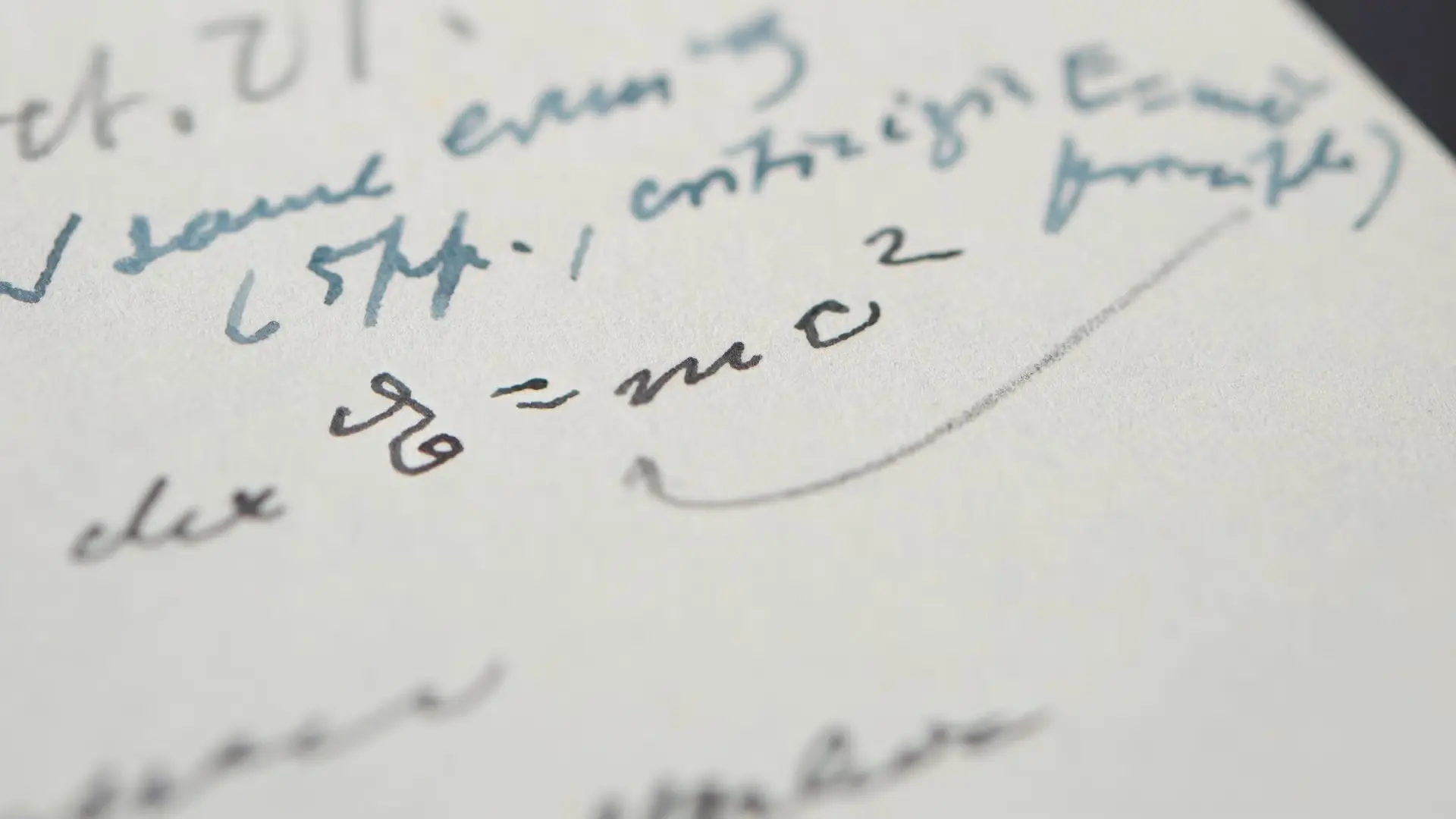
The world's most famous equation, and probably its most misunderstood. What it says is this: mass and energy are two currencies for the same thing, and the exchange rate between them is the speed of light squared. That rate is astronomically high: if one kilogram of matter turned entirely into energy, it would release roughly forty percent of the energy of the largest nuclear weapon ever detonated. The kilo of flour on your kitchen scale carries, in theory, enough energy to light a small country for months. Fortunately the flour is extremely tight-lipped about it.
As Stewart stresses, the claim that the equation “gave birth” to the nuclear bomb is closer to urban legend. Its real legacy is rewriting our understanding of space and time: time stretching with speed, space curving with mass, black holes, the Big Bang. And, surprisingly, a job right in the middle of everyday technology.
In everyday life
Your navigation depends on relativity: the clocks on GPS satellites drift from clocks on the ground by microseconds a day, both because of their speed and because of the weaker gravity up there. Left uncorrected, your position would wander off by more than ten kilometres a day, and navigation would be useless within a day. Nuclear plants convert mass directly into electricity. And the PET scan at the hospital takes the P in its name from the positron, a piece of antimatter, and runs on E = mc².
The Schrödinger Equation
matter in its wave form
The “impossible” number i from Plate V takes the lead role here. Schrödinger's equation models matter not as a particle but as a wave, and describes how that wave spreads. The wave function Ψ is the cloud of probability for where a particle might be found. At the subatomic scale there is no certainty, only probability. An electron does not sit in one place, it lives in a distribution of possibilities.
The philosophical aches of this idea have not eased in a hundred years. Schrödinger himself set up his famous cat thought experiment to point out the strangeness in the theory's interpretation, and the cat, over its owner's objection, became the mascot of physics folklore. But on the experimental side there is no dispute: quantum mechanics is the most accurate theory humanity has ever tested, and all of modern electronics stands on top of it.
In everyday life
The chip in your phone holds billions of transistors, and every one was designed around the quantum behaviour of electrons. Flash memory is written by pushing electrons through a barrier they could never cross in classical physics, using quantum tunnelling, which means you store your photos with a literal quantum trick. Lasers, LED bulbs, solar panels, all are on Ψ's payroll.
Information Theory
the founding charter of the information age
In 1948 Claude Shannon asked a strange question: can information be measured? His answer was this equation, and it was his paper that introduced the word “bit” into humanity's vocabulary. The idea is clever: the information a message carries is measured by the surprise it causes. “The sun will rise tomorrow” carries almost zero bits because it surprises no one. What is rare, what is unexpected, that is information. That the same formula turns up as entropy in thermodynamics is one of the deepest coincidences in physics, or perhaps not a coincidence at all.
Shannon set two ceilings: how far a message can be compressed at most, and how much error-free data can be pushed through a noisy channel at most. Engineers have been racing to approach those two ceilings ever since, and what we call the digital age is really that race itself.
In everyday life
Every photo you send on WhatsApp is compressed according to Shannon's limits. A scratched CD plays without skipping thanks to error-correcting codes. The QR code at the checkout is coded with enough redundancy that it still reads even if a third of it is covered. ZIP files, photos from space probes, banking encryption — the twenty-first century is played inside the field Shannon drew in 1948.
Chaos
the wild child of a simple rule
This is the most innocent-looking equation on the list. Written with high-school algebra, it is a tiny rule modelling how a population changes from one generation to the next when resources are limited. But turn up the value of k slowly and strange things happen: the population first settles on a fixed value, then starts oscillating between two values, then four, then eight, and past a certain threshold it becomes complete bedlam — behaviour that settles into no pattern, looks random, yet has not a shred of randomness in it. Deterministic chaos.
The real lesson is this: even simple, fully deterministic systems can behave unpredictably, and an imperceptibly small difference in the starting conditions can change the outcome entirely. This is what Lorenz called the butterfly effect. Some of what we take for randomness is really the impatience of a hidden order.
In everyday life
The reason the weather forecast keeps its mouth shut about ten days out is the law of chaos: because the atmosphere is chaotic, measurement error grows exponentially and the forecast horizon is mathematically limited. Cardiologists analyse chaotic patterns in heart rhythm. Space agencies, meanwhile, turned chaos from enemy to ally: probes ride chaotic orbital corridors to tour the planets on almost free fuel.
The Black-Scholes Equation
the formula that grows money and burns it
The youngest and most controversial member of the list. Black-Scholes tells you what a financial derivative, say the right to buy a stock at a set price on a future date, is worth today. The principle it rests on is elegant: if the price is right, no one can make a risk-free profit. Thanks to this equation, options acquired a “rational” price and became goods to be bought and sold, and derivative markets swelled to a volume many times the size of the world economy.
The trouble is in its assumptions. The model assumes market swings follow a well-behaved distribution. Remember the bell curve from Plate VII: it gives almost zero probability to events at the extremes. But real markets love the extremes. Crashes the model calls “once in a hundred thousand years” knock at the door every few decades. The 2008 crisis was a globally scaled, harshly priced lesson in the difference between understanding an equation and trusting it blindly. Stewart's placing this equation on the list is, I think, a deliberate warning: mathematics changes the world for the better too, but it only “changes” it.
In everyday life
Your pension fund, the protected investment products the bank sells, the hedges companies use against currency risk, the futures contracts that let a farmer sell a crop before harvest — all of them stand on the ground this equation laid. Whether you notice it or not, this formula met your money long ago.
A confession to close on. Writing these seventeen equations one after another, the thing that struck me is that none of them was found in order to “find an equation.” Napier wanted to end the astronomers' calculating misery. D'Alembert was curious about a violin string. Fourier was wrestling with heat. Shannon was fighting the noise on telephone lines. Each one went after a small, concrete, almost ordinary problem and came back holding a key that opens the universe.
Let us return to Robert Recorde's two parallel lines. “No two things can be more equal,” he said. Five centuries later, a violin string was written on the left of those lines and radio waves on the right. A falling apple was written on the left, the Moon on the right. Mass and energy, heat and information, order and chaos met on the two banks of the same lines. An equation is really a tip-off letter reporting that two different corners of the universe are secretly the same thing. Because these seventeen letters were opened, the world changed. Who knows how many are still waiting in their envelopes.