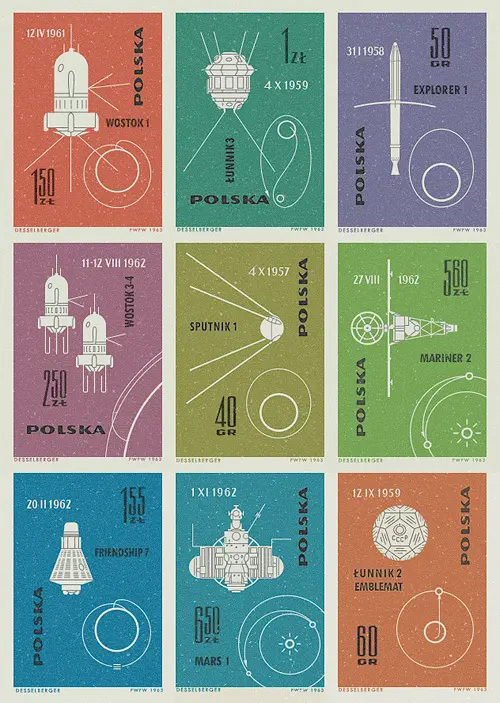
In 1963 the Polish post issued a ten-stamp series titled “Conquest of Space.” Each stamp shows a satellite or spacecraft sent into space between 1957 and 1962. Across the sheet are Sputnik 1, Łunnik 2 and 3, Wostok 1 and 3-4, and from the American side Explorer 1, Friendship 7, Mariner 2, and Mars 1. In the corner of each stamp is the exact launch date and the craft's name.
The visual language of the series is spare and consistent. Each spacecraft is drawn in white thin lines on a single-color ground. These lines, which recall an engineering drawing, render the body, the antennas, and the orbital path of the craft in just a few strokes. On every stamp a planet or orbital ring repeats as a plain circle. The colors set them apart. Brick red, mustard green, purple, turquoise, and orange come together so the sheet reads like a color palette.
A few white lines fit an entire age of satellite launches into a single frame.
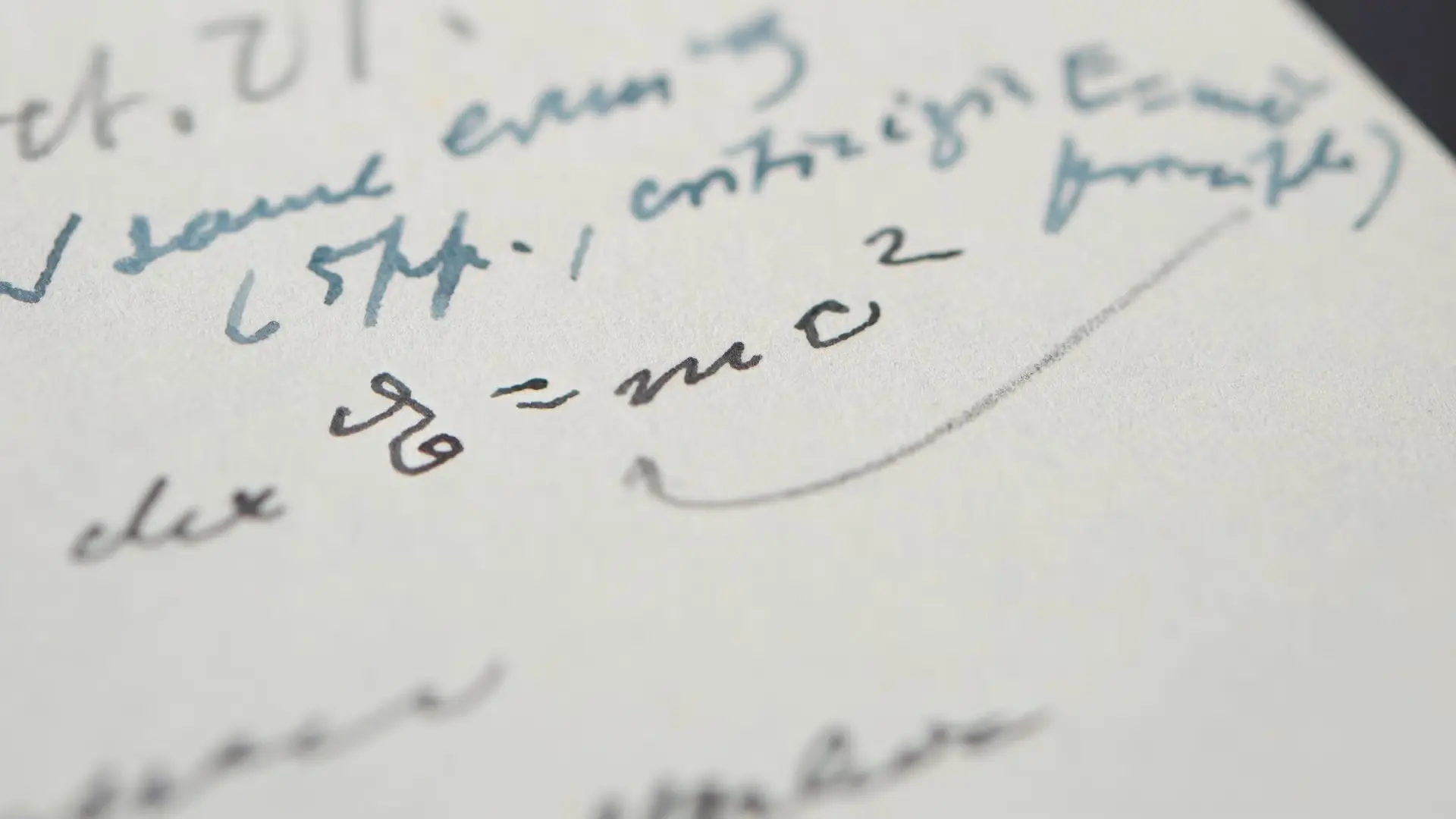
The spacecraft in the series are chosen from both the Soviet and American programs. Sputnik 1 is the first artificial satellite to reach orbit, in 1957. Łunnik 2 is the first human-made object to reach the surface of the Moon. Łunnik 3 was the first to image the far side of the Moon. Wostok 1 is the craft that carried Yuri Gagarin. From the American side, Explorer 1, Friendship 7 for John Glenn's orbital flight, and Mariner 2 the first successful interplanetary craft to reach Venus. The series thus sets the space race of the era side by side on one sheet — a compressed history of orbital mechanics at the scale of a postage stamp, not unlike how Einstein's equations once traveled on paper no larger than a letter.
The “DESSELBERGER” signature in the lower corner of the stamps belongs to the designer. Jerzy Desselberger is one of the leading figures of post-war Polish stamp art. This generation, working within the limits of a small piece of paper, developed both technical precision and a spare graphic language — the same discipline that makes a physicist's notebook or a typographer's page legible at a glance. This series is a good example of that sensibility. The designer avoided ornament and settled for just enough line to make each craft recognizable.
Today the series continues to draw the interest of collectors and graphic designers. Its simplicity, limited palette, and engineering-drawing lines still look modern sixty years on. It can also be read as a design lesson. It is a plain example of saying much with little line and of ordering a page through color. Six decades after launch, you can still walk through a space station from your browser — but these stamps remain the most compact map of how we first left Earth.
Source: Present & Correct