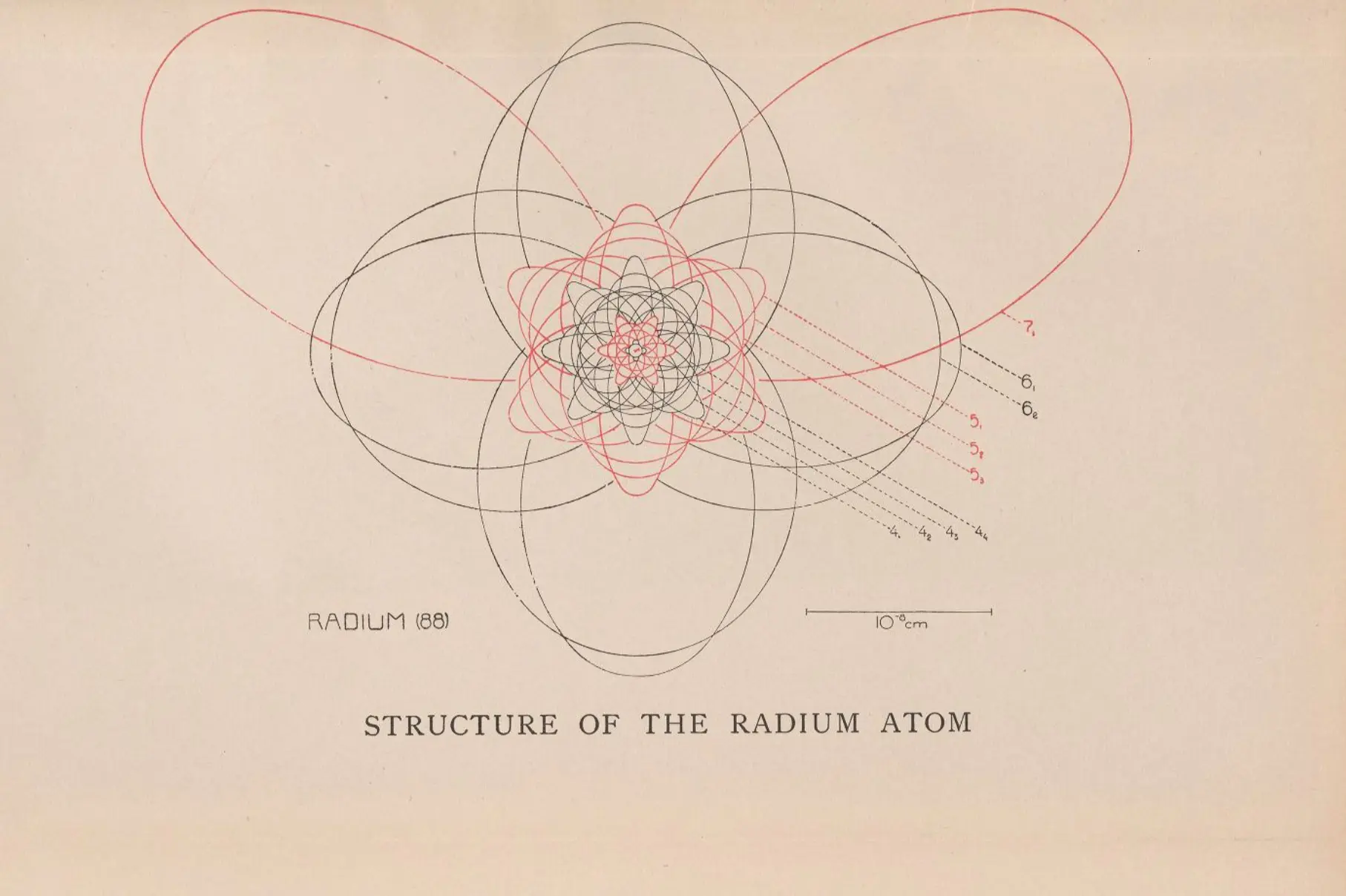
You have probably seen this plate somewhere. Dozens of nested ellipses on yellowed paper, a swarming black and red knot at the centre, two enormous red loops opening outward like wings, and a column of numbers on the right tied to the drawing by fine dotted leaders. At the bottom sits a single line of type, the structure of the radium atom.
Almost every time the image surfaces online it carries the same note: Niels Bohr’s own hand. Fermat’s Library posted it with that caption in 2017 and the label spread from there to Reddit, Pinterest and a long tail of Facebook pages. The Abakcus account posted it the same way, which is why the correction belongs here.
There is no signature on the plate, no date, no artist. Only a scale bar, the name of the element and its atomic number. Everything else was added later.
Plate
The book is not by Bohr, it is about him
The image comes from Bohrs Atomteori, almenfatteligt fremstillet, published in Copenhagen in 1922. The title means roughly “Bohr’s Atomic Theory, Explained for Everyone.” The authors were Helge Holst, a Danish librarian and science writer, and Hendrik Anthony Kramers, the Dutch physicist who had been Bohr’s first assistant. The catalogue entry lists 32 figures and two colour plates, and this is one of the two.
The Danish edition was printed in two thousand copies for a country of about three and a third million people. When Bohr took the Nobel Prize in Physics that December, an English translation was pushed through quickly and appeared in 1923 in Copenhagen and London. Robert Bruce Lindsay and his wife Rachel Tupper Lindsay, then living in Copenhagen on a fellowship, did the translation, and Ernest Rutherford wrote the foreword from the Cavendish Laboratory, dated 8 October 1923. On the title page Kramers is a lecturer at the institute for theoretical physics and Holst is librarian at the Royal Technical College of Copenhagen.
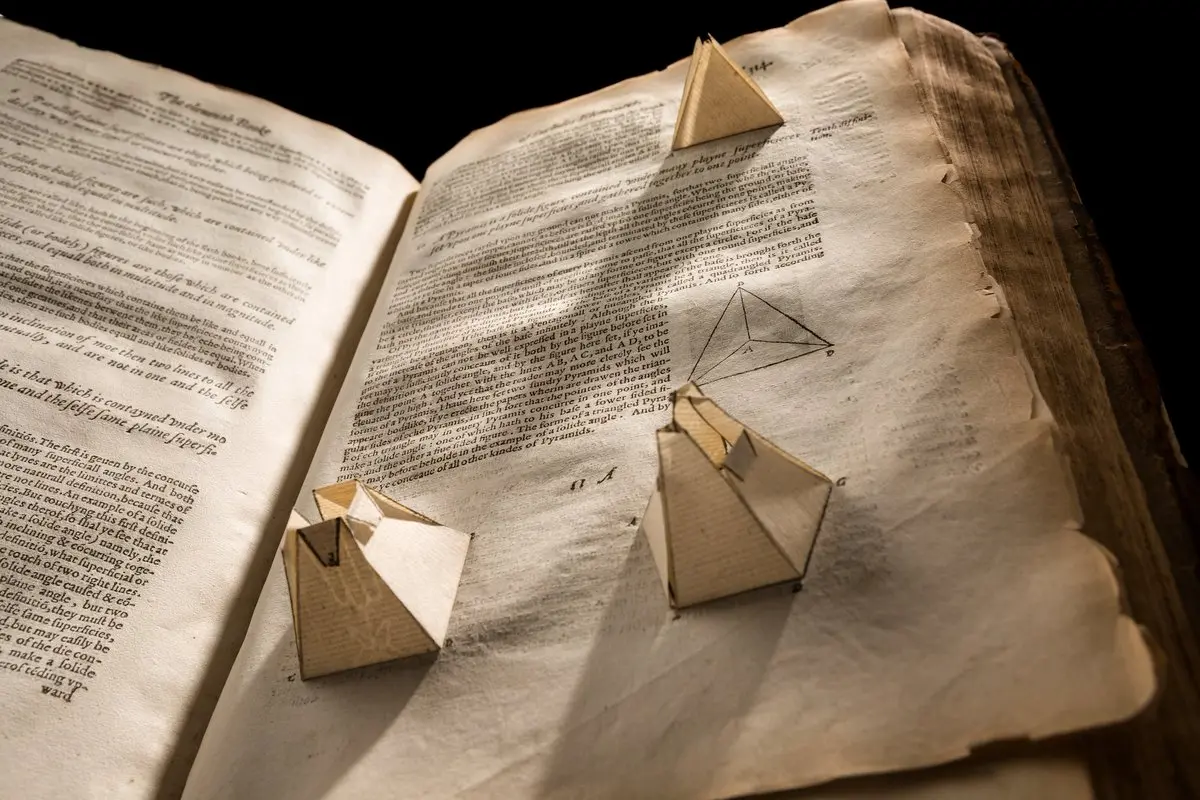
The radium plate is the last folded sheet at the back, wider than the page it lives in. Folding a diagram into a book is an old printer’s trick for a picture that refuses to fit the page — the same one that gives the first English Euclid its pop-up solids. The high-resolution scan circulating online comes from the copy held by the Smithsonian libraries, uploaded at the end of 2024 and free to anyone.
One more detail. The first Danish edition drew eleven elements, carbon among them. Carbon was quietly dropped from every later edition, because Bohr had begun to doubt his own symmetric arrangement for it. He was right to doubt it.
Artist
So who drew these ellipses
Nobody knows. The closest thing to evidence comes from Kramers himself. Writing in 1923 for an issue marking the tenth anniversary of Bohr’s theory, he says the plates were made at Bohr’s request for use in his lectures, not for the book. That same year the Canadian physicist John McLennan showed the pictures at the British Association meeting in Liverpool and was even more careful, noting only that they were said to resemble the ones Bohr used in his own lectures.
The Niels Bohr Archive in Copenhagen holds glass lantern slides from the period with atomic pictures on them. Whether these are the originals Bohr projected or reproductions made from the book is not known. Helge Kragh and Kristian Hvidtfelt Nielsen, who traced the book’s history in detail, settle it in one sentence: little is known about the origin of the diagrams. There is no equivalent here of the Zurich notebook, where every line is demonstrably Einstein’s, or of a journal filled page by page in one hand.
So “Bohr’s sketch” claims too much. “Nothing to do with Bohr” claims too little. What actually happened is that a piece of teaching material Bohr commissioned, explained and used, drawn by someone whose name has not survived, went into a book and then carried his signature for a hundred years.
Notation
What the numbers on the plate mean
The labels down the right side read 41 42 43 44 and 61 62 in black, 51 52 53 and 71 in red. This nk notation did not exist in the original 1913 model. The large number n is the principal quantum number. The small number k is the second quantum number Arnold Sommerfeld introduced when he turned Bohr’s circles into ellipses.
The job of k is to fix the shape. The ratio of the short semi-axis to the long one is exactly k over n. When k equals n the ellipse collapses into a circle. When k drops to one the orbit narrows into a needle and the electron dives to the bottom of the nucleus on every pass.
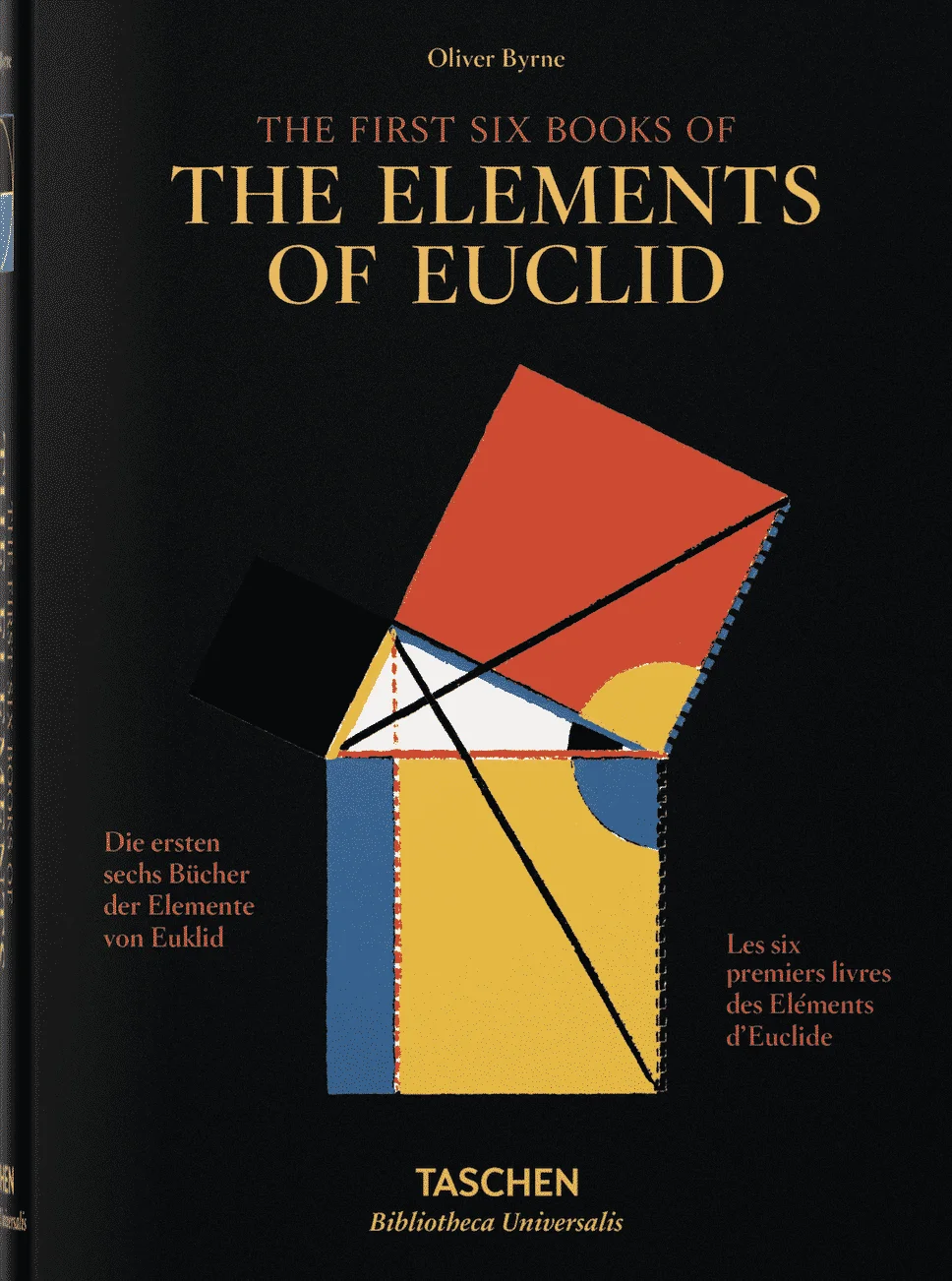
The colours are not decoration either. Orbits with even n were printed black, odd n red — the same discipline that lets Byrne’s coloured Euclid replace letters with inks. The eight-pointed black star at the middle is n equals 4, the red rosette wrapped around it is n equals 5, the large black ovals outside are n equals 6, and the two red wings at the edge are n equals 7. The scale bar at the lower left marks 10−8 centimetres, one ångström. So the plate is not only a schematic. It makes a claim about how big the thing is.
Rule
The symmetry Bohr imposed in 1921
The arithmetic behind the plate comes from a short letter Bohr sent to Nature in the spring of 1921. There he argues that electrons are captured by the nucleus one at a time: the first two into one-quantum orbits, the next eight into two-quantum orbits, the next eighteen into three-quantum orbits and the next thirty-two into four-quantum orbits.
The bold part comes next. In the same letter Bohr divides each group into equal sub-groups. The group of eight becomes two sub-groups of four, the group of eighteen becomes three sub-groups of six, and the group of thirty-two becomes four sub-groups of eight. Each of the labels 41 42 43 44 on the plate therefore stands for exactly eight electrons.
Bohr’s answer to what holds the whole arrangement together arrives here too. The outer orbits, especially the flattened ones with small k, plunge in among the inner shells on every revolution. He calls this penetration a coupling between the groups and makes it the reason the atom does not simply fall apart. You can see it on the plate. The great red wings belong to the outermost electrons, yet their sharp ends reach all the way down to the nucleus.
Rebuilt
Taking the plate apart shell by shell
The plate below is rebuilt from Bohr’s 1921 rule in code rather than traced. Every ellipse has its short axis set to k over n, the nucleus sits at a focus, the orbits of a sub-group are spread evenly around the full circle with sub-groups interleaved between one another, and the colours follow whether n is odd or even. Switch shells off and the frame zooms inward, which solves the one problem the printed plate could not: the outer orbits are so large that the forty electrons inside collapse into a single knot.
| Sub-shell | Electrons | b / a | Ink |
|---|---|---|---|
| 11 | 2 | 1.00 | red |
| 21 | 4 | 0.50 | black |
| 22 | 4 | 1.00 | black |
| 31 | 6 | 0.33 | red |
| 32 | 6 | 0.67 | red |
| 33 | 6 | 1.00 | red |
| 41 | 8 | 0.25 | black |
| 42 | 8 | 0.50 | black |
| 43 | 8 | 0.75 | black |
| 44 | 8 | 1.00 | black |
| 51 | 6 | 0.20 | red |
| 52 | 6 | 0.40 | red |
| 53 | 6 | 0.60 | red |
| 61 | 4 | 0.17 | black |
| 62 | 4 | 0.33 | black |
| 71 | 2 | 0.14 | red |
The precession switch makes visible a warning Kramers and Holst printed on page 192. Drawing the ellipses closed, they wrote, is only a convenience. In reality the orbits turn slowly and therefore never close on themselves. A second warning sits on the same page. Although the drawings try to be true to scale, they should still be read as largely symbolic, because the orbits do not in fact lie in one plane.
There is still a good deal of uncertainty as to the relative positions of these planes.
Kramers and Holst, 1923, p. 192
So the two men who wrote the book were openly worried that their plate would be mistaken for a photograph of an atom. The warning stayed in the body of the book. The plate went out into the world alone.
Ledger
What it got exactly right and what it missed entirely
Shell by shell the plate gives 2, 8, 18, 32, 18, 8, 2. The numbers in the periodic table for radium today are 2, 8, 18, 32, 18, 8, 2. A model that knew nothing of spin or wave functions produced a sequence that is still correct, digit for digit, a century later.
Go one level down and it inverts. Where Bohr split thirty-two electrons into four equal groups of eight, we now have 2, 6, 10 and 14. The group of eighteen is not six and six and six but 2, 6, 10. The group of eight is not four and four but 2 and 6. Bohr’s appetite for symmetry got every shell total right and every compartment inside them wrong.
| Shell | Bohr, 1921 | Today | Total |
|---|---|---|---|
| n = 2 | 4 + 4 | 2 + 6 | 8 |
| n = 3 | 6 + 6 + 6 | 2 + 6 + 10 | 18 |
| n = 4 | 8 + 8 + 8 + 8 | 2 + 6 + 10 + 14 | 32 |
| n = 5 | 6 + 6 + 6 | 2 + 6 + 10 | 18 |
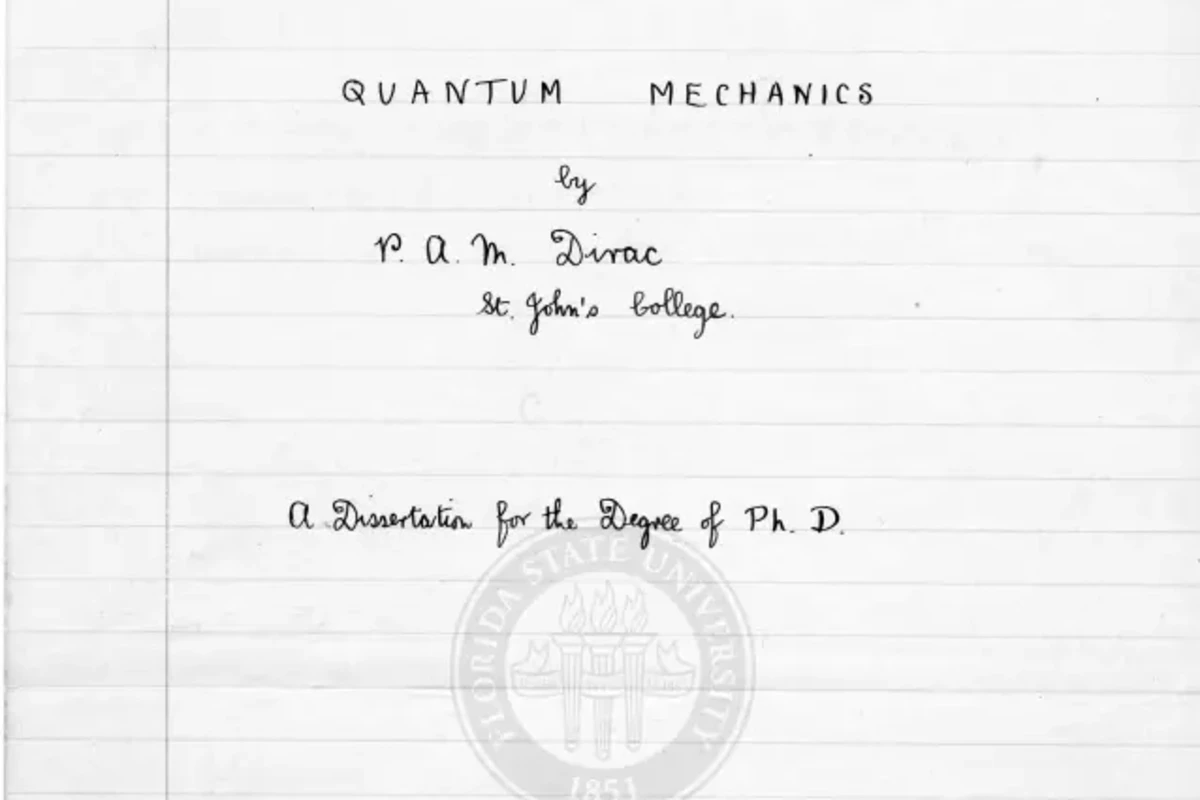
The correct split arrived in 1925 with Wolfgang Pauli’s exclusion principle. The orbits themselves went the same way at the same time. As early as December 1924 Pauli was needling Bohr in a letter about our good friend Kramers and his coloured picture books, because he no longer believed an electron followed any definite path through space. Once Werner Heisenberg in 1925 and Erwin Schrödinger in 1926 had built the new mechanics, the ellipses were gone — and a doctoral student in Cambridge was already writing the thesis that would carry the name quantum mechanics. The physics on the plate had been retired three years after it was printed.
The plate survived anyway. When Oskar Klein revised the Danish edition in 1929 and added a whole new chapter on quantum mechanics, the colour plates stayed in. A two-ink diagram with no scientific standing left was kept because it looked good.
Radium
Why radium out of all the elements
Eleven elements were drawn for the book, but radium got the star treatment, and that was no accident. In 1922 radium, discovered by the Curies in 1898, was the most marketable word in popular science. It glowed in the dark, it was said to cure cancer, and it cost more per gram than gold. The work that isolated it left its own residue: Marie Curie’s laboratory notebooks are still radioactive and kept in lead-lined boxes. In those same years thousands of young women in New Jersey were painting watch dials with radium paint and shaping their brushes with their lips. The bill for that only came due in the middle of the decade.
Here is the irony. Everything that made radium famous comes from the nucleus. The radiation, the decay, the glow, all of it is the work of that tiny fist at the centre. The plate does the opposite. It draws all eighty-eight electrons one by one and reduces the nucleus to an unlabelled dot — the very thing that, twenty-three years later in the New Mexico desert, turned out to matter most. A picture that shows none of the properties the substance is known for, and all of the rest of it.
Authors
What became of the two men
Kramers arrived in Copenhagen in 1916 at twenty-one, became Bohr’s first assistant and stayed until 1926. His 1924 work on the scattering of light was one of the stepping stones Heisenberg used to build quantum mechanics. Holst’s story is stranger. A physics graduate turned science writer and librarian, he was the first Dane to write at length on general relativity, and he spent that time objecting to Einstein and pushing his own alternative built on a hypothetical field generated by the stars. In a letter from 1920 Einstein called Holst’s work poor.
The book itself was well received. One chemist wrote that it could be read in a single sitting of two or three hours and reported watching people read it on the streetcar. Victor Weisskopf later recalled reading it at fifteen and not understanding much of it. The book he did not understand made him a physicist.
As for Bohr, he never mentioned the Kramers and Holst book in a single lecture or piece of writing for the rest of his life.
Copy
Read the whole book here
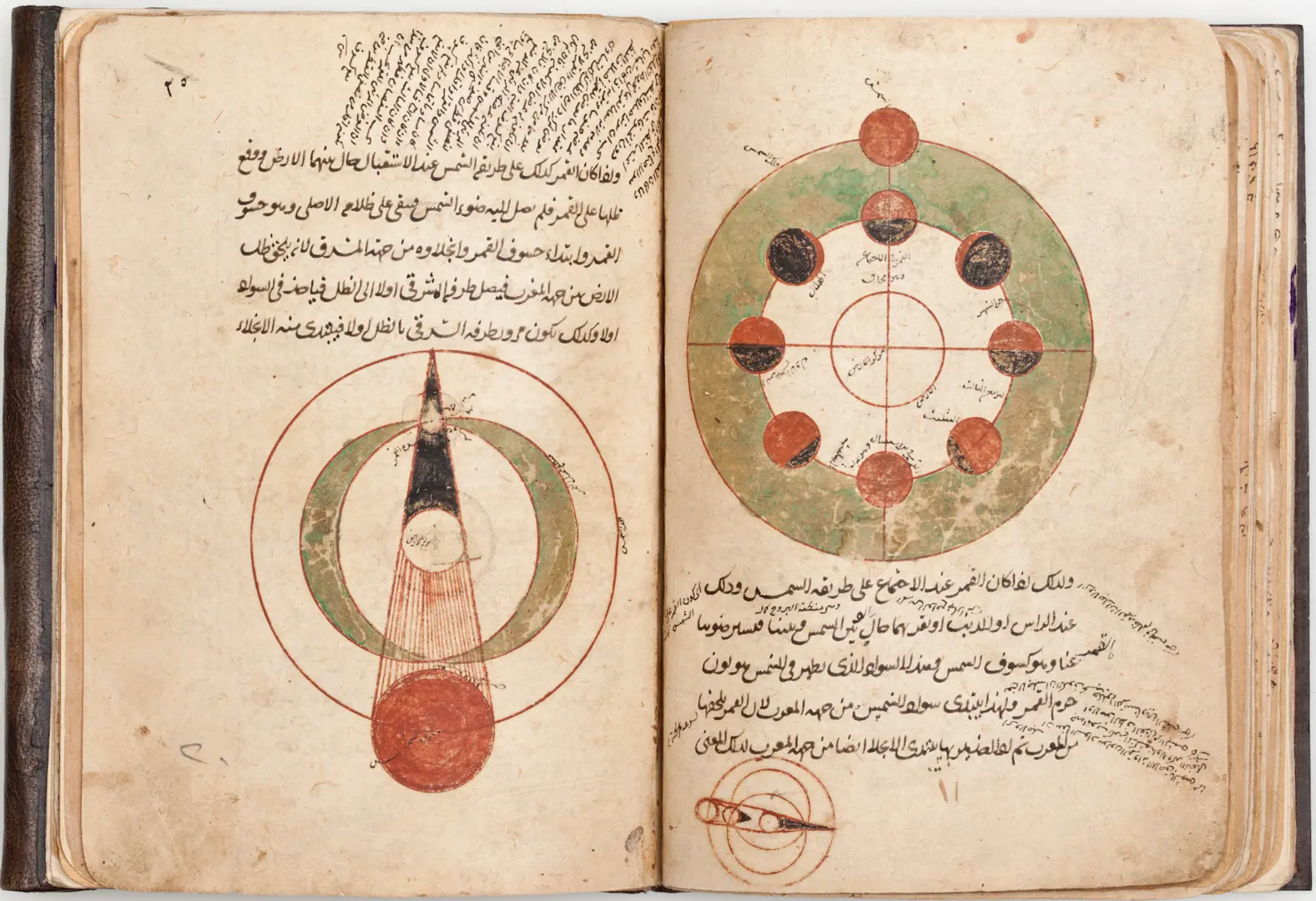
The Smithsonian copy of the 1923 English edition is in the public domain and scanned in full, so there is no reason to send you anywhere else for it. Turn the pages below. It sits well beside the coloured orbit diagrams of a much older astronomy manuscript — seven centuries apart, the same instinct to draw the invisible in ink.
Sources
- H. A. Kramers and Helge Holst, The Atom and the Bohr Theory of its Structure, Gyldendal, 1923 — Smithsonian Libraries copy, embedded above.
- Helge Kragh and Kristian Hvidtfelt Nielsen, “Spreading the Gospel,” on how the book was written and how it travelled.
- Helge Kragh, “The Many Faces of the Bohr Atom,” on where the plates sit in the history of physics.
- Niels Bohr, “Atomic Structure,” letter to Nature, 1921.
- The plate itself, reproduced from the folded insert at the back of the 1923 edition.