Give yourself a pencil, a ruler and three minutes, and you can draw a triangle made of three thick beams that looks as real as a heavy piece of iron sitting on a table. Hand the same drawing to the best carpenter in the world, to the most precise CNC machine or to the most expensive 3D printer, and none of them can make it, because this object cannot exist in the three-dimensional space we live in. That is the Penrose triangle: a shape the eye accepts without a single objection and geometry rejects in plain, final terms.
It also goes by the Penrose tribar, the impossible tribar, or simply the impossible triangle. I will mostly call it the Penrose triangle, because that is the name people search for, but the name Penrose is not on the first page of the story. On the first page there is a Swedish schoolboy, a Latin class and nine cubes. Then come a psychiatrist and his mathematician son, a Dutch graphic artist, engineers teaching computers to see, a physicist talking about cohomology, a giant sculpture in Australia, and finally four mathematicians who place the triangle in five-dimensional space. All of them are worried about the same three beams.
There are three things to play with along the way. You can draw the triangle yourself in four strokes of the pen, cover one of its corners with a card and watch the rest turn innocent, and turn a model of real cubes until, at exactly one angle, it becomes the impossible object. But first we have to go to that Latin class.
1934 · Stockholm
Nine cubes in a Latin class
Oscar Reutersvärd is eighteen, and as the story goes, during a dull hour of Latin grammar he is drawing six-pointed stars in the margin of his notebook. He starts lining up cubes around one of the stars, and as he puts them side by side he notices something. The nine cubes form a triangle, each cube sits properly against its neighbour, but the triangle as a whole contradicts itself somewhere once you think of it as a real object. Reutersvärd later names the drawing Opus 1.
This first drawing differs from the smooth Penrose triangle everyone knows in one important way. Reutersvärd builds it not from single-piece beams but from separate cubes, and he draws those cubes not in perspective but in parallel projection. Parallel projection, the method architects and draughtsmen love, does not shrink distant lines and keeps edges that are parallel in space parallel on paper. The detail matters later, because the question of why the Penrose triangle can be drawn but not built has a lot to do with this projection forgetting something. It forgets depth. A line coming straight toward your eye and a line passing beside you can become the same line on paper.
After that Latin class Reutersvärd gives the rest of his life to figures like this. He draws around 2,500 impossible figures, and most of them rest on the same principle: locally everything is fine, globally nothing is. Impossible staircases, frames passing through themselves, columns whose front and back cannot be told apart. He almost never lets his pencil slip into perspective, always keeping that calm, distant, technical-drawing gaze. In 1982 the Swedish postal service issues a set of stamps with his impossible figures, and Opus 1, 48 years after it was first drawn, starts travelling on the corners of millions of envelopes.
What strikes me most in Reutersvärd's story is that he sees the figure not as a problem but as a discovery. A mathematician looking at the drawing first asks why it is not possible. Reutersvärd asks how many more of these he can draw if this one is not possible, and he spends more than fifty years answering that question. His archive is still the largest in the field.
1954 · Amsterdam
An exhibition, a doctoral student and his father
Twenty years after Reutersvärd's cubes, the International Congress of Mathematicians meets in Amsterdam. As part of the congress, an exhibition opens at the Stedelijk Museum with the work of a Dutch graphic artist only just becoming known among mathematicians, Maurits Cornelis Escher. One of the people walking through it is a 23-year-old doing his doctorate at Cambridge, Roger Penrose.
Penrose is taken with those worlds where stairs go both up and down and a wall is floor and ceiling at the same time, but he also notices something. In Escher's work of that period the impossibility is spread across the whole scene, more than one point of view sitting side by side in the same picture. Back home Penrose asks himself a plainer question. Can I squeeze impossibility into a single object, with as few lines as possible? After a few attempts he arrives at a triangle of three beams, each corner of which looks like a right angle.
Roger shows the triangle to his father. Lionel Penrose is a geneticist and psychiatrist, fond of puzzles and wooden toys. He applies the same idea to stairs and draws a closed loop of four flights where you always climb but never rise. That is the figure we now call the Penrose stairs.
Father and son publish the two drawings in the British Journal of Psychology in February 1958. The paper is called “Impossible objects, a special type of visual illusion” and runs three pages, 31 to 33. In those three pages the “impossible object” gets its name in a scientific journal for the first time.
No trick of light, no shadow error, no two scenes glued together. Only three beams and three corners. Roger Penrose called it impossibility in its purest form.
The Penroses do not know Reutersvärd's 1934 drawing, and Reutersvärd does not know their paper. The same idea is reached in two countries, by two roads, more than twenty years apart. That is why some sources call it the Reutersvärd triangle and some the Penrose triangle, and the argument over the name is not quite finished. The Penrose name probably stuck because of where the paper appeared and what happened after it.
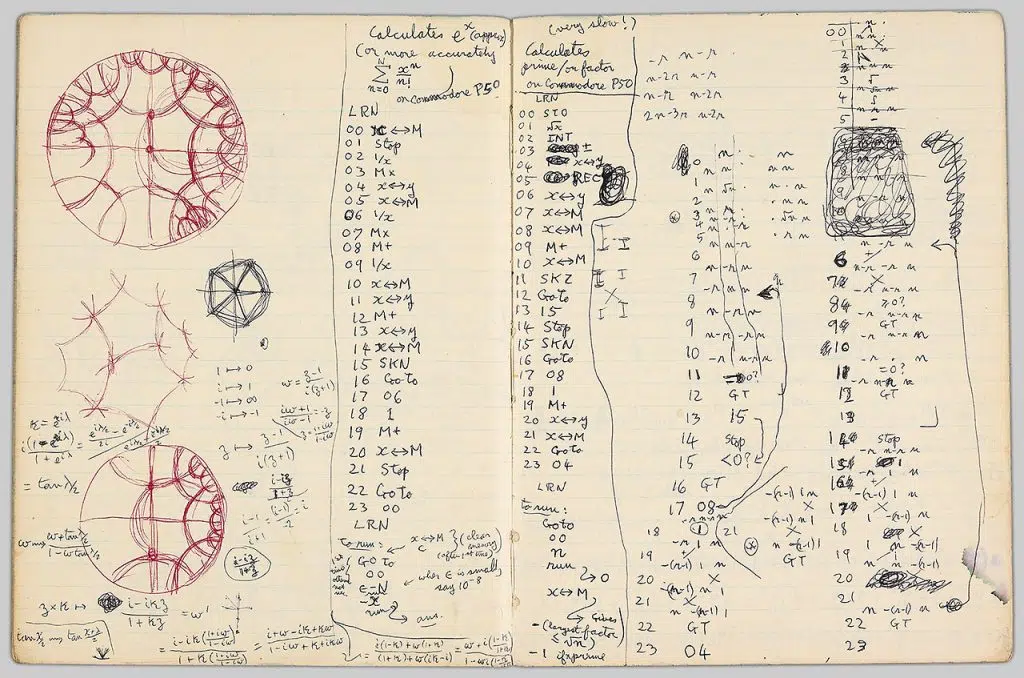
Most of us know Roger Penrose for other things: the 2020 Nobel Prize in Physics for showing that black holes are an unavoidable consequence of general relativity, and the tilings he found in 1974, with fivefold symmetry and never repeating. Leafing through Roger Penrose's notebook, I think the question that caught that young doctoral student in an exhibition hall stayed with him all along. The tilings and the triangle are both about the global consequences of local rules.
1960–1961 · Baarn
Escher's water mill
The Penroses' paper reaches Escher, and the story closes a full circle: a paper inspired by Escher's exhibition now inspires Escher. He first takes Lionel's stairs and in 1960 makes the lithograph Ascending and Descending. On the roof of a monastery two rows of monks walk an endless staircase, one row up and one row down, and none of them gets anywhere.
In 1961 it is the triangle's turn. In Waterfall, perhaps Escher's best-known work, a water channel zigzags along the long sides of two elongated Penrose triangles and seems to go a little lower at every step. Yet at the end of the loop the water finds itself two storeys higher than where it started. It falls, the waterfall turns a wheel, and the water enters the channel again. A perpetual motion machine, at least on paper.
There are actually three Penrose triangles in the picture: two formed by the channel, a third between them formed by two segments of the channel and a support tower. In his note on the print Escher adds that to keep the wheel turning you have to add a little water now and then, because of evaporation. A man who breaks every law of thermodynamics in a single picture is honest enough not to neglect evaporation.
Waterfall also gives an important clue for what follows. In the Penrose triangle the thing that keeps piling up is depth. In Escher's picture it is height. The beams that come toward the eye as you go around the triangle become, in Waterfall, the two storeys the water gains on every lap. Two disguises of the same error, explained by the same mathematics. The cleverest thing about the picture is that it makes you feel the impossibility through gravity. Depth is hard to see, but everyone notices at once that water is flowing uphill.
Escher's interest in impossible objects predates Waterfall. In the 1958 print Belvedere a man holds an impossible cube and a drawing of it lies on the floor. The influence was never one-way. Each side kept feeding the other's work.
The proof
Why it does not close
Now to the real question. Look carefully at the drawing and your eye tells you three things. The object is made of three straight beams with a square cross-section. The beams meet in pairs at the corners. And the two beams meeting at each corner are perpendicular. Each of these is perfectly reasonable on its own.
They cannot all be true at once, and vectors show it fastest. Represent the three beams by three vectors a, b and c, following the directions you take as you go around. The triangle closes, so the three add to zero. The beams are perpendicular, so the dot product of any two is zero.
Five lines, one contradiction
- a + b + c = 0the triangle closes
- a · b = 0, b · c = 0, c · a = 0every corner is a right angle
- a · (a + b + c) = a · 0 = 0
- a · a + a · b + a · c = 0
- |a|² + 0 + 0 = 0 ⟹ |a| = 0
So the first beam has length zero, and the same calculation does it for b and c. A triangle with no beams, just a single point. I love that so short a proof has so heavy a consequence. In three-dimensional space there are no three nonzero vectors that are pairwise perpendicular and close up end to end, and that is that.
You can see it without vectors too. Stand in the corner of a room. Three lines leave the point where the floor and two walls meet: east, north and up. Walk five steps east, five north, then climb five up. Are you back at the corner? Not at all, you are above and diagonally across from where you began. The drawing of the Penrose triangle tells you that at the end of this walk you are back where you started.
The dashed line is the key to the whole story. It exists in space, but if your eye sits exactly on it, the end of the path lands right in front of the start and the projection erases the 8.66 units between them. The Penrose triangle is a real path, closed up on paper by that forgetfulness.
The same idea reads as depth. At each corner of the drawing one beam seems in front and the other behind. The right end of the bottom beam is close to you, the right-hand beam comes even closer as it heads for the top, and the left-hand beam coming down from the top comes closer again. Go once around and each beam has brought you a little nearer, so you arrive back at the same point on paper but, by the depth accounting, closer than you began. It is like walking steadily forward along a number line and arriving back at the start. Possible in the plane, not on the line.
Local and global
Every corner is innocent
What makes the Penrose triangle so interesting is that the error is nowhere. If a drawing had a wrong line you would find it and erase it. Here there is no line to erase. Cover any corner with your hand and the rest becomes an object that could be built. Try it.
All three corners are open. Each is fine on its own, but the three cannot meet in three-dimensional space.
Whichever corner you cover, the other two corners and three pieces of beam read as a consistent object. Under the card the two beams might pass one in front of the other without ever touching, and your eye accepts that without effort. The impossibility is not in any corner, it is in the way the corners connect. Mathematicians call this locally consistent but globally inconsistent.
The eye is fooled so easily because of how the visual system works. It does not take in a picture in one go. It jumps several times a second, and the area it sees sharply at each glance is small. The brain builds a whole out of these pieces, and the cues it uses to settle depth are local too. A line disappearing behind another forms a T-junction, which the brain reads as “this surface is in front of that one”. Parallel edges, Y-shaped junctions where three lines meet, the different tones of the faces, all say how a corner sits. In the Penrose triangle none of these cues lies. The lie is in the relationship between them, and to check that the brain would have to hold the whole drawing at once. Most of the time it does not need to, because in the real world local cues almost always add up.
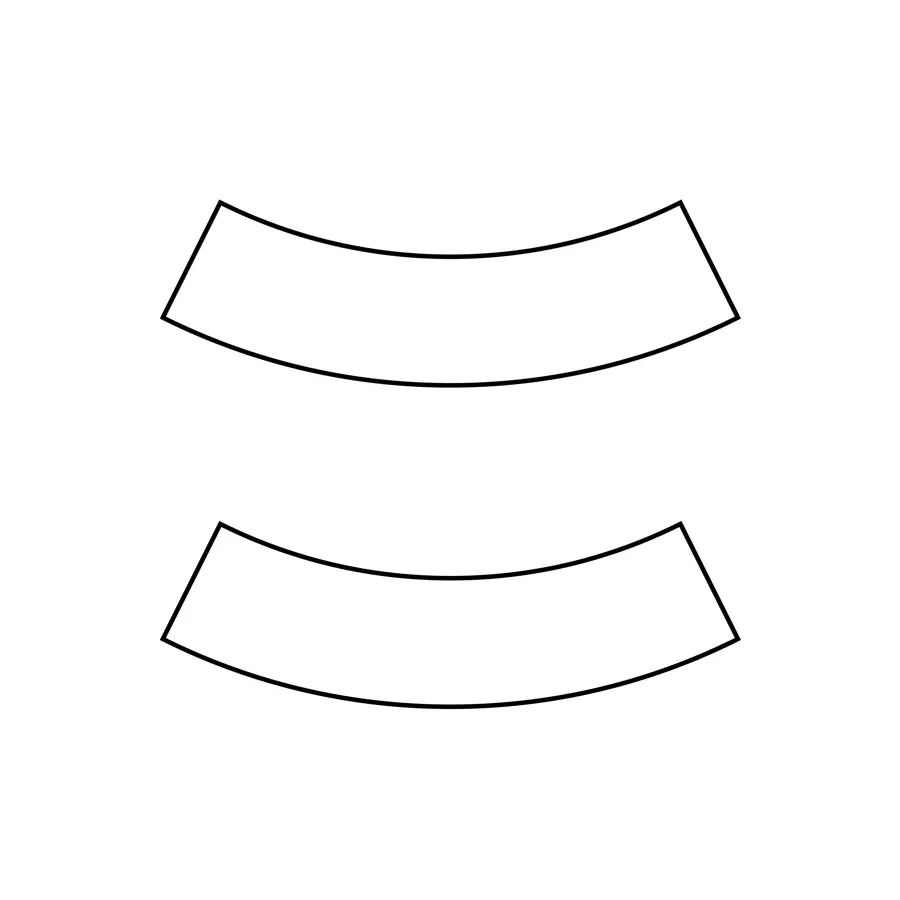
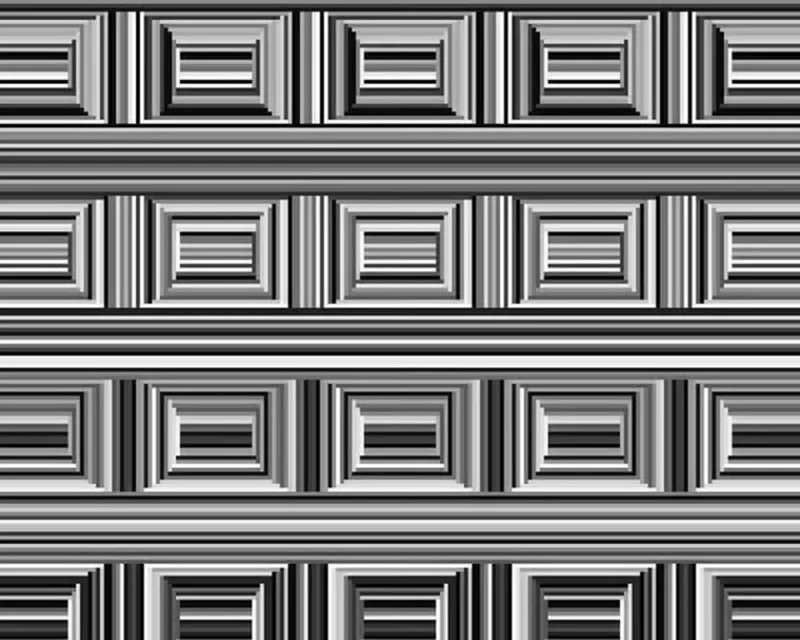
So it takes a moment to feel that something is wrong. The eye approves each corner in turn, and when the lap is complete it senses that something is off but cannot say where. Even then the drawing goes on looking like a real object. Knowing does not change seeing, just as the two arcs of the Jastrow illusion keep looking different after you have laid one on top of the other, and the circles in the Coffer illusion stay hidden until someone points at them.
There is a classic drawing that shows the idea. On the left stands a real object shaped like a Λ, two beams meeting at the top. In the middle is another real object where the bottom beam meets the right-hand beam. Slide the left piece across until its upper horizontal edge lies on the upper horizontal edge of the middle piece, and the two overlap into the Penrose triangle. Each piece is fine alone. Joined, they are impossible, like two true sentences that tell a lie when put side by side.
In the early 1970s the split between local and global becomes a serious problem for computers. Researchers want machines to read line drawings as three-dimensional objects, and in 1971 David Huffman and Max Clowes, independently, come up with a method. Each line gets a label: plus for a convex edge, minus for a concave one, an arrow for a boundary hiding the back of a surface. Every junction is then checked against the list of junctions possible in the real world.
The method works very well, and the Penrose triangle passes it. Every junction is valid, every line gets a meaningful role, and still the object cannot be built. Huffman titled his paper accordingly.
Impossible objects as nonsense sentences.
David Huffman, 1971
A sentence flawless in grammar and empty in meaning. That is why the triangle became a textbook example in machine vision: local checks are necessary but not sufficient. The Japanese engineer Kokichi Sugihara solves the problem at the root in the 1980s, gathering the method in his 1986 book Machine Interpretation of Line Drawings. Every surface in the drawing must be a plane in space, every plane has a few unknown coefficients, and the lines and junctions set up equations and inequalities between them. If the system has a solution the drawing can be built. For the Penrose triangle it has none. The method has a by-product: some drawings that look impossible pass the test and can really be made. Starting from these, Sugihara builds ramps on which marbles seem to roll uphill, and in 2010 they win the Best Illusion of the Year contest.
1992 · Leonardo
The bookkeeping of depth
About 38 years after drawing the triangle, Roger Penrose publishes a short paper in the journal Leonardo, “On the cohomology of impossible figures”. He shows that impossibility can be measured, that how impossible a figure is can be expressed by a number. The word cohomology looks frightening, but the idea is no different from a ledger.
Split the triangle into a few slightly overlapping pieces, say one per beam. Each piece alone can be read as a real object, but there is always an ambiguity left over. In parallel projection you can slide a piece back and forth along the line of sight and the drawing does not change. In perspective you can make it twice as big and twice as far away and the drawing stays the same. So the depth or scale of each piece is fixed only up to a constant.
Where two pieces overlap, their depths must agree, which ties their constants together. A certain shift going from the first beam to the second, another from the second to the third, another back from the third to the first. In a consistent object the shifts cancel and the lap totals zero. In the Penrose triangle it does not. The number left in your hands is the measure of the figure's impossibility, what mathematicians call a nonzero element of its first cohomology group. For a perspective drawing the shifts multiply instead of adding, and at the end of the lap a ratio different from one is left over.
The beauty of this view is that it explains in a single sentence the kinship between the triangle, the stairs and Waterfall. In all three there is a closed loop, every part of it is consistent, and something accumulates along it: depth, height, the level of the water. The two storeys in Escher's picture are the number left over in Penrose's paper, translated into the language of gravity. And the 8.66-unit dashed line above is that number made concrete. In the model below you can actually see it.
One point of view
Seen from the right angle
The Penrose triangle cannot be built, but an object that looks like one can, and the difference matters. There are solid objects that, from a certain angle, look exactly like the drawing. All of them use the same trick: the object is open somewhere, and the opening lies exactly along the line of sight.
The model below is made of fifteen cubes: five east, five north, five up, just like the walk. The last cube sits right in front of the first, 8.66 units closer along the line of sight, and it is cut at an angle so that from that direction it seems to pass behind the first cube. The blue piece is the cut cube. Drag the model or use the sliders. At zero degrees, and only there, the triangle closes.
The path is open. The last cube does not touch the first, and the gap shows once you move 37.5° off the line of sight.
Turn it a few degrees and it is obvious that the triangle is an open path rising like a staircase and curling over itself. Bring it back to zero and the path closes, and the eye again raises no objection. There is no way to feel the 8.66-unit gap, because looking with one eye, from a fixed point, with parallel rays, no depth information is left. At the one angle, the top face of the first cube and the side faces of the last cube read as a single corner, while in space they are several cubes apart. Henry Segerman makes the same point with a 3D-printed object in his real-life impossible triangle.
The best known sculpture built on this principle stands in Perth, Australia. Impossible Triangle, put up by Brian McKay and Ahmad Abas in East Perth and unveiled on 5 November 1999, looks like a flawless Penrose triangle from one spot. Step a few paces aside and one beam reaches out into empty air. Everyone who wants to photograph it has to stand in the same place, at the same height, because the sculpture is designed for a single eye.
In Gotschuchen, Austria, there is another one in thick, light-coloured timber. Seen from the right spot, anyone posing in front of it seems to stand inside the triangle. What I like most about these sculptures is that they make the viewer move. You stand in front of a picture, but around these you walk, searching for the spot, and when you find it something falls into place.
There is a completely different approach as well. In 1969 the Soviet kinetic sculptor Vyacheslav Koleichuk makes a Penrose triangle by twisting the beams slightly instead of leaving them straight. The object is truly closed, with no gap anywhere, but its beams are not straight and its corners are not exact right angles. One of the proof's conditions is relaxed, and the object starts to exist. W. A. Stanggaßinger's stainless steel Real Penrose Triangle in Wasserburg am Inn is a fine example: the beams look straight from one angle, but run your hand over them and you would feel the twist.
Today a 3D printer makes a Penrose triangle in a few hours, and palm-sized copies of Reutersvärd's cube triangle are everywhere. Most rest on the cut-cube principle: flawless from one angle, the trick showing as soon as they turn. A two-page note in the perception journal Perception in 1979, proposing a simple design for an impossible triangle, shows how early such physical models drew interest.
Pen and paper
Draw it yourself in four steps
Drawing the Penrose triangle with your own hand is the shortest way to understand it. You need no ruler tricks and no eraser, only four steps, and each step is a ring of three straight lines. The panels below follow the sketch the way I first learned it, bottom to top on a single page.
Step 1 of 4
A triangle with tails
Draw an equilateral triangle, but let every side run on past one corner. The base runs out to the left, the left side climbs past the top, the right side drops past the bottom. Turning the page, the three tails chase each other the same way round.
Step one is a triangle with tails. Draw an ordinary equilateral triangle, but do not stop any side at its corner. Let the base run on to the left, the left side run on past the top, the right side run on below the bottom right. The direction matters only in that all three tails turn the same way round, like the arms of a pinwheel. This small asymmetry is the seed of the whole illusion.
Step two adds a parallel outside each line, one beam-width away. Each new line starts from the end of a tail and runs a little longer than the line inside it. You now have two rings, and already the frame seems to have thickness.
Step three does the same once more, another beam-width out and another unit longer. Every side now carries three parallel lines, which is exactly what a square beam seen from a corner shows you: two faces and three edges.
Step four closes the three open tips with three short strokes. That is all. Twelve straight lines, none crossing another, nothing erased. Shade the three faces white, grey and black if you like, and notice that each tone starts on the inside of one beam and turns into the outside of the next as it rounds a corner. The impossibility was already in step one, in the way the three tails chase each other. Every later line simply follows it.
Reutersvärd's road is the other way to get there, and it makes the lie easier to locate. On isometric dot paper, draw a cube near the top of the page, then five more running to the lower right, each a little in front of the previous one. From the lower right corner add five cubes to the left, again each in front of the last. From the lower left, stack cubes back up toward the top. Three settle in without trouble. The fourth falls exactly beneath the very first cube, and if you keep to the rule it would sit in front of that cube and cover its lower half.
The whole trick is in that one decision. Draw the fourth cube as if it were behind the top cube, leaving empty the part the top cube covers, and the triangle closes. Fourteen of the fifteen cubes are honest, one lies, and that single lie makes the drawing impossible. The blue cut cube in the model above is its three-dimensional counterpart. In the model the lie hides inside the line of sight. On paper it hides under a pencil stroke.
There is an instructive side effect. Ask the person who drew it which corner is the impossible one and they always point to the corner where they told the lie. Show the same drawing to someone who has never seen it and they cannot find it, because nothing on the paper marks that corner out. The three corners of the smooth triangle are identical, and turned through 120 degrees it lands on itself. The lie is not told at one corner. It is spread around the whole loop.
Other spaces
Where the triangle can exist
Everything so far holds in the ordinary three-dimensional space we are used to. But mathematicians cannot help asking where it works if it does not work here, and there are two lovely answers.
The first is to change the shape of space. In his 1988 book A Topological Picturebook, George Francis passes on an observation he attributes to John Stillwell: the Penrose triangle can really exist in certain Euclidean three-dimensional manifolds. Think of old computer games where a character leaving the right edge of the screen came back in on the left. Locally the screen was an ordinary plane, but as a whole it closed like a ring. Do the same in three dimensions along the direction of depth, so that anything moving 8.66 units along the line of sight comes back to where it started. In such a space the last cube of the model really sits next to the first, with no cut and no special viewpoint. The triangle is closed from every direction. Every small piece of that space is the same as ours, rulers and angles measure the same. Only the way the whole connects is different, which is once again the old split between local and global.
The second is to add dimensions. Give up straight beams and right angles, but keep distances on the surface: think of the tribar's surface as paper you may bend but never stretch or shrink. Mathematicians call this an isometric embedding. At the 2020 Maple Conference, Zhenbing Zeng, Yaochen Xu, Zhengfeng Yang and Zhi-bin Li showed that this surface can be isometrically embedded in five-dimensional Euclidean space, and that five is the lowest dimension possible. To close the Penrose triangle without spoiling a single one of its distances you need two extra dimensions. Three is not enough, and neither is four.
The triangle also has a relationship with the Möbius strip. In his Scientific American column of August 1978, Martin Gardner explains that a Möbius strip with thickness is really a twisted prism. Join the ends of a thick square prism with a quarter twist and its four long faces become a single face, which a bug has to walk around four times to get home. According to Gardner, tracing a line around the Penrose triangle forms such a four-loop Möbius strip. You can follow it in step four of the drawing above: each tone starts on one face of a beam, turns onto another face of the next beam at the corner, and the three tones flow into one another around the loop. That kinship is, to me, the least known side of this figure.
Family
Relatives
The Penrose triangle is the plainest and best-known impossible object, but the family has other members. The Penrose stairs have been with us since the start: a closed loop of four flights, each step one up, and at the end you are on the step you started on. Mathematically the same structure, with height accumulating instead of depth.
The impossible cube in Escher's Belvedere is a cube frame in which one edge passes in front at one end and behind at the other. Again every corner is innocent on its own. The impossible trident, the blivet or devil's tuning fork, has three round prongs at one end that turn into two rectangular arms at the other. Here the impossibility is not in depth but between figure and ground: the eye reads a line as the edge of a prong at one end and the edge of the gap between prongs at the other. Roger Shepard's elephant does something similar, its legs and the gaps between them swapping places until you cannot say how many legs it has.
I give the triangle a place of its own because its impossibility is the most easily proved. The five-line vector argument works this cleanly for no other figure. The stairs need height bookkeeping, the trident needs figure and ground, the elephant a counting problem. The triangle asks only for three right angles and a closing condition, which is probably exactly what Penrose meant by impossibility in its purest form.
Reutersvärd's Opus 1 and the triangle in the Penroses' 1958 paper live on as two names for one figure. Art historians put Reutersvärd forward, mathematicians and psychologists the Penroses. Escher carried both drawings into a water channel. And Roger Penrose received the Nobel Prize in Physics in 2020, 66 years after that exhibition in Amsterdam, at the age of 89.
Sources
- L. S. Penrose and R. Penrose, “Impossible objects, a special type of visual illusion”, British Journal of Psychology 49 (1958), 31–33.
- Bruno Ernst, on Oscar Reutersvärd, in M. C. Escher: Art and Science (1986).
- Roger Penrose, “On the cohomology of impossible figures”, Leonardo 25 (1992).
- David A. Huffman, “Impossible objects as nonsense sentences”, Machine Intelligence 6 (1971).
- Kokichi Sugihara, Machine Interpretation of Line Drawings, MIT Press (1986).
- George K. Francis, A Topological Picturebook, chapter 4, Springer (1988).
- Martin Gardner, “Mathematical Games”, Scientific American, August 1978.
- Z. Zeng, Y. Xu, Z. Yang and Z. Li, in Maple in Mathematics Education and Research, Springer (2021).
- Brouwer and Rubin, note in Perception (1979).