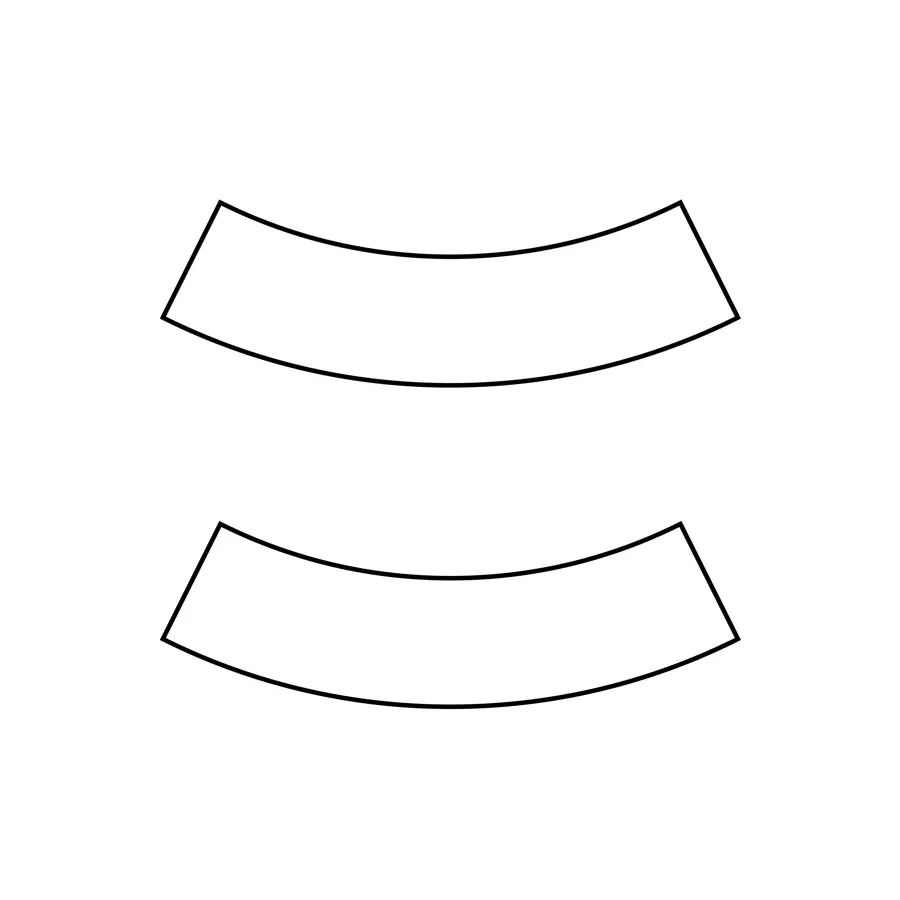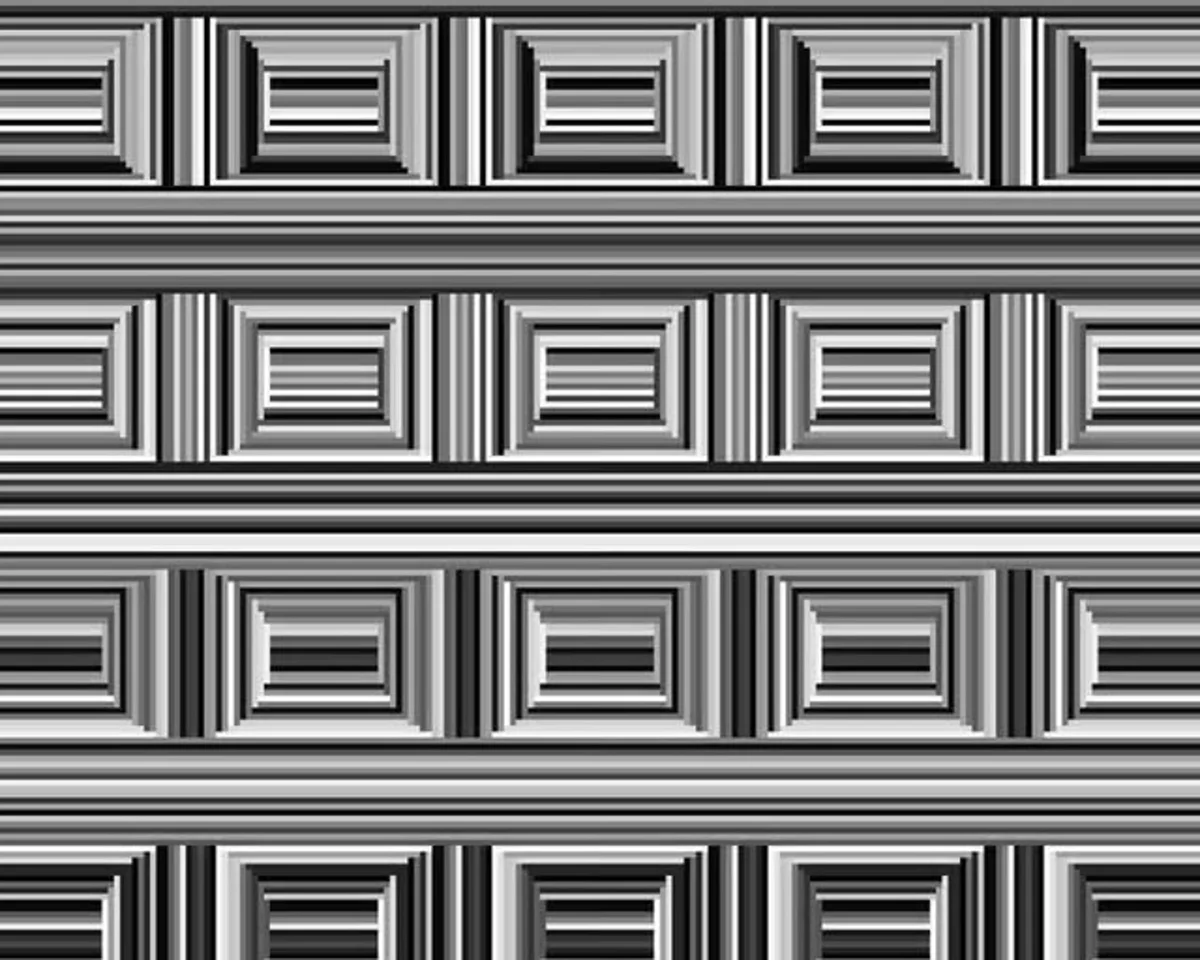
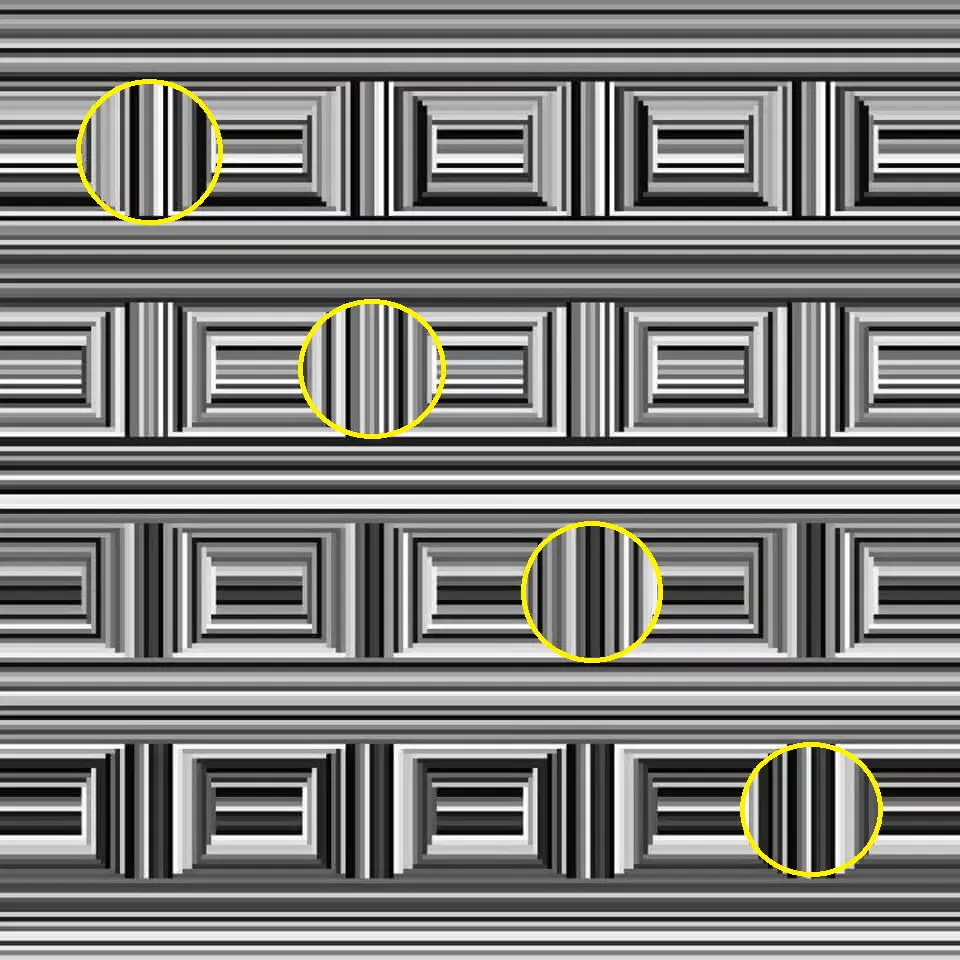
Look at the picture above for a few seconds and tell yourself what you see. Most likely you see rectangular panels with shaded edges, sunk into a grey wall. Panels lined up row after row like the surface of an old apartment door or a church ceiling, so orderly they are almost boring. And yet in the same picture there are sixteen circles, in four rows. None of them hides behind anything, they are made of the very same lines as the panels and stand right in front of your eyes, and the great majority of people cannot see a single one of them at first glance.
The best-known version of this picture was drawn in 2006 by the vision scientist Anthony Norcia. Back then Norcia worked at the Smith-Kettlewell Eye Research Institute in San Francisco, and today he works at Stanford. He sent the picture to that year's Best Illusion of the Year contest and it made the finals, but first place went to someone else. Norcia himself says the discovery was largely an accident, and that it grew out of an op-art pattern drawn earlier by the Italian Gianni Sarcone. The name comes from architecture. A coffer is the decorative panel sunk into a ceiling or a door.
According to Norcia, people seeing the picture for the first time almost never notice the circles, and they usually compare the rectangles they see to door panels. Norcia explains this as a tug of war between two forces inside the picture. Some of the cues in the image tell the brain there are sixteen separate regions there. On the other side, the brain has a very strong prior for reading this surface as closed-edged, sunken boxes, and every time it is the prior that wins. In Norcia's view the prior stands on two legs. The first is closure, the expectation that edges will turn and wind around until they enclose a shape. The second is our habit of looking at shading and guessing how deep something is.
1915 – 1960s
Edges nobody drew
Seeing an edge nobody drew is in fact an ordinary thing the brain does every day. In 1941 the German psychologist Walter Ehrenstein drew lines running outward from a single center and cut them off before they reached it. In the middle a disc appears that nobody drew, a little brighter than its surroundings. Its edge passes through a place where there is not a single line on the paper. Fourteen years later Gaetano Kanizsa turned the same idea into a triangle made of three open-mouthed circles, and everyone who saw the edges of that triangle was actually looking at empty space. It is the same brain that happily accepts an impossible triangle as a solid object.
On the neurological side there is a type of cell that David Hubel and Torsten Wiesel found in the visual cortex in the 1960s. These cells care less about a line itself than about the place where the line ends. When the ends line up along a curve, the brain starts treating that curve like an edge. The circles in the Coffer picture don't have a single line of their own either. The boundary of each circle is made of the points where the vertical and horizontal lines stop or shift by half a step.
What makes me think the most in this picture is a simple piece of geometry. Three points in the plane that don't lie on one line are enough to determine a single circle. In the version I built, each circle has twenty line ends on its edge, and all of them sit on the same circle. So every circle is described with roughly seven times the points geometry asks for. The brain has the equipment to pull a circle out of these points but it doesn't, because each of those same points is also the corner of a rectangle. The brain gives corners special weight, and the moment a line end is read as a corner it loses its chance of belonging to any other shape.
Twenty points on one circle, seven times what geometry asks for, and still the brain sees corners.
There is a rule for this too, and the Danish psychologist Edgar Rubin showed it in 1915 with his famous vase drawing. An edge can have two sides, but it can belong to only one shape at a time. When you see the vase the edge belongs to the vase, when you see the two faces looking at each other it belongs to the faces, and seeing both at once is nearly impossible. In the Coffer picture too, as long as a line end belongs to a rectangle it cannot belong to a circle. The circles only appear when you pull those ends out of the panels' hands.
1826
Light comes from above
The second leg of the prior is shading. In 1826 the Scottish physicist David Brewster recorded something odd about engraved seals. A seal cut inward looked like a relief when it was lit from below or turned upside down. The reason is that the brain assumes light always comes from above. We perceive a shape with a dark top edge and a light bottom edge as a hollow sinking inward, and the reverse as a bump coming outward, and when you turn the page upside down the two swap places. Because the panels in the Coffer picture have a dark top edge and a light bottom edge, the brain reads each panel as a box sunk into the wall and lit from above, and ties every line end to the frame of that box. Context bends what we see in the Jastrow illusion in much the same way, where two identical arcs refuse to look the same size.
I built the pattern below so you can take these two legs apart one at a time. When the shift is at zero, the inside of the circles is exactly the same as the outside, and at that moment there really are no circles in the picture. As you drag the slider to the right, the pattern inside the circles shifts up to half a step, and only then do the circles appear, made of nothing but line ends. Turn the shading off and the panels lose their depth, leaving flat lines behind. Flip the light and the boxes sunk into the wall swell outward. If you still haven't found the circles, the last button marks where they are, and there is nothing to be ashamed of in that.
Each circle has 20 line ends on its edge. Three points are enough to determine a circle.
The shortest way to see the circles is to ignore the horizontal lines and let your eyes travel only along the vertical ones. Since the horizontal lines are what close the panels, ignoring them weakens the closure cue, and the ends of the vertical lines begin to join up. Once you have seen them, though, going back is hard. People who have noticed the circles once see them right away when they come across the same picture months, even years later.
c. 125 AD
The Pantheon, the other way round
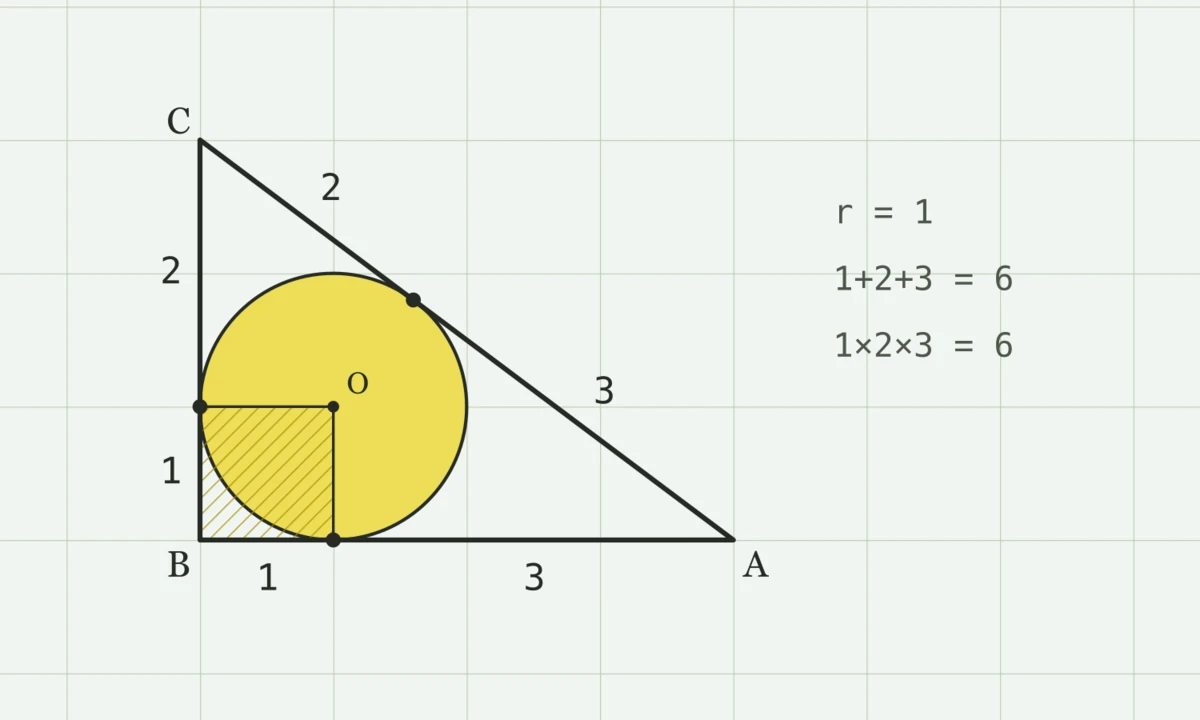
To see how old the thing Norcia calls a prior is, a trip to Rome is enough. The dome of the Pantheon was finished under Emperor Hadrian, in the 120s AD, and its inner surface holds 140 coffers arranged in five rings. Each ring has 28 coffers. The coffers both lighten the dome and get smaller and smaller toward the opening of about 8 meters at the top. The inner diameter of the dome is 43.3 meters, and the height from the floor to the top is also 43.3 meters. So a sphere of the same diameter fits exactly into that space, a little like the unit circle that fits exactly inside the 3-4-5 triangle.
The arrangement in the Pantheon is the exact opposite of the Coffer picture. There the circles are real and nobody misses them, while the rectangular coffers are lined up on top of those circles. The number 28 per ring is interesting on its own.
Nobody knows whether the architect chose the number for that reason. The only thing we know is that because 28 doesn't divide evenly by eight, the rows of coffers don't line up with the eight-bay arrangement below the dome.