
DIY · Card 92 · Physics · Colour
Five glasses, some paper towels and three colours. Over a few hours, the water climbs up the paper, walks across into the empty glasses, and mixes into a rainbow all by itself.
01The brief
Water that walks uphill, by itself.
½ the gap
means water climbs twice as high (Jurin’s law)
√t
how the wet front spreads: four times the time, twice the distance
1718
when James Jurin worked out the law of capillary rise
Leave a paper towel dangling in a glass and water creeps up it, against gravity, with nothing pumping it. Bridge two glasses with a towel and the water climbs out of one and drips into the other.
With three colours and five glasses, it paints a rainbow while you wait. It is the same effect that colours the coloured carnations, and a cousin of the pepper and soap trick.
02Kit
Glasses, paper towels and three colours.
Tick off what you have
0 of 4 ready
03Method
Fill, colour, bridge, then wait.
Step 1 of 8 · Minute 0
You need five clear glasses or jars of the same size, kitchen paper towels, water, and red, yellow and blue food colouring.
Nothing seems to happen.
Why
The towel ends aren’t deep enough in the water, or the arch is very tall.
Fix
Push the towel ends right down to the bottom of each glass, and keep the arches low.
The colours look muddy.
Why
Too much colouring, or a mix of all three colours meeting.
Fix
Use only a few drops, and keep red and blue apart, with yellow in the middle.
Water is dripping onto the table.
Why
A towel arch is touching the outside of a glass.
Fix
Make sure each towel goes straight from inside one glass to inside the next.
04Capillary action
Water molecules are attracted to the surfaces of glass and paper. In a narrow gap, that attraction pulls water up the walls, and the water pulls more water behind it, until the weight of the column balances the pull.
Change the width of the tube and the liquid:
Climbs to
7.4 cm
Change
rises
Water molecules cling to glass and to paper fibres more strongly than to each other, so they creep up the walls and drag the rest of the water with them, until the weight of the column balances the pull. Jurin’s law, h = 2γ cos θ ⁄ (ρ g r), says the narrower the gap, the higher it climbs.
Now set the clock running on the five glasses:
Water crept along the towel
11 cm
Empty cups now
20 % full
Full cups now
87 % full
The water first has to soak up and over each towel, which is slow: the distance grows only with the square root of time, so the last few centimetres take longest. Once the towels are wet, water flows from full cups to empty ones until the levels are equal, and red and yellow make orange, yellow and blue make green. A rough model; your towels and cups will set the real pace.
05The big idea
Small things,
different rules.
In a bucket, gravity wins: water lies flat at the bottom. In a gap thinner than a hair, the pull of the surfaces is stronger than the water’s weight, and water climbs walls.
The smaller you go, the more surfaces matter and the less weight does. That is why insects can walk on water, why dust floats and why your towel can lift water that no bucket could hold up.
06The math
1 · Jurin’s law
h = 2γ cos θ ⁄ (ρ g r)
γ surface tension, θ contact angle, ρ density, r tube radius.
2 · Washburn’s law
L ∝ √t
How far water creeps into paper after time t.
3 · Halve the gap
r ⁄ 2 → 2h
Height is inversely proportional to radius.
For water in clean glass, 2γ ⁄ (ρ g) ≈ 2 × 0.072 ⁄ (1000 × 9.81) ≈ 1.5 × 10⁻⁵ m². In a tube 1 mm wide (r = 0.5 mm) it climbs 1.5 × 10⁻⁵ ⁄ 0.0005 ≈ 3 cm. In a gap 20 µm wide, like those between paper fibres, the limit is about 1.5 m.
The climb slows as it goes: by Washburn’s law, if water creeps 2 cm up a towel in a minute, it takes about four minutes to reach 4 cm and sixteen to reach 8 cm. That is why the last stretch over the top of the arch takes longest.
07Real life
From the tallest trees to the ink in a fountain pen.
Tall trees
Water rises up thin tubes inside a tree’s trunk partly by capillary action. But to reach the top of a 100-metre redwood, it must also be pulled from above, as leaves evaporate water and draw up the column behind it.
Coloured flowers
Stand a white carnation in coloured water and its petals change colour within a day, as water climbs the stem and carries the dye with it.
Candle wicks
A candle’s wick soaks up melted wax by capillary action and feeds it to the flame, which vaporises and burns it. The wick itself barely burns.
Chromatography
Drop ink on paper and dip the end in water. As the water climbs, it carries the ink’s different dyes at different speeds, separating them into bands of colour: paper chromatography.
Fountain pens
A fountain pen’s nib has a fine slit. Ink is drawn along it by capillary action, which is why the pen writes when touched to paper and doesn’t leak when it isn’t.
Soil and plants
Water held in the tiny spaces between soil grains stays there after rain, clinging to the grains by capillary forces. That stored water is what plant roots drink between showers.
1718
James Jurin was a doctor, a mathematician and secretary of the Royal Society in London. In 1718 and 1719 he carried out careful experiments with fine glass tubes of different widths, dipped in water.
He found a simple rule: the height the water rose was inversely proportional to the tube’s width. Halve the width and the water rose twice as high. Jurin’s law still carries his name, and it explains why the finest gaps, like those in paper, soil and the stems of plants, lift water the furthest.
08Is and isn’t
The towel soaks water up like a sponge sucks.
Nothing sucks. Water is pulled along by its attraction to the paper fibres, creeping into the tiny gaps between them.
Capillary action alone lifts water to the tops of trees.
It helps, but only by tens of centimetres in a tree’s tubes. The rest of the lift comes from water evaporating from the leaves and pulling the column up.
The water keeps flowing until the glasses are empty.
It stops when the levels are equal. Water only flows from the higher level to the lower one.
Wider strips climb higher.
Wider strips carry more water at once, but how high water climbs depends on how narrow the gaps between fibres are, not on the strip’s width.
09Go further
A
Towel race
Try kitchen towel, toilet paper, a napkin and a coffee filter. Which climbs fastest?
B
Measure the climb
Mark how far the water has crept up a towel every five minutes. Graph it. Does it slow down like √t?
C
Colour flowers
Stand white carnations or celery stalks in coloured water overnight and watch the colour travel.
D
Ink rainbows
Draw a dot of black felt-tip on a strip of coffee filter and dip the end in water. What colours hide in the black?
E
Uphill walk
Raise one glass on a book. Does the water still walk, and which way?
10Questions
Line up five glasses, fill the first, third and fifth with water and add red, yellow and blue food colouring. Fold four paper towels into strips and bridge each pair of neighbouring glasses. Over a few hours, the coloured water climbs the towels and fills the empty glasses with orange and green.
By capillary action. Water molecules cling to the paper’s fibres more strongly than they cling to each other, so they creep up the narrow gaps between fibres, pulling more water behind them. Once a towel is soaked, water flows from the fuller glass to the emptier one.
The colours start climbing within minutes and drip into the empty glasses within about an hour. It takes several hours, often overnight, for the water levels to even out.
The way a liquid moves up a narrow tube or through tiny gaps, even against gravity, because it is attracted to the surfaces around it. The narrower the gap, the higher it climbs: that is Jurin’s law.
Once the water levels in neighbouring glasses are equal, there is no more ‘downhill’ for the water to flow. The towels stay soaked, but the net flow stops.
Safety · Completely safe. Food colouring can stain clothes, tables and fingers, so work on a tray or old newspaper, and don’t drink the coloured water.
All DIY cards →Keep wandering
A few more pieces in the same spirit — math, design, and slow attention.
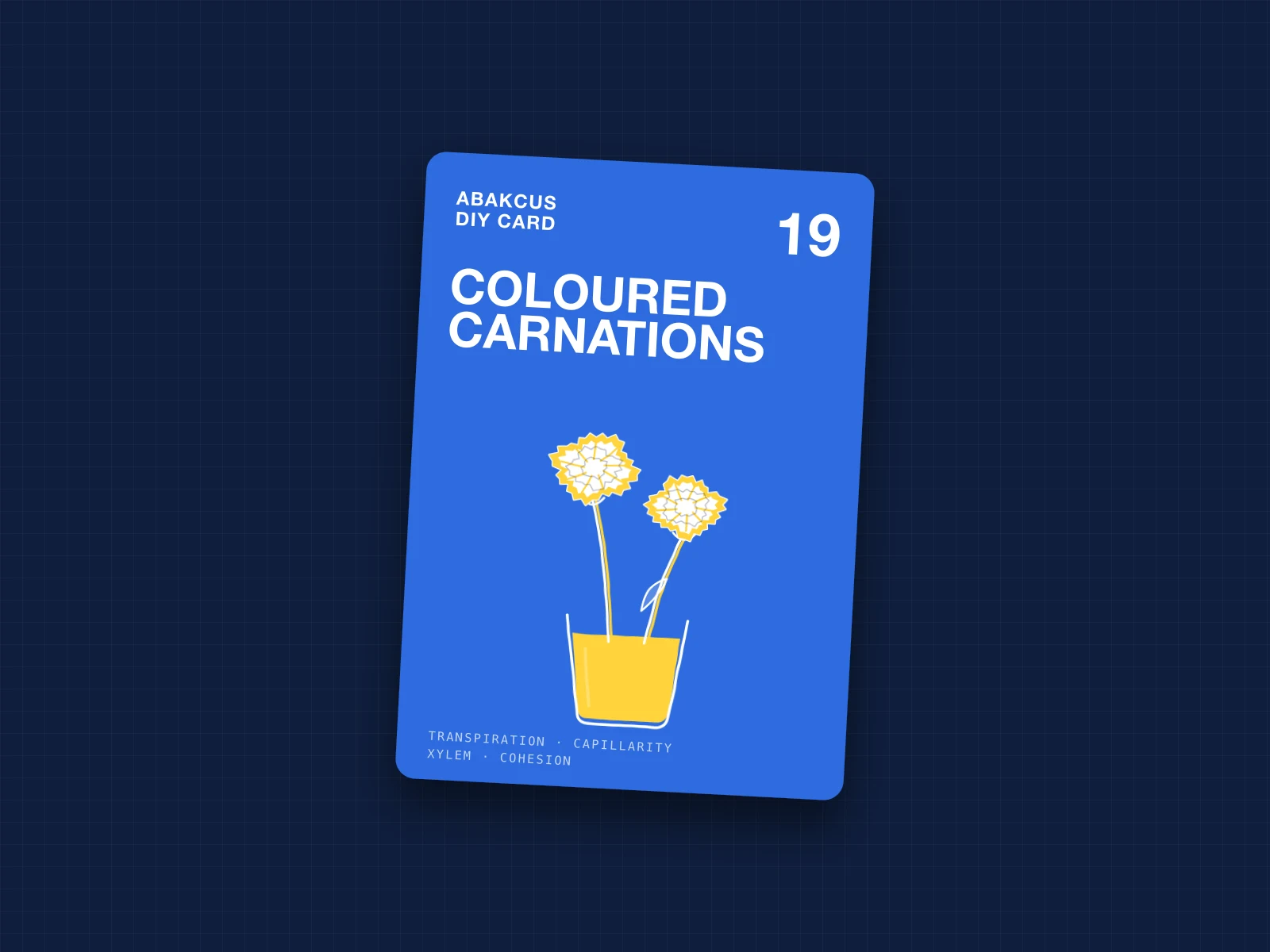
The Coloured Carnations Experiment: How Flowers Drink Water
Stand white carnations in coloured water and by the next day their petals have changed colour. The dye has climbed the stem through tubes thinner than a hair, pulled up by the flower itself.
Open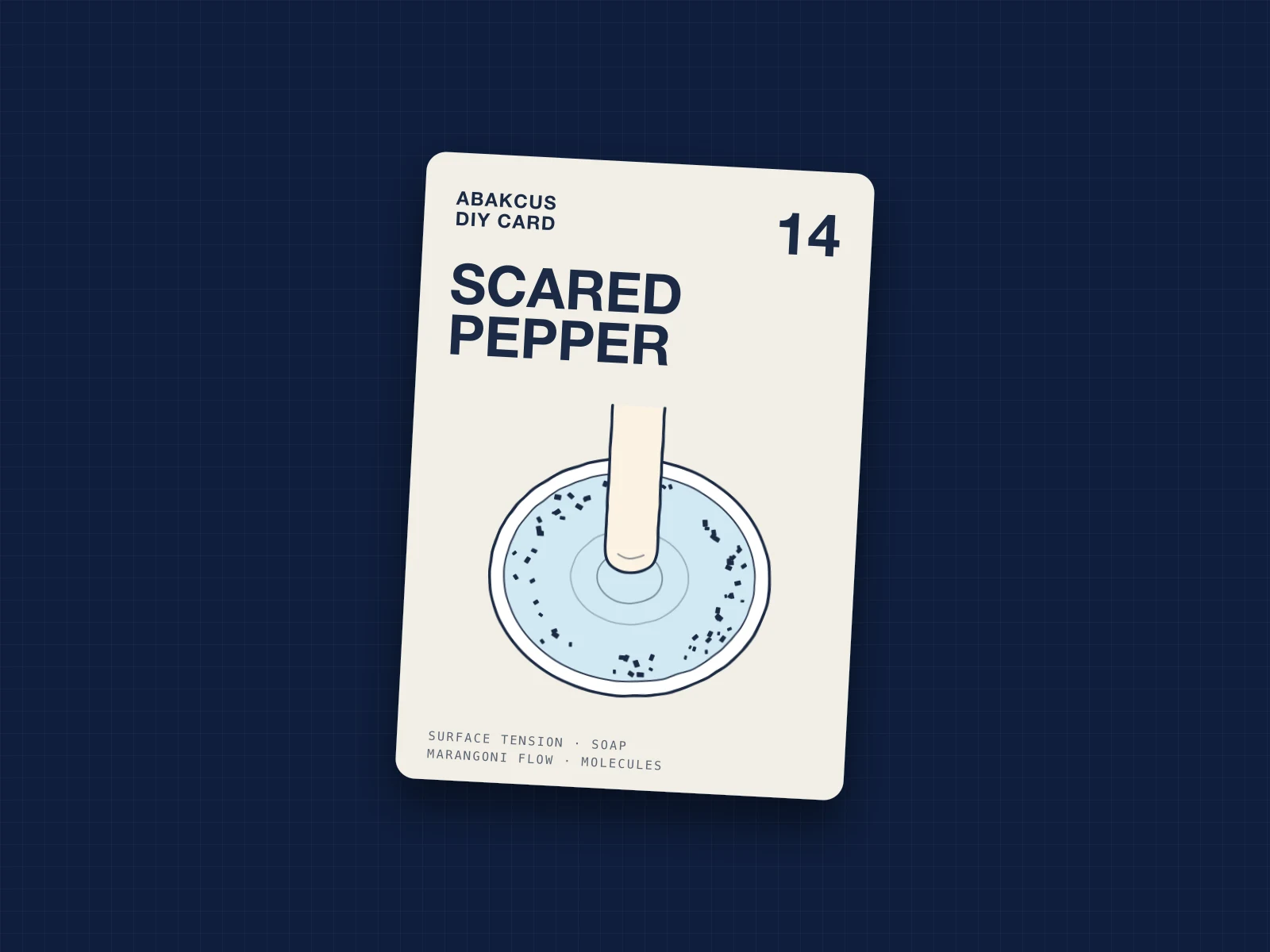
The Pepper and Soap Experiment: Surface Tension Explained
Sprinkle pepper on water, touch the middle with a soapy finger, and the pepper flees to the edge in a split second. It isn’t scared of the soap. The water’s skin is pulling it away.
Open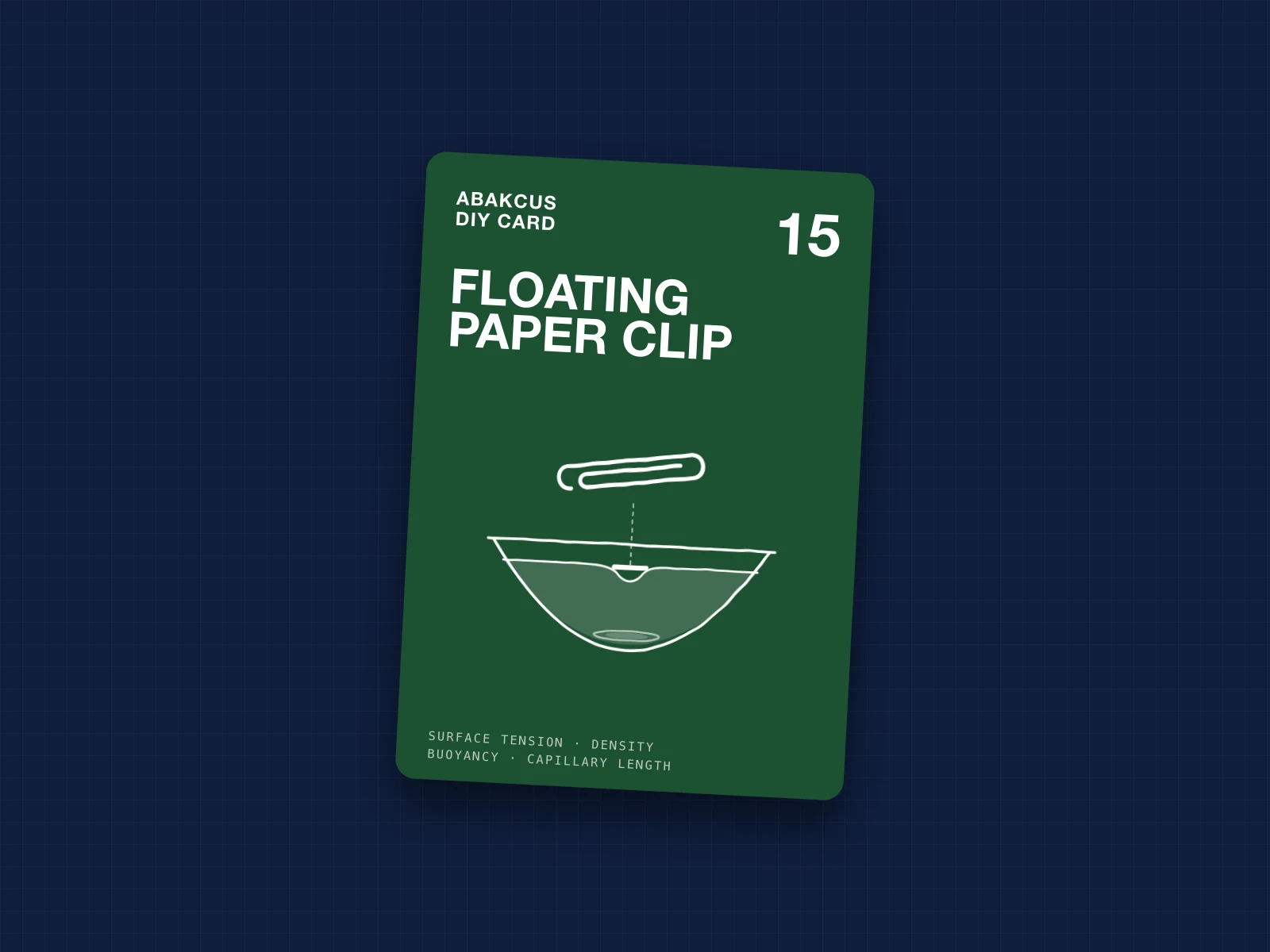
How to Float a Paper Clip on Water: Surface Tension
Steel is nearly eight times denser than water, and a paper clip still lies on top of it if you put it down gently. The surface bends into a dimple and holds it, like a trampoline, until a drop of soap breaks the spell.
Open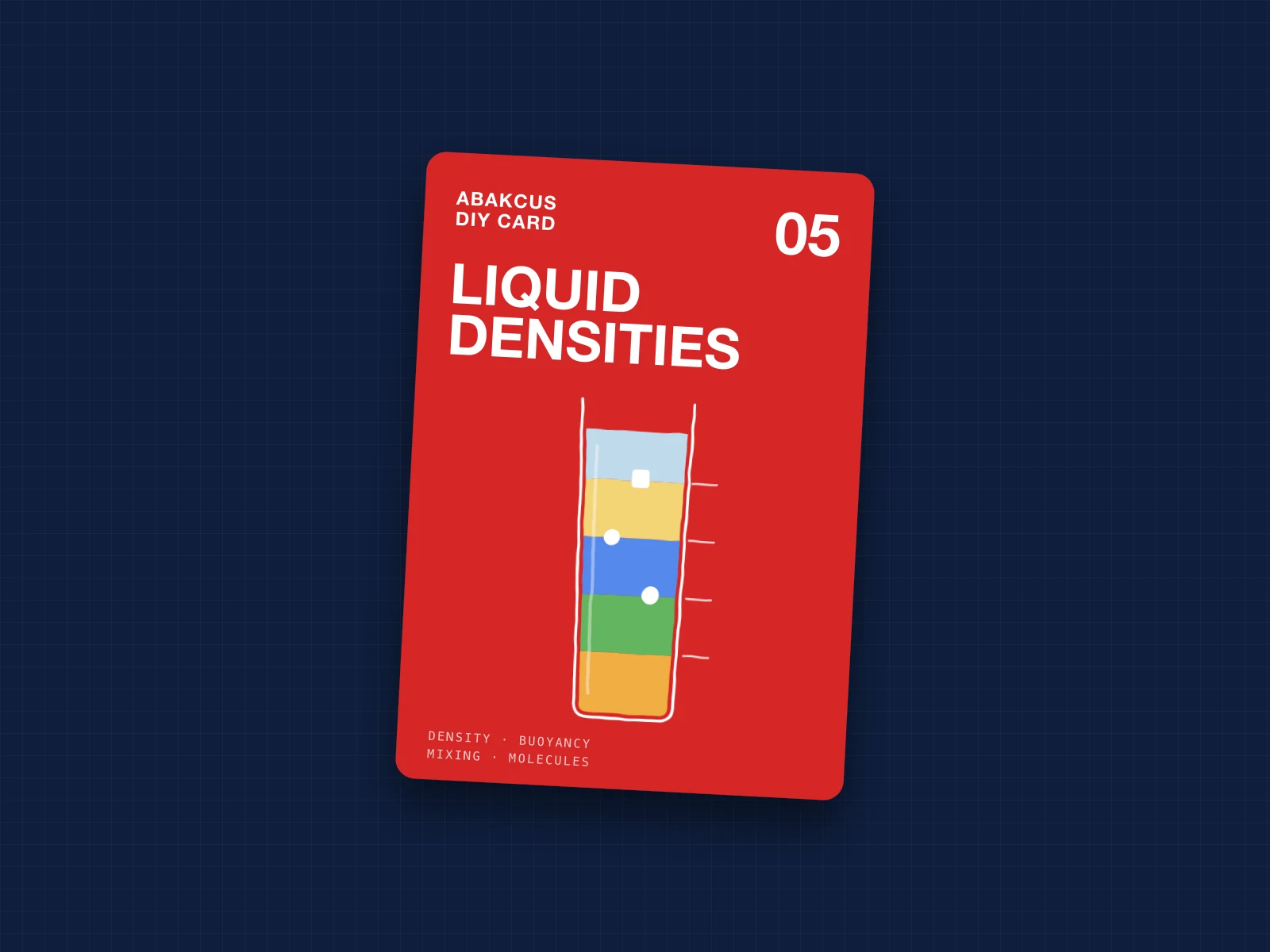
How to Make a Density Tower: Stacking Liquids in a Glass
Honey, washing-up liquid, water, oil and rubbing alcohol, poured one by one into a glass, settle into five sharp layers. Which goes where is decided by one number, and one of them only stays put thanks to the oil.
Open
How to Make a Spectroscope From a CD and a Cereal Box
An old CD and a cereal box make a real scientific instrument. Point it at the sky, a lamp or a street light and see the hidden colours each one is made of.
Open
How to Make Rock Candy Crystals on a Stick
Sugar, water and a week of patience. Dissolve far more sugar than cold water can hold, hang a seeded stick in the syrup, and watch crystals grow day by day.
Open