
DIY · Card 82 · Physics · Light
An old CD and a cereal box make a real scientific instrument. Point it at the sky, a lamp or a street light and see the hidden colours each one is made of.
01The brief
Every light has a fingerprint. Here is how to read it.
1.6 µm
between the tracks of a CD: about 625 lines per millimetre
14–26°
where a CD sends violet to red light
589 nm
the single yellow-orange colour of a sodium street lamp
Tilt a CD in the light and colours slide across it. Those colours are a clue: the disc is splitting light apart, just as a prism does, but using its thousands of tiny, evenly spaced tracks instead of glass.
Put a piece of disc in a dark box with a narrow slit and you have a spectroscope, the instrument that told astronomers what stars are made of. It belongs with the pinhole camera and the kaleidoscope.
02Kit
An old disc, a cereal box and some black tape.
Tick off what you have
0 of 5 ready
03Method
A slit at one end, a disc at the other, darkness in between.
Step 1 of 8 · Minute 0
You need an old CD or DVD you no longer want, an empty cereal box, black tape, scissors, a craft knife, a ruler and two small pieces of card with straight edges.
No rainbow, just a white glare.
Why
You are seeing the straight reflection.
Fix
Tilt your eye or the box slightly: the rainbow sits to one side of the bright reflection.
The colours are blurred together.
Why
The slit is too wide.
Fix
Bring the two card edges closer, until the slit is a thin line of light.
The spectrum is faint.
Why
Light is leaking in or the source is dim.
Fix
Tape every seam, look from a darker room, and aim at a bright sky or lamp.
04Splitting light
Light is a wave. Reflected from many evenly spaced tracks, the waves add up only in certain directions, and those directions depend on the wavelength, the colour. So each colour leaves the disc at its own angle.
Choose a disc and a colour:
First rainbow at
20.1°
Second rainbow at
43.4°
Violet to red spread
11°
Light reflected from neighbouring tracks only adds up in directions where the extra distance is a whole number of wavelengths: d sin θ = m λ. Longer, redder waves need a bigger angle. On a CD, with tracks 1.6 µm apart, the first rainbow runs from about 14° for violet to 26° for red. A DVD’s tracks are twice as close, so it spreads the colours much wider and has no second rainbow at all.
Now point the spectroscope at different lights:
A smooth rainbow from violet to red. Look closely with a good slit and you may see thin dark lines: the Fraunhofer lines, where atoms in the Sun’s atmosphere absorb particular colours.
05The big idea
Light is
a barcode.
Every kind of atom gives out and absorbs light only at its own particular wavelengths. Spread a light into its spectrum and those wavelengths appear as lines, a barcode that identifies the atoms that made it.
That is how we know what the Sun and distant stars are made of without ever going there: we read their barcodes. Your cereal box does the same job, just less precisely.
06The math
1 · Grating equation
d · sin θ = m · λ
d the track spacing, m the order (1, 2…).
2 · Lines per mm
N = 1000 ⁄ d
For a spacing d in micrometres.
3 · Colour and speed
c = f · λ
Speed of light, wavelength and frequency.
A CD has d = 1.6 µm, so 1000 ⁄ 1.6 = 625 tracks per millimetre. Red light at 700 nm leaves at sin⁻¹(0.7 ⁄ 1.6) ≈ 26°; violet at 400 nm at sin⁻¹(0.4 ⁄ 1.6) ≈ 14.5°. A second, fainter rainbow appears at about 30° to 61°.
Sodium’s yellow-orange light, 589 nm, has a frequency of 3 × 10⁸ ⁄ 5.89 × 10⁻⁷ ≈ 5.1 × 10¹⁴ waves per second. Your spectroscope sorts colours that differ by a few per cent in that frequency.
07Real life
From a new element in the Sun to the colours of butterflies.
Helium, found in the Sun
During a solar eclipse in 1868, astronomers saw a yellow line in the Sun’s spectrum that matched no known element. It was a new one, named helium after the Greek for Sun, and was found on Earth 27 years later.
The expanding universe
The lines in a galaxy’s spectrum are shifted towards red when it moves away from us. In 1929 Edwin Hubble showed that the further away a galaxy is, the bigger the shift: the universe is expanding.
Firework colours
Each metal glows with its own spectral lines: strontium gives red, sodium yellow-orange, barium green and copper blue-green. Firework makers choose their colours from the periodic table.
Butterfly wings
The brilliant blue of a Morpho butterfly isn’t pigment. Tiny ridges on its scales, spaced a fraction of a micrometre apart, reflect blue light strongly, the same kind of trick as a CD.
Banknote holograms
The shimmering foil patches on banknotes and bank cards are diffraction gratings too, finely embossed so that different colours and pictures appear as you tilt them.
Rainbows
A real rainbow splits light a different way: by refraction in raindrops, which bend each colour by a slightly different amount. Same colours, different physics from your CD.
1814
Joseph von Fraunhofer was orphaned at 11 and apprenticed to a glassmaker; at 14 he survived the collapse of the workshop he lived in. He went on to become the finest optician in Europe.
Testing his glass in 1814, he spread sunlight into a spectrum and found it crossed by hundreds of fine dark lines, which he carefully mapped. He later built the first diffraction gratings to measure them. Decades afterwards, chemists realised each line was the signature of an element: the beginning of astronomical spectroscopy.
08Is and isn’t
The colours on a CD come from a coating.
They come from the shape of the surface: the evenly spaced tracks. Flatten the tracks and the rainbow disappears.
All white light is the same.
Daylight, LEDs and fluorescent tubes all look white but have completely different spectra, as your spectroscope shows.
Only a prism can split light.
Prisms split light by refraction; gratings like a CD do it by diffraction. Professional spectrographs usually use gratings.
The dark lines in sunlight are mistakes.
They are real: missing colours absorbed by atoms in the Sun’s atmosphere. They tell us what the Sun is made of.
09Go further
A
A spectrum gallery
Draw what you see from five different lights: sky, filament bulb, LED, fluorescent tube, phone screen. How many are true rainbows?
B
Measure the tracks
Shine a laser pointer (red, low power, never at eyes) onto a CD and measure where the spots land on a wall. Use d sin θ = λ to work out the track spacing.
C
Phone spectrometer
Tape your spectroscope’s peephole to a phone camera and photograph the spectra to compare them side by side.
D
Fraunhofer lines
With a very narrow slit, look for thin dark lines in daylight. Can you find the dark pair in the yellow-orange?
E
Flame colours
With a grown-up, sprinkle a pinch of salt into a gas flame and look at it through the spectroscope. What colour line appears?
10Questions
Cut a narrow slit in one end of a cereal box and a slanted slot near the bottom of the other end. Slide in a quarter of an old CD, shiny side up, cut a peephole above it, tape up any light leaks, and point the slit at a bright sky. A rainbow appears on the disc.
Its data is stored along a spiral track with turns about 1.6 micrometres apart. Those evenly spaced lines act as a diffraction grating: light reflected from neighbouring tracks reinforces only at certain angles, and each colour has its own angle.
A smooth rainbow from daylight and old filament bulbs, a blue spike and a yellow hump from white LEDs, separate bright lines from fluorescent tubes, and a single yellow-orange line from sodium street lamps.
A DVD’s tracks are only 0.74 µm apart, so it spreads the colours much wider, from about 33° to 71°. That makes the spectrum bigger but harder to catch in a box designed for a CD.
Never. Point the slit at bright sky or a white cloud, well away from the Sun. Sunlight through any optical device can damage your eyes.
Safety · Never point your spectroscope at the Sun. A grown-up should cut the disc, which can splinter into sharp edges. Never shine a laser into anyone’s eyes.
All DIY cards →Keep wandering
A few more pieces in the same spirit — math, design, and slow attention.
How to Make a Pinhole Camera From a Shoebox
A shoebox, a square of foil and a needle. Prick one tiny hole and the world outside appears on a paper screen, in colour, moving and upside down.
Open
How to Make a Kaleidoscope From a Kitchen-Roll Tube
Three strips of mirror in a kitchen-roll tube and a pinch of beads. Turn it to the light and a jumble of sequins becomes a perfect, ever-changing pattern.
Open
How to Measure the Speed of Light With Chocolate
Take the turntable out of a microwave, heat a bar of chocolate for twenty seconds, and measure the gap between the melted spots. Multiply by the number on the back of the oven and you get the speed of light, give or take a few percent.
Open
How to Make a Paper Microscope With a Glass Bead Lens
A strip of card, a glass bead the size of a grain of sand and a slip of sticky tape. Hold it to your eye and an onion skin becomes a wall of cells.
Open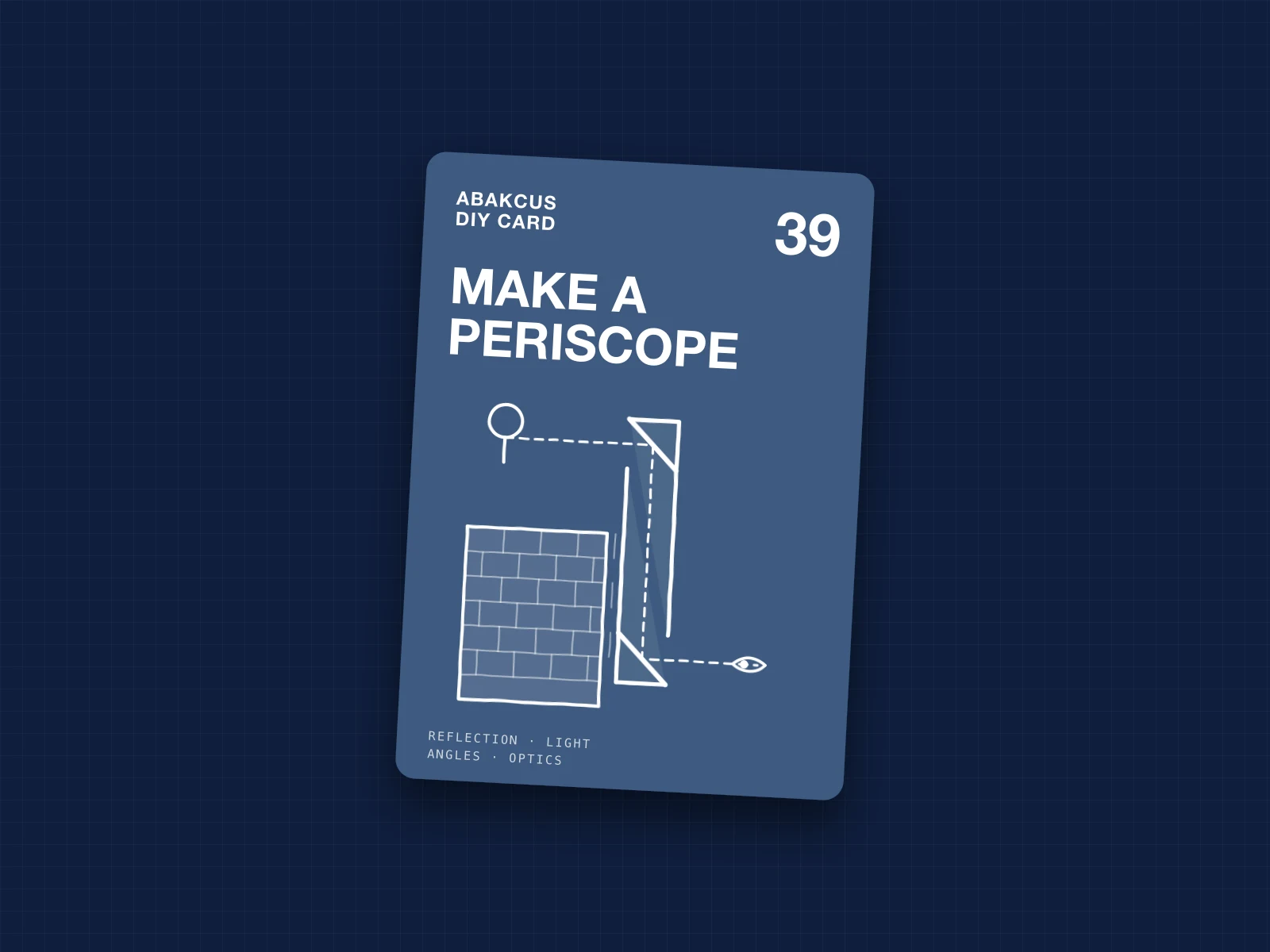
How to Make a Periscope With Two Mirrors and a Box
Two juice cartons and two small mirrors. Set the mirrors at exactly 45° and you can see over walls, round corners and above a crowd, without ever showing your head.
Open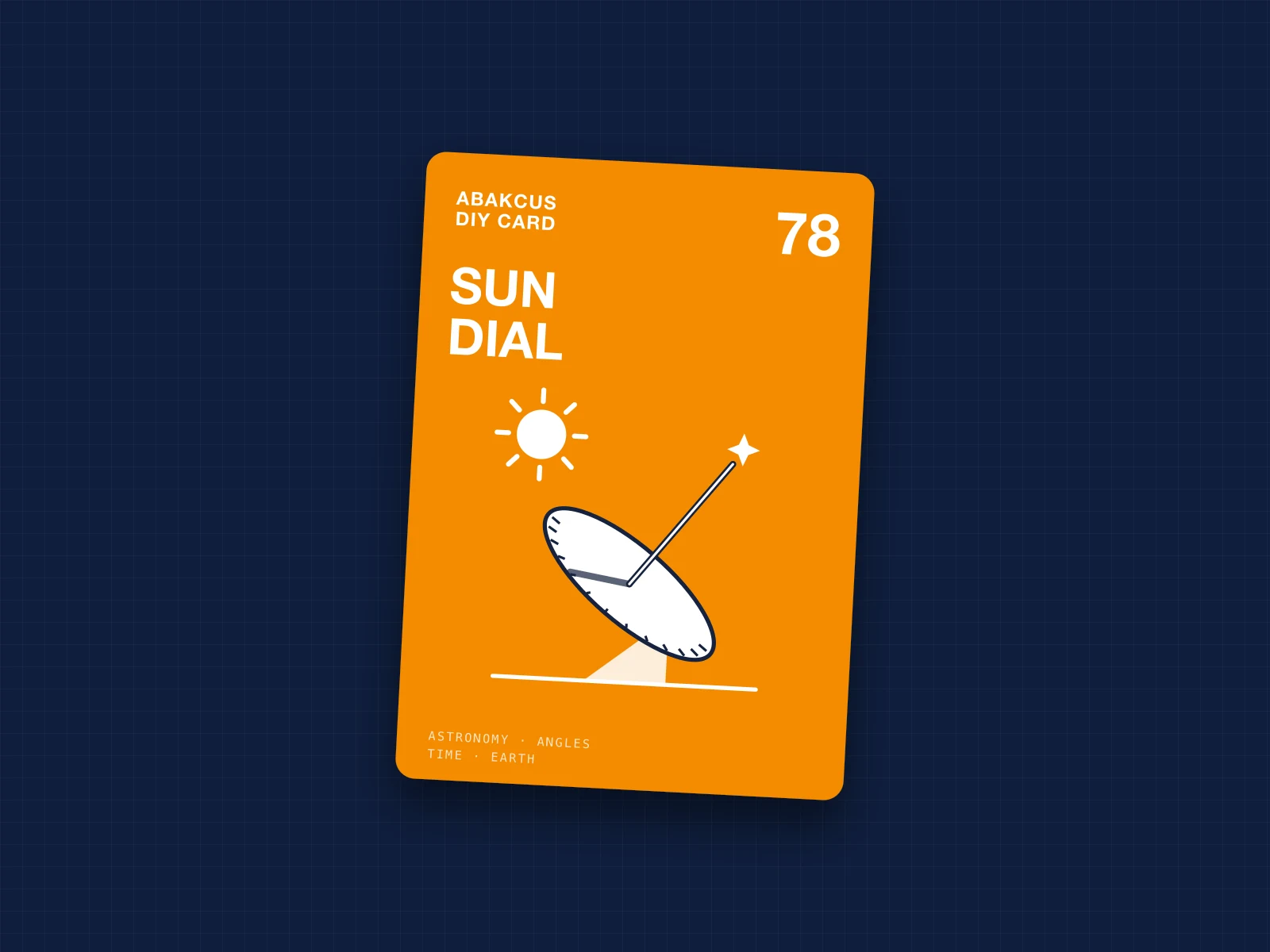
How to Make a Sundial From a Paper Plate
A paper plate, a pencil and the turning Earth. Tilt the plate to your latitude, point the pencil at the pole star, and the shadow turns 15° every hour.
Open