
DIY · Card 78 · Astronomy · Angles
A paper plate, a pencil and the turning Earth. Tilt the plate to your latitude, point the pencil at the pole star, and the Sun moves its shadow 15° every hour, as steady as a clock.
01The brief
Tell the time with the turning of the Earth.
15°
that the shadow turns every hour on an equatorial dial
±16 min
how far the Sun runs fast or slow over the year
3,200
years since the oldest known Egyptian sundial was made
The Sun doesn’t really move across the sky; the Earth turns beneath it, once a day, 15° an hour. A sundial is a way of reading that turn. Line a pin up with the Earth’s axis and its shadow sweeps round as steadily as the planet spins.
A paper plate makes the simplest dial of all, one whose hour lines are perfectly even. It is a natural companion to the water clock and the moon clock.
02Kit
A plate, a pencil and a sunny day.
Tick off what you have
0 of 5 ready
03Method
Draw the hours, add the pin, then tilt it to your latitude.
Step 1 of 8 · Minute 0
You need a stiff paper plate or a disc of card about 20 cm across, a pencil or a straight straw, a protractor, a ruler, a pen, some extra card for a stand, tape, and a phone with a compass app.
The shadow is hours out.
Why
The dial is facing the wrong way.
Fix
Turn it so the top of the pencil points north and the 12 line points straight down the slope. Check with the compass again.
No shadow on the top face.
Why
It is between September and March.
Fix
Look underneath: the Sun is now south of the equator’s plane and lights the back of the dial.
Close, but 20 to 60 minutes off.
Why
Clock time isn’t sun time.
Fix
Subtract an hour for summer time, then allow for your longitude and the equation of time; the shadow dial above does the sum for you.
04Shadows and angles
Tilted to your latitude, the plate lies parallel to the equator and the pencil parallel to the Earth’s axis. From the dial’s point of view, the Sun simply circles the pencil once a day, so the shadow turns at a perfectly steady rate.
Change the place, the date and the time:
Sun’s height
59°
Shadow turned
-30°
Clock reads
10:02
The shadow turns 15° an hour whatever the date or latitude, because the dial is parallel to the equator and turns with the Earth. On this date the Sun is 1 minutes behind the clock (the equation of time), and it shines on the top face.
Lay the same dial flat on the ground and the hour lines are no longer even:
| Hours from noon | Flat dial | Equatorial |
|---|---|---|
| 1 | 10.0° | 15° |
| 2 | 20.7° | 30° |
| 3 | 33.3° | 45° |
| 4 | 48.7° | 60° |
| 5 | 67.8° | 75° |
Dashed blue: the even 15° steps of an equatorial dial. Solid: where the hour lines fall on a flat garden dial at 41°. The gnomon must still point at the pole, rising at 41° from the ground, so its shadow sweeps unevenly across a flat face. That is why every garden sundial is made for one latitude only.
05The big idea
The Earth
is the clock.
Long before springs and quartz crystals, the turning planet was the only clock there was. Hours, minutes and seconds were all fractions of one day: one spin of the Earth relative to the Sun.
A sundial doesn’t measure time; it reads it off the planet directly. Line it up with the axis and you are watching the Earth turn, 15° at a time.
06The math
1 · Hour angle
H = 15° × (h − 12)
h the sun time in hours.
2 · Flat dial lines
tan θ = sin φ · tan H
φ your latitude; θ the line’s angle from the noon line.
3 · Longitude
24 × 60 ⁄ 360 = 4 min
Minutes of time per degree east or west.
At 3 pm sun time, H = 15 × 3 = 45°: on the paper plate the shadow sits exactly on the 45° line. On a flat garden dial at latitude 41°, the 3 o’clock line is at tan⁻¹(sin 41° × tan 45°) = tan⁻¹(0.656) ≈ 33.3° from the noon line instead.
Istanbul, at 29° east, uses a time zone set for 45° east, so its sun time runs 16 × 4 = 64 minutes behind the clock before you even add the equation of time, which swings from about −14 minutes in February to about +16 in early November.
07Real life
From ancient Egypt and Jaipur to the surface of Mars.
Measuring the Earth
Around 240 BC Eratosthenes compared noon shadows in Syene and Alexandria. A difference of about 7° told him the distance between the cities was a fiftieth of the way round the Earth, and so he estimated its size.
Jantar Mantar
In the 1730s the Maharaja Jai Singh II built giant stone instruments in Jaipur. Its great sundial has a gnomon about 27 metres tall, whose shadow moves visibly as you watch.
Sundials on Mars
NASA’s Spirit and Opportunity rovers, which landed in 2004, each carried a small sundial used to calibrate their cameras, inscribed with the words “Two worlds, one Sun”.
The analemma
Photograph the Sun from the same spot at the same clock time every week for a year and it traces a figure of eight in the sky: the equation of time and the changing seasons, drawn together.
The Sundial Bridge
The Sundial Bridge in Redding, California, opened in 2004, is held up by a tilted 66-metre pylon that doubles as the gnomon of a huge sundial on the ground below.
Time zones
Every town once kept its own sun time. Railways needed shared timetables, and in 1884 an international conference picked Greenwich as the prime meridian for the world’s time zones.
2013
Clearing an ancient workmen’s hut in Egypt’s Valley of the Kings, archaeologists from the University of Basel found a flat piece of limestone with a black semicircle painted on it, divided into twelve sections of about 15° each.
A small hole in the middle once held a peg that cast the shadow. It dates from the 13th century BC, making it one of the oldest sundials ever found, and its makers had already divided the daylight into the same 15° steps as your paper plate.
08Is and isn’t
A sundial shows the same time as a clock.
It shows sun time. Summer time, your position in the time zone and the equation of time can put it more than an hour out.
Any sundial moves 15° an hour.
Only an equatorial dial. On a flat garden dial the hour lines are squeezed together near noon and spread out in the morning and evening.
Point it at magnetic north.
Strictly, it should point at true north, towards the pole star. In many places the two are within a few degrees; in some they differ by more.
Sundials don’t work in winter.
They work whenever the Sun shines. An equatorial dial simply uses its underside from September to March.
09Go further
A
A shadow stick
Push a stick into the ground and mark the tip of its shadow every half-hour. The shortest shadow points due north, at solar noon.
B
Find your longitude
Note the clock time of the shortest shadow. Each 4 minutes away from noon (after corrections) is one degree east or west of your time-zone meridian.
C
A garden dial
Use the flat-dial table to draw hour lines for a horizontal sundial at your latitude, with a triangular gnomon at your latitude angle.
D
Track the analemma
Mark the shadow tip at exactly 12:00 clock time every week. Over months the marks draw part of a figure of eight.
E
A human sundial
Draw hour marks in chalk on a playground, stand in the middle, and let your own shadow tell the time.
10Questions
Draw 24 lines every 15° on both sides of a paper plate, push a pencil through the centre, and prop the plate on a card stand so the pencil points north and rises at an angle equal to your latitude. The pencil’s shadow then moves 15° every hour across the lines.
The pin, or gnomon, must point to true north (in the southern hemisphere, true south) and slope up at your latitude, so it lines up with the Earth’s axis. A phone compass is close enough for a home dial in most places.
A sundial shows sun time. The clock adds an hour in summer time, uses one time for a whole time zone, and ignores the equation of time, which makes the Sun run up to about 16 minutes fast or 14 minutes slow over the year.
A garden sundial lies flat, but its gnomon points at the pole, so the shadow sweeps across the flat face at an uneven rate. The lines follow tan θ = sin(latitude) × tan(15° × hours from noon), which bunches them up around noon.
Very old. In 2013, archaeologists from the University of Basel found a limestone sundial in Egypt’s Valley of the Kings dating from the 13th century BC: a semicircle divided into 12 sections of about 15° each.
Safety · Never look directly at the Sun while you work: watch the shadow, not the light. Wear a hat and sun cream if you stay outside to check the dial.
All DIY cards →Keep wandering
A few more pieces in the same spirit — math, design, and slow attention.

How to Make a Water Clock That Times Exactly One Minute
Two plastic cups, a pinhole and three-quarters of a cup of water. Tune the hole until it runs dry in exactly sixty seconds, and you have built the oldest kind of clock there is.
Open
How to Make a Moon-Themed Clock With a Moon Phase Window
A full moon for a clock face, a battery movement and a hand-turned phase window. It keeps the time to the second and, with a nudge every few days, keeps pace with the Moon.
Open
How to Make a Color-Coded After-School Routine Clock
A plain white wall clock and five pots of paint. Paint each part of the afternoon as a slice of the face and the hour hand shows what comes next.
Open
How to Make a Pinhole Camera From a Shoebox
A shoebox, a square of foil and a needle. Prick one tiny hole and the world outside appears on a paper screen, in colour, moving and upside down.
Open
How to Build a Compass With a Needle, a Magnet and Water
A sewing needle, a magnet and a bowl of water. Fifty strokes turn the needle into a magnet, and floated on the water, it swings round to feel the invisible field of the whole Earth.
Open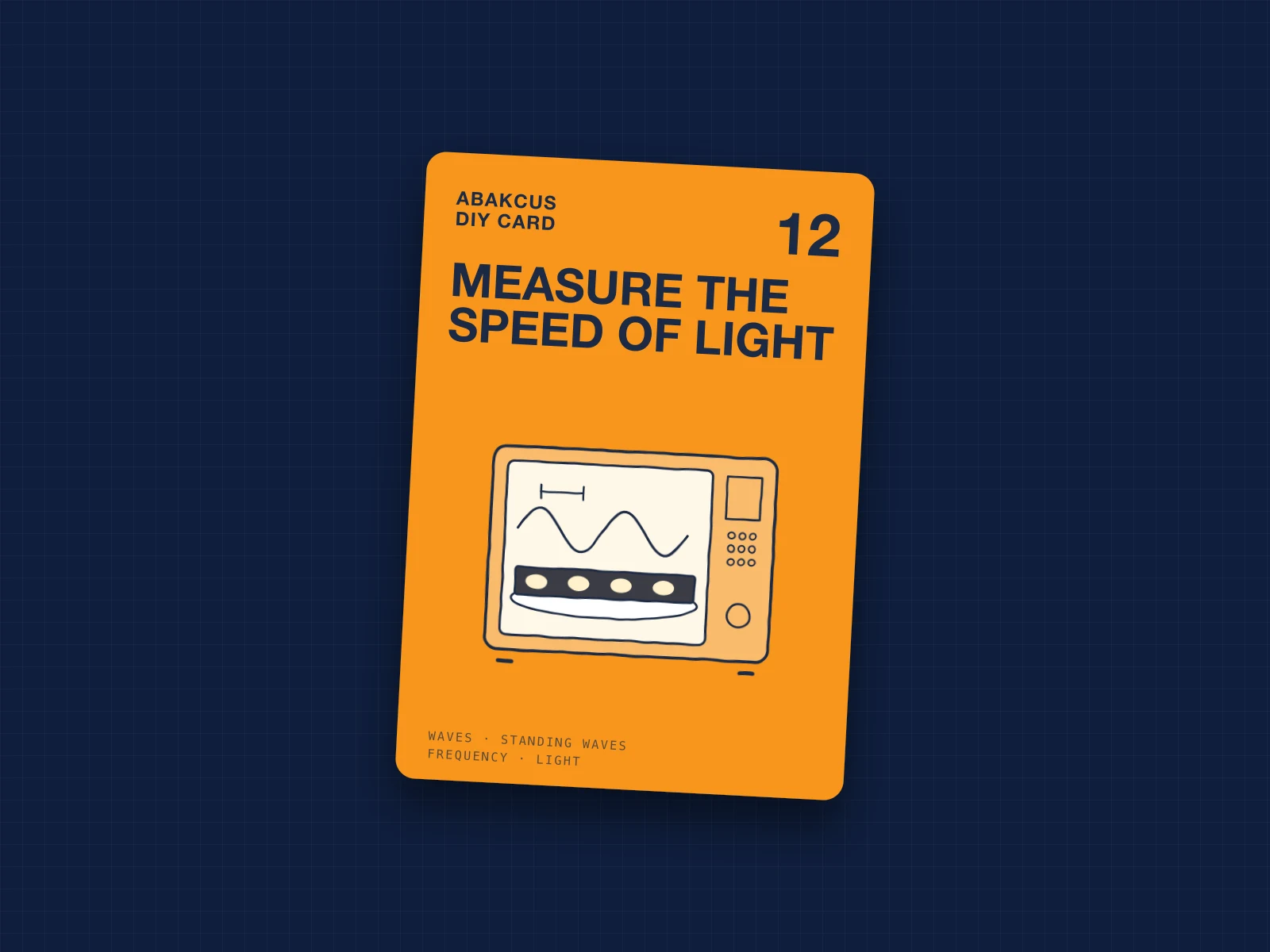
How to Measure the Speed of Light With Chocolate
Take the turntable out of a microwave, heat a bar of chocolate for twenty seconds, and measure the gap between the melted spots. Multiply by the number on the back of the oven and you get the speed of light, give or take a few percent.
Open