
DIY · Card 77 · Light · Symmetry
Three strips of mirror in a kitchen-roll tube and a pinch of beads. Turn it towards the light and a handful of jumbled sequins becomes a perfect, ever-changing pattern.
01The brief
Throw in chaos, get back symmetry.
60°
between each pair of mirrors in a classic three-mirror tube
360⁄θ − 1
reflections from two mirrors at an angle θ
1816
the year David Brewster invented the kaleidoscope
Drop a handful of beads on a table and they make a mess. Put the same beads at the end of a tube of mirrors and they make a snowflake, a stained-glass window, a mandala. Turn the tube a little and a completely new one blooms.
The magic is all in the mirrors, and in the angles between them. It is a natural partner for the periscope, another tube of mirrors, and the hexaflexagon, built from the same 60° triangles.
02Kit
A tube, some mirror card and a pinch of beads.
Tick off what you have
0 of 5 ready
03Method
Fold the mirrors, fill the bead chamber, add a peephole.
Step 1 of 8 · Minute 0
You need a cardboard tube (a kitchen-roll tube is ideal), a sheet of mirror card or thin reflective plastic, a ruler, scissors, tape, clear plastic from food packaging, a handful of small beads and sequins, some card and decorations.
The pattern looks smeared or doubled.
Why
The mirror card is scratched or bent.
Fix
Use fresh, flat mirror card and handle it by the edges. Peel off any protective film only at the end.
The pattern doesn’t join up neatly.
Why
The three strips aren’t the same width.
Fix
Measure and cut them carefully so the triangle is truly equilateral, with 60° at every corner.
It looks dim.
Why
Not enough light reaches the beads.
Fix
Point it at a bright window (never the Sun), use see-through beads, and make the outer disc frosted rather than card.
04Mirrors and symmetry
Each mirror shows a reflection of the object, and of the other mirror’s reflection, and of that reflection’s reflection. The angle between the mirrors decides how many copies fit round before they close up into a circle.
Change the angle and count the flags:
Angle between the mirrors
Slices
6
Reflections
5
Back to front
3
The orange flag is real; the rest are reflections, including reflections of reflections. At 60°, 360 ⁄ 60 = 6 slices fit round the hinge, so you see 5 copies. The blue ones are mirror images, flag pointing the other way; the white ones have been reflected twice, which turns them the right way round again.
Now put beads between the mirrors instead of a flag, and turn the tube:
Mirror angle
Only one slice holds real beads, 30° wide. The other 11 are reflections, so the whole circle has 12-fold mirror symmetry, however randomly the beads fall. Narrower mirror angles give more slices and lacier patterns; Brewster’s own favourites were around 20°.
05The big idea
Symmetry is
repetition.
A pattern is symmetric when some move, a turn or a reflection, leaves it looking the same. A kaleidoscope builds patterns the other way round: it takes one random slice and applies the moves, so symmetry is guaranteed.
Mathematicians describe all the moves together as a group. Two mirrors at 30° make a group of 12 moves: 6 turns and 6 reflections, one for each of the 12 slices. Every pattern they show is unchanged by all 12.
06The math
1 · Slices
n = 360° ⁄ θ
Two mirrors at angle θ, when θ divides 360°.
2 · Reflections
n − 1
Every slice but the real one.
3 · Mirror width
s = D · √3 ⁄ 2
For a tube of inner diameter D.
Two mirrors at 30° make 360 ⁄ 30 = 12 slices: one real and 11 reflections, half of them mirror images. At 20° there are 18 slices and 17 reflections.
A kitchen-roll tube is about 4 cm across inside, so the three mirror strips should be 4 × 0.866 ≈ 3.5 cm wide; cut them at 3.3 cm so they slide in. With three mirrors at 60°, six triangles fit round every corner, 6 × 60° = 360°, so the reflected triangles tile the view without gaps, as far as the eye can see.
07Real life
From the Moon to the walls of the Alhambra.
Mirrors on the Moon
Apollo 11 left a panel of corner reflectors on the Moon in 1969: three mirrors at right angles that send light straight back where it came from. Laser pulses bounced off them still measure the Moon’s distance to within centimetres.
Bike reflectors
The little plastic reflector on a bicycle is moulded into hundreds of tiny corner cubes. However the headlights hit it, the light bounces back towards the driver.
The Alhambra
The tiled walls of the Alhambra in Granada repeat their motifs by turns and reflections, the same moves as a kaleidoscope. Mathematicians have found many of the possible symmetry patterns there.
Seventeen wallpapers
In 1891 the crystallographer Evgraf Fedorov proved there are exactly 17 ways a pattern can repeat across a flat surface. A kaleidoscope with three 60° mirrors makes one of them.
Infinity mirrors
Two mirrors facing each other, as in a lift or a barber’s shop, are a kaleidoscope with a 0° angle: the reflections run away in a line that seems to go on for ever.
Snowflake symmetry
A snowflake has the same symmetry as a kaleidoscope with mirrors at 30°: six arms, each with matching left and right sides, twelve identical slices in all.
1816
The Scottish physicist David Brewster was studying how light is polarised when it reflects off glass. Around 1816, experimenting with mirrors set at angles, he noticed the beautiful symmetric patterns they made and built a tube to show them off.
He named it from the Greek for “beautiful form viewer” and patented it in 1817. But a prototype had already been copied by London opticians, cheap imitations flooded the streets, and the kaleidoscope became a craze across Europe while its inventor earned almost nothing.
08Is and isn’t
Kaleidoscope patterns are random.
The beads are random; the pattern never is. The mirrors force perfect symmetry onto whatever falls in front of them.
More mirrors always mean more reflections.
It’s the angle that counts. Two mirrors at 20° give 17 reflections; three mirrors at 60° give an endless field of them.
A mirror swaps left and right.
It swaps front and back. Your right hand stays on the right of the mirror; it’s the direction you face that reverses.
Kaleidoscopes are an ancient invention.
David Brewster invented the kaleidoscope around 1816. Within months it was a craze across Britain and France.
09Go further
A
Two mirrors only
Replace one mirror with black card. What happens to the endless pattern? How many slices do you see now?
B
A teleidoscope
Swap the bead chamber for a clear marble. Now the kaleidoscope turns whatever you point it at into a pattern.
C
Book mirrors
Stand two mirrors on a hinge with a coin between them. Close the angle bit by bit and count the coins.
D
Paper snowflakes
Fold a paper circle into twelfths and cut it. Unfold: you have made the pattern a 30° kaleidoscope would show.
E
A square kaleidoscope
Build one with four mirrors in a square. How does the pattern differ from the triangle’s?
10Questions
Cut three equal strips of mirror card, tape them into a triangular prism with the shiny sides inwards, and slide it into a cardboard tube. Close one end with a chamber of loose beads between two clear plastic discs, cover the other with a card eyepiece, and look through it towards a bright window.
The mirrors reflect the beads, and reflect the reflections, so one small slice of the view is copied all the way round. However randomly the beads fall, the copies are arranged symmetrically, which makes every pattern look designed.
Two mirrors at an angle θ divide the view into 360 ⁄ θ slices, so you see 360 ⁄ θ − 1 reflections. At 90° you see three; at 60°, five; at 30°, eleven.
The Scottish scientist Sir David Brewster, around 1816, while studying how light is polarised by reflection. He patented it in 1817, but copies appeared so quickly that he earned very little from it.
Three mirrors in an equilateral triangle, 60° apart, fill the whole view with an endless repeating pattern. Two mirrors at an angle that divides 360° evenly, like 30° or 20°, give a single round mandala.
Safety · Never point a kaleidoscope at the Sun. Use mirror card or plastic, not glass mirrors, and keep beads and sequins away from children under three.
All DIY cards →Keep wandering
A few more pieces in the same spirit — math, design, and slow attention.
How to Make a Periscope With Two Mirrors and a Box
Two juice cartons and two small mirrors. Set the mirrors at exactly 45° and you can see over walls, round corners and above a crowd, without ever showing your head.
Open
How to Make a Hexaflexagon From a Strip of Paper
A strip of ten paper triangles folds into a hexagon with three faces instead of two. Pinch, push and open, and a face you never coloured blooms from inside.
Open
How to Make a Pinhole Camera From a Shoebox
A shoebox, a square of foil and a needle. Prick one tiny hole and the world outside appears on a paper screen, in colour, moving and upside down.
Open
How to Make Moiré Patterns With Two Grids and a Turntable
Two squares of black mesh and a turntable. Spin one grid under the other and giant shimmering squares bloom and swirl, a pattern that exists in neither grid.
Open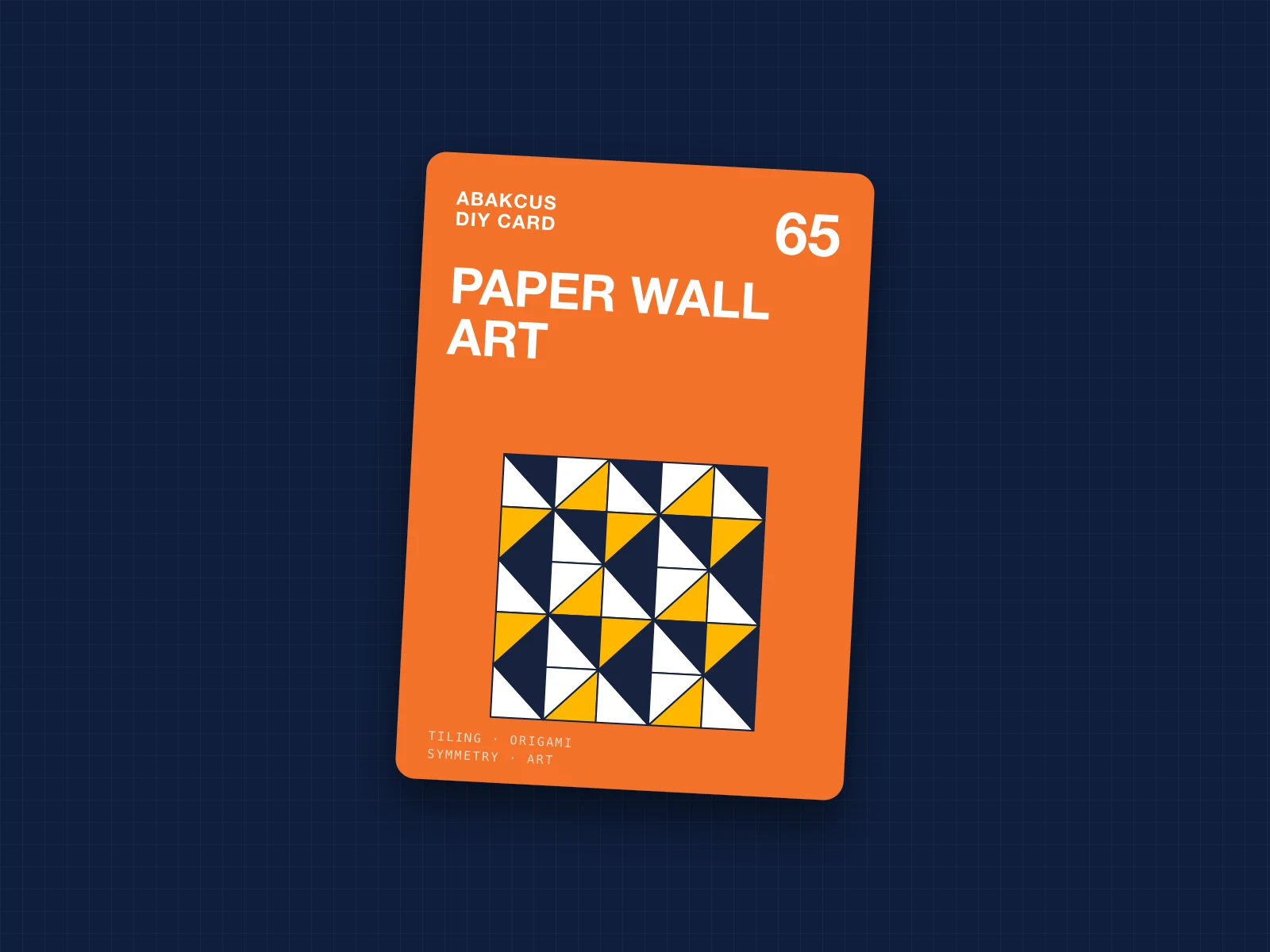
How to Make Geometric Paper Wall Art From Folded Triangles
Square sheets of coloured paper, one classic origami fold and a board. Fold two dozen identical triangles, turn them this way and that, and a pattern takes over the wall.
Open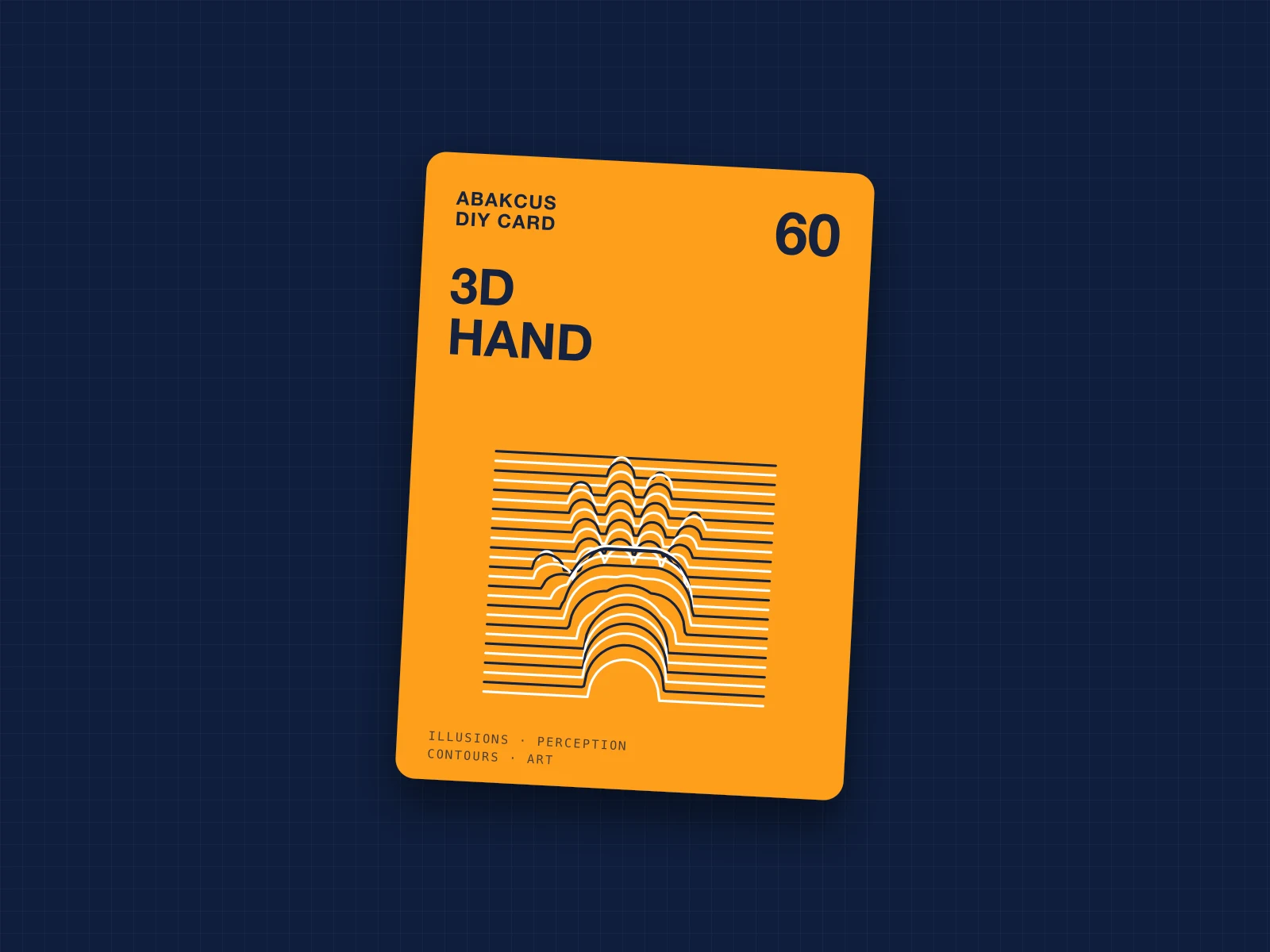
How to Draw a 3D Hand Optical Illusion With Curved Lines
Trace your hand, then draw nothing but lines across the page, each arching up as it crosses the outline. Thirty lines later, your hand rises off the paper.
Open