
DIY · Card 55 · Mathematics · Patterns
Two squares of black mesh and a turntable. Spin one grid under the other and giant shimmering squares bloom and swirl across them, a pattern that exists in neither grid.
01The brief
Make a pattern that is in neither of its parts.
2
identical grids of holes, one turned slightly against the other
29×
how much bigger the moiré squares are than the holes, at a 2° turn
1874
when Lord Rayleigh first described moiré scientifically
Look through the two wire guards of an electric fan and you see something that isn’t there: big, shimmering bands that swirl when you move your head. Neither guard has any such pattern. It appears only where the two overlap.
That ghost pattern is a moiré, pronounced mwar-ay. You can make a bold one with two squares of needlepoint mesh and a turntable, and play with it until you can predict exactly how big it will be. It is a cousin of the beats in the pendulum wave, where slightly different rhythms make large patterns, and of the missing square puzzle, another lesson in not trusting your eyes.
02Kit
Mesh, black paint and something that spins.
Tick off what you have
0 of 5 ready
03Method
The painting takes a little time; the patterns appear instantly.
Step 1 of 8 · Minute 0
You need a sheet of plastic canvas, the stiff mesh used for needlepoint, scissors, black acrylic paint, a sponge, and a lazy Susan or any turntable. A phone camera is useful at the end.
You can’t see any pattern.
Why
The grids are lined up perfectly, or too far apart vertically.
Fix
Turn the top grid a few degrees, and hold it just above the bottom one, not high in the air.
The pattern is faint.
Why
Too little contrast between bars and holes.
Fix
Paint the mesh fully black and put bright white paper underneath, in good light.
Painted holes are clogged.
Why
Too much paint.
Fix
Dab, don’t brush, and blow through the mesh before it dries to clear the holes.
04The pattern
With one grid turned, there are places where the bars of the top grid sit right on the bars of the bottom one, so the holes stay open and light shines through. A little further on, the top bars cross the bottom holes and block them. Bright and dark regions alternate, making a new grid of their own, far coarser than the mesh.
Turn the top grid and watch the giant squares grow and shrink:
Where the two grids’ lines lie on top of each other, light gets through the holes; where they fall in between, the holes are blocked. Those regions form a new, giant grid. The smaller the angle, the bigger it is: at 5.0° the new squares are 11.5 times the size of a hole. Spin the top grid and the giant pattern spins too, much faster than the grids themselves.
Moiré also appears when two patterns are lined up but have slightly different spacings, like two combs with different teeth. Then something remarkable happens when you slide one:
Band spacing
115 px
Magnification
13 ×
Watch the dark bands as you slide the top stripes a few pixels: the bands move about 13 times as far. That is how engineers use moiré to see movements and stretches far too small for the eye, and the same trick as the vernier scale on a calliper.
05The big idea
Small differences,
big patterns.
Two patterns that almost match make a third pattern from their mismatch. The smaller the difference, the bigger the pattern, and the more it magnifies any change.
It is the same mathematics as two musical notes slightly out of tune, whose sound throbs in slow beats, and as the vernier scale that lets a calliper read a tenth of a millimetre. Moiré turns tiny differences into things you can see.
06The math
1 · Turned grids
D = d ⁄ (2 sin(θ ⁄ 2))
Identical spacing d, turned by θ.
2 · Small angles
D ≈ d ⁄ θ
With θ in radians.
3 · Different spacings
D = d₁d₂ ⁄ |d₁ − d₂|
Parallel stripes, spacings d₁ and d₂.
Plastic canvas has about 3.6 mm between holes. Turn one grid by 5° and D = 3.6 ⁄ (2 sin 2.5°) ≈ 41 mm: moiré squares about 11 times the hole size. At 2° they are about 103 mm, nearly the whole square; at 20°, only 10 mm.
For stripes 1 mm and 1.1 mm apart, D = 1 × 1.1 ⁄ 0.1 = 11 mm. Slide one set by 0.1 mm and the bands jump by about a whole millimetre: a tenfold magnification, the principle of the vernier scale.
07Real life
A nuisance on camera, a tool in the lab, and a fabric long before either.
Fan guards
Look through the front and back wire guards of an electric fan and you see shimmering bands around the centre: the two sets of wires, at slightly different spacings, making a moiré.
Stripes on screen
Film a fine striped shirt, a brick wall or a computer screen and wavy coloured bands appear on the video. The camera’s grid of pixels and the fine pattern beat against each other.
Watered silk
Moiré was a fabric before it was a pattern: silk pressed in two damp layers so its slightly uneven threads print rippling, wood-grain-like sheens onto each other. It has been made for centuries for ribbons and gowns.
Banknotes
Many banknotes carry patterns of fine lines designed so that a photocopier or scanner turns them into obvious moiré bands, spoiling a forgery.
Measuring strain
Engineers print a fine grating on a part, lay a second grating over it and load the part. As it stretches by tiny amounts, moiré fringes march across, revealing strains far too small to see.
Vernier scales
The sliding scale on a calliper has 10 marks in the space of 9 on the main scale. Like two gratings with different spacings, only one pair of marks lines up, and which one tells you the next decimal place.
1874
People had admired moiré silk for centuries, but the British physicist Lord Rayleigh was the first to treat moiré as science. In 1874 he pointed out that laying two fine gratings over each other produces broad fringes, and that these could reveal tiny flaws in the regularity of a diffraction grating.
The idea grew into a whole family of measuring methods. Today moiré helps check the flatness of surfaces, the strain in bridges and aircraft parts, and the alignment of the masks used to make computer chips.
08Is and isn’t
The pattern is printed on the grids.
Neither grid has any large pattern. The big squares exist only where the two grids overlap, and change completely when you move either one.
A bigger angle makes a bigger pattern.
The opposite. The closer the grids are to lined up, the bigger the moiré. At exactly 0° it grows infinitely large and vanishes.
Moiré is just an annoying glitch.
It is a nuisance in photos and prints, but scientists use it on purpose to test gratings, measure tiny strains and magnify small shifts.
You need two identical patterns.
Any two fine, regular patterns will do: lines and lines, grids and grids, circles and circles, or patterns of slightly different spacing.
09Go further
A
Print your own
Print two copies of a page of thin parallel lines on clear acetate. Lay one on the other and turn it. Then try lines of slightly different spacing.
B
Rings
Print concentric circles on acetate. Slide one copy across the other. What shapes do the fringes make?
C
Two combs
Hold two fine combs one in front of the other against a window and slide one sideways. Count how far the bands move.
D
Net curtains
Look through two layers of a net curtain, or a folded fine mesh bag, and shift them. Where else do you spot moiré at home?
E
Measure the angle
Measure the moiré spacing for a few angles and compare with d ⁄ (2 sin(θ⁄2)), using your mesh’s hole spacing for d.
10Questions
A large pattern of light and dark bands that appears when two fine, regular patterns, such as two grids or two sets of lines, overlap at a slight angle or with slightly different spacing. Where their lines coincide, light gets through; where they fall in between, it is blocked. The result is a new pattern much bigger than either one.
Cut two identical squares of plastic needlepoint canvas and paint them black. Lay one on a lazy Susan, hold the other just above it, and slowly spin the turntable. Giant shimmering squares appear and swirl as the grids turn against each other.
A camera’s sensor is a fine grid of pixels. When it films a fine stripe or check that is close to the pixel spacing, the two patterns overlap and make a moiré: wavy, flickering bands that aren’t on the shirt at all. That is why presenters are often asked to avoid narrow stripes.
For two identical grids with spacing d, turned by an angle θ, the fringes are d ⁄ (2 sin(θ⁄2)) apart. At small angles that is roughly d ⁄ θ, with θ in radians, so a 2° turn makes fringes about 29 times the grid spacing.
From a French name for watered silk, a fabric with a rippling sheen made by pressing two layers of slightly uneven cloth together. The word probably comes, via French, from the English mohair. The fabric’s ripples are themselves a moiré of its threads.
Safety · Safe and simple. Cover the table when painting, and if staring at swirling patterns makes you dizzy, take a break.
All DIY cards →Keep wandering
A few more pieces in the same spirit — math, design, and slow attention.
How to Make a Pendulum Wave Toy From Nuts and String
Twelve nuts on twelve strings, each a little shorter than the last. Let them go together and they weave waves and snakes, then swing back into a perfect line.
Open
How to Make the Missing Square Puzzle and Find the Trick
Four pieces of card make a triangle. Swap two of them round and the same pieces make the same triangle, with a square missing. Where did it go?
Open
How to Make a Harmonograph That Draws With a Pendulum
A broom handle, a board on a Y of string and a felt-tip pen. Set it swinging and the pen draws figures of eight and woven shells, the shapes of musical harmony.
Open
How to Measure the Speed of Light With Chocolate
Take the turntable out of a microwave, heat a bar of chocolate for twenty seconds, and measure the gap between the melted spots. Multiply by the number on the back of the oven and you get the speed of light, give or take a few percent.
Open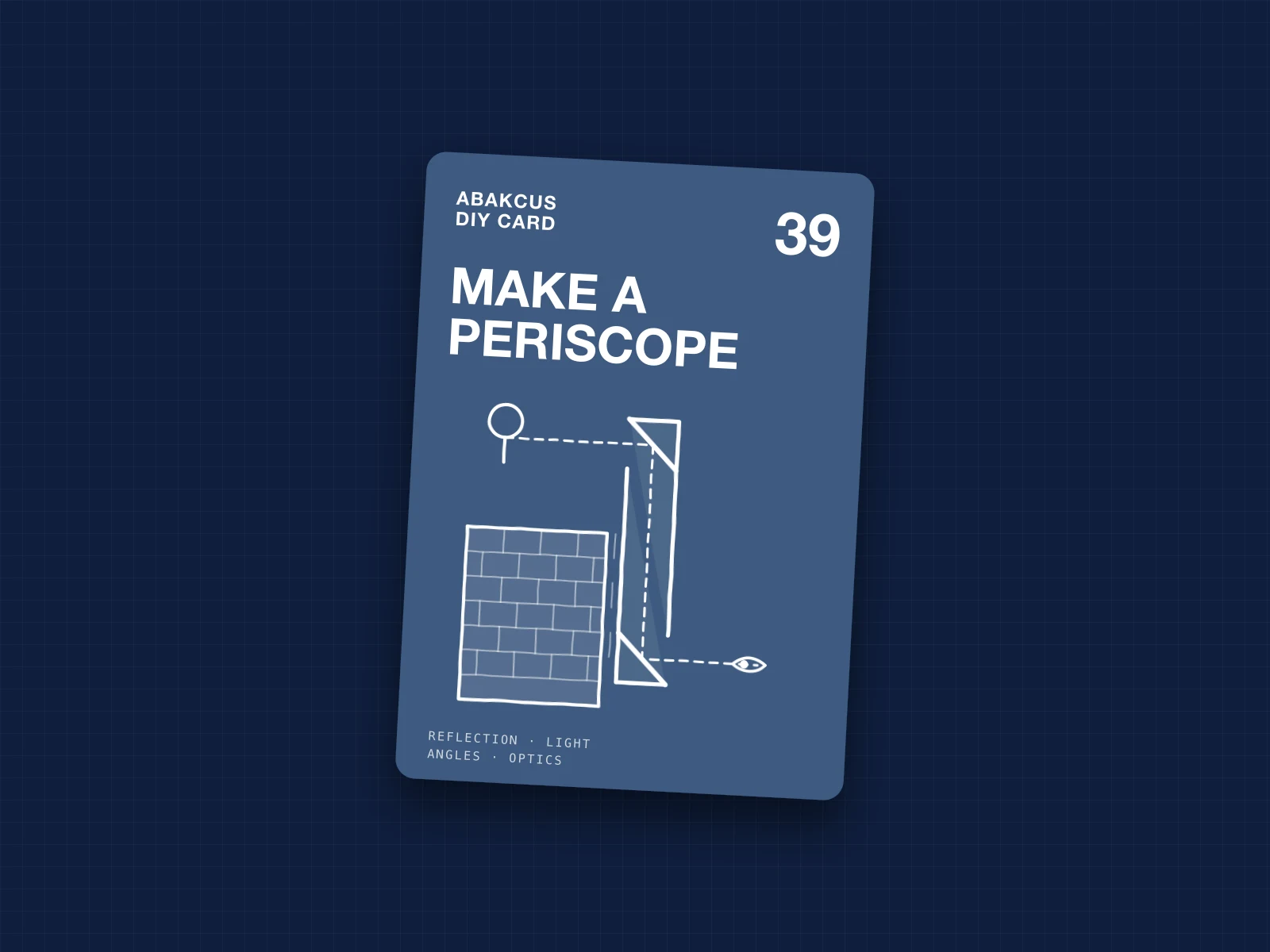
How to Make a Periscope With Two Mirrors and a Box
Two juice cartons and two small mirrors. Set the mirrors at exactly 45° and you can see over walls, round corners and above a crowd, without ever showing your head.
Open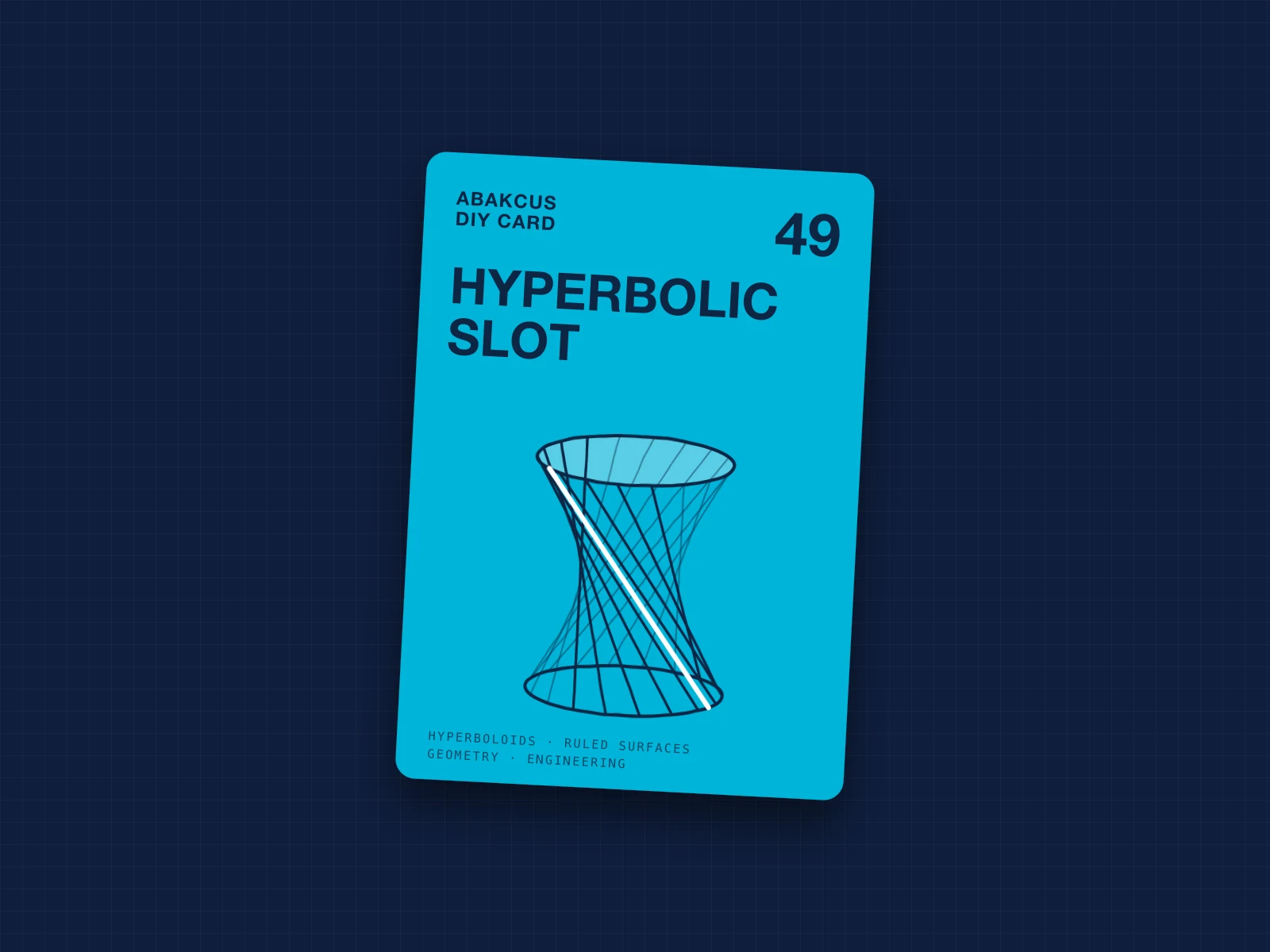
How to Make a Hyperbolic Slot: A Straight Rod Through a Curve
A pencil, a skewer and a sheet of foam board. Spin a perfectly straight stick and it glides through a perfectly curved slot, thanks to the shape of a cooling tower.
Open