
DIY · Card 75 · Mathematics · Geometry
Ten triangles in a strip of paper, folded into a hexagon that has three faces instead of two. Pinch it, open it, and a face you never coloured appears from inside the folds.
01The brief
A piece of paper with three faces.
10
equilateral triangles in the strip, one of them for glue
360°
six 60° corners meeting at the centre: exactly a full turn
1939
the year a Princeton student found the first flexagon
Colour one side of a hexagon green and the other yellow, and you’d expect that to be the end of it. A hexaflexagon has a third face folded away inside. Pinch two triangles, push, open, and a face nobody coloured blooms out of the middle.
It takes half an hour, a strip of paper and a little care with angles. Behind it is geometry that runs from honeycombs to the shape of space. It pairs well with the Möbius strip and the geodesic dome.
02Kit
Paper, a ruler and three colours.
Tick off what you have
0 of 4 ready
03Method
Draw, crease, wind, glue, then flex.
Step 1 of 8 · Minute 0
You need a sheet of paper, a ruler, a pencil, a protractor or a compass, scissors, a glue stick and pens or pencils in three colours.
The hexagon won’t lie flat.
Why
The triangles aren’t quite equilateral.
Fix
Redraw them with a protractor or compass so every angle is exactly 60°, and cut carefully on the lines.
It won’t flex.
Why
You are pinching at a place where the folds lock.
Fix
Rotate the hexagon one triangle round and try again. Only every other corner opens at any time.
The paper tears at the folds.
Why
Too many flexes on thin paper.
Fix
Make the next one from thin card, and reinforce the creases with clear tape before folding.
04Folds and angles
Nine triangles have eighteen sides between them. Six show on top and six underneath, which leaves six tucked inside the folds. Flexing turns the folds inside out, so a different six come to the surface.
Flex it and follow the faces:
On top
green
Underneath
blue
Flexes
0
the six states, in order
A hexagon with a picture on its green face: a white dot at the inner corner of every triangle. Flex it and watch.
Why does the whole thing lie perfectly flat? Count the angles at the centre:
Angles add to
360°
Left over
0°
The sheet
flat
Six triangles fill the 360° around the point exactly, so the sheet lies flat. That is why a flexagon’s six triangles make a perfect flat hexagon.
05The big idea
Flat is
360°.
Paper lies flat wherever the angles round each point add up to exactly 360°. A little less and it curls into a point, like the tip of a cone; a little more and it ruffles into a saddle.
That single rule tells you which shapes tile a floor, which fold into solids, and why a sphere can’t be flattened into a map without stretching. A flexagon sits exactly on the line: six triangles, 360°, flat.
06The math
1 · Triangle height
w = a · √3 ⁄ 2
For a strip of width w, the triangle side is a.
2 · Strip length
3f + 1
Triangles for f faces, plus one to glue.
3 · Descartes’ rule
Σ (360° − angles) = 720°
Missing angles add up to this for any closed solid.
A strip 4 cm wide needs triangles with sides of 4 ⁄ 0.866 ≈ 4.6 cm. Ten of them in a zigzag take up 11 × 4.6 ⁄ 2 ≈ 25 cm of strip. The three-faced flexagon uses 3 × 3 + 1 = 10 triangles; the six-faced one 3 × 6 + 1 = 19.
Round a point, six triangles give 6 × 60° = 360°. An icosahedron has five at every corner, 60° short at each of its 12 corners: 12 × 60° = 720°. A cube has three squares at each of 8 corners, 90° short: 8 × 90° = 720° again. It never fails.
07Real life
From beehives and snowflakes to a famous magazine column.
Honeycombs
Bees build in hexagons. In 1999 Thomas Hales proved what had long been suspected: of all ways to divide a flat surface into equal cells, hexagons use the least wall for the space they hold.
Geodesic domes
Five triangles round some corners and six round the rest: that mix lets a dome of flat triangles curve smoothly into a sphere, as in Buckminster Fuller’s designs.
Crocheted saddles
In 1997 the mathematician Daina Taimina crocheted the first physical models of the hyperbolic plane, adding stitches faster than a flat sheet allows, just like putting seven triangles round a point.
Snowflakes
Water molecules freeze into a hexagonal crystal lattice, so every snowflake grows six arms at 60° to one another, the same angle as each corner of a flexagon triangle.
Graphene
A single layer of carbon atoms linked in hexagons, first isolated in 2004 by Andre Geim and Konstantin Novoselov using sticky tape. It is one atom thick and stronger than steel for its weight.
Mathematical Games
Martin Gardner’s article on hexaflexagons in Scientific American, in December 1956, was such a hit that it became a monthly column, Mathematical Games, which he wrote for 25 years.
1939
In the autumn of 1939, Arthur Stone, a young English mathematician at Princeton, found that American notebook paper was too big for his English binder. He trimmed an inch off each sheet and, with the strips left over, started folding.
One strip, folded into a hexagon, turned out to have three faces. Fascinated, Stone and three friends, the mathematician Bryant Tuckerman, the physics student Richard Feynman and the young lecturer John Tukey, formed a flexagon committee to work out how they worked. Seventeen years later Martin Gardner told the world about them in Scientific American.
08Is and isn’t
A sheet of paper has two sides.
A flat sheet does, but a folded loop of paper can show three faces, six, or more, one after another.
Flexagons were designed as a toy.
They were found by accident, in 1939, by a student folding strips of paper left over from trimming his notebook sheets.
Six faces need six pieces of paper.
A hexahexaflexagon is one strip of 19 triangles, wound and folded so that six different faces can come to the top.
Any triangles will do.
Only equilateral ones. Their 60° corners are what let six of them fit exactly round the centre and lie flat.
09Go further
A
The hexahexaflexagon
Fold a strip of 19 triangles into a six-faced flexagon. Some faces turn up often; can you find the shy ones?
B
Draw across the faces
Draw one big picture across a whole face, then flex. How is it cut up when it comes back?
C
Count the states
Number every triangle on both sides of the strip before folding. Record what appears on top after every flex.
D
Seven round a point
Tape seven paper triangles round a point. What shape does the paper make? Now try eight.
E
A square flexagon
Look up tetraflexagons, made from squares instead of triangles. How many faces can you find?
10Questions
Draw a strip of ten equilateral triangles, crease every line both ways, and fold the strip back on itself at every third crease so it winds into a flat hexagon. Glue the spare triangle down, colour the two visible faces, then flex it to find the third face hidden inside.
Pinch two neighbouring triangles together so they fold up, push the opposite corner in to make a three-pointed star, then open the star out from the middle. The face that was hidden inside the folds opens up on top.
Arthur Stone, a British graduate student at Princeton, found the first one in 1939 while folding strips he had trimmed from American notebook paper. With Bryant Tuckerman, Richard Feynman and John Tukey he formed a ‘flexagon committee’ to work out how they behaved.
As many as you like, in principle. The trihexaflexagon from 10 triangles has three faces; the hexahexaflexagon, folded from a strip of 19 triangles, has six. Bigger ones need longer strips and get thicker and harder to flex.
Each corner of an equilateral triangle is 60°, and six of them meet at the centre: 6 × 60° = 360°, exactly a full turn. With five the paper would curl into a point; with seven it would ruffle.
Safety · Completely safe. Younger children may need help cutting the strip neatly and folding it into the hexagon.
All DIY cards →Keep wandering
A few more pieces in the same spirit — math, design, and slow attention.
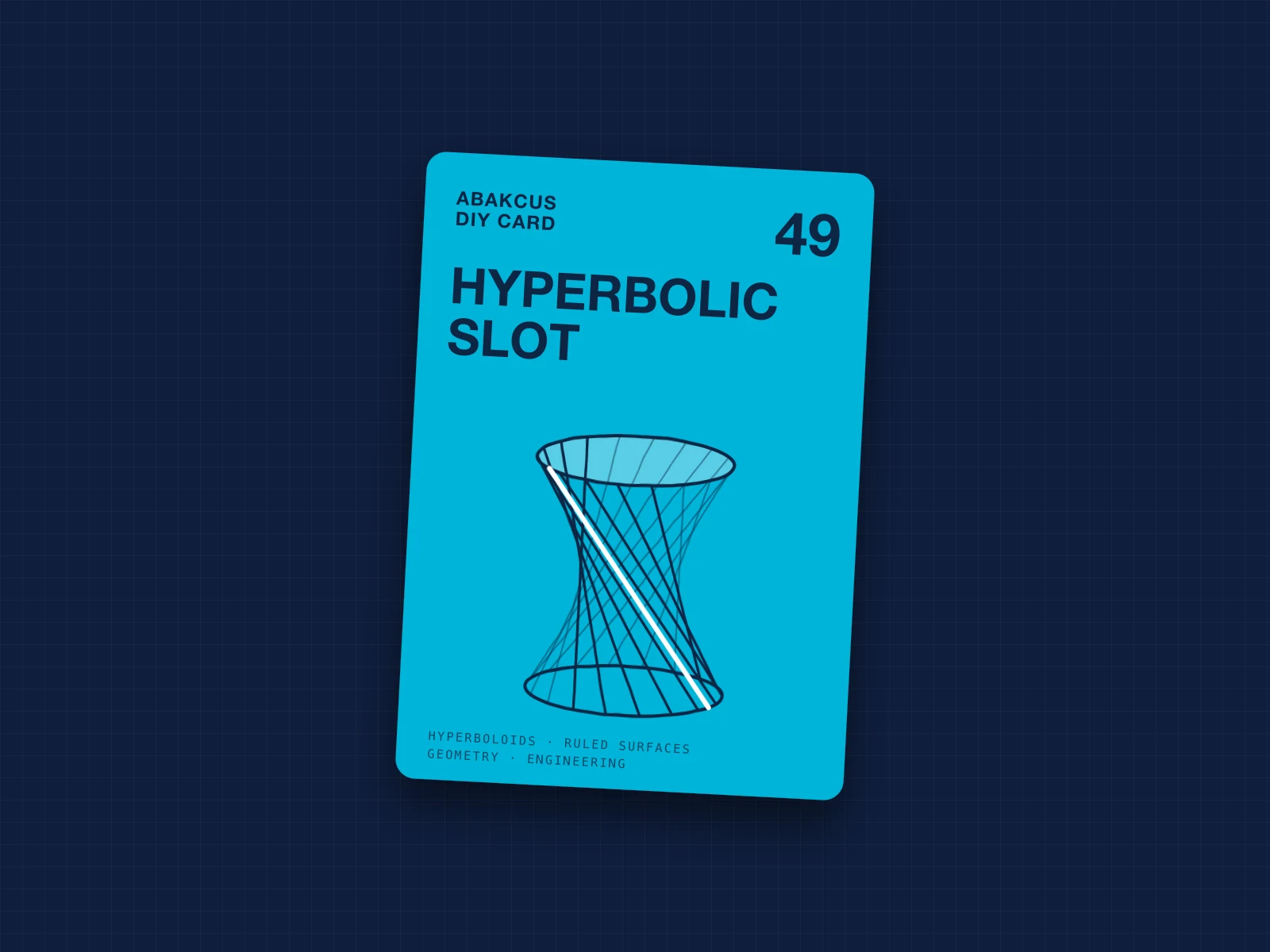
How to Make a Hyperbolic Slot: A Straight Rod Through a Curve
A pencil, a skewer and a sheet of foam board. Spin a perfectly straight stick and it glides through a perfectly curved slot, thanks to the shape of a cooling tower.
Open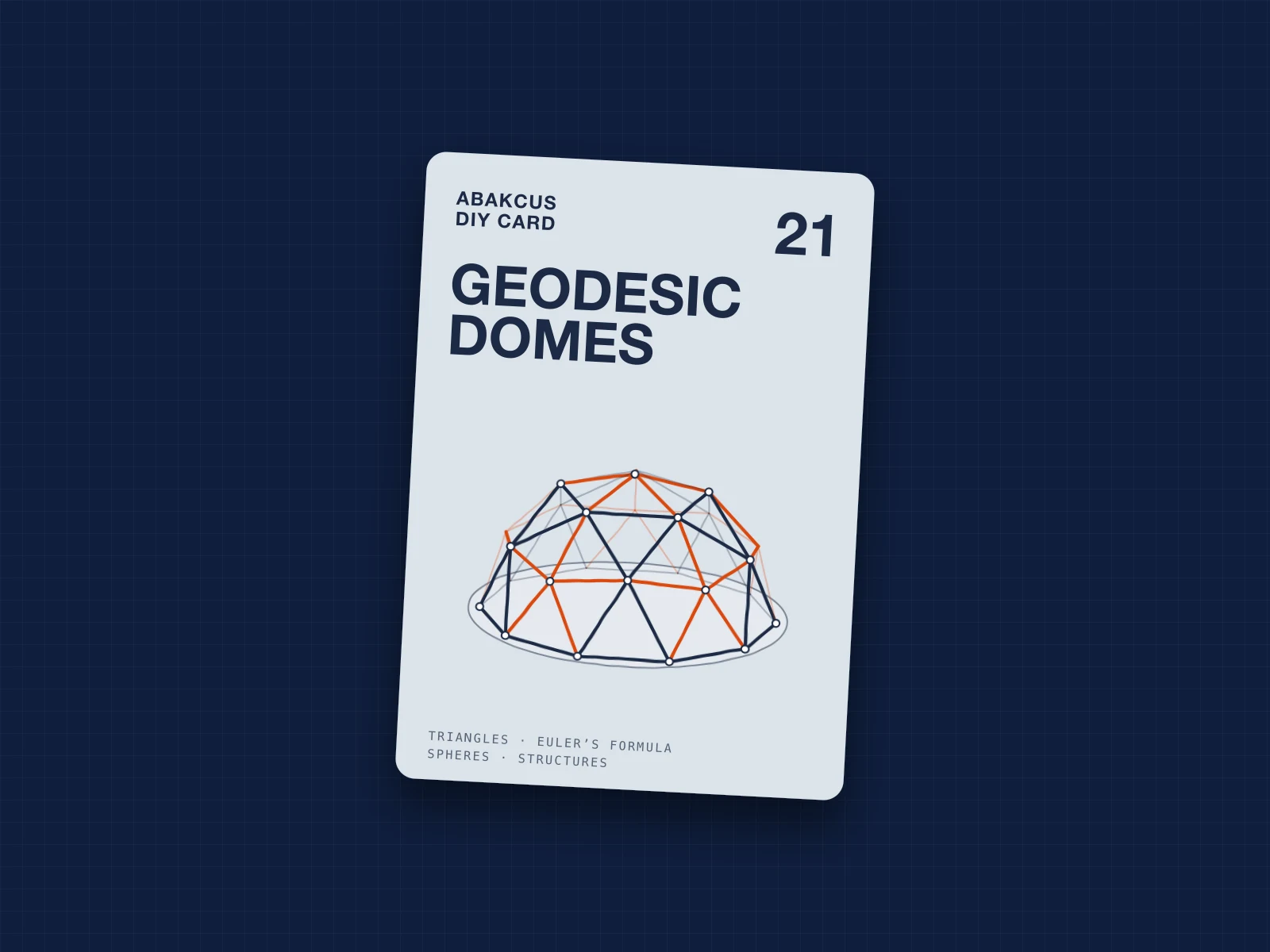
How to Build a Geodesic Dome From Newspaper
Sixty-five rolled-up newspapers, two lengths, a lot of tape: a dome two metres across that you can sit inside. Triangles can’t change shape, and that one fact holds the whole thing up.
Open
How to Make a Kaleidoscope From a Kitchen-Roll Tube
Three strips of mirror in a kitchen-roll tube and a pinch of beads. Turn it to the light and a jumble of sequins becomes a perfect, ever-changing pattern.
Open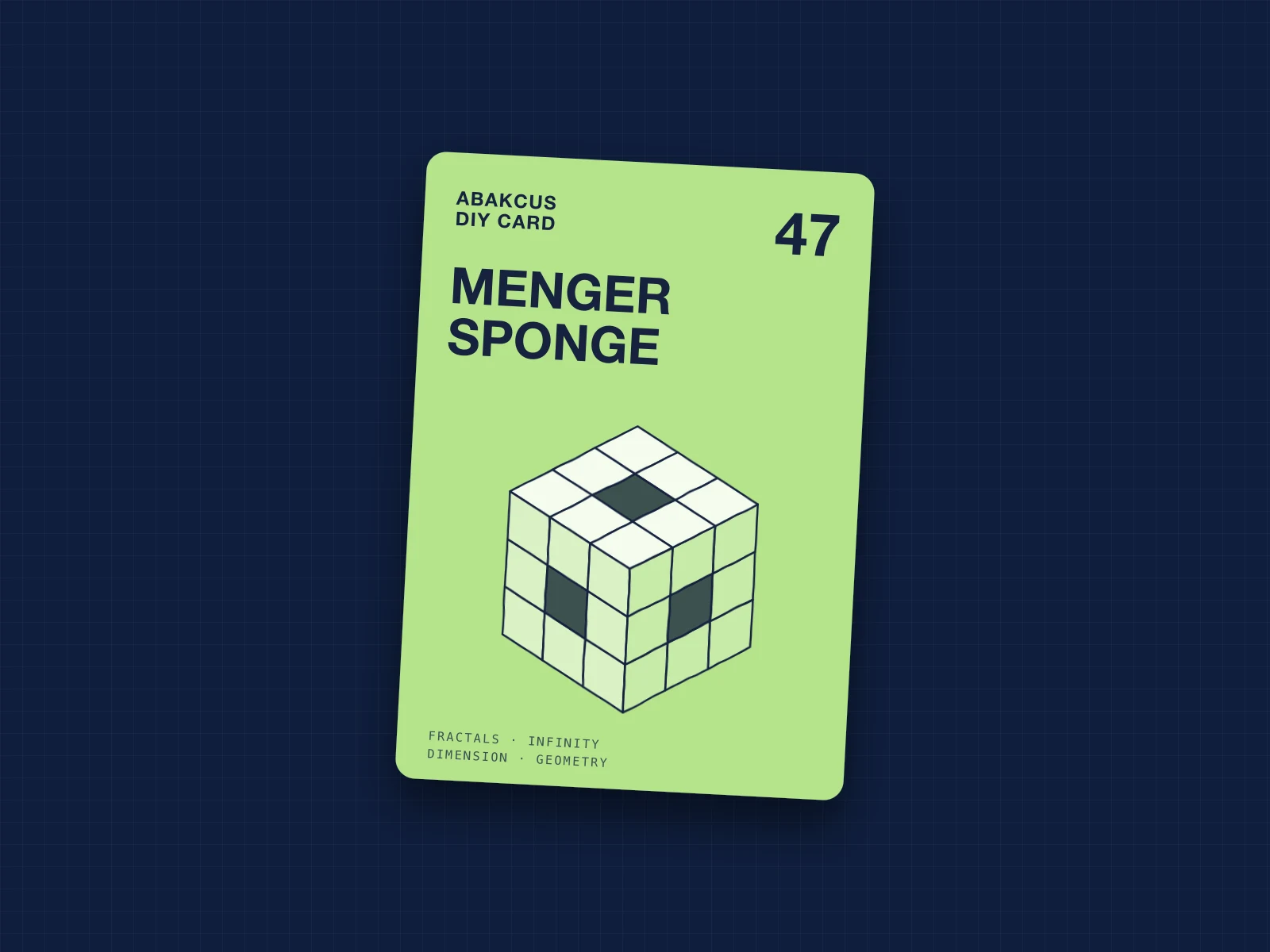
How to Build a Level-One Menger Sponge From Business Cards
A hundred and twenty business cards, folded into twenty cubes and locked together without glue. The first step of a shape with no volume and an infinite surface.
Open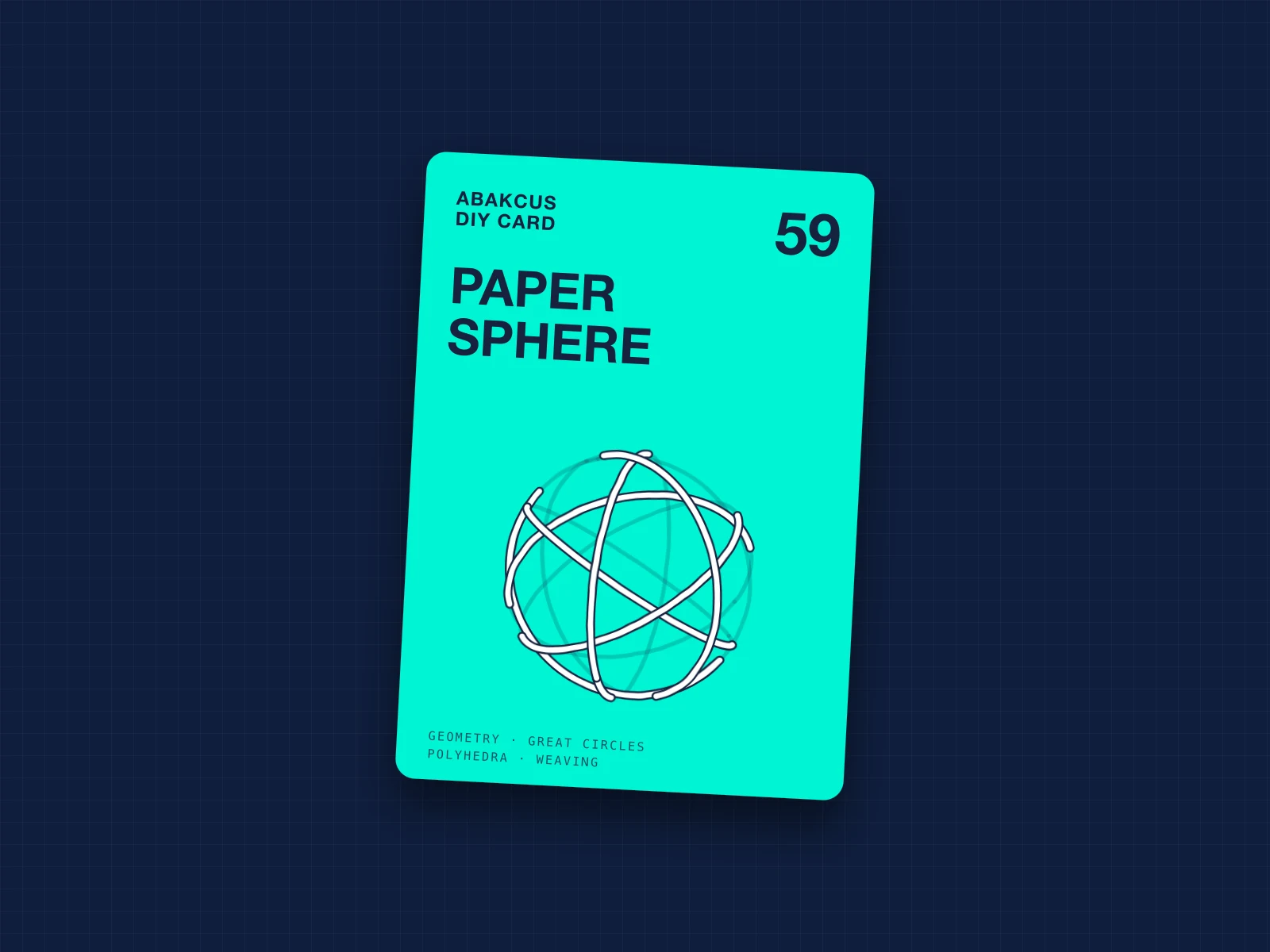
How to Make a Paper Sphere From Six Woven Strips
Six strips of card, ten pencil marks on each and some patience. Weave them together and they close into a springy ball with 12 pentagon holes and 20 triangles.
Open
How to Make 3D Folding Paper Letters From Flat Nets
A sheet of card, a ruler and some careful folding. Two letter-shaped faces and one long strip make a bold 3D letter; make a few and spell out a name.
Open