
DIY · Card 95 · Math · Topology
A strip of paper, a half-twist and a piece of tape. The loop you get has one side and one edge, and when you cut it in half, it refuses to come apart.
01The brief
One twist. One side. One edge.
1
side and 1 edge, after a single half-twist
2×
as long: what you get when you cut it down the middle
1858
when Möbius and Listing each found it
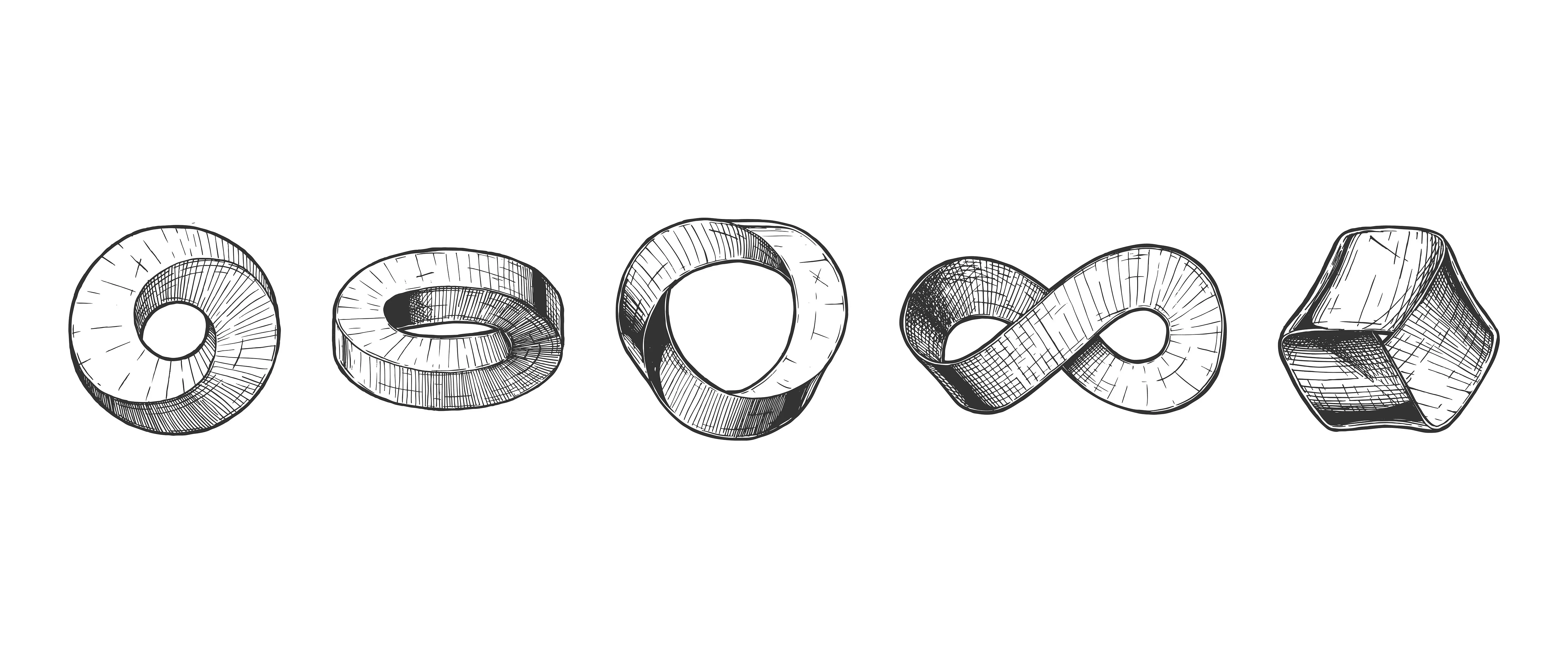
Every loop of paper you have ever made had an inside and an outside. Give the strip one half-twist before you tape it and that stops being true. An ant walking along it would cover every bit of the paper and come home without ever stepping over an edge.
It takes two minutes to make and a lifetime to get used to. For the long story of the strip, read our piece on the Möbius strip; for more paper that behaves strangely, fold a hexaflexagon.
02Kit
Paper, tape, scissors and a pen.
Tick off what you have
0 of 4 ready
03Method
Twist, tape, draw, then cut.
Step 1 of 8 · Minute 0
You need a few sheets of A4 paper, sticky tape, scissors, a pencil and two felt-tip pens of different colours.
My band has two sides.
Why
You gave it a full twist, or no twist.
Fix
Turn one end over just once before taping: half a turn, not a full one.
The cut ends in the wrong place.
Why
The scissors drifted off the line.
Fix
Draw the line first, then cut slowly along it. Keep the band flat where you are cutting.
The tape came apart while cutting.
Why
The tape only covered part of the join.
Fix
Tape the join on both faces, right across the width.
04One side
On a plain loop, a pen line comes home after one lap and the other face stays clean. On a Möbius strip, one lap brings the pen back to its starting point but on the other face, and only a second lap brings it home:
Laps so far
0.00
Laps to get home
2
Lap 1: the pen draws along one face of the paper.
The pen runs a little off-centre so you can tell the laps apart: orange for the first, teal for the second. A line drawn exactly down the middle would come back on top of itself.
Now change the number of half-twists and choose where to cut:
Half-twists before you tape it
Sides
1
Edges
1
You get one piece · linked: Only one piece
An odd number of half-twists makes a band with one side and one edge. Cutting along the middle of a one-sided band can’t split it in two, because the cut line is a single loop that runs round twice. Try 3 half-twists and cut down the middle: you get a knot.
05The big idea
Shape is
how it joins.
Stretch your Möbius strip, crumple it, slide the twist around: it still has one side. In topology, the mathematics of shape without measurement, what counts is not lengths or angles but how the pieces are joined.
To a topologist, a coffee mug and a doughnut are the same shape, because each has one hole. A plain loop and a Möbius strip are different, because no amount of bending will give the plain loop a single side.
06The math
1 · Sides
n odd → 1 · n even → 2
n is the number of half-twists.
2 · Euler characteristic
V − E + F = 0
Vertices − edges + faces, for any way of cutting it into polygons.
3 · Middle cut
one loop, length 2L
For a Möbius strip of length L.
Each half-twist swaps the two faces once. After n swaps, the top face meets the bottom face if n is odd, making one side, or meets itself again if n is even, leaving two. The same goes for edges: odd gives one, even gives two.
Picture the strip as a rectangle whose two short ends are glued with a flip, so the top-left corner meets the bottom-right. Count the rectangle as 4 corners, 4 sides and 1 face, then glue: 2 corners, 3 sides and 1 face remain, so V − E + F = 2 − 3 + 1 = 0, the same as a plain band. That number alone can’t tell them apart; the number of sides can.
The middle line of a Möbius strip runs round the loop twice before it closes, because after one lap it is on the ‘other side’. Cutting along it opens a slit that is 2L long and gives you a single loop twice the length. Cut a third of the way in and the line still goes round twice, but now it leaves the middle third behind: a thinner Möbius strip of length L, linked through the long loop.
07Real life
From the recycling symbol to a single molecule.
The recycling symbol
Three chasing arrows, drawn in 1970 by student Gary Anderson for a design contest, are folded into a Möbius strip: things go round and come back.
Conveyor belts
A belt with a half-twist wears on its whole surface instead of just one face, so it lasts longer. Engineers have patented Möbius belts for that reason.
Escher’s ants
In his 1963 woodcut Möbius Strip II, M. C. Escher drew nine red ants marching endlessly along a single strip, on what looks like both sides.
Infinity scarves
Sew the ends of a long scarf together with a half-twist and it drapes neatly around the neck with no ‘wrong side’ showing.
Electronics
A Möbius resistor, a strip of metal foil twisted and joined like a Möbius band, cancels its own magnetic field, which can matter in sensitive circuits.
Molecules
In 1982 chemists made a molecule whose atoms are linked in a ring with a half-twist: a Möbius strip a few billionths of a metre across.
1858
In 1858, two German mathematicians who did not know of each other’s work found the same strange surface. Johann Benedict Listing, in Göttingen, came across it that July. August Ferdinand Möbius, an astronomer and mathematician in Leipzig, wrote it into his notebooks the same year.
Listing published first, in 1861. Möbius described it in 1865, in a paper about measuring the volume of polyhedra, as a surface with only one side. Listing had also coined the word ‘topology’, but it is Möbius whose name the strip carries.
08Is and isn’t
Any twisted loop is a Möbius strip.
Only an odd number of half-twists gives one side. A loop with a full twist (two halves) still has two sides and two edges.
Cut it in half and you get two strips.
Cutting along the middle gives one loop, twice as long. You need a two-sided band to get two pieces.
Where you put the twist changes the shape.
It doesn’t. You can slide the twist anywhere around the loop and it is the same object, because stretching and bending never change the number of sides.
It’s just a party trick.
It started a branch of mathematics. One-sided surfaces are key to topology, and the Möbius strip shows up in physics, chemistry and engineering.
09Go further
A
Three half-twists
Make a band with three half-twists and cut it down the middle. You will get a knotted loop: a trefoil knot.
B
Two bands, one cross
Tape two plain loops together at right angles and cut each down the middle. You will get a square frame.
C
A Möbius heart
Do the same with two Möbius strips, one twisted left and one twisted right, then cut both. Two linked hearts!
D
Count with paint
Use a pen to colour one side of a plain loop and one side of a full-twist loop. How much of each band is coloured?
E
Fold another way
Read our longer piece on the Möbius strip, then try a band that looks like a figure eight. How many sides does it have?
10Questions
Cut a long strip of paper, give one end a half-twist, turning it over once, and tape the two ends together. The result has only one side and one edge.
It doesn’t fall into two pieces. Cutting along the middle gives one long loop, twice as long as the original, with two full twists in it.
You get two loops linked together: a Möbius strip a third as wide and the same length as the original, and a two-sided band twice as long with two full twists.
The half-twist joins the top face at one end to the bottom face at the other, so the two faces become one continuous surface. An ant could walk over every part of it without crossing an edge.
Two German mathematicians found it independently in 1858: August Ferdinand Möbius and Johann Benedict Listing. Listing published first, in 1861, but the strip took Möbius’s name.
Safety · Completely safe. Younger children may need help starting a cut in the middle of the strip; pinch a small fold and snip it rather than stabbing with the scissors.
All DIY cards →Keep wandering
A few more pieces in the same spirit — math, design, and slow attention.
The Möbius Strip: That a One-Sided Thing Should Be Possible
A half twist turns a two-sided loop into a one-sided object — from Möbius and Listing in 1858 to the recycling symbol in your pocket.
Open
How to Make a Hexaflexagon From a Strip of Paper
A strip of ten paper triangles folds into a hexagon with three faces instead of two. Pinch, push and open, and a face you never coloured blooms from inside.
Open
How to Make a Paper Sphere From Six Woven Strips
Six strips of card, ten pencil marks on each and some patience. Weave them together and they close into a springy ball with 12 pentagon holes and 20 triangles.
Open
How to Make 3D Folding Paper Letters From Flat Nets
A sheet of card, a ruler and some careful folding. Two letter-shaped faces and one long strip make a bold 3D letter; make a few and spell out a name.
Open
How to Make a Tangram From a Square of Card
One square of card, five straight lines, seven pieces. Rearrange them into cats, boats and swans, and every picture has exactly the area of the square.
Open
How to Make an Abacus: A Soroban From a Shoebox Lid
A shoebox lid, five skewers and 25 beads become a Japanese soroban that counts to 99,999 and makes place value and carrying visible.
Open