
DIY · Card 64 · Mathematics · Nets
A sheet of card, a ruler and some careful folding. Two letter-shaped faces and one long strip turn into a bold 3D letter; make a few and spell out a name.
01The brief
Turn flat card into solid letters.
2
letter-shaped faces, front and back
1
strip, exactly as long as the letter’s edge
4
more outside corners than inside ones, round any outline
Every box, every carton and every paper model starts life flat. Mathematicians call that flat pattern a net. Fold it along the right lines, in the right directions, and a solid shape stands up.
A 3D letter is one of the friendliest nets there is: two identical faces and a strip that runs round the edge. Plan it with a little measuring, fold it with care, and you can spell any word in solid paper. It is a cousin of the cardboard chair, another strong shape folded from flat card, and of the cardboard windball.
02Kit
Card, a ruler and glue. The maths does the rest.
Tick off what you have
0 of 5 ready
03Method
Measure the edge, mark the corners, score every fold.
Step 1 of 8 · Minute 0
You need sheets of thin card or thick A4 paper in bright colours, a ruler, a pencil, scissors, a glue stick and a blunt knife or an empty ballpoint pen for scoring. Squared paper helps for planning.
The strip is too short or too long.
Why
The perimeter was measured round the wrong edge, or the corners weren’t counted.
Fix
Measure along every edge, including the short ones in corners, and add them up. Use the planner to check.
The folds are soft and wobbly.
Why
The card wasn’t scored first.
Fix
Run a blunt knife or an empty pen along a ruler at each fold before folding. The fold will snap crisp.
The letter twists.
Why
The front and back faces don’t match.
Fix
Cut the second face by tracing round the first, and glue corner to corner, checking as you go.
04Nets
A paper letter is a prism: the same shape all the way through, like a stick of rock with a letter in it. Unfolded, it is two copies of the letter and a long strip, as long as the letter’s edge and as wide as its depth. A letter with a hole needs a second strip round the hole.
Choose a letter and see its net, folds marked:
Letter area
208 cm²
Strip length
88 cm
Mountain · valley
6 · 6
Holes
1
Solid orange lines are mountain folds, at the letter’s outside corners; dashed blue ones are valley folds, at its inside corners. Going once round any outline, there are always exactly four more outside corners than inside ones, because the strip turns one full circle. Round a hole it is the other way: four more inside corners. R has 6 and 6.
Planning a banner? Type a word and see how much strip, how many folds and how much card it needs:
Letters
5
Side strip in all
3.12 m
Folds to make
44
A4 sheets, about
5
Doubling the size of the letters doubles the length of strip but quadruples the area of the faces, so big letters eat paper fast. The estimate allows for tabs and for wasted corners when you cut the pieces from A4.
05The big idea
Flat
folds solid.
A solid shape can be cut along some of its edges and laid out flat, and a flat shape folded back into a solid. Working out which cuts and which folds is a branch of geometry with deep unsolved questions.
One of them is named after Dürer: can every convex solid be unfolded into a single flat net without overlapping? Nobody knows. Your letters, at least, unfold perfectly.
06The math
1 · Strip length
L = P
The perimeter: every edge of the letter, added up.
2 · Card needed
2A + P d
Two faces of area A, plus a strip P long and d deep.
3 · Corners
outside − inside = 4
Round any outline; reversed round a hole.
On a 4 cm grid, a capital L is 7 squares, so each face is 7 × 16 = 112 cm². Its edge is 16 grid lengths, 64 cm. At 3 cm deep the whole letter needs 2 × 112 + 64 × 3 = 416 cm² of card, two-thirds of an A4 sheet before tabs.
Going round the L’s outline, the strip turns at 6 corners: 5 outward and 1 inward. 5 − 1 = 4, four right-angle turns, one full circle. That is true of every outline you can draw with right angles, and a hole turns the other way: 4 more inward than outward.
07Real life
From cereal boxes to shop signs to spacecraft.
Cardboard boxes
Almost every box you’ve ever opened started as a flat net, cut and creased by a machine in one go, then folded up and glued. Unfold one and you can see its net.
Dürer’s nets
In his 1525 book on geometry, the German artist Albrecht Dürer printed flat nets for solids such as the cube and the regular polyhedra, to be cut out and folded up: some of the first ever published.
Shop signs
Many big letters on shopfronts are built exactly like yours: a face cut in the shape of the letter and a strip of metal bent round its edge, called a return, with lights inside.
Pop-up books
In the late 1800s the German illustrator Lothar Meggendorfer made books whose pictures moved and stood up as you turned the page. Paper engineers still design every fold the same way you did: by working out where mountain and valley folds must go.
Folded solar panels
Spacecraft carry big solar panels folded flat. The Miura fold, invented by the Japanese astrophysicist Koryo Miura, lets a whole sheet open in one pull, and was tested on a satellite launched in 1995.
Flat-pack furniture
A flat-pack bookcase is a 3D shape broken into flat panels for the journey home. Folding a paper letter is the same puzzle in reverse: how does flat become solid?
1525
Albrecht Dürer, famous for his engravings, also wrote a book on geometry for artists and craftsmen, Underweysung der Messung. In it he did something new: he drew solids unfolded flat, as nets that a reader could cut out and fold up.
Most of his nets work perfectly. Five hundred years later, the question his drawings raised, whether every convex solid has a net that doesn’t overlap itself, is still unanswered. Folding paper letters puts you in good company.
08Is and isn’t
Every letter folds differently.
Every letter follows the same rule: two faces and a strip as long as the edge, folded at every corner. Only the lengths and fold positions change.
Bigger letters need just a bit more paper.
Doubling the height doubles the strip length but makes each face four times the area. Paper use climbs fast.
Any arrangement of six squares folds into a cube.
Only 11 do. Arrangements such as a straight line of six, or four squares in a 2 × 2 block, can’t fold into a cube.
Curvy letters are impossible.
They work too: the strip simply bends smoothly round the curves instead of folding sharply. Block letters are just easier to measure.
09Go further
A
Cube nets
There are exactly 11 nets of a cube. Draw arrangements of six squares on squared paper and cut them out. How many of the 11 can you find?
B
A deeper letter
Make the same letter 2 cm deep and 8 cm deep. How does the strip change? How does the look change?
C
Count the corners
For every letter in your name, count the outside and inside corners. Is the difference always 4?
D
A hollow letter
Leave the front face off and fill the letter with a photo or tiny objects, like a little display case.
E
Curves
Draw a round letter like S or O with curves instead of squares. Measure its edge with string to find the strip length.
10Questions
Draw the letter in blocky squares and cut it out twice, for the front and back. Measure round its edge, cut a strip that long and as wide as the depth you want, with tabs on both sides, and fold it at every corner. Glue the strip round the back face, then glue the front face on top.
Exactly the perimeter of the letter, the distance all the way round its edge. A letter with a hole, such as O, A or R, needs a second strip round the hole. On a grid of 4 cm squares, a capital L needs 64 cm of strip and an R 72 cm outside plus 16 cm round its hole.
Where the letter’s edge turns outward, at an outside corner, the strip folds one way; at an inside corner it folds the other. Going once round any outline there are always exactly four more outside corners than inside ones, because the strip turns through one full circle.
A flat shape that folds up into a 3D solid. A cube has exactly 11 different nets. A paper letter’s net is its two faces plus the strips that wrap round its edges. The artist Albrecht Dürer published some of the first nets of solids in 1525.
Two faces per letter plus the side strips. For letters 15 cm tall and 3 cm deep, each one takes roughly half to one sheet of A4. Doubling the size of the letters roughly quadruples the paper needed for the faces.
Safety · Safe and simple. If you score with a craft knife instead of a blunt tool, a grown-up should do it, on a cutting mat.
All DIY cards →Keep wandering
A few more pieces in the same spirit — math, design, and slow attention.
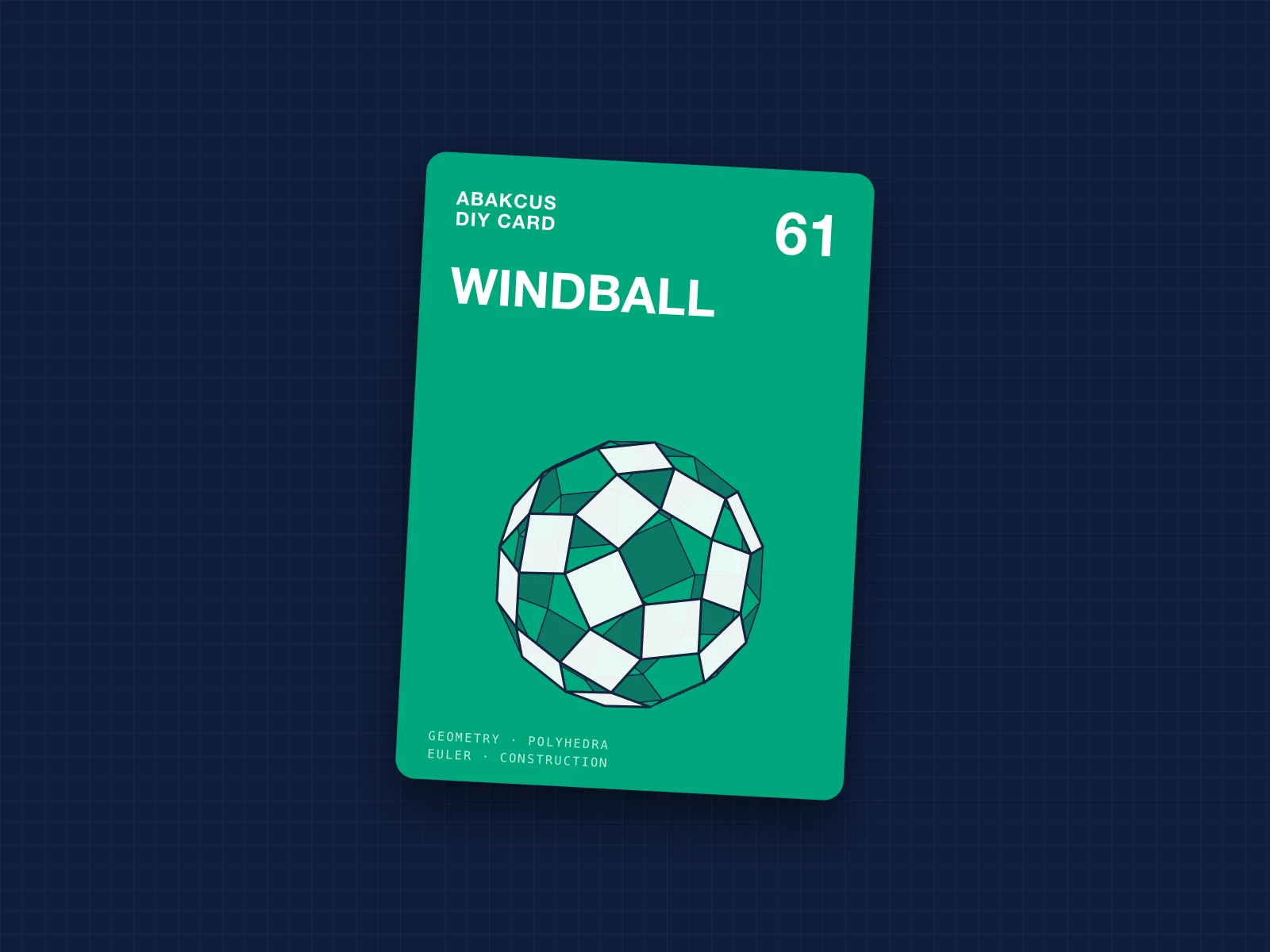
How to Build a Giant Cardboard Windball From 30 Squares
Thirty squares cut from old boxes, joined only at their corners. Clip them round rings of three and five and they curl into a ball a metre across.
Open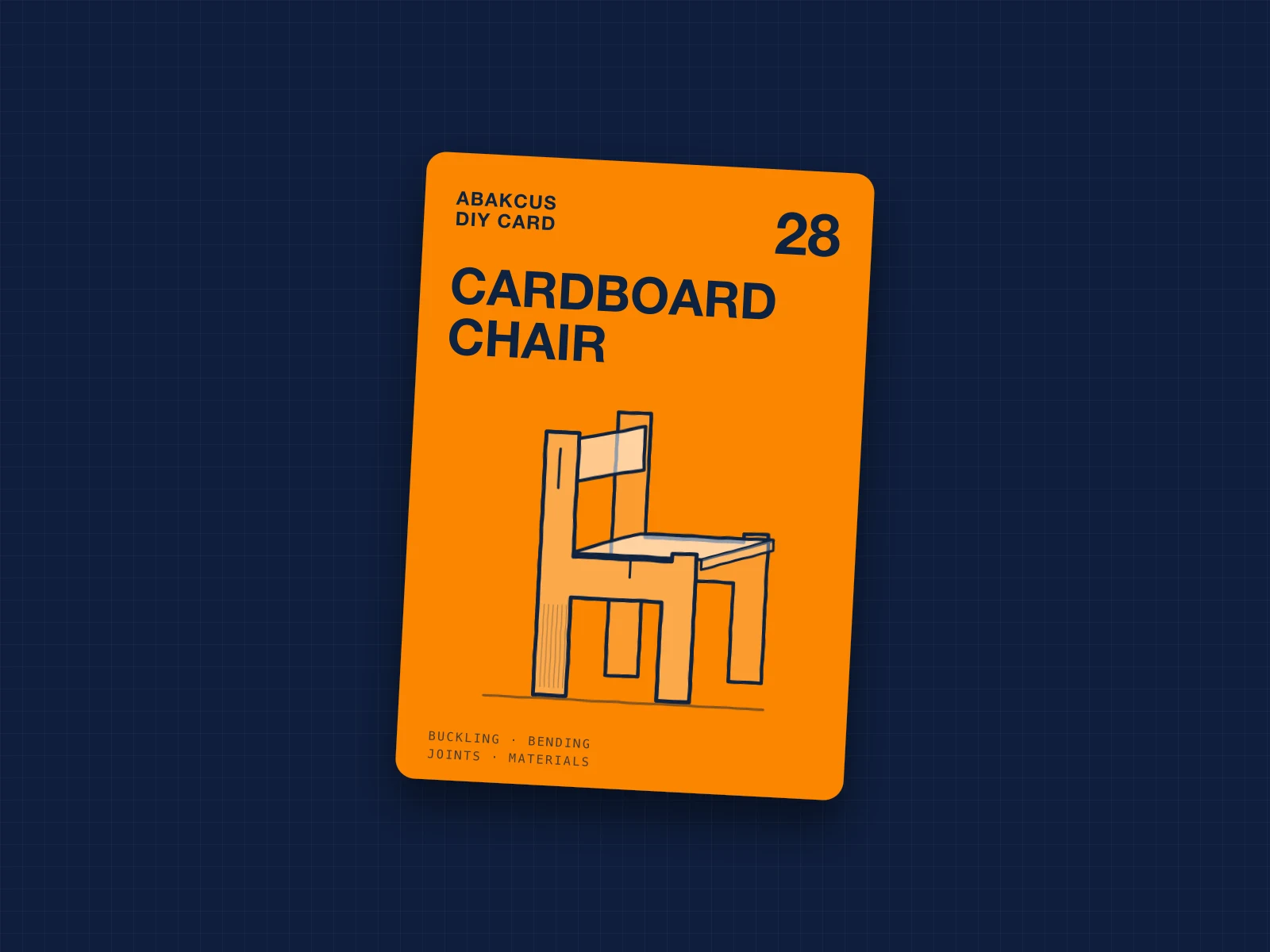
How to Make a Cardboard Chair That Holds Your Weight
Nothing but cardboard: no glue, no tape, no screws. Just slots, folds and the flutes the right way up, and a chair that holds a grown-up.
Open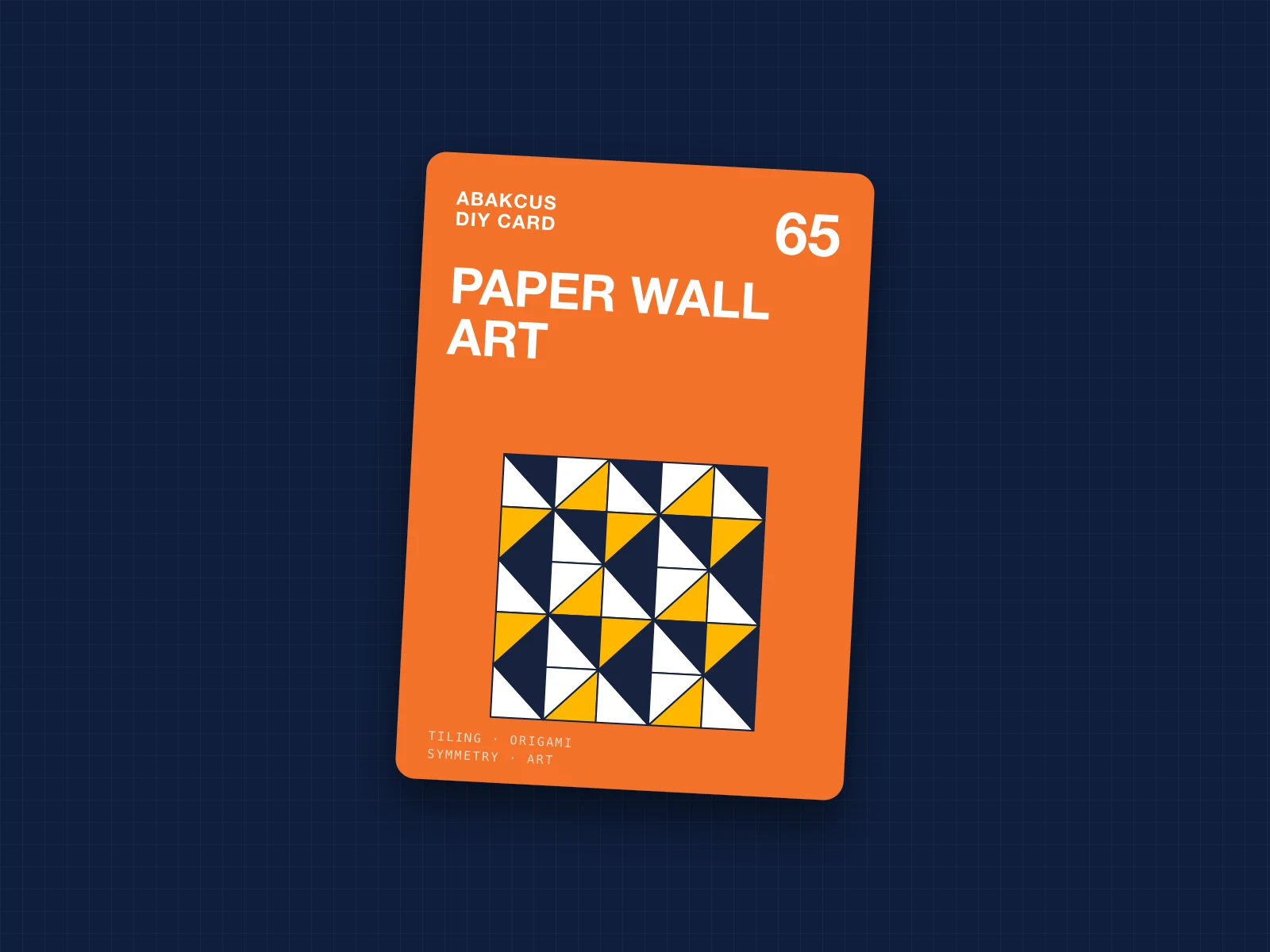
How to Make Geometric Paper Wall Art From Folded Triangles
Square sheets of coloured paper, one classic origami fold and a board. Fold two dozen identical triangles, turn them this way and that, and a pattern takes over the wall.
Open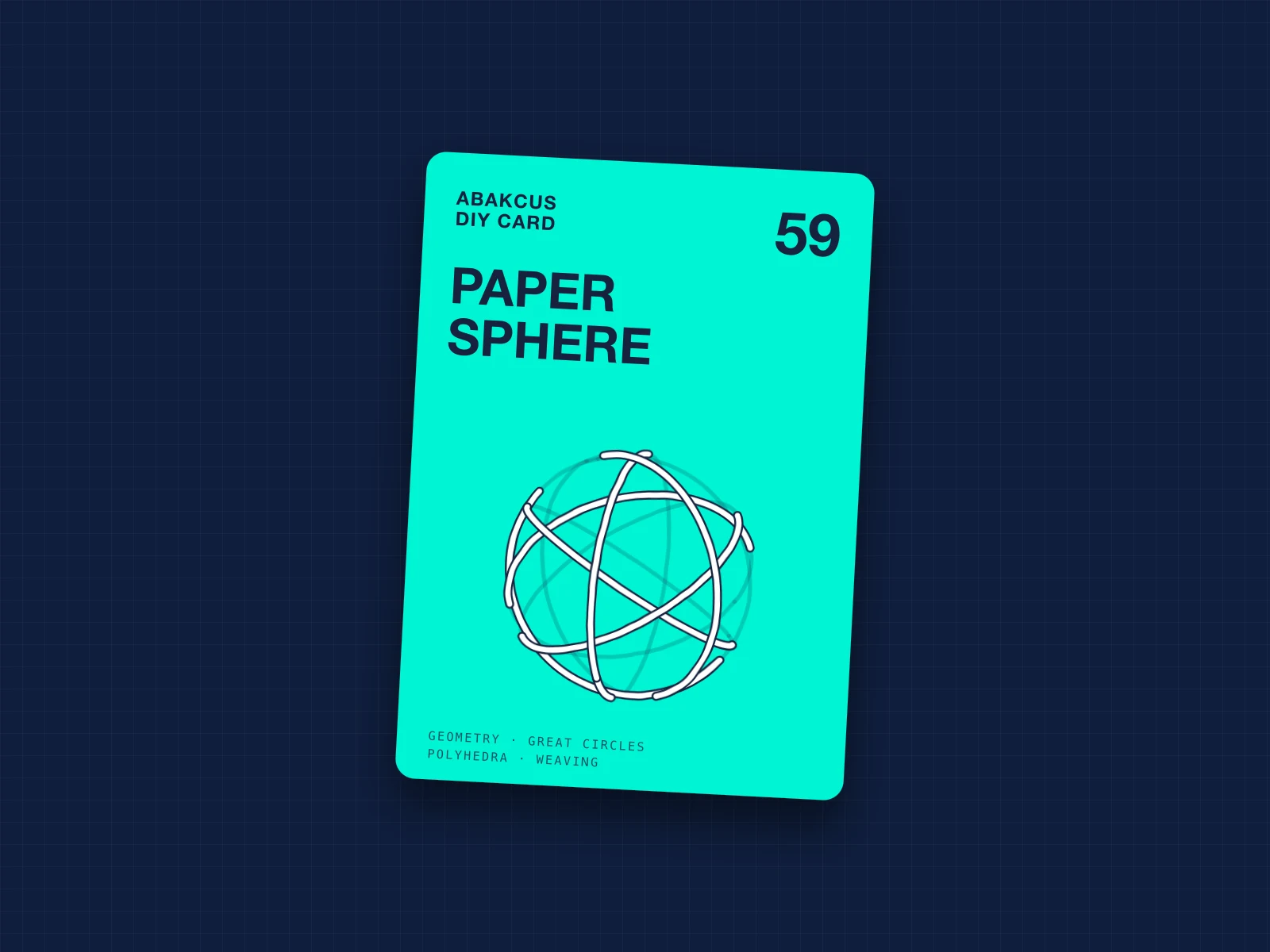
How to Make a Paper Sphere From Six Woven Strips
Six strips of card, ten pencil marks on each and some patience. Weave them together and they close into a springy ball with 12 pentagon holes and 20 triangles.
Open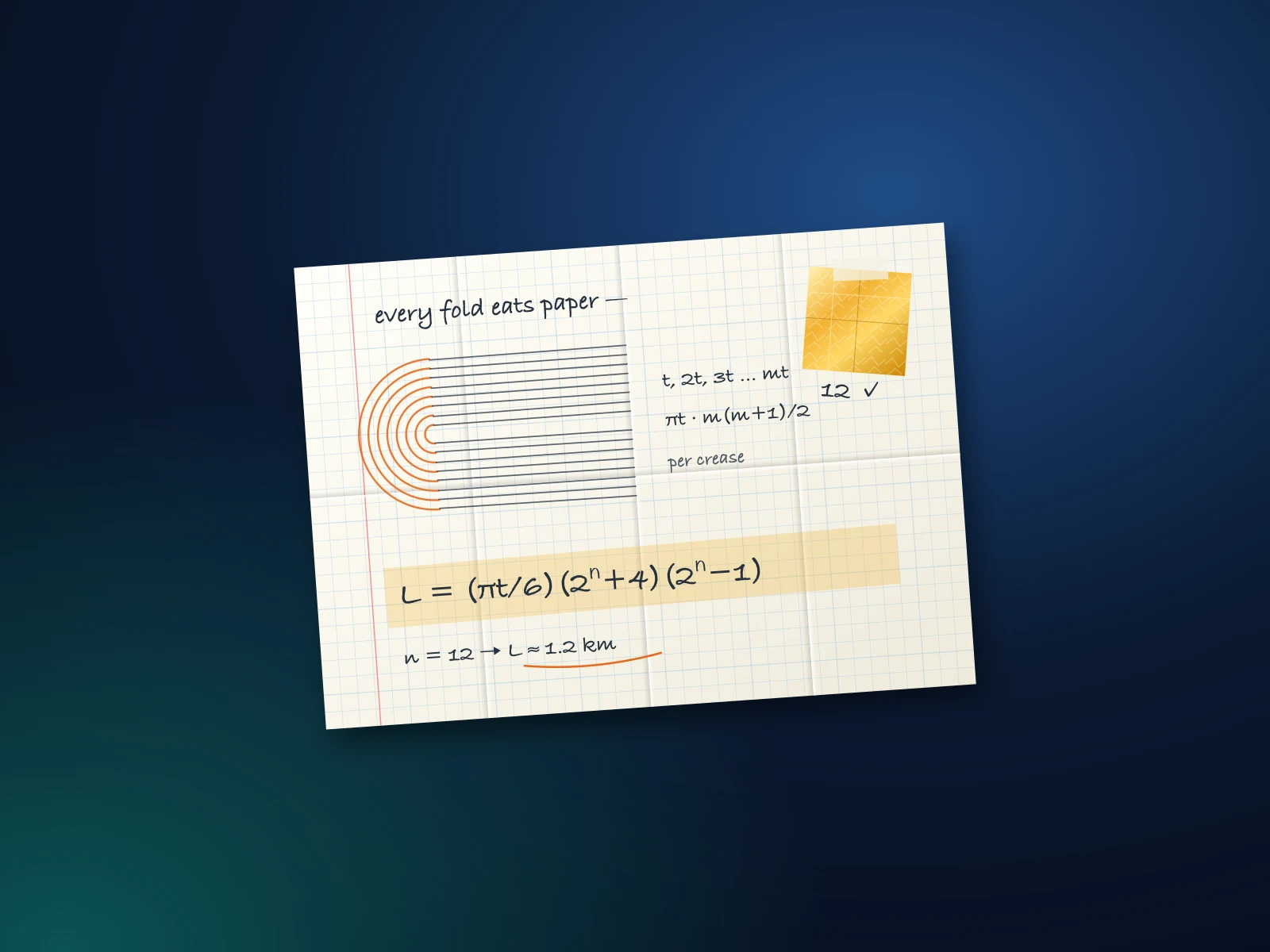
How Many Times Can You Fold Paper? Britney Gallivan's 12 Folds
Forty-two folds reach the Moon, yet paper quits at seven. A high-school junior worked out why — then folded a 1.2 km roll twelve times.
Open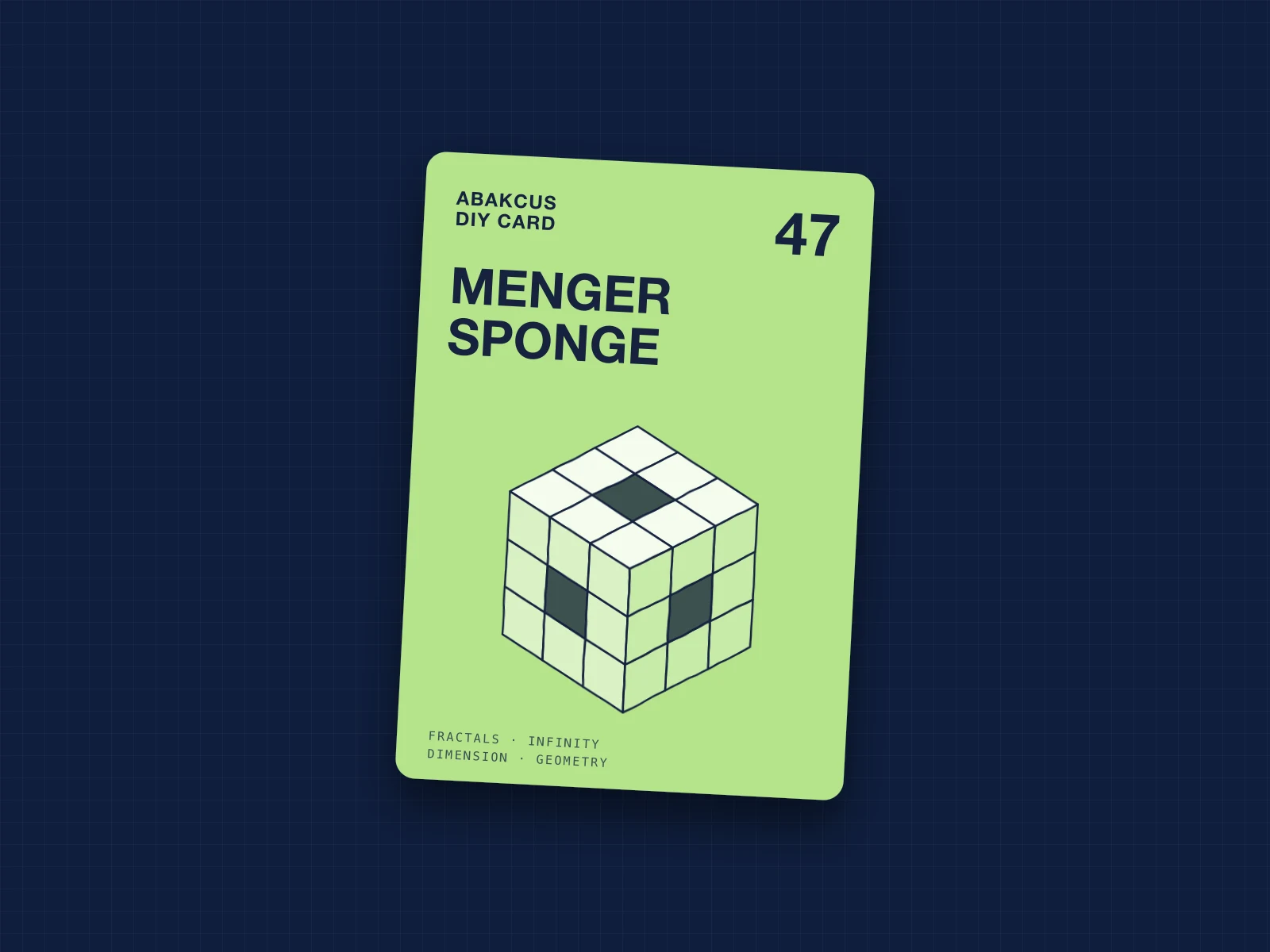
How to Build a Level-One Menger Sponge From Business Cards
A hundred and twenty business cards, folded into twenty cubes and locked together without glue. The first step of a shape with no volume and an infinite surface.
Open