
DIY · Card 47 · Mathematics · Fractals
A hundred and twenty business cards, no glue and an afternoon. Fold them into twenty little cubes, lock them together, and you are holding the first step of a shape with no volume and an infinite surface.
01The brief
Build a fractal you can hold, from business cards alone.
20
small cubes in a level-one sponge: a 3 × 3 × 3 block with seven removed
2.73
the sponge’s fractal dimension: more than a surface, less than a solid
1926
the year the mathematician Karl Menger first described it
Take a cube. Cut it into 27 smaller cubes, like a Rubik’s cube, and throw away the one in the middle of each face and the one at the very centre. Twenty are left. Now do the same to each of those twenty. And again. And again, for ever.
What you get is the Menger sponge, one of the most famous shapes in mathematics: full of holes within holes, with no volume left at all, yet an infinite surface. You can’t build the whole thing, but you can build its first step in an afternoon, and see the pattern for yourself. It is folding put to work, like the record-breaking paper fold, and a structure made of repeated units, like the geodesic dome.
02Kit
A box of business cards and some patience. No glue, no tape, no scissors.
Tick off what you have
0 of 3 ready
03Method
Fold cards into units, units into cubes, and twenty cubes into a level-one sponge.
Step 1 of 8 · Hour 0
You need 120 business cards, all the same size, plus another 72 or so if you want to cover the outside neatly. Plain ones are easiest to fold, but any will do. No glue, no tape, no scissors.
The cubes come out lopsided.
Why
The cards weren’t crossed squarely before folding.
Fix
Line the edges up carefully, centred, and press each fold flat with a fingernail.
The cube won’t close.
Why
Too many tabs run the same way.
Fix
Use three units with tabs one way and three the other, so each edge has one tab and one plain side.
The sponge sags or comes apart.
Why
Some cube-to-cube joins aren’t tucked in.
Fix
Push every tab right under its neighbour, and build on a flat table, layer by layer.
04Fractals
Your level-one sponge is built from twenty cubes. A level-two sponge is built from twenty level-one sponges, each shrunk to a third of the size; level three from twenty level-twos. Every level is made of copies of the one before. Shapes like this, the same pattern on every scale, are called fractals.
Look at any face and you see a Sierpinski carpet: a square with its middle ninth gone, and the same done to every smaller square. Choose a level and see what it would take to build:
Cubes
20
Business cards
120
Solid left
74 %
Building time
1 hours
Level one, the one on this card: 20 cubes, 120 business cards, an afternoon’s folding. The face is a square with its middle punched out. Estimated at three minutes a cube.
Now imagine going on for ever. Each level throws away 7 of every 27 pieces, so the solid shrinks away to nothing. But each hole opens up new walls, so the surface keeps growing, without any limit. The finished sponge is all skin and no inside:
Each level keeps 20 of 27 pieces, so the volume is multiplied by 20⁄27 every time and shrinks towards zero. But every hole opens new walls inside, and the surface grows by about 20⁄9 each time, towards infinity. In the limit, the sponge is all surface and no inside. It isn’t a solid, or a sheet: it has a dimension of about 2.73, somewhere between the two.
05The big idea
One rule,
repeated.
The whole sponge comes from a single instruction: split into 27, keep 20. Apply it once and you have something simple. Apply it again and again, and you get a shape of endless detail, with properties nothing ordinary can have.
Nature uses the same trick. Trees, rivers, lungs and ferns all grow by repeating a simple rule at smaller and smaller scales. Mathematicians call the result fractal, and the business-card sponge is a way to hold one in your hands.
06The math
1 · Cubes at level n
N = 20ⁿ
Each level replaces every cube with 20 smaller ones.
2 · Volume
V = (20 ⁄ 27)ⁿ
For a starting cube of volume 1, each level keeps 20 of every 27 parts.
3 · Dimension
D = log 20 ⁄ log 3 ≈ 2.73
Shrink by 3 and you need 20 copies to rebuild it. A solid would need 3³ = 27, a sheet 3² = 9.
Your level-one sponge has 20 cubes and 20 × 6 = 120 cards. Level two has 20² = 400 cubes and level three 20³ = 8,000, which is 48,000 cards before any panels. The volume left after level three is (20⁄27)³ ≈ 41 %; after ten levels, about 5 %.
The surface, for a starting cube of side 1, is 2(20⁄9)ⁿ + 4(8⁄9)ⁿ: 6 for the plain cube, 8 for level one, about 13.0 for level two, and it keeps growing by roughly 20⁄9, more than double, every level. The dimension line explains why: a sponge is ‘more’ than any surface, so no finite area can ever cover it.
07Real life
From antennas to lungs to the coast of Britain, repeated patterns are everywhere.
Fractal antennas
Some radio antennas are shaped like fractals, Sierpinski carpets and their cousins. Their self-repeating shape packs a lot of edge into a small space and responds to many different frequencies at once, useful in phones and other compact devices.
Your lungs
Your lungs branch and branch again into hundreds of millions of tiny air sacs. Folded into your chest is a surface for swapping oxygen roughly the size of a badminton court. Like the sponge, it is all about huge surface in little volume.
Activated charcoal
The charcoal in water filters is riddled with pores within pores. A single gram can have a surface of several hundred square metres or more, which is why it soaks up so much. It is a real material built on the Menger sponge’s trick.
Coastlines
In 1967 Benoît Mandelbrot asked how long the coast of Britain is, and showed that the answer depends on your ruler: the finer it is, the more wiggles you follow and the longer the coast gets. Coastlines, like the sponge, have fractional dimensions.
The Sierpinski carpet
Every face of the Menger sponge is a Sierpinski carpet, described by the Polish mathematician Wacław Sierpiński in 1916: a square with its middle ninth removed, and the same done to the eight squares left, for ever.
MegaMenger
In October 2014, volunteers at around twenty sites around the world each built part of a level-four Menger sponge from business cards, about a million cards in all. Together, the pieces made a sponge of 160,000 cubes.
1926
The Austrian mathematician Karl Menger was not trying to make a pretty shape. In 1926, working on the question of what ‘dimension’ really means, he described the sponge as an extreme example: in his sense it is only a curve, a one-dimensional object, yet any curve you can imagine can be found somewhere inside it.
Seventy years later, the origamist Jeannine Mosely started folding one from business cards. Her level-three sponge took about a decade and 66,048 cards, counting the panels. It is a three-dimensional echo of the paper folding on this site, and proof that a fractal can be built by hand, one fold at a time.
08Is and isn’t
A shape with infinite surface must be infinitely big.
The Menger sponge fits inside the cube you started with, yet its surface grows without limit. All that surface is folded into ever smaller holes.
Dimensions come in whole numbers: 1, 2 or 3.
For ordinary shapes, yes. Fractals can sit in between. The sponge has a dimension of about 2.73: more than a surface, less than a solid.
Fractals are just pretty computer pictures.
Menger described his sponge in 1926, decades before computers could draw it, while working on what ‘dimension’ means. Fractal ideas now help design antennas, model coastlines and understand lungs.
You’d need glue to hold it together.
Business-card cubes lock by their tabs alone, and so do the joins between cubes. Large card sponges have been built without a drop of glue.
09Go further
A
Count the faces
How many small square faces can you see on the outside of your level-one sponge, including inside the holes? Check your count against the formula.
B
Draw the carpet
On squared paper, draw a Sierpinski carpet of level two, 9 × 9 squares. Then try level three, 27 × 27. How many squares are filled?
C
Level two
With friends, build twenty level-one sponges and join them into a level-two sponge of 400 cubes. How long does it take?
D
The hole through it all
Look through a hole in the middle of a face. What do you see? How many straight tunnels run right through the sponge?
E
Another fractal
Fold or cut a Sierpinski triangle, or a tetrahedral version from paper. What is its dimension?
10Questions
Cross two business cards at right angles, fold each over the other and pull them apart to make two units. Six units lock together into a small cube. Make twenty cubes, then join them, tabs tucked under tabs, into a ring of eight, four corner cubes on top, and another ring of eight. That is a level-one Menger sponge.
Six cards per cube. A level-one sponge has 20 cubes, so 120 cards, plus about 72 more to panel the outside. Level two takes 400 cubes and 2,400 cards; level three 8,000 cubes and 48,000 cards, plus thousands more for panels.
A fractal described by the mathematician Karl Menger in 1926. Start with a cube, split it into 27 smaller cubes and remove the centre of each face and the very centre, keeping 20. Repeat with each of those, for ever. What is left has no volume at all but an infinite surface.
About 2.73. Shrinking the sponge to a third of its size gives a piece that takes 20 copies to rebuild the whole. For an ordinary solid it would take 27 copies, 3³, and for a flat sheet 9, 3². Since 20 = 3^2.73, the sponge sits between a surface and a solid.
Each level keeps 20 of every 27 pieces, so the volume is multiplied by 20⁄27 each time, which shrinks towards zero. But each level also cuts new holes, and the walls of those holes add surface faster than material is taken away: the surface grows by about 20⁄9 each time, without limit.
Safety · About as safe as it gets. Watch out for paper cuts on crisp new cards, and take breaks: two hours of folding is hard on the fingers.
All DIY cards →Keep wandering
A few more pieces in the same spirit — math, design, and slow attention.
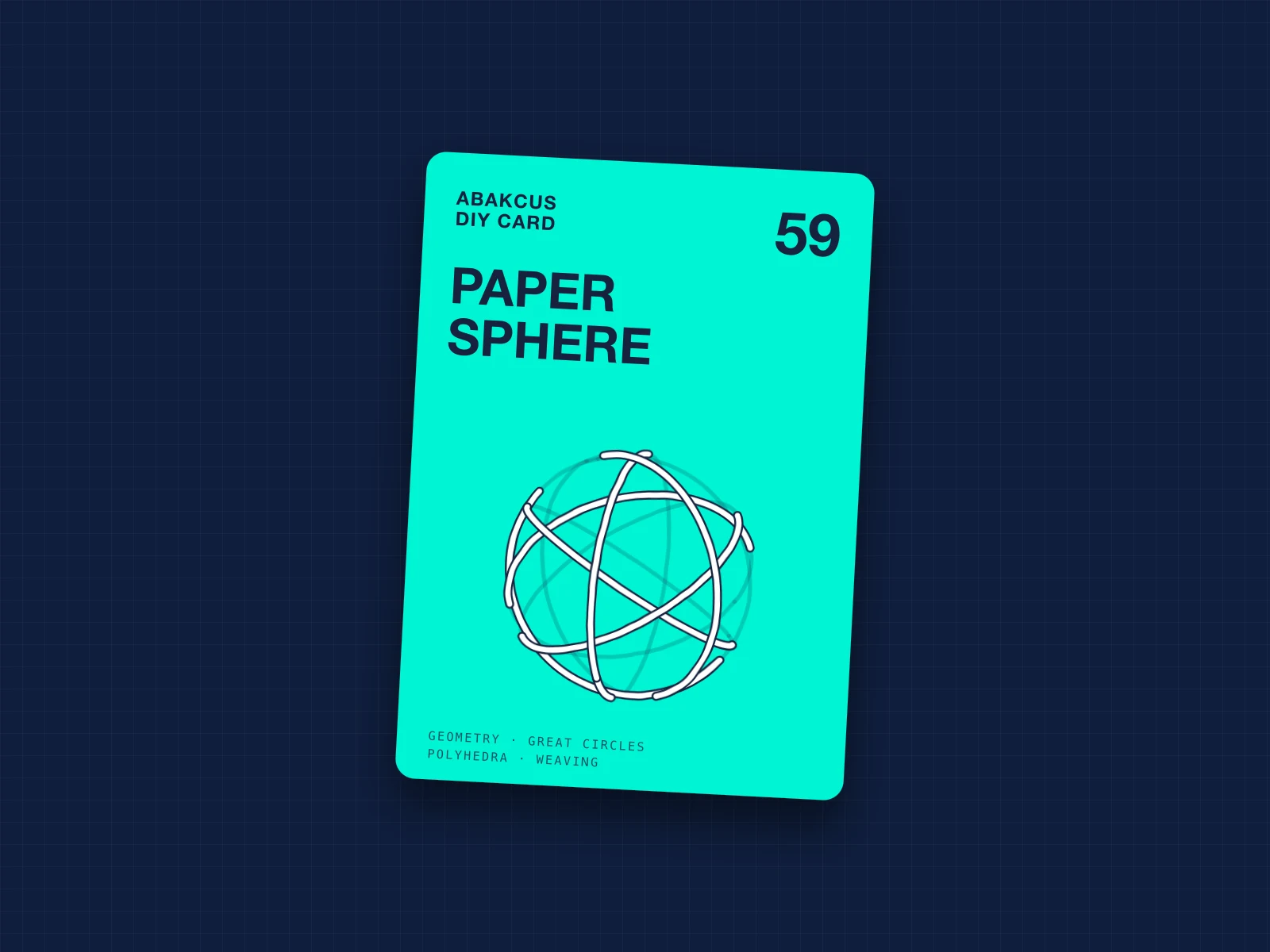
How to Make a Paper Sphere From Six Woven Strips
Six strips of card, ten pencil marks on each and some patience. Weave them together and they close into a springy ball with 12 pentagon holes and 20 triangles.
Open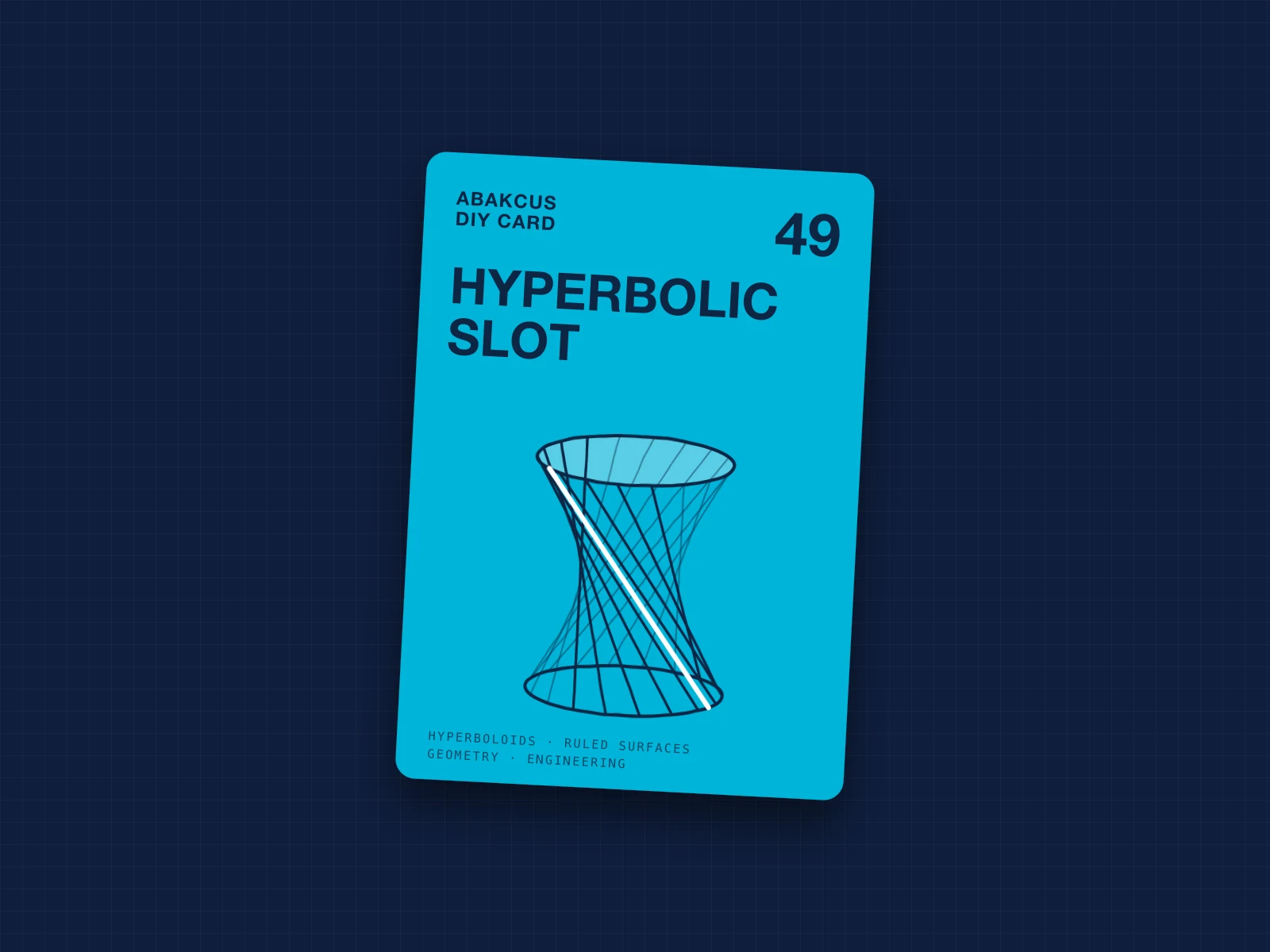
How to Make a Hyperbolic Slot: A Straight Rod Through a Curve
A pencil, a skewer and a sheet of foam board. Spin a perfectly straight stick and it glides through a perfectly curved slot, thanks to the shape of a cooling tower.
Open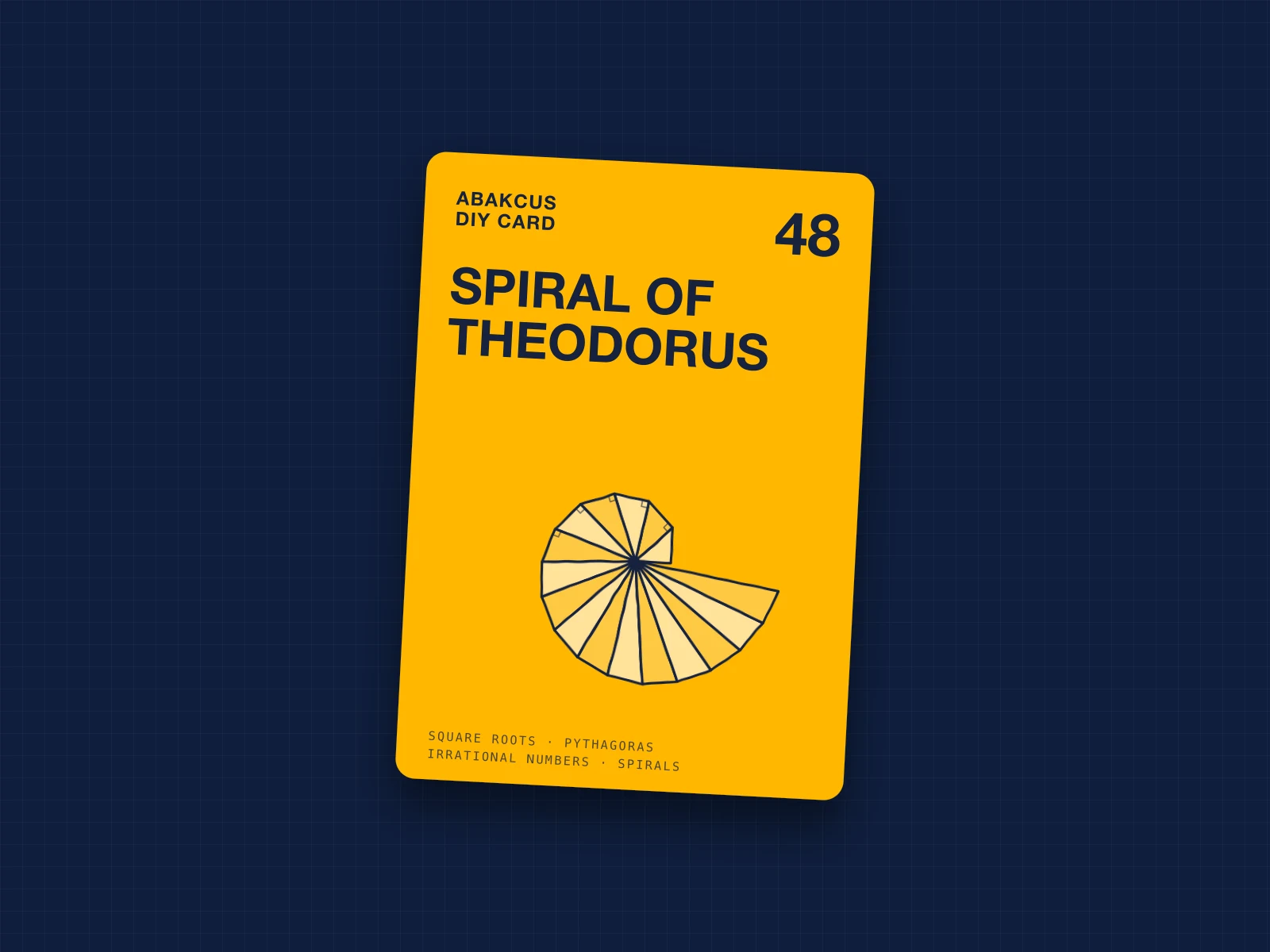
How to Construct the Spiral of Theodorus With a Ruler
A ruler, a square corner and a pencil. Build one right triangle on another and draw every square root from √2 to √17, curled into a snail shell.
Open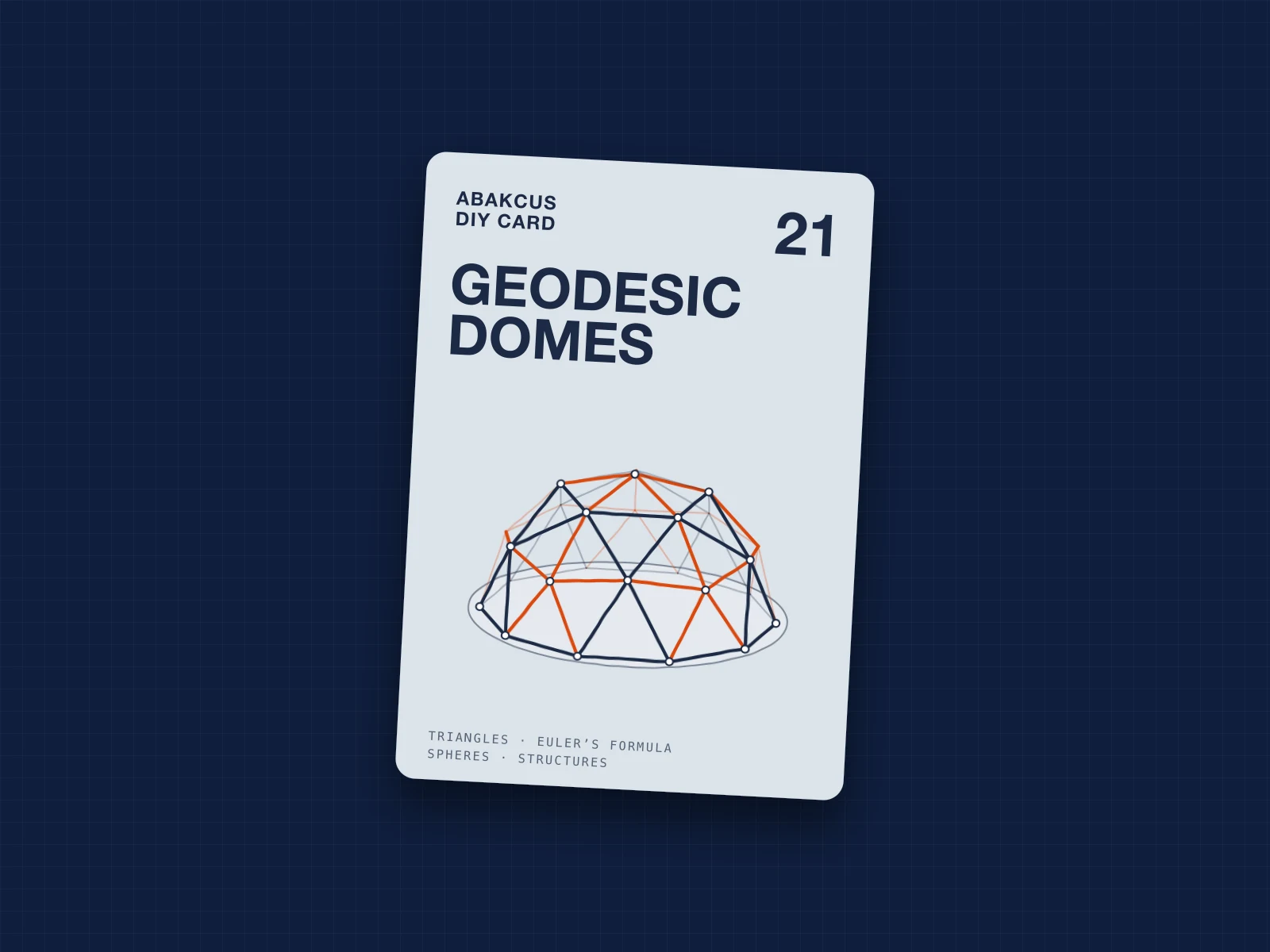
How to Build a Geodesic Dome From Newspaper
Sixty-five rolled-up newspapers, two lengths, a lot of tape: a dome two metres across that you can sit inside. Triangles can’t change shape, and that one fact holds the whole thing up.
Open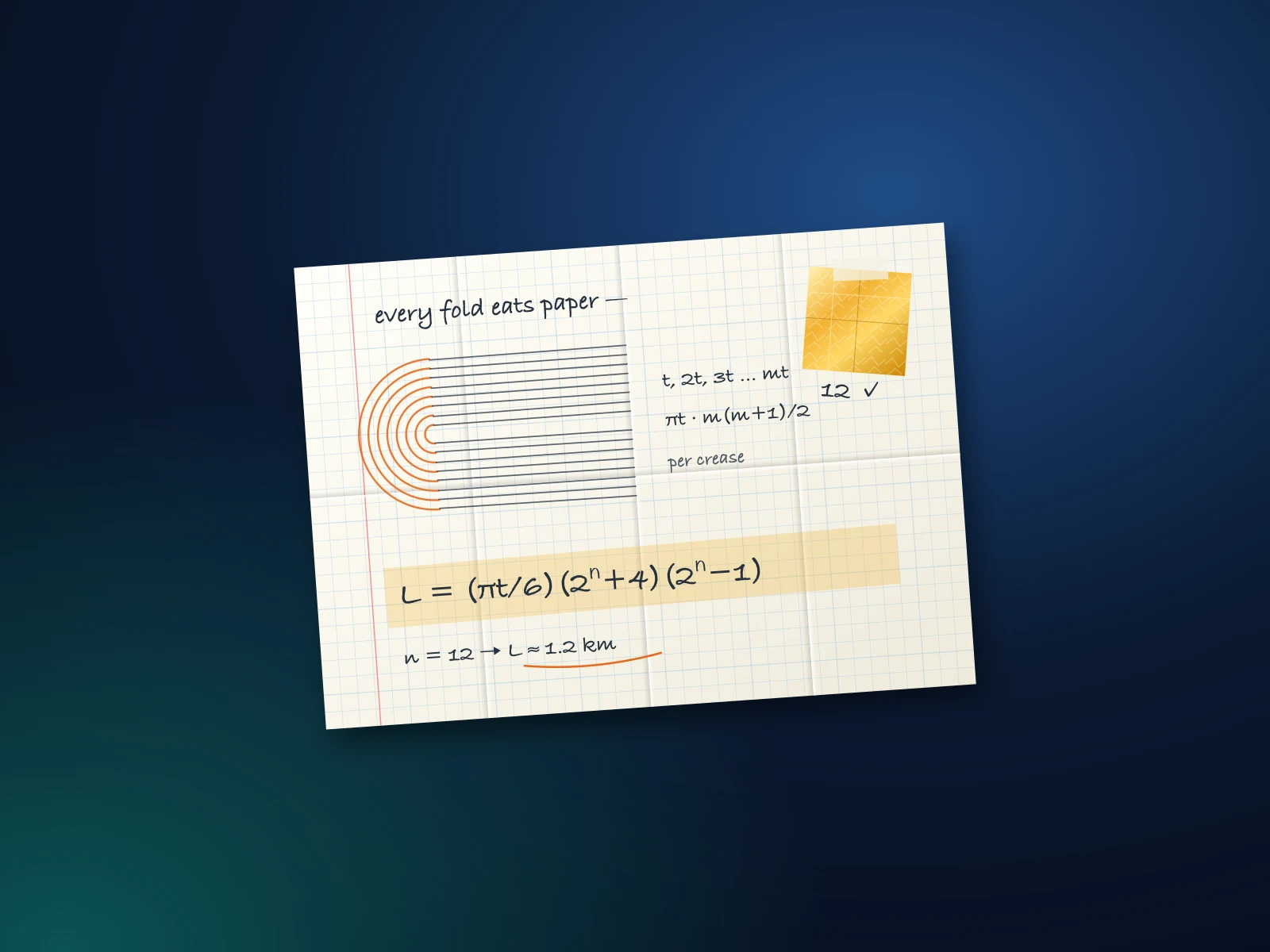
How Many Times Can You Fold Paper? Britney Gallivan's 12 Folds
Forty-two folds reach the Moon, yet paper quits at seven. A high-school junior worked out why — then folded a 1.2 km roll twelve times.
Open
How to Make a Homemade Paper Water Bomb (Origami)
One square of paper, no glue, no scissors. A dozen folds and a puff of breath turn it into a cube that holds a cupful of water, for just long enough to drop it.
Open