
DIY · Card 38 · Engineering · Origami
One square of paper, no glue, no scissors. A dozen folds and a puff of breath turn it into a cube that holds a cupful of water, for just long enough to drop it.
01The brief
Fold a single sheet of paper into a container that holds water, until you want it not to.
¼
the edge of the finished cube, as a share of the side of the square you start with
100 mL
about what a bomb from a 20 cm square holds: 30 times the weight of its paper
10 %
roughly how much of its strength ordinary paper keeps when it is soaking wet
Paper and water are enemies. Pour water on a sheet of paper and it wrinkles, softens and tears. Yet fold the same sheet the right way and it becomes a bucket that holds a cupful, with no glue, no tape and no cuts.
The water bomb is a lesson in two things at once. Its shape is pure geometry: a square that collapses along its creases into a cube. And its life is a race between the water you put in and the paper softening around it. Like the cardboard boat, it is paper asked to hold water; like the paper helicopter, it is a flat sheet given a job by folding alone.
02Kit
A square of paper and some water. The skill is all in the folding.
Tick off what you have
0 of 4 ready
03Method
Crease, collapse into a triangle, fold and tuck, blow it up, fill it, and drop it fast.
Step 1 of 8 · Minute 0
You need a square of paper, about 20 cm across, a pipette or a straw, a jug of water and a tray or the outdoors. Printer paper cut square works; origami paper is easier to fold.
It won’t puff up when you blow.
Why
The creases are soft, or the hole is squashed shut.
Fix
Sharpen every crease with a fingernail, open the hole with a pencil tip, and blow in one quick puff.
Water pours out of a corner.
Why
A flap isn’t tucked fully into its pocket.
Fix
Empty it, let it dry, and push each flap right down into its pocket before filling.
It goes soggy before you can throw it.
Why
Thin paper soaks through in a minute or so.
Fix
Fill it outside, right where you will drop it, or try a glossy magazine page.
04Physics
Paper is a mat of tiny cellulose fibres, held together where they touch by hydrogen bonds, a kind of molecular stickiness. Dry, those bonds are strong, and a sheet of paper can carry far more than you’d think. But water molecules slip in between the fibres and form hydrogen bonds of their own, prising the fibres apart. Soaked paper keeps only a small fraction of its strength.
So a water bomb weakens from the moment it is filled. Held still, its walls carry only the gentle weight of the water. Dropped, the moving water stops in an instant when it lands and slams into the walls far harder. Choose the paper, wait, and drop:
Cube edge
5.0 cm
Water inside
106 mL
Wall strength now
817 N/m
Slap on landing
987 N/m
Splash · The landing slaps the water against the walls far harder than it pressed while you held it. Wet paper can’t take it, and the bomb splits along a crease.
Size changes everything, in a way Galileo spotted in 1638. Make the bomb twice as big and it holds eight times the water, but uses only four times the paper. More water per sheet, but more load on every centimetre of wall. Scale it up:
Water
106 mL
Water ÷ paper
33×
Safe drop
1.0 m
Every time the paper doubles in size, the water goes up eight times and the paper only four. More splash per sheet, but a weaker bomb.
Both widgets use typical strengths and soaking times for each paper, with a big allowance for the weak creases and corners. They are a model of the trends, not a forecast for your bomb: test yours.
05The big idea
Folding is
engineering.
A crease is an instruction. Fold a square along the right lines, mountain one way and valley the other, and it has no choice but to collapse into one particular shape, and to spring back out into another.
That idea has left the toy box. Solar panels that unfold in space, stents that open inside arteries and airbags that burst from a steering wheel are all designed as crease patterns first, the mathematics of origami put to work.
06The math
1 · The cube
e ≈ s ⁄ 4
A square of side s folds into a cube with edges about a quarter as long.
2 · Square–cube
water ⁄ paper ∝ e³ ⁄ e² = e
The water goes with the volume, the paper with the area. Their ratio grows with size.
3 · The landing
v = √(2 g h)
Dropped from height h, it lands at this speed, and the faster it lands, the harder the slap.
A 20 cm square folds into a cube about 5 cm on each edge. Puffed and rounded, it holds roughly 0.85 × 5³ ≈ 106 mL of water, a little more than 100 grams. The paper weighs 80 g/m² × 0.04 m² = 3.2 g. So the bomb carries about 33 times its own weight in water.
Dropped from 2 m, it lands at √(2 × 9.8 × 2) ≈ 6.3 m/s. The water inside must stop in a fraction of a centimetre, and the pressure of that sudden stop goes as ρ v²: about 1000 × 6.3² ≈ 40,000 Pa, about eighty times the pressure of the water just sitting in the bomb. No soggy sheet of paper stands a chance.
07Real life
From operating theatres to kitchen roll, the water bomb’s two lessons are everywhere.
Origami stents
In 2006 engineers at Oxford, with partners in Japan, described a stent graft, a tube that holds open a blood vessel, folded from a single sheet of metal foil using the waterbomb base. It folds small enough to slide through an artery, then springs open where it is needed.
Airbags
A car airbag has to fold flat into a steering wheel and burst open in a few hundredths of a second without tangling. The mathematics of origami crease patterns has been used to work out how to fold them.
Kitchen roll
Ordinary paper falls apart when wet because water breaks the hydrogen bonds that hold its fibres together. Kitchen roll and paper towels contain wet-strength resins that tie the fibres together with bonds water can’t undo.
Paper cups
A paper cup would be a soggy mess in minutes, just like your bomb, so its inside is coated with a thin film of plastic or wax. The paper gives it shape and stiffness; the coating keeps the water out of the paper.
Elephants and ants
Galileo noticed in 1638 that if you scale an animal up, its weight grows with the cube of its size but the strength of its bones only with the square. That is why elephants need thick legs and ants can carry many times their weight: the same square–cube law as your bomb.
Paper balloons
In Japan the same folded shape has long been a children’s toy, the kami fusen or paper balloon, blown up and batted into the air like a ball. Fill it with water instead of air and it becomes a water bomb.
1995
The Japanese astrophysicist Koryo Miura devised a fold of tilted parallelograms that lets a large sheet collapse into a tiny packet, and open again with one pull on its corners. In 1995 the Space Flyer Unit satellite tested a solar array folded this way, unfolding it in orbit.
The Miura fold is now taught to engineers, and sold folded into maps that open and close in a single movement. Like the water bomb, its whole behaviour is set by its creases: get the pattern right and the paper does the rest.
08Is and isn’t
The folds make it waterproof.
The folds hold the shape, but paper soaks up water from the first second. A paper water bomb is a race between filling it and the paper going soft.
Paper is weak.
Dry printer paper is surprisingly strong when pulled: a strip one centimetre wide can hang a few kilograms. Wet, it keeps only about a tenth of that, which is the bomb’s whole problem.
A bigger sheet makes a better bomb.
It makes a bigger splash, but a weaker bomb. Water grows with the cube of the size and the paper only with the square, so a huge bomb’s walls are overloaded before it even lands.
You need tape or glue to hold it together.
No. The tucked flaps lock the layers in place by friction, and the water pressing outwards keeps them pressed together.
09Go further
A
Paper trial
Fold bombs from printer paper, origami paper, a magazine page and baking paper. Fill each and time how long until it leaks.
B
Size test
Fold bombs from squares of 10, 15, 20 and 30 cm. Measure how much water each holds. Does doubling the paper really give eight times the water?
C
Drop height
Drop identical fresh bombs from higher and higher. What is the lowest drop that bursts them? Does waiting before dropping change it?
D
Air bomb
Blow one up with air only and bat it about like a balloon. How long can you keep it in the air?
E
Unfold it
Unfold a used bomb carefully and look at the creases. Can you see the pattern of the waterbomb base in the square?
10Questions
Crease a square of paper along both diagonals and fold it in half the other way, then collapse it into a triangle. Fold the corners up to the top, the sides in to the middle, and tuck the loose flaps into the pockets, front and back. Blow into the hole at the end to puff it into a cube, then fill it with water.
Usually a minute or two with ordinary printer or origami paper. Water soaks into the paper straight away, and wet paper keeps only around a tenth of its dry strength. Glossy magazine paper lasts longer, and coated papers longer still, but they are harder to fold.
Thin, crisp paper that holds a crease: origami paper or printer paper cut square. It folds accurately and inflates easily. Thicker or coated paper lasts longer when wet but is springier and harder to puff up into a neat cube.
As big as your paper, but bigger isn’t always better. A square twice as wide holds eight times as much water on only four times as much paper, so the walls carry far more load and burst more easily. Squares of 15 to 25 cm make reliable bombs.
Because the water inside is moving when it hits the ground and has to stop in a split second. That sudden stop slams it against the walls with far more force than it pressed while you held it, and soggy paper tears open along a crease.
Safety · Drop water bombs outdoors, onto grass or paving, never at people’s faces, pets, electrical things or anyone who hasn’t agreed to get wet. Pick up the soggy paper afterwards.
All DIY cards →Keep wandering
A few more pieces in the same spirit — math, design, and slow attention.
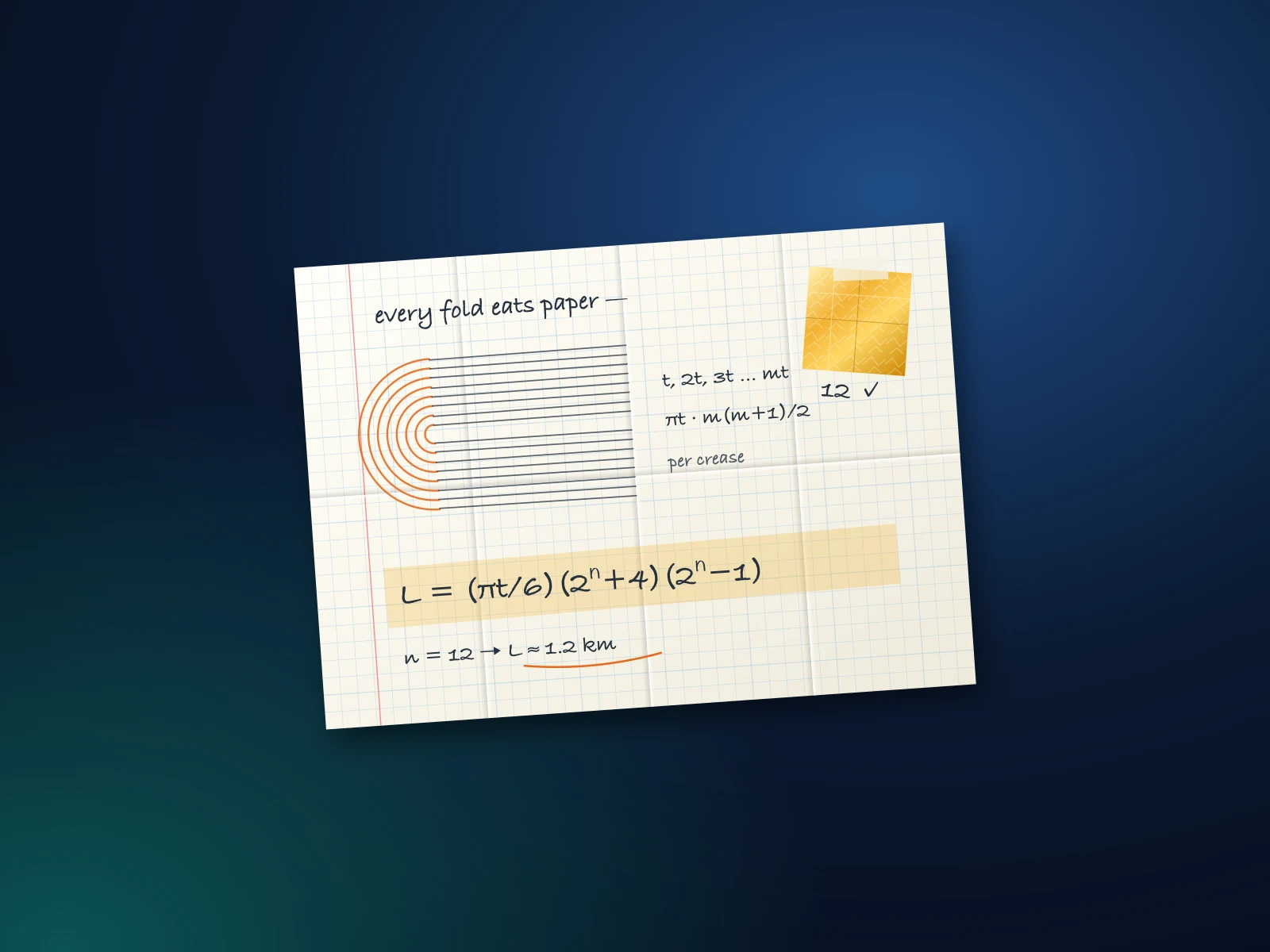
How Many Times Can You Fold Paper? Britney Gallivan's 12 Folds
Forty-two folds reach the Moon, yet paper quits at seven. A high-school junior worked out why — then folded a 1.2 km roll twelve times.
Open
How to Make a Cardboard Boat That Floats (and Carries Coins)
One sheet from an old box, folded into a tray and sealed with tape and wax. Then the test: how many coins can it carry before the water comes over the side?
Open
How to Design and Build a Paper Helicopter That Spins
A strip of paper, three snips and a paper clip. Drop it from up high and it doesn’t fall: it whirls, spinning its way gently to the floor like a sycamore seed.
Open
How to Float a Paper Clip on Water: Surface Tension
Steel is nearly eight times denser than water, and a paper clip still lies on top of it if you put it down gently. The surface bends into a dimple and holds it, like a trampoline, until a drop of soap breaks the spell.
Open
How to Make a Cartesian Diver With a Straw and a Bottle
A scrap of straw, a pinch of plasticine and a bottle of water. Squeeze the bottle and the diver sinks; let go and it floats back up, without ever being touched.
Open
A Tough Nut to Crack: How to Open a Brazil Nut Whole
A bag of Brazil nuts and a nutcracker. Squeeze one flat and it shatters; squeeze one on its ridge and the shell falls open around a perfect kernel. The difference is where you press.
Open