Take a sheet of A4 paper and fold it in half. It is about 0.1 millimetres thick. Fold it once and it is 0.2. Fold it again and it is 0.4. Every fold doubles the thickness, and a rule that simple, repeated a few dozen times, carries you somewhere genuinely strange.
At ten folds the stack is past 10 centimetres, a fistful. At seventeen it is 13 metres. At the twenty-third fold it reaches 839 metres and clears the top of the Burj Khalifa. At twenty-seven it is 13 kilometres high: Everest falls away and airliners pass under your feet. Fold thirty crosses the Kármán line, the 100-kilometre mark where space officially begins. Thirty-two reaches the orbit of the International Space Station, thirty-seven the width of Earth. At fold forty-two you are on the Moon. At fifty-one you reach the Sun. At one hundred and three you are wider than the observable universe. It is the same dizzying zoom as the Eameses’ Powers of Ten, only each step is a factor of two, and the camera is a sheet of paper.
Press play below, or drag the slider, and ride it up.
01
The cosmic elevator
One fold per tick. The white column is the folded stack; the teal sliver under it is how wide the sheet has become.
Thickness on top, width beside it. Landmarks pass as dashed lines; the sky turns to night around fold 30, where the stack leaves the atmosphere.
The first time I watched this, my eyes stayed on the rising column. Then I noticed the third number. As the thickness doubles, the length of the sheet halves, and that side of the story is at least as odd as the other. A 29.7-centimetre page is down to 73 microns at the twelfth fold, the thickness of a human hair. At seventeen it is a bacterium, at twenty-two a virus. At thirty-one it is the size of a single atom. By fold forty-seven its width matches a proton, and by fifty-eight it is a thousandth of one, while its thickness stretches past the spot where Voyager 1 is drifting today.
- 10a fist10 cma fingernail0.3 mm
- 12a coffee mug41 cma human hair73 µm
- 17a four-storey building13 ma bacterium2.3 µm
- 22past the Eiffel Tower419 ma virus71 nm
- 23Burj Khalifa839 ma smaller virus35 nm
- 27Everest, and the airliners13 kma protein2.2 nm
- 30the edge of space107 kma water molecule0.28 nm
- 31halfway to the ISS215 kma single atom0.14 nm
- 37the width of Earth13,744 kma sixtieth of an atom2.2 pm
- 42the Moon439,805 kma few uranium nuclei68 fm
- 47a quarter of the way to Mars14 million kma proton2.1 fm
- 51the Sun225 million kma thirteenth of a proton0.13 fm
- 58beyond Voyager 128.8 billion kma thousandth of a proton10⁻¹⁸ m
- 103the observable universe107 billion lyabout 1,800 Planck lengths3 × 10⁻³² m
At fold one hundred and three you would be holding a needle as long as the universe and about 60 quadrillion times narrower than a proton. Even then it would still be some 1,800 Planck lengths wide, so physics would technically allow it.
We will never see that needle. The reason is not out in space but on the desk. Put the two numbers on the same chart and you can see exactly where the trip ends.
02
Where the trip actually ends
Log scale. Orange is the thickness of the stack, blue the remaining length of the sheet. They cross at about fold 5.8; past that point the folded paper is a block thicker than it is long.
The thickness curve and the length curve cross just before the sixth fold. After that, what you hold is no longer a folded sheet but a block thicker than it is long. You might as well try to fold a brick. The cosmic trip ends before it leaves the table, and that is where the line everybody has heard comes from: you cannot fold a piece of paper in half more than seven times, no matter how big it is.
03
Every bend eats paper
The chart gives a good intuition, but it hides the real reason. Thickness alone does not stop a sheet. What stops it is that every crease eats paper.
When you fold a stack in half, the layers have to go around each other at the crease. The innermost layer traces a tiny semicircle. The next one out has to pass around that one, so its semicircle is a little bigger. The outermost layer wraps the whole stack. Paper spent on those semicircles adds nothing to the flat folded length; it disappears into the bend.
A flat A4 sheet: 0.1 mm thick, 297 mm long.
Top: a side view of the folded stack, not to scale. Bottom: the 297 mm length of an A4 sheet, to scale. Orange is the paper lost inside the bends.
Call the thickness of the paper t. If the stack has m layers, the semicircles at the crease have radii of roughly t, 2t, 3t, …, mt. A semicircle of radius r is πr long, so a single crease swallows:
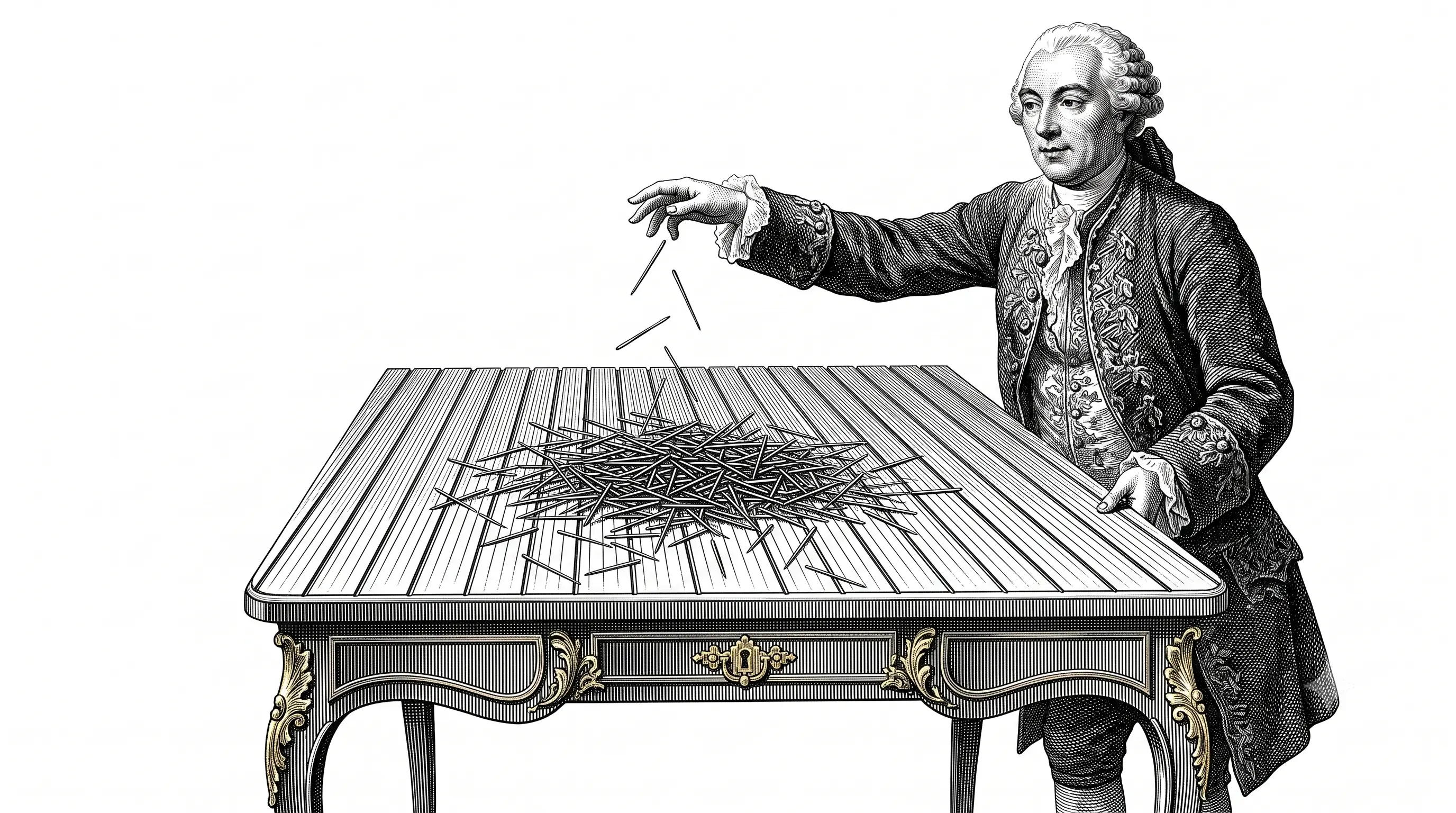
On the first fold only one layer bends and the loss is just πt, less than a third of a millimetre for 0.1 mm paper. But the number of layers doubles with every fold, so the loss grows with the square of it. That π hiding in a stack of paper is the same kind of surprise as Buffon’s needle, where dropping needles on a floor counts out the circle constant.
Add those losses from the first fold to the nth and you get the shortest strip that can be folded in half n times, always in the same direction:
L: minimum length of the strip · t: thickness · n: number of folds
To test it, set n = 1: (πt/6) · 6 · 1 = πt, a single semicircle. For n = 2 you get 4πt, which is the first fold’s πt plus the 3πt used by the two layers of the second. For a sheet folded in alternating directions, like a napkin, there is a second formula:
W: minimum side of a square sheet folded in alternating directions
Run both formulas on an A4 page and the legend suddenly makes sense. Folding the same way every time, six folds need about 22 centimetres, and the long side of A4 is 29.7, so it fits. The seventh needs almost 88. Alternating directions, seven folds need a 16-centimetre side and A4’s 21-centimetre short side covers it. The eighth wants 45.
fits
Same direction, 6 folds
doesn’t fit
Same direction, 7 folds
fits
Alternating, 7 folds
doesn’t fit
Alternating, 8 folds
So seven is not made up. For the paper everyone has at hand, folded the way everyone folds it, it is a real limit. The legend is not wrong; it is incomplete. The wrong part is “no matter how big”. The limit is set by the ratio between the paper’s length and its thickness, and when the ratio changes, so does the limit. Try it:
04
The folding calculator
A4’s long side (29.7 cm) won’t do; you need about 3 times that.
The formula is the best case: perfect semicircles, no slipping, no air gaps. Real paper asks for a little more. The drawing is the crease of the last fold; orange is the paper spent there.
The seven-fold legend circulated for decades, and nobody had sat down to look inside the crease.
05
Britney Gallivan and the gold leaf
The person who found the formula was not a mathematician. The legend had been passed around in textbooks, schoolyards and quiz shows for decades, and the one who finally looked was Britney Gallivan, a junior at high school in Pomona, California.
In 2001 her pre-calculus teacher made the class an extra-credit offer: fold anything in half twelve times. The teacher most likely expected the students to struggle for a while and discover the impossibility with their own hands. Gallivan took “anything” literally. She found a square of gold leaf about ten centimetres on a side and 0.28 microns thick, thinner than the wavelength of visible light. Working with tweezers, soft brushes and a ruler, she folded the gold in half twelve times.
2001
A pre-calculus teacher in Pomona, California, offers extra credit: fold anything in half twelve times.
Soon after
Britney Gallivan, a junior, folds a 4-inch square of gold leaf twelve times with tweezers and soft brushes.
Then
The teacher moves the goalposts: it has to be paper. Every paper she tries stops early.
At the desk
She stops folding and starts calculating, and derives the loss formula for each bend.
$85
The formula asks for about 1.2 km of thin paper. She buys a 4,000-foot roll of industrial toilet paper.
27 Jan 2002
Eight hours on the floor of a shopping-mall corridor. Fold twelve closes.
A 10.16 cm square of gold leaf, folded twelve times in alternating directions, shrinks to a square of about 1.6 mm. Its 4,096 layers together are barely over a millimetre thick.
The teacher then said that wasn’t what was meant; it had to be paper. I love this moment of the story. A rule changed after the fact is usually annoying, but here it is exactly what brought the real question into the open. With gold leaf the problem was dexterity. With paper it was something else, and Gallivan had to find out what. She tried every paper she could get, and none of it worked. Then she stopped folding and sat down to calculate. By her own account she could not accept that folding had a limit: either she would get to twelve or she would understand what was stopping her. The two formulas above came out of that desk.
Her result said twelve folds needed a strip of about 1.2 kilometres. Nobody sells paper like that, but the length and thinness she needed existed in an industrial roll of toilet paper. It cost $85 and was 4,000 feet long, 1,219 metres. Now the problem was space: a flat floor long enough to lay out 1.2 kilometres and bring the ends together. She worked in the long corridor of a shopping mall.
06
Eight hours in a mall corridor
The 1,219 m strip halves with each fold while the layers double. Per-fold timing is illustrative; the whole job took about eight hours.
She laid the strip on the floor, walked one end to the other, carried the growing stack, smoothed the creases, walked again. Every fold was a trip half as long as the one before, but the stack got heavier each time and the creases swallowed more paper each time. After eight hours of crawling on the floor, the twelfth fold was done.
27 January 2002
The first person to fold a single sheet of paper in half 9, 10, 11 and 12 times.
1,219 m · 4,096 layers · 8 hours
According to the Guinness World Records entry, the date was 27 January 2002. Gallivan became the first person to fold a single sheet of paper in half nine, ten, eleven and twelve times. She then wrote up her trials, how the formulas came about and what didn’t work in a small booklet, which the Historical Society of Pomona Valley published. A high-school extra-credit assignment ended up in a historical society’s list of publications. Like Marilyn vos Savant and the Monty Hall problem, it is a story of an outsider being right about something everyone “knew”.
Since then people have claimed thirteen folds or more. In some of those attempts the paper was cut, the pieces stacked and taped, or the sheet was pleated like an accordion instead of folded in half. Gallivan’s rule was simple: one sheet, uncut, unjoined, folded exactly in half every time. By that standard twelve is still the record. A strip of paper hides more mathematics than it lets on, as the Möbius strip shows from the other direction.
the next fold
By the same formula, a thirteenth fold in paper as thin as Gallivan’s needs about 4.8 km. A mall corridor won’t do. You would have to close a city’s main street to traffic.
Questions people ask
How many times can you fold a piece of paper in half?
An ordinary A4 or letter sheet stops at about seven folds, because each bend uses up paper and the folded block soon becomes thicker than it is long. The limit depends on the ratio of length to thickness, not on a magic number: with a long enough strip, Britney Gallivan folded paper in half twelve times.
Who holds the record for folding paper in half the most times?
Britney Gallivan, then a high-school junior in Pomona, California, folded a single 1,219-metre strip of toilet paper in half twelve times on 27 January 2002. Guinness World Records lists her as the first person to fold one sheet in half twelve times.
Why can’t you fold paper more than seven times?
Each fold doubles the number of layers, and at the crease every layer has to wrap around the ones inside it. The paper used in those nested semicircles grows with the square of the layer count, so after six or seven folds an A4 sheet simply runs out of length.
How thick would paper be if you folded it 42 times?
A 0.1 mm sheet folded 42 times would be 2⁴² × 0.1 mm thick, about 440,000 km, which is farther than the Moon. At 51 folds it would reach the Sun, and at 103 folds it would be wider than the observable universe.
What is Britney Gallivan’s paper folding formula?
For a long strip folded in the same direction n times, the minimum length is L = (πt/6)(2ⁿ + 4)(2ⁿ − 1), where t is the thickness. For a square sheet folded in alternate directions, the minimum side is W = πt · 2^(3(n−1)/2).
Sources
- Guinness World Records, “Most times to fold a piece of paper”.
- Britney Gallivan, How to Fold Paper in Half Twelve Times: An “Impossible Challenge” Solved and Explained, Historical Society of Pomona Valley, 2002.