
DIY · Card 48 · Mathematics · Geometry
A ruler, a square corner and half an hour. Build one right triangle on another, sixteen times over, and you draw every square root from √2 to √17, curled into a snail shell.
01The brief
Draw square roots with nothing but a ruler.
16
right triangles, each with one side exactly one unit long
351°
how far the sixteen triangles turn: just short of a full circle
√17
the last root Theodorus is said to have proved irrational, about 4.123
Draw a right triangle whose two short sides are each one unit long. Its long side measures √2. Now use that long side as the base of a new right triangle, with another one-unit side at a square corner. Its long side measures √3. Keep going, and the triangles wind round into a spiral of square roots.
It is called the spiral of Theodorus, after a mathematician of ancient Greece who, Plato tells us, proved that √3, √5 and so on up to √17 can’t be written as fractions. Building it takes half an hour and some care with right angles, and at the end you can check every root with a ruler. It goes well with the business-card Menger sponge, another shape built by repeating one simple rule.
02Kit
Paper, a ruler and a square corner. That’s all the geometry needs.
Tick off what you have
0 of 4 ready
03Method
One unit, one square corner, then join back to the centre. Again and again.
Step 1 of 8 · Minute 0
You need a large sheet of paper, A3 if you have it, a ruler, a sharp pencil and something with a perfect right-angled corner: a set square, or just a postcard. Coloured pens for later.
The spiral drifts off shape after a few triangles.
Why
Small errors in the right angles add up.
Fix
Use a proper square corner for every right angle, and draw thin, sharp lines.
Your measurements don’t match the calculator.
Why
The one-unit sides have crept longer or shorter.
Fix
Measure every unit side from the corner point exactly, not by eye, and use a bigger unit.
It runs off the paper.
Why
The unit is too big for the sheet.
Fix
√17 is about 4.1 units, so the spiral is about 8 units across. Choose a unit an eighth of your paper’s width.
04The roots
Pythagoras’ theorem says that in a right triangle, the square on the long side equals the squares on the other two added together. Each new triangle has the last hypotenuse as one side and 1 as the other, so the square of the new hypotenuse is one more than the square of the old. Starting from 1, the squares go 2, 3, 4, 5 … and the hypotenuses are their square roots.
The triangles get thinner as they go, so the spiral turns more slowly the further out it gets. Add triangles one at a time and watch it close in on a full turn:
Newest hypotenuse
√17
Its length
4.1231
Turned so far
351.2°
Sixteen triangles: the last hypotenuse is √17 and the spiral has turned 351°, just short of a full circle. This is where Theodorus is said to have stopped.
√4, √9 and √16 come out as whole numbers, 2, 3 and 4. All the others are irrational. You can draw them exactly, but no fraction is exactly equal to them, however large the numbers. Try to catch one:
√2
1.4142135624
Best fraction
17 ⁄ 12
Its square
2.00694444
Off by 2.5e-3. Allow bigger denominators and the fraction creeps closer, but its square is never exactly 2. √2 is irrational: its decimals go on for ever without repeating, and no fraction, however big, can equal it.
05The big idea
Real lengths,
no fractions.
The ancient Greeks first thought every length could be measured as a ratio of whole numbers, a fraction. The diagonal of a square proved them wrong: √2 is a perfectly real length, but no fraction equals it.
The spiral makes this visible. Each of its lines is a definite length you can draw and measure. Most of them are irrational numbers, whose decimals go on for ever without repeating. The ruler doesn’t mind.
06The math
1 · Each new hypotenuse
hₙ₊₁² = hₙ² + 1² ⇒ hₙ = √n
The old hypotenuse and a side of 1 make a right angle.
2 · Each triangle’s angle
θₙ = arctan(1 ⁄ √n)
At the centre, the triangle with sides √n and 1.
3 · Spacing far out
gap → π ≈ 3.14
The distance between neighbouring windings settles down.
The first triangle has an angle of 45° at the centre, the second 35.3°, the third 30°. Add up the first sixteen and you get about 351°, just short of 360°. The seventeenth adds 13.6° more, taking the total to about 365° and the spiral over its own beginning.
Far out, the angles get small, roughly 1 ⁄ √n radians each, and the spiral’s radius √n grows by about half a unit for every radian it turns. After a full turn of 2π it is about π further out: the same even spacing as the groove on a record.
07Real life
From the shape of a sheet of paper to the groove on a record.
A4 paper
The long side of a sheet of A4 is √2 times the short side, the first hypotenuse of the spiral. Fold it in half and you get A5, with exactly the same shape. Only √2 does that trick.
Builders’ right angles
Builders still check a corner with Pythagoras: measure 3 one way, 4 the other, and the diagonal must be 5. The spiral uses the same theorem, again and again, with sides of 1.
Record grooves
The groove on a vinyl record is an Archimedean spiral: each turn the same distance from the last. Far from the centre, the spiral of Theodorus behaves the same way, with a gap of about π.
Screens and diagonals
A TV or phone is sold by the length of its diagonal, worked out exactly as the spiral’s hypotenuses are: the square root of width squared plus height squared.
A shocking discovery
Legend says the Pythagoreans were horrified to find that √2, the diagonal of a square, is not a fraction. Theodorus pushed the idea further, showing the same for √3, √5 and onwards to √17.
Euclid’s Elements
Theodorus’ student Theaetetus went on to show the general rule: the square root of a whole number is either whole or irrational. His work on such lengths found its way into Book X of Euclid’s Elements.
√17
In Plato’s dialogue Theaetetus, written in the fourth century BC, a young Theaetetus remembers a lesson from his teacher, Theodorus of Cyrene. Theodorus had shown, one root at a time, that √3, √5 and the rest up to √17 are irrational, and there, for some reason, he stopped.
Nobody knows why. One much-loved guess is this very spiral: if Theodorus drew his roots this way, √17 is the last before the drawing runs into itself. Whatever the truth, Theaetetus went on to prove the general rule, and the puzzle of where his teacher stopped has kept mathematicians curious for more than two thousand years.
08Is and isn’t
Theodorus drew this spiral.
Nobody knows. No drawing of his survives, only Plato’s mention that he proved the roots irrational up to √17. The spiral is a modern guess at how he might have shown it.
It’s a golden spiral, like a nautilus shell.
Golden spirals widen faster and faster. The spiral of Theodorus settles to an even spacing, about π between turns, much more like a coil of rope.
Irrational numbers can’t really be drawn.
Every hypotenuse in the spiral is an exact irrational length, drawn with a ruler. What you can’t do is write them down exactly as a fraction or a finite decimal.
If you keep going, the lines will eventually land on top of each other.
In 1958 the mathematician Erich Teuffel proved that no two hypotenuses ever coincide, however far you take the spiral.
09Go further
A
Whole-number roots
Colour the triangles whose hypotenuse is a whole number: √4, √9, √16. Do they fall in any pattern around the spiral?
B
Paper strips
Instead of drawing, cut the triangles from card and glue them down. Does the overlap at √18 look different when it is real paper?
C
Measure the gap
Keep going to √50 or more. Measure the distance between the first and second windings along a line from the centre. Does it get closer to 3.14 units?
D
Fractions for √2
1/1, 3/2, 7/5, 17/12, 41/29 … Each fraction is closer to √2 than the last. Can you find the rule that makes the next one?
E
Your own spiral
Try making the extra side 2 units each time instead of 1. What are the hypotenuses now? Does it still make a spiral?
10Questions
Draw a right triangle with two sides of one unit. On its long side, the hypotenuse, build a second right triangle whose other side is again one unit. Keep building on each new hypotenuse. The hypotenuses measure √2, √3, √4 and so on, and the triangles curl into a spiral.
Sixteen triangles take the spiral round about 351°, almost a full turn. The seventeenth would cross the starting line and overlap the first triangle. Plato says Theodorus proved the roots irrational up to √17, and this overlap is a popular guess at why he stopped there, though no one knows for sure.
A Greek mathematician of the fifth century BC, from Cyrene in what is now Libya. In Plato’s dialogue Theaetetus, he is described showing that the square roots of 3, 5 and so on up to 17, apart from the perfect squares, cannot be written as fractions.
No. A golden spiral grows faster and faster. The spiral of Theodorus settles down: far out, each winding sits about π, roughly 3.14 units, beyond the one before, like the groove on a record. That makes it very close to an Archimedean spiral.
It shows how to draw any square root with just a ruler and a right angle, using Pythagoras’ theorem. It also makes irrational numbers visible: lengths like √2 and √5 are perfectly real on paper, even though no fraction can describe them exactly.
Safety · Completely safe: paper, pencil and ruler. If you use a compass, mind its sharp point.
All DIY cards →Keep wandering
A few more pieces in the same spirit — math, design, and slow attention.
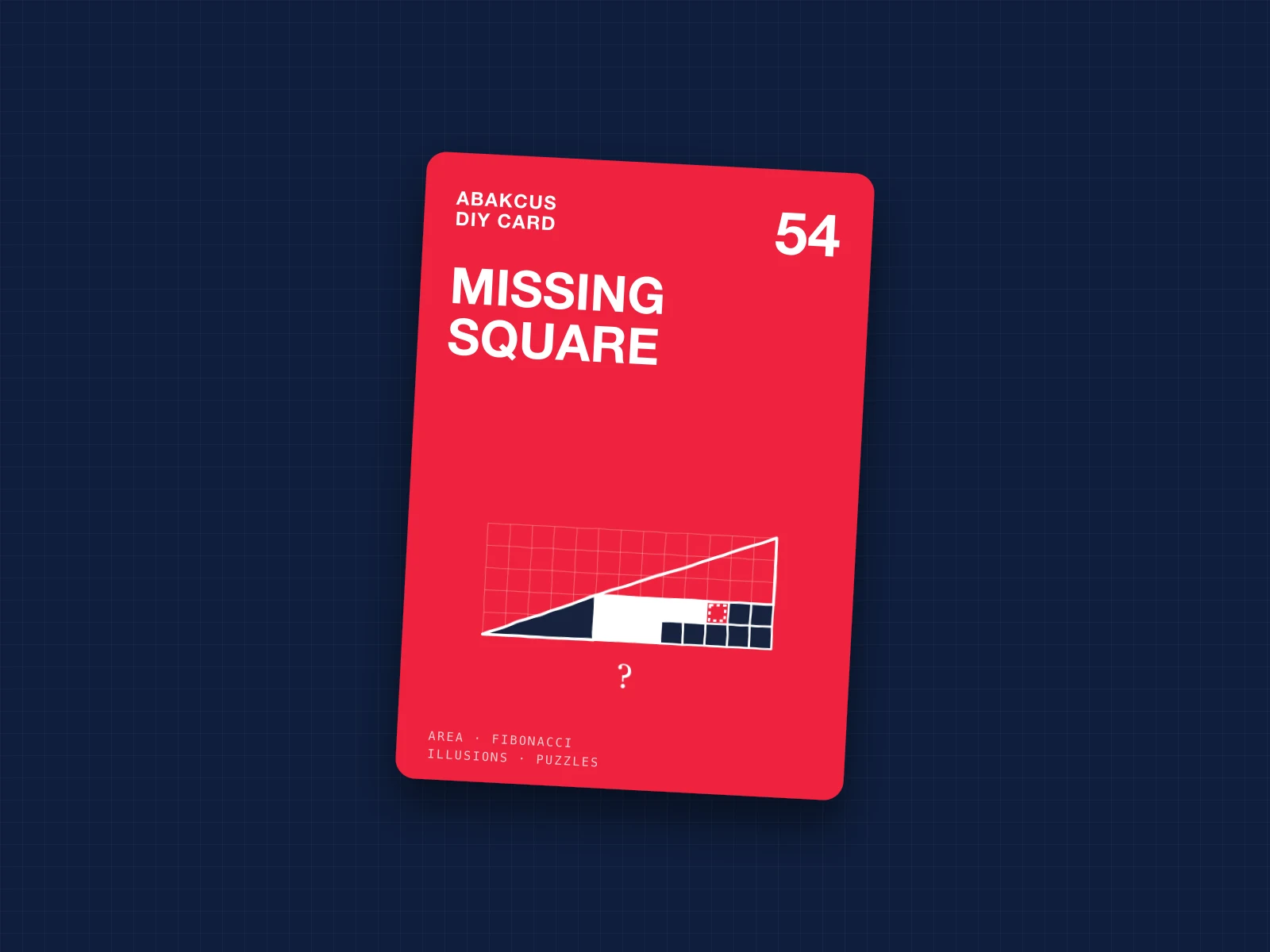
How to Make the Missing Square Puzzle and Find the Trick
Four pieces of card make a triangle. Swap two of them round and the same pieces make the same triangle, with a square missing. Where did it go?
Open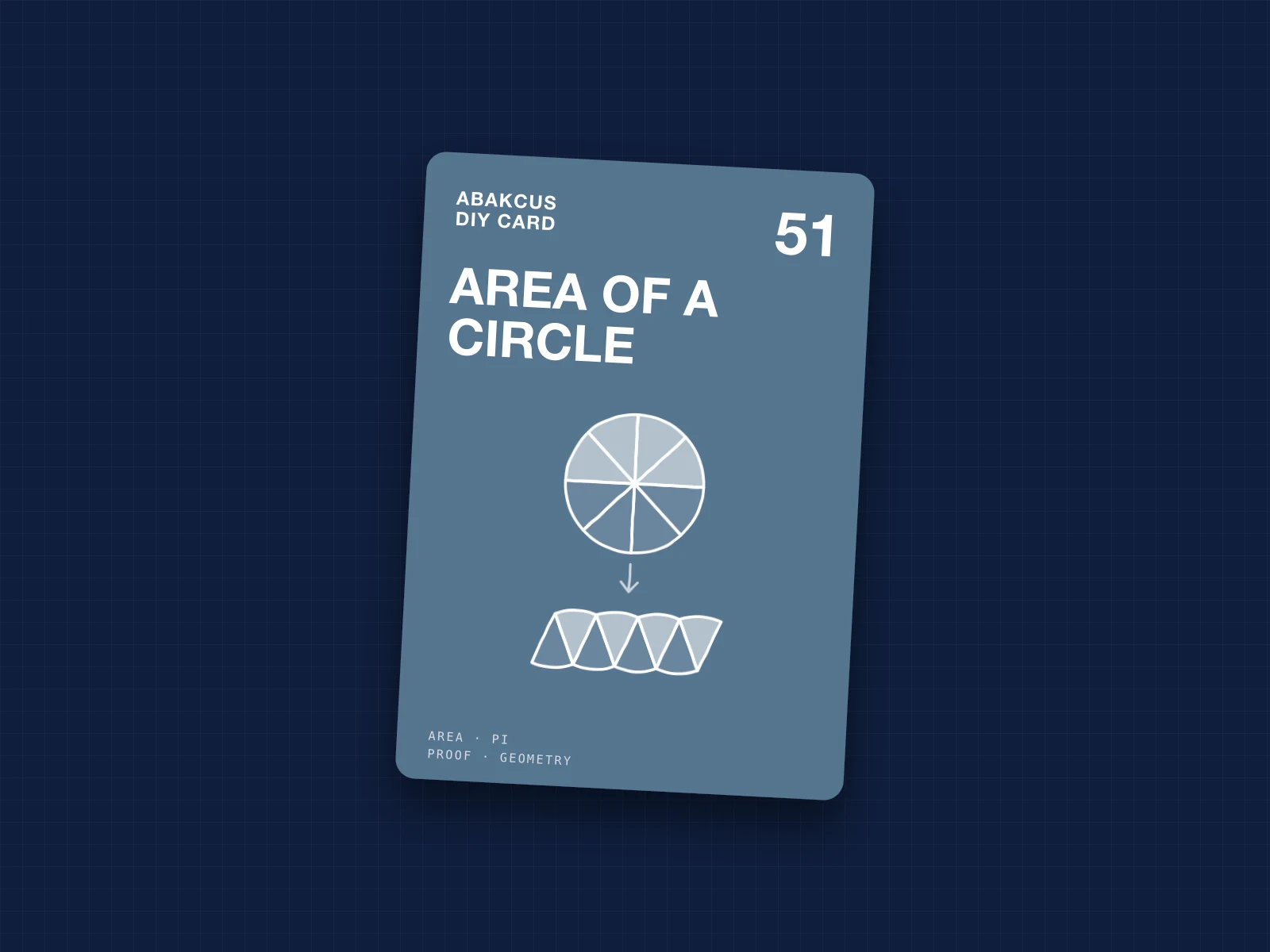
How to Show the Area of a Circle Is πr² With Paper Slices
A paper circle, three folds and a pair of scissors. Cut it into slices, lay them top to tail, and the circle becomes a rectangle that shows why its area is πr².
Open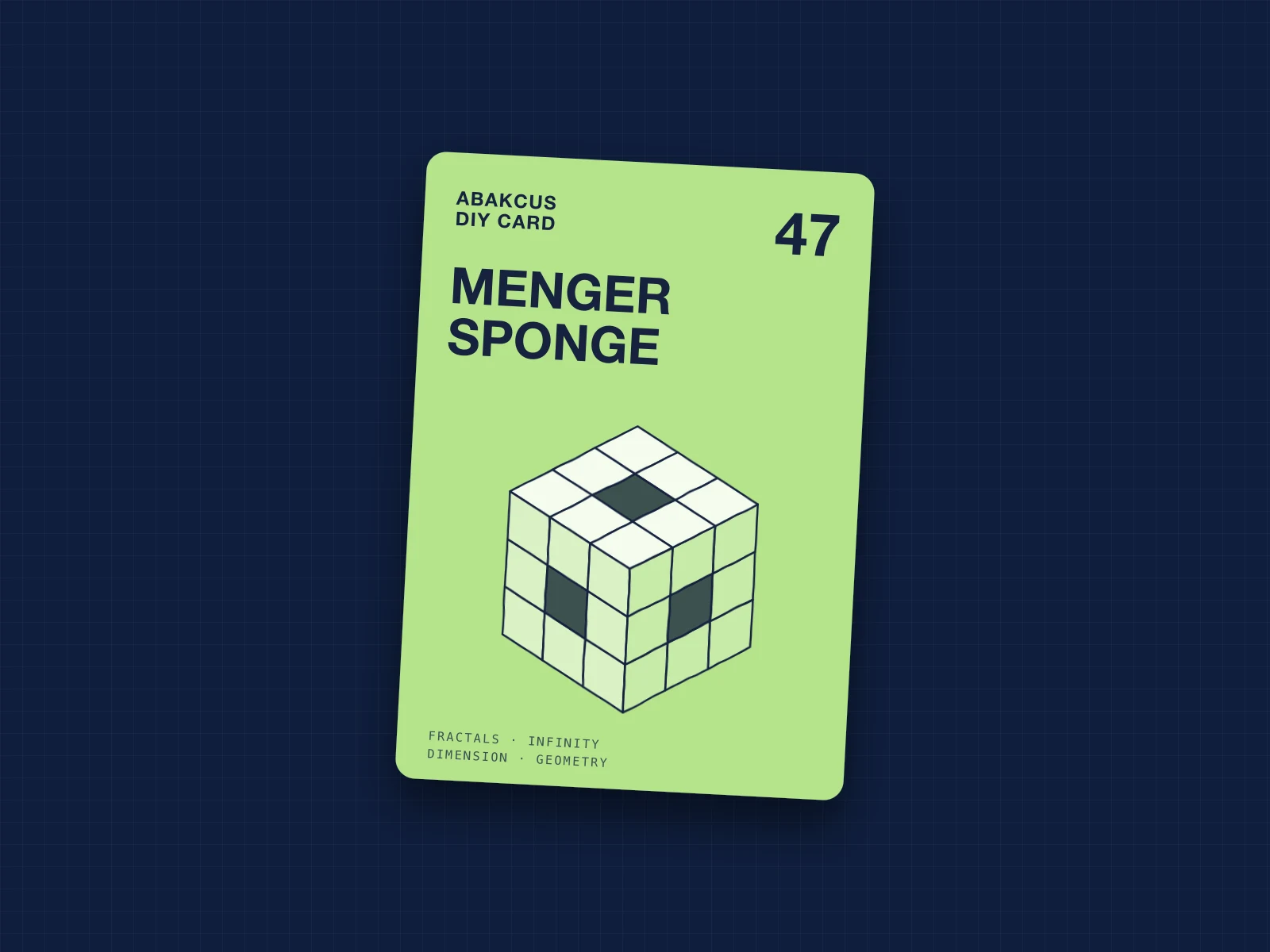
How to Build a Level-One Menger Sponge From Business Cards
A hundred and twenty business cards, folded into twenty cubes and locked together without glue. The first step of a shape with no volume and an infinite surface.
Open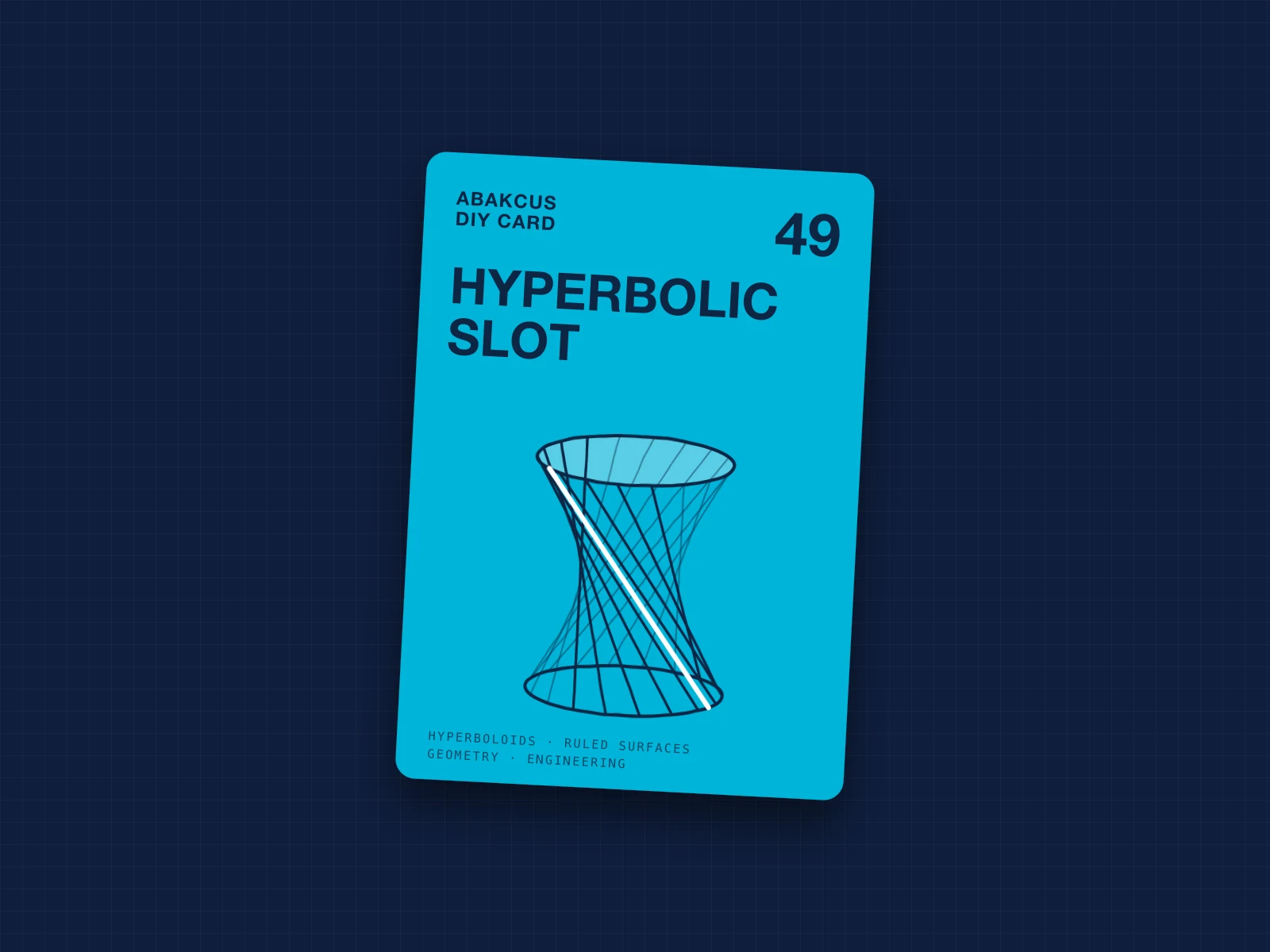
How to Make a Hyperbolic Slot: A Straight Rod Through a Curve
A pencil, a skewer and a sheet of foam board. Spin a perfectly straight stick and it glides through a perfectly curved slot, thanks to the shape of a cooling tower.
Open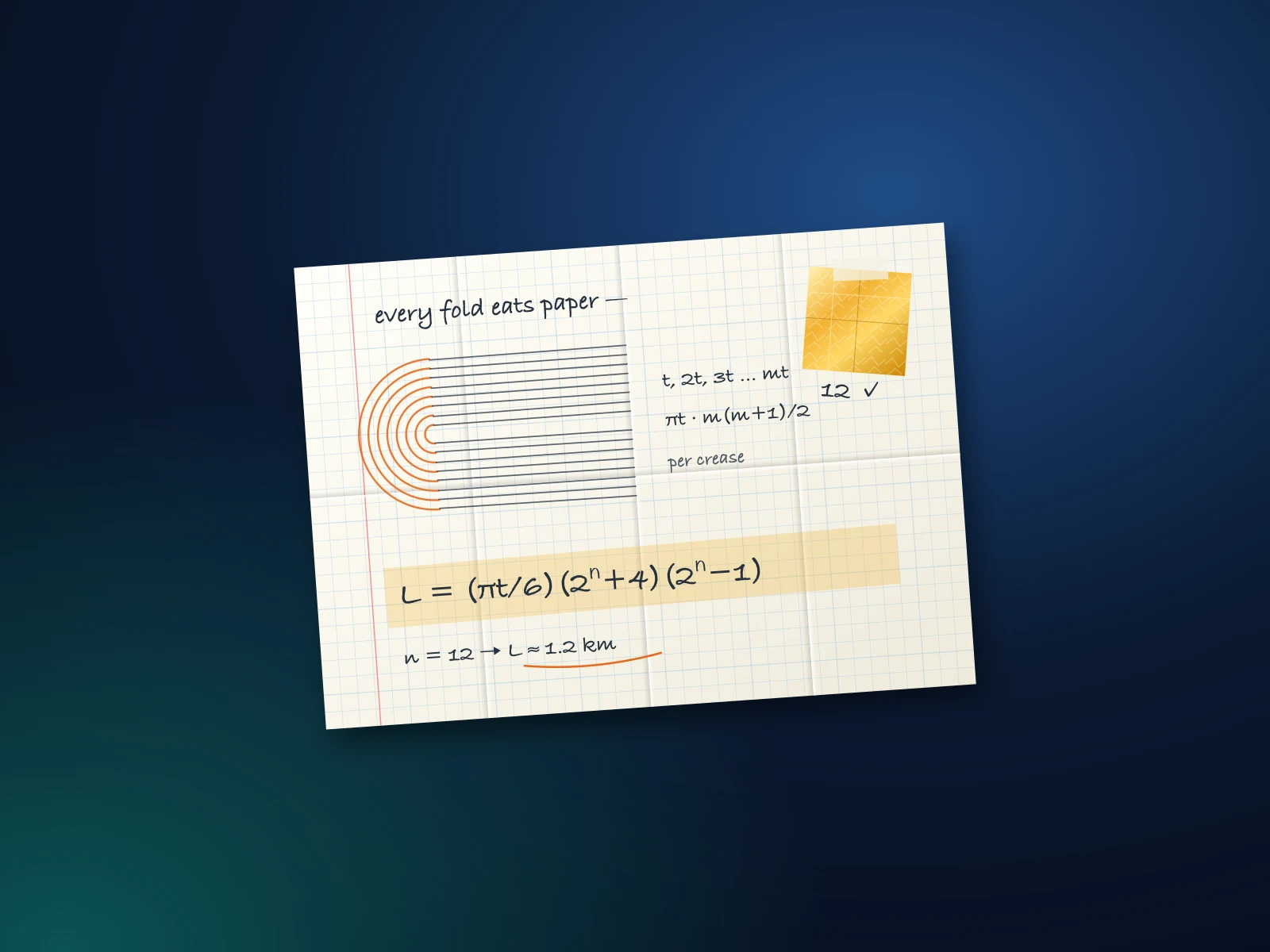
How Many Times Can You Fold Paper? Britney Gallivan's 12 Folds
Forty-two folds reach the Moon, yet paper quits at seven. A high-school junior worked out why — then folded a 1.2 km roll twelve times.
Open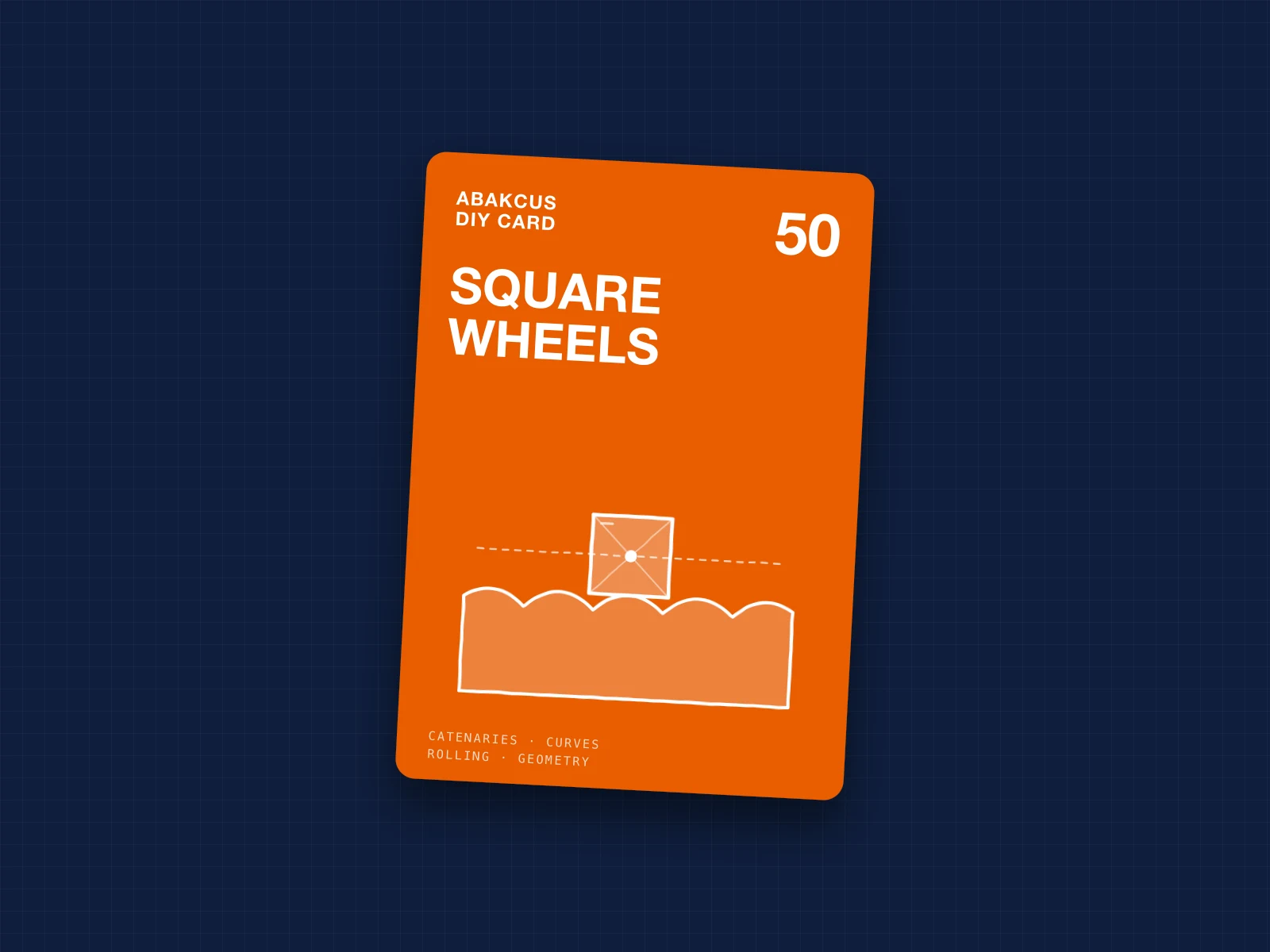
How to Make Square Wheels That Roll Smoothly on a Bumpy Road
Two cardboard squares, a skewer and a necklace. Trace a hanging chain, turn it upside down for a road, and square wheels roll as smoothly as round ones.
Open