
DIY · Card 27 · Engineering · Buoyancy
One sheet from an old box, folded into a tray and sealed with tape and wax. Then the test: how many coins can it carry before the water comes over the side?
01The brief
Build a cardboard boat that stays afloat with as much cargo as it can carry.
1 g
of cargo held up by every cubic centimetre of hull under the water line
3.5 kg
the most a tray 30 × 20 × 6 cm could carry before water reaches its rim
1974
the year students first raced cardboard boats as a university final exam
Cardboard seems like the worst thing to build a boat from. Leave a box out in the rain and it turns to mush. And yet a sheet of it, folded and sealed, floats like a cork and carries a pile of coins that would sink straight to the bottom on their own.
The trick is not the material but the shape. A hollow hull pushes water out of the way, and the water pushes back up. Get the shape right and that push can hold up many times the boat’s own weight. Keep it level and keep it dry, and it stays up. Like the floating paper clip, it is something that ought to sink, held up by water.
02Kit
An old box, a roll of tape and something waxy. The coins are the test.
Tick off what you have
0 of 6 ready
03Method
Draw a net, cut and fold it into a tray, seal and waterproof it, then load it one coin at a time.
Step 1 of 8 · Minute 0
You need a sheet of corrugated cardboard from a box, a ruler and pencil, scissors, strong tape, and something to keep the water out: wax paper, kitchen foil, a candle stub or wax crayons. For cargo, a pile of coins or a small bag of sugar.
Water seeps in at the corners.
Why
The corner flaps leave gaps, or the cut edges of the board are open.
Fix
Fold the flaps round the outside, then tape every edge inside and out, overlapping the strips.
It tips over as you load it.
Why
The coins are piled up in one tall stack, or all at one end.
Fix
Spread the coins flat across the whole bottom, starting in the middle.
The bottom sags and goes soft.
Why
Water is soaking into the paper.
Fix
Dry it out and waxproof the outside again, more thoroughly, or cover the whole hull in foil.
04Physics
Put the boat on the water and it sinks a little, pushing water aside. That water pushes back up. The deeper the hull sits, the more water it has shoved out of the way and the harder the water pushes. The boat settles at exactly the depth where the push up matches its weight. This is Archimedes’ principle: a floating object pushes aside its own weight of water.
Water weighs one gram per cubic centimetre, so every cubic centimetre of hull below the water line holds up one gram. Add a coin and the boat sinks until it has pushed aside another coin’s weight. It keeps working until the water line reaches the rim. After that, water pours in, and it is over. Change the hull’s size and shape, load it up, and find where it sinks:
Boat’s own weight
60 g
Water pushed aside
560 g
Most it can carry
3540 g
Pennies (2.5 g)
1416
Every cubic centimetre under the water line holds up one gram. This hull sinks 9 mm to push aside 560 g of water, 1 g per cm³.
Floating is only half the challenge. A boat also has to stay the right way up. Its weight pulls down through one point, the centre of gravity, G. The water pushes up through another, the centre of buoyancy, B, the middle of the water the hull pushes aside. When the boat leans, more of the low side goes under, so B slides towards the low side.
If B slides out past G, the two forces twist the boat back upright. If the boat is narrow and the coins are stacked tall, B can’t get past G, and the same twist rolls it over. Lean it and see:
A 30 cm long boat with 8 cm sides, carrying 500 g of coins.
Draft
1.5 cm
G above the floor
3.1 cm
Metacentric height GM
5.5 cm
Righting lever GZ
15.0 mm
Stiff and stable. Width does the work here: doubling the beam makes BM four times bigger, so B swings far out to the low side as soon as the boat leans.
Both models assume perfectly dry, rigid cardboard of about 500 g per square metre and fresh water. A real boat leaks and sags first, so it carries less.
05The big idea
Shape beats
material.
Screw a sheet of cardboard into a ball and it sinks once it soaks through. Fold the same sheet into a tray and it carries a kilo. Nothing about the material changed; only the shape did, and with it the amount of water it can push aside.
That is why ships can be built of steel, and once were even built of concrete. Engineers rarely get to pick a perfect material. They make an ordinary one do extraordinary work by giving it the right shape.
06The math
1 · Archimedes’ principle
F = ρ V g
The upward push equals the weight of the water displaced: its density ρ, volume V and g.
2 · How deep it sits
T = m ⁄ (ρ L W)
For a box hull of length L and width W carrying a total mass m, the draft T follows straight away.
3 · Will it stay up?
GM = KB + BM − KG
GM, the metacentric height, must be positive. BM = W² ⁄ 12T grows with the square of the width.
Take a tray 30 cm long and 20 cm wide. With 500 g of coins and its own 60 g of board, it sinks until T = 560 ⁄ (1 × 30 × 20) ≈ 0.93 cm. Barely a centimetre. Filled to a 6 cm rim, the same hull would push aside 3,600 g of water, so on paper it could carry about 3.5 kg.
The stability line is the more surprising one. KB is the height of the centre of buoyancy above the bottom, KG the height of the centre of gravity, and BM how far the boat’s ‘balance point’, the metacentre M, sits above B. Because BM = W² ⁄ 12T, a boat twice as wide is four times as stable, and sits half as deep, which makes it more stable still. Width is the cheapest stability there is.
07Real life
Every ship, barge and submarine floats on the same rule as your cardboard tray.
The Plimsoll line
Painted on the side of every cargo ship is a circle with a line through it. Load the ship until the water reaches that line and no further. Britain made the mark compulsory in 1876, after a long campaign by the MP Samuel Plimsoll against overloaded ‘coffin ships’.
Steel and concrete ships
Steel is eight times denser than water, yet a steel ship floats, for the same reason your cardboard tray does: shaped into a hollow hull, it pushes aside its own weight in water long before it is under. During the First World War, shortages of steel even led to ships built of concrete.
River barges
Barges are flat-bottomed boxes, just like your tray. On a shallow river a box shape carries the most cargo for the least depth of water, which is why barges look almost exactly like the boat on this card, only bigger.
The Vasa
In 1628 the Swedish warship Vasa sailed less than a mile on her maiden voyage before a gust of wind heeled her over and she sank. She was narrow and top-heavy, with two decks of heavy guns: her centre of gravity sat too high for her width, the mistake the tip test lets you make.
Cardboard regattas
Every spring, students at Southern Illinois University race people-carrying boats made of corrugated cardboard across a lake. The race began in 1974 as a design professor’s final exam, and cardboard boat races are now held all over the world.
Submarines
A submarine sinks and rises by changing its own weight, not its size. It lets sea water into ballast tanks to dive, and blows it out with compressed air to surface. Archimedes’ rule doesn’t change: what matters is the weight of water pushed aside.
1628
On 10 August 1628 the Vasa, the pride of the Swedish navy, set sail from Stockholm with crowds watching. Within minutes a gust of wind heeled her over; a second gust laid her on her side, water poured in through the open gun ports, and she sank in the harbour.
She had been built too tall and too narrow, with too much weight high up and too little ballast low down. In the tip test’s terms, her GM was dangerously small. She was raised in 1961 and stands in a museum in Stockholm today. Read how two different rulers may have helped sink her in the Vasa and the two rulers.
08Is and isn’t
Heavy things sink and light things float.
What matters is the weight of the whole boat, air included, compared with the water it can push aside. A steel ship weighs thousands of tonnes and floats; a small pebble weighs a few grams and sinks.
The taller the walls, the more it carries.
Taller walls do add capacity, but no more than making it longer or wider by the same proportion, and they raise the centre of gravity, so the boat gets tippier. Extra width adds capacity and stability together.
Archimedes found his principle jumping out of the bath shouting ‘Eureka!’
That story was written down by the Roman architect Vitruvius two centuries after Archimedes died, and may be a legend. Archimedes’ real legacy is his book On Floating Bodies, which states the principle and works out when floating shapes stay upright.
Cardboard boats can’t last in water.
Bare board does go soggy within minutes. But taped, waxed or painted, cardboard boats carry adults across lakes in regattas every year. Keeping the water out of the paper is the whole trick.
09Go further
A
Predict, then load
Measure your boat and use L × W × H to predict how many grams it should carry. Then load it. How close did you get, and what stopped it early?
B
Shape race
Build a box, a pointed bow and a V-hull from the same size of sheet. Which carries most? Then pull each across a bath on a thread: which is fastest?
C
Salt water
Stir lots of salt into the water and load the boat again. Salty water is denser, so the boat should carry a little more. Does it?
D
Waterproofing trial
Make three identical boats: bare, waxed and foil-covered. Float them empty and time how long before each one sags or leaks.
E
Tip test
Load your boat with a stack of coins at one end. How tall a stack can it take before it tips? Then try the same coins spread flat.
10Questions
Fold a single sheet of corrugated cardboard into an open tray, with a flat bottom and walls about 5 cm high, tucking the corner flaps round and taping every seam. Waterproof the outside with wax paper, foil or rubbed-on candle wax. A wide, flat tray like this floats high and carries a surprising load.
On paper, a hull can carry the weight of the water it would hold if filled to the rim, minus its own weight. A tray 30 cm long, 20 cm wide and 6 cm deep could hold up 3.5 kg before water reaches the rim. In practice leaks, soggy board and tipping stop it well before that.
For carrying cargo, a wide, flat-bottomed box: it pushes aside the most water for its size and is very hard to tip over. V-shaped and pointed hulls are faster but carry less, because they displace less water for the same length, width and depth.
Seal every edge with tape, since the cut ends of corrugated board soak up water like rows of straws. Then cover the outside in wax paper or foil, or rub it all over with a candle or wax crayons. Full-size regatta boats are painted with several coats of house paint or varnish.
Because its centre of gravity is too high for its width. When a boat leans, the centre of the water it displaces moves to the low side. If it moves out past the centre of gravity, the boat rights itself; if the boat is narrow and the load is stacked tall, it doesn’t, and over it goes.
Safety · A grown-up should handle the craft knife. Test boats in a sink, bath or paddling pool with someone watching, and never use candle wax that has been heated.
All DIY cards →Keep wandering
A few more pieces in the same spirit — math, design, and slow attention.
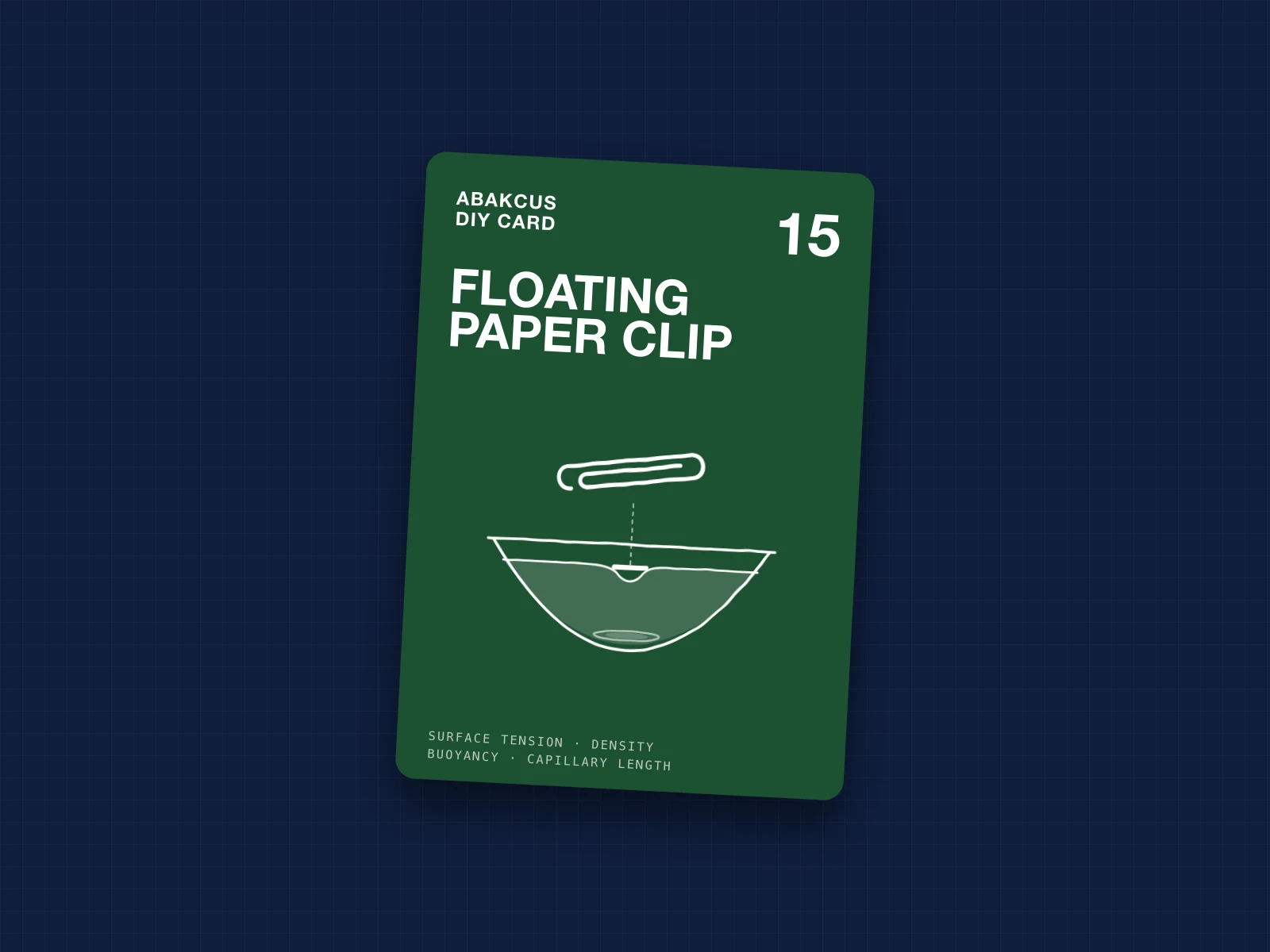
How to Float a Paper Clip on Water: Surface Tension
Steel is nearly eight times denser than water, and a paper clip still lies on top of it if you put it down gently. The surface bends into a dimple and holds it, like a trampoline, until a drop of soap breaks the spell.
Open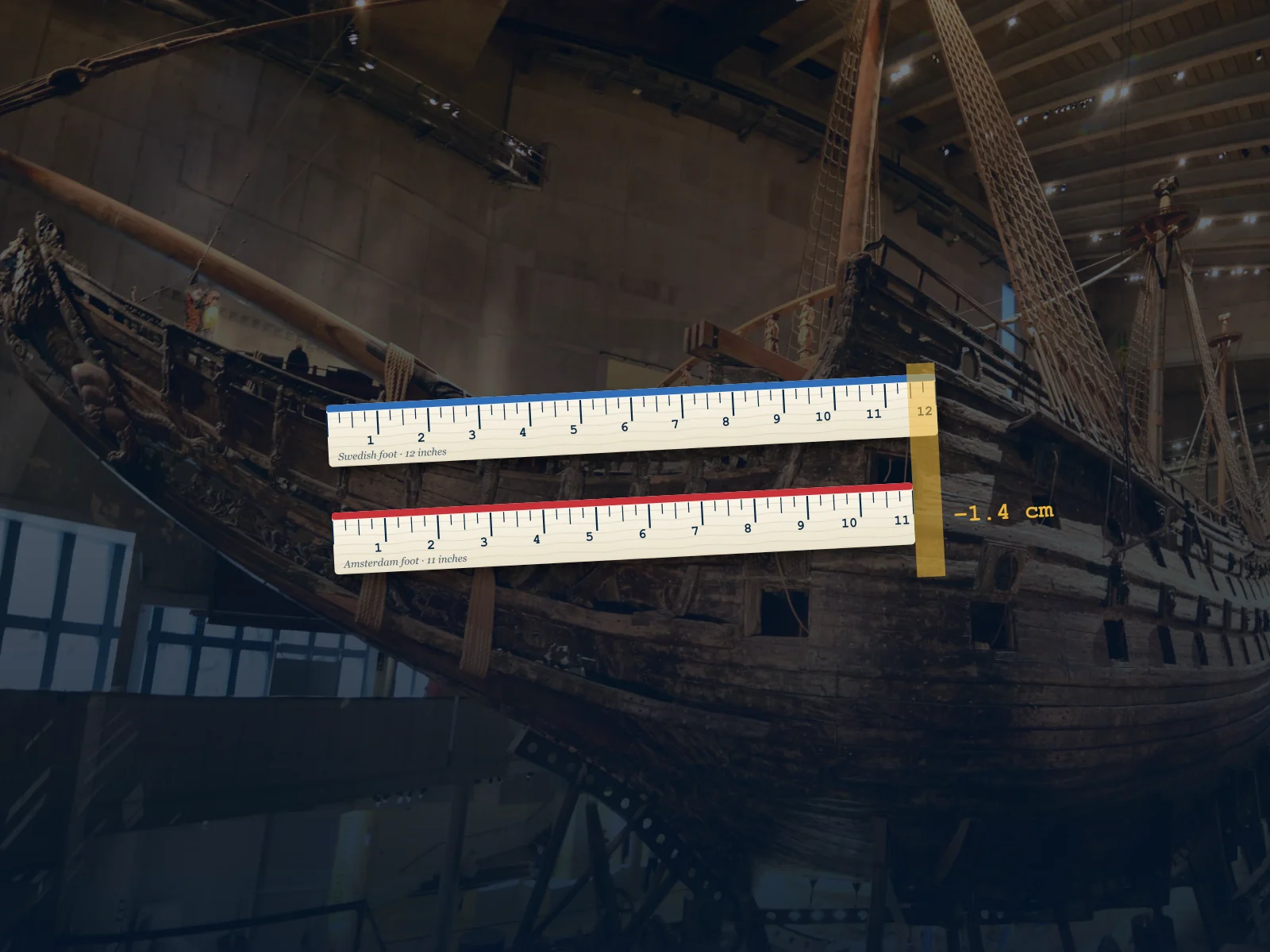
Why Did the Vasa Sink? The Ship Built With Two Rulers
In 1628 Sweden's mightiest warship sank 1,300 metres into its maiden voyage. Inside the wreck lay two kinds of ruler, and a hull that is not the same on both sides.
Open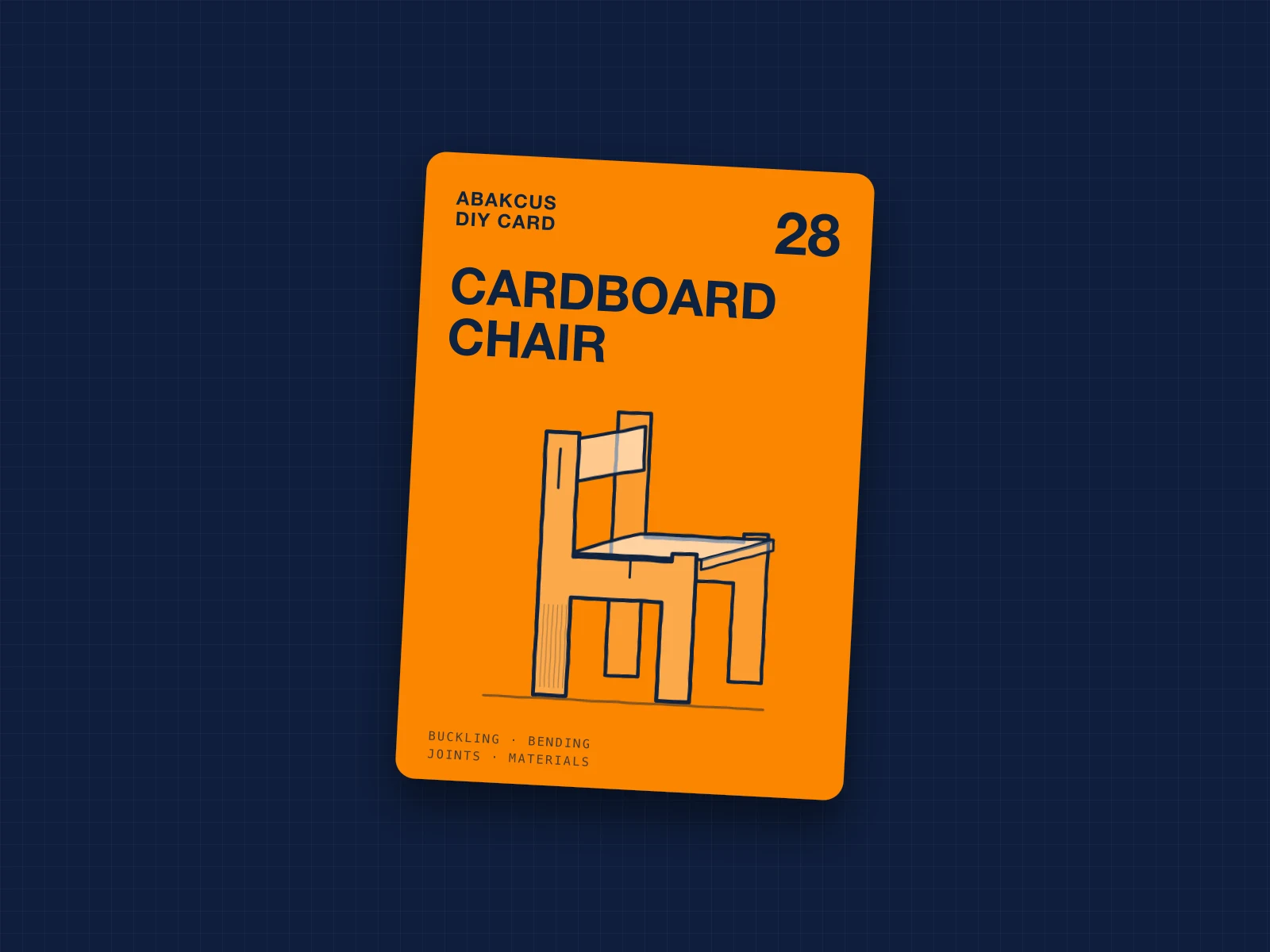
How to Make a Cardboard Chair That Holds Your Weight
Nothing but cardboard: no glue, no tape, no screws. Just slots, folds and the flutes the right way up, and a chair that holds a grown-up.
Open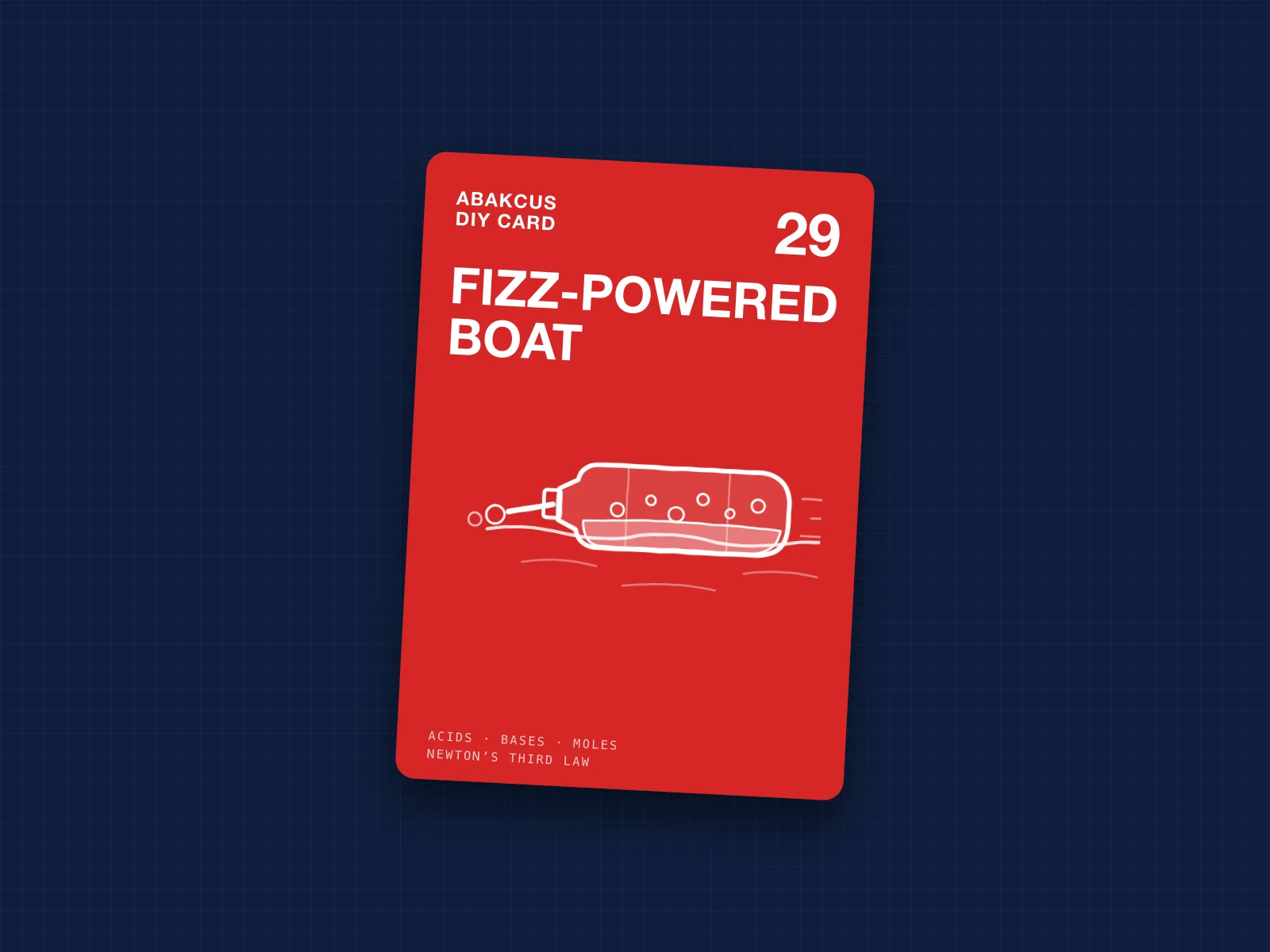
How to Build a Boat Powered by a Chemical Reaction
A bottle, a straw, a spoonful of baking soda and a splash of vinegar. The fizz has only one way out, and when it rushes out the back the boat shoots off the other way, like a tiny rocket.
Open
How to Make a Density Tower: Stacking Liquids in a Glass
Honey, washing-up liquid, water, oil and rubbing alcohol, poured one by one into a glass, settle into five sharp layers. Which goes where is decided by one number, and one of them only stays put thanks to the oil.
Open
How to Build a Spaghetti Bridge (and Why Pasta Buckles)
One strand of dry spaghetti can hang five kilograms from its end, then buckles under less than two hundred grams pushed along it. A good bridge pulls where pasta is strong and keeps the pushes short.
Open