
DIY · Card 28 · Engineering · Structures
Nothing but cardboard: no glue, no tape, no screws. Just slots, folds and the right way up for the flutes, and a chair that holds a grown-up.
01The brief
Build a chair you can sit on, from cardboard and nothing else.
30×
more load from the same strip of board rolled into a tube than standing flat, in the leg lab
8×
stiffer seat ribs when you double their depth, from the same rule as a floor joist
200 kg
the rating of the cardboard bed frames in the Tokyo 2020 athletes’ village
Try sitting on an empty box and it crumples under you. Try it on a box full of books and it holds. The cardboard is the same; what changed is that its walls were held straight. That is the whole secret of a cardboard chair.
Cardboard used flat bends at the slightest push. Stood on its edge, with its flutes running along the load and its walls stopped from bowing, it can carry a person. This challenge is about finding those shapes, and joining them without a drop of glue. It is the same fight against buckling as the spaghetti bridge, and the same trick of tubes as the straw through a potato.
02Kit
Big boxes and a sharp knife. What you don’t need matters as much: no glue and no tape.
Tick off what you have
0 of 5 ready
03Method
Read the flutes, cut two sides and a grid of ribs, slot it all together, and test it slowly.
Step 1 of 8 · Minute 0
Collect two or three large, clean boxes, the kind a fridge, a bike or a lot of shopping came in. Open them out flat. You also need a long ruler, a pencil, and a craft knife and cutting mat for a grown-up. No glue and no tape: that is the challenge.
A leg bows outwards and folds.
Why
A flat panel is buckling, not crushing.
Fix
Fold the leg into an L or a tube, or slot a cross brace between the two side panels low down.
The seat sags in the middle.
Why
The ribs are too shallow, too few, or have their flutes across.
Fix
Make the ribs deeper, add more, and run the flutes along each rib.
The chair wobbles and leans sideways.
Why
The slots are too wide, so the joints rattle.
Fix
Cut slots exactly as wide as the board is thick, and add a second cross piece at the back.
04Physics
Corrugated board is three sheets of paper: two flat liners glued to a wavy one, the fluting, in between. The flutes are a row of tiny arches. Squeeze the board along its flutes and the arches stand like columns; squeeze it across them and they simply fold flatter. That is why the board is more than twice as strong one way as the other.
A leg can fail in three ways. The board can crush, the most it can ever take. The whole leg can bow out sideways, which is buckling. Or one flat wall can ripple while the rest stays put. Buckling and rippling almost always come first, at a fraction of the crushing load, unless the shape stops them. Give every leg the same strip of board and change only the shape:
One leg holds
4 kg
The chair holds
18 kg
Load on it
40 kg
Fails by
bowing
Down they go · It bows outwards like a ruler squeezed end to end. A flat sheet is floppy because all its material sits right on its middle line.
The seat has a different job. It spans a gap and has to resist bending. When a beam bends, its top edge is squashed and its bottom edge stretched, while its middle hardly works at all. So the best seat puts board as far from the middle as possible: deep ribs on edge, not flat sheets. Build the seat:
Sag in the middle
—
Strength used
631 %
Board in the ribs
800 cm²
Stiffness vs 1 rib, 1 cm
× 500
The top edges of the ribs crush and the seat folds in the middle. Doubling the depth of every rib makes the seat eight times stiffer; doubling the number of ribs only makes it twice as stiff.
Both models use typical figures for single-wall box board, about 4 mm thick with an edge crush strength near 5.6 kN per metre. Real board varies, and damp or creased board is much weaker, so build in a big margin.
05The big idea
Fold it,
don’t thicken it.
A flat strip of board holds a few kilos. Roll the same strip into a tube and it holds a person. Not a gram of material was added; it was only moved, away from the middle line and into a shape that can’t bow.
Nature and engineers both do this. Bones and bamboo are hollow tubes, aircraft wings are thin skins over ribs, and steel beams are shaped like an I. Strength comes from where the material is, not just how much of it there is.
06The math
1 · Crushing
P = ECT × w
The most a leg can take: the board’s edge crush strength times the length of loaded edge, w.
2 · Euler buckling
P = π² E I ⁄ L²
A slender leg of length L bows at this load. I, the second moment of area, measures how far material sits from the middle.
3 · A rib on edge
I = t d³ ⁄ 12
For a rib of thickness t and depth d, bending stiffness goes as the cube of the depth.
A strip 24 cm wide of board rated at about 5.6 kN/m could crush at 5,600 × 0.24 ≈ 1,340 N, the weight of about 137 kg. Laid flat as a leg 42 cm long, its I = w t³ ⁄ 12 is tiny because it is only 4 mm thick, and Euler’s formula says it bows at around 4 kg.
Roll it into a tube about 7.6 cm across and I = π r³ t is more than five hundred times bigger. Now the leg would rather crush than bow, and crushing is the best it can do: about thirty times the flat strip. The seat works the same way through t d³ ⁄ 12: a rib 10 cm deep is a thousand times stiffer than the same rib lying flat, 1 cm of it deep.
07Real life
From athletes’ beds to cathedrals, cardboard does structural work wherever it is shaped well.
Olympic beds
At the Tokyo 2020 Games, the 18,000 beds in the athletes’ village had frames of high-strength cardboard, rated to carry about 200 kg. After the Games they were recycled into paper products.
The Cardboard Cathedral
After the 2011 earthquake in Christchurch, New Zealand, the architect Shigeru Ban built a temporary cathedral whose A-shaped roof rests on giant cardboard tubes. It opened in 2013 and is still in use. Ban has built shelters from paper tubes after disasters around the world.
Honeycomb doors
Open up most lightweight interior doors and you’ll find a core of paper honeycomb between two thin skins. The paper cells, standing on edge, hold the skins apart and make the door stiff for a fraction of the weight of solid wood.
Floor joists
The timbers under a wooden floor are laid on edge, tall and thin, never flat. It is exactly the trick of your seat ribs: depth is what resists bending, so the same wood carries far more standing up than lying down.
Stacking boxes
Warehouse boxes are stamped with a rating like ‘32 ECT’: how many pounds an inch of the board’s edge can take before it crushes. Boxes are stacked with their flutes standing up, so the walls carry the load of the boxes above along their strongest direction.
Steel I-beams
Bridges and buildings are framed with I-beams: two flanges held far apart by a thin web. Moving material away from the middle, where it does little, to the top and bottom, where it does most, is the same idea as standing your ribs on edge.
1972
In the early 1970s the architect Frank Gehry noticed a pile of corrugated cardboard outside his office and started experimenting. The result was Easy Edges, a range of furniture made of layers of board glued together with their flutes running in alternating directions. Its star was the Wiggle Side Chair, a single ribbon of cardboard curving from back to floor.
The chairs were strong, quiet and cheap, and they sold so well that Gehry stopped making them, worried he would become known as a furniture designer instead of an architect. The Wiggle chair is still made today and sits in museum collections. The material Gehry trusted had been invented only a century earlier: corrugated paper was patented in 1871, for wrapping bottles.
08Is and isn’t
Cardboard is too weak to sit on.
Board carries a lot when it is pushed along its edge, with the flutes running the same way. Chairs, beds and even a cathedral’s columns are made of it. What fails is board used flat, where it bends.
Thicker panels are the way to make it stronger.
Gluing sheets into a thicker slab helps, but the same board stood on edge as deep ribs is far stiffer: stiffness grows with the cube of depth. Shape, not thickness, is the cheap way to strength.
Tape and glue are what hold cardboard furniture together.
Good cardboard furniture holds together by its joints. Tight, accurately cut slots lock the pieces in place, and the load flows through board pressing on board, not through a strip of tape.
If it holds when you sit gently, it’s safe.
Dropping onto a seat can briefly double the force on it, and leaning back loads the rear legs much more than the front. Leave plenty of margin, and test the ways people really sit.
09Go further
A
Leg test
Make five legs from identical strips: flat, folded, triangle, square and rolled. Stack books on each until it fails, and compare with the leg lab.
B
Flute test
Roll two identical tubes, one with the flutes along it and one across. Which carries more books before it crushes?
C
Lightest chair
Weigh your chair. Then redesign it to hold the same person with less board. The best engineers measure strength per gram.
D
Stool in one sheet
Can you make a stool from a single sheet of board, folded and slotted, with no separate pieces at all?
E
Rib depth
Span a gap between two piles of books with one strip laid flat, then the same strip on edge. Load each with coins until it touches the table.
10Questions
Cut two identical side panels from big sheets of corrugated board, with the flutes running up and down the legs. Cut slots halfway into the pieces where they cross, and slot a grid of deep ribs between the sides for the seat and a panel across the back posts. Snug halving joints hold everything by friction.
Yes, if the load is carried by board standing on edge with the flutes running along the load. A strip of single-wall board about 24 cm wide, rolled into a tube, can carry over 100 kg before it crushes; four legs like that, and a seat of deep ribs, hold an adult with room to spare.
Along the direction of the load. In the legs they should run up and down; in the seat ribs, along each rib. Board squeezed along its flutes is more than twice as strong as board squeezed across them.
Usually by buckling, not crushing. A flat panel bows sideways under a load far smaller than the board could actually crush under. Folding panels into tubes, adding cross braces and standing seat ribs on edge stop the bowing, so the board is used at its full strength.
Two pieces that each have a slot cut halfway through them, so they slide into each other at right angles and end up flush. It is the joint inside a box of wine bottles or a cardboard egg tray, and it needs no glue if the slots are cut exactly as wide as the board is thick.
Safety · A grown-up should do all the cutting with a sharp knife on a cutting mat. Test the chair slowly, low to the ground and on a soft floor, and never stand on it.
All DIY cards →Keep wandering
A few more pieces in the same spirit — math, design, and slow attention.
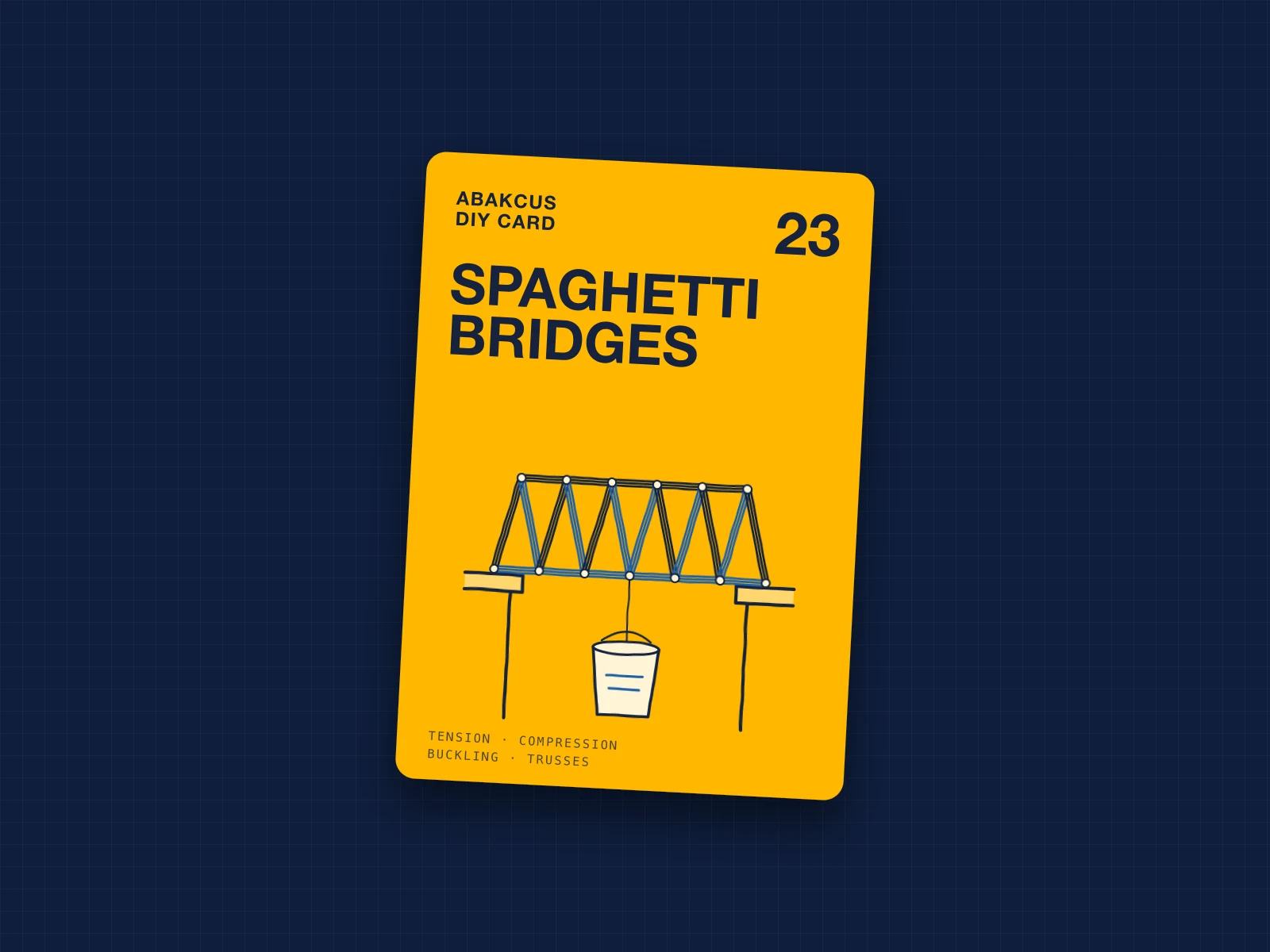
How to Build a Spaghetti Bridge (and Why Pasta Buckles)
One strand of dry spaghetti can hang five kilograms from its end, then buckles under less than two hundred grams pushed along it. A good bridge pulls where pasta is strong and keeps the pushes short.
Open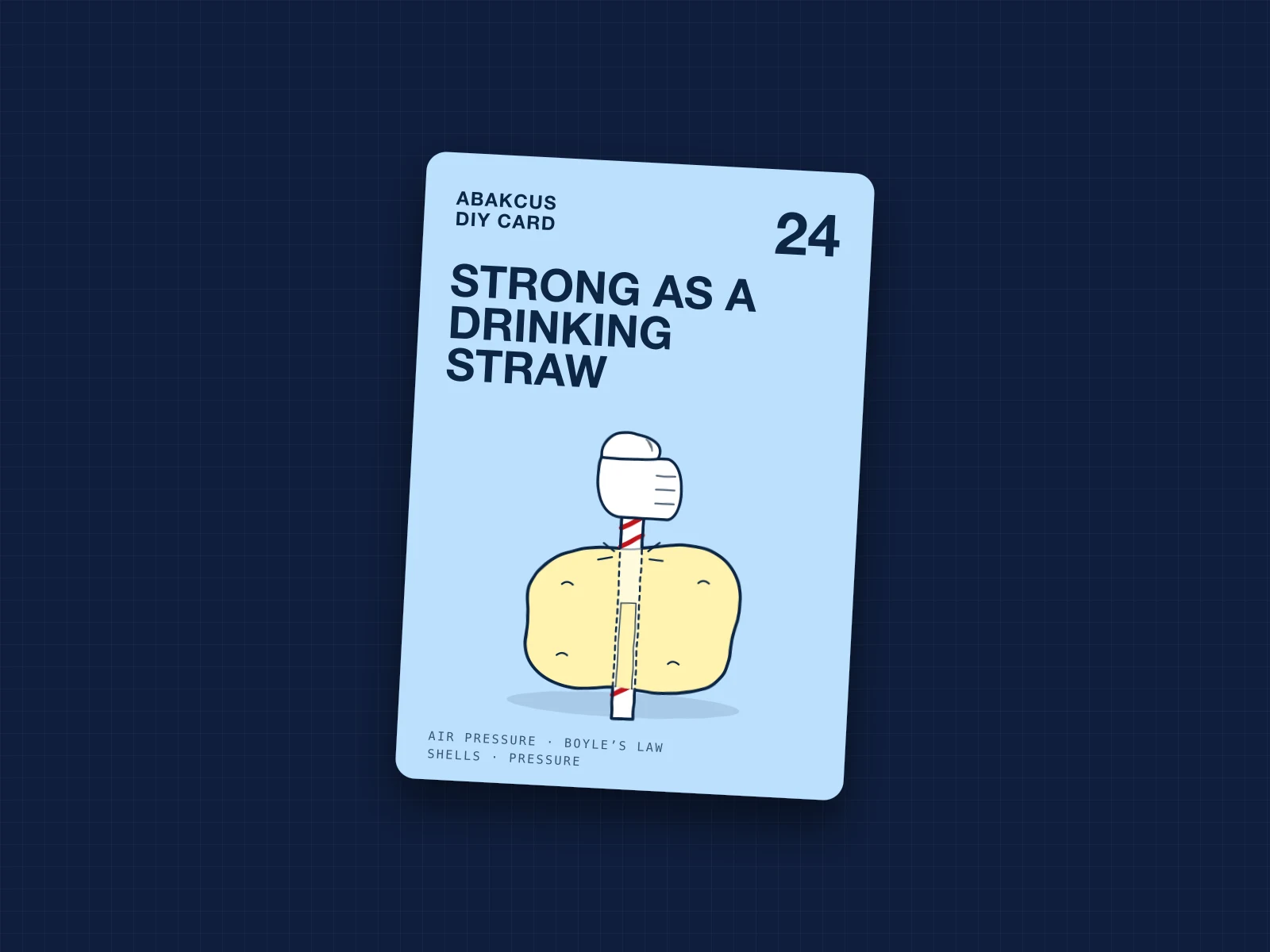
How to Push a Straw Through a Raw Potato
Stab a potato with a plastic straw and the straw crumples. Put your thumb over the top first and it goes straight through. The air trapped inside can’t get out, so the straw can’t cave in.
Open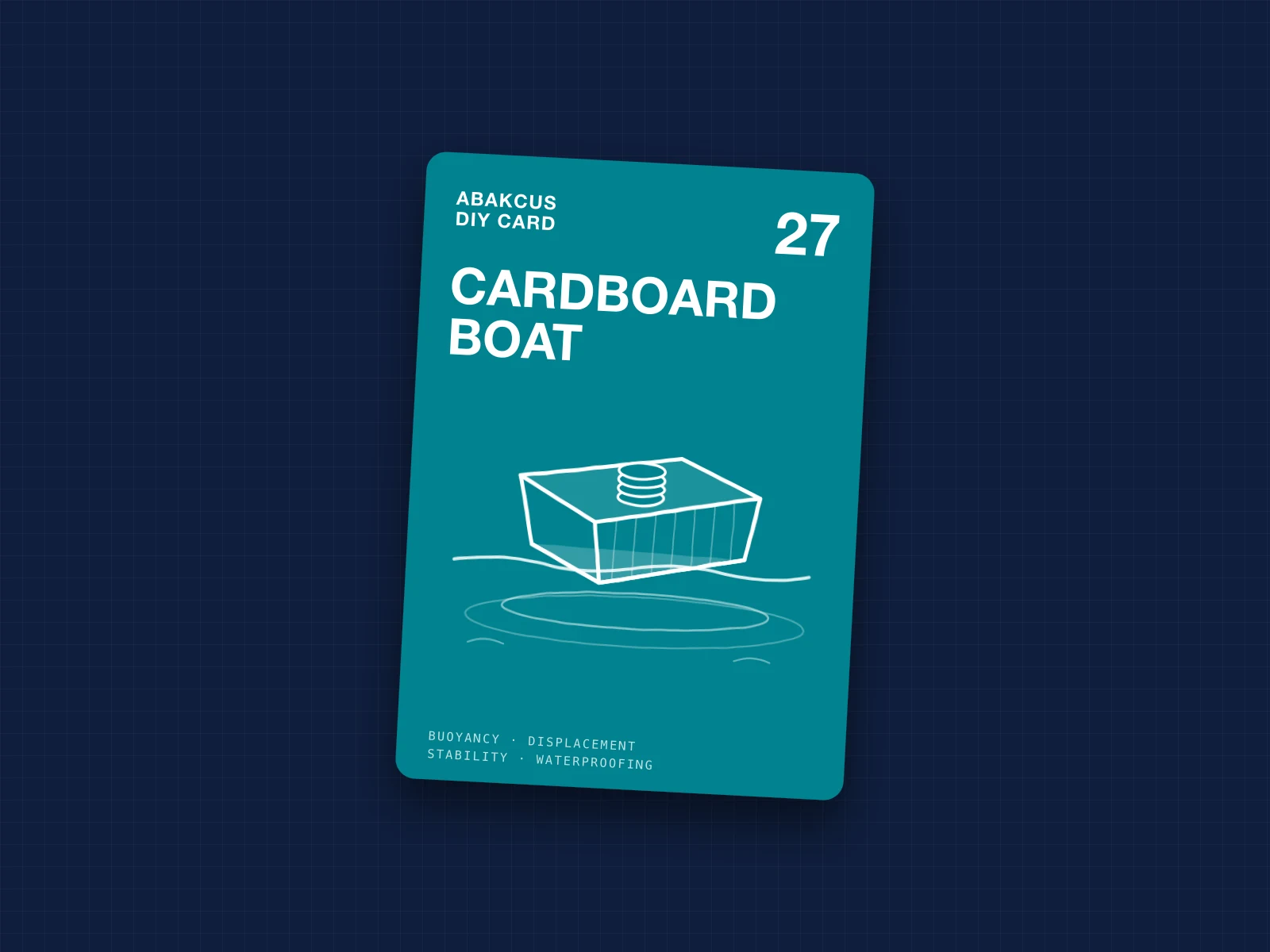
How to Make a Cardboard Boat That Floats (and Carries Coins)
One sheet from an old box, folded into a tray and sealed with tape and wax. Then the test: how many coins can it carry before the water comes over the side?
Open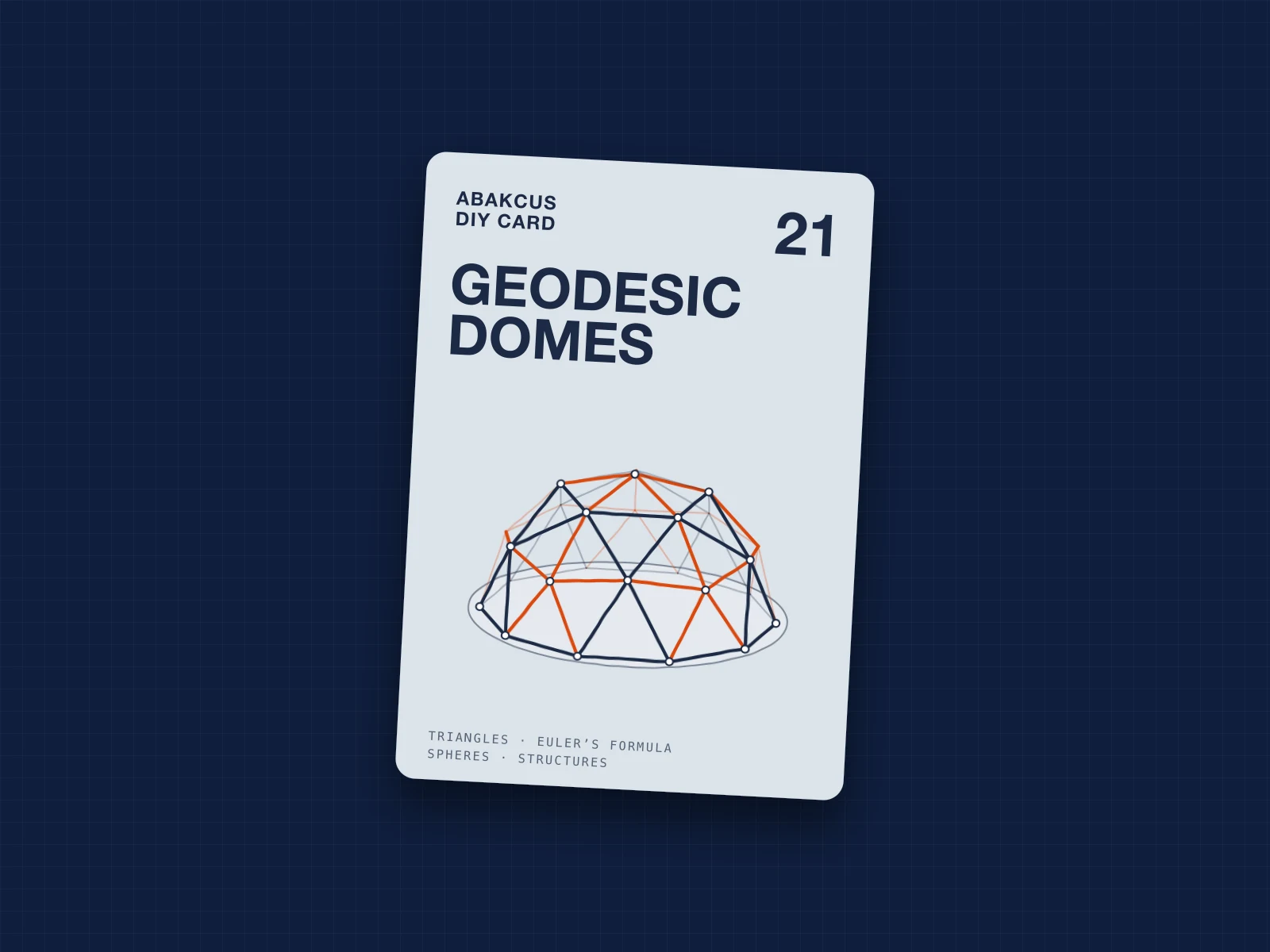
How to Build a Geodesic Dome From Newspaper
Sixty-five rolled-up newspapers, two lengths, a lot of tape: a dome two metres across that you can sit inside. Triangles can’t change shape, and that one fact holds the whole thing up.
Open
How to Build a Marble Run From Cardboard Tubes
Split tubes, a wall and some tape: a zigzag run that keeps a marble busy for half a minute on a one-metre drop it could fall in less than half a second. Height is the fuel; the trick is spending it slowly.
Open
How to Build a Cotton Reel Tank (Thread Spool Tank)
An empty cotton reel, a rubber band, a pencil and a slice of candle. Wind it up and it crawls across the floor and over books, slowly giving back every turn you put in.
Open