
DIY · Card 24 · Engineering · Air pressure
A plastic straw against a raw potato: the straw crumples. Do it again with your thumb pressed over the top, and it goes straight through. Nothing changed but the air inside.
01The brief
Push a drinking straw right through a raw potato, without it bending.
0.15 mm
the thickness of a plastic straw’s wall, about one and a half sheets of paper
+25 kPa
the rise in air pressure when a 4 cm core of potato fills part of a 20 cm sealed straw
10×
how much more the push is concentrated on the straw’s thin rim than on a solid rod
A straw is about the flimsiest thing in the kitchen: a tube of plastic so thin you can squash it between two fingers. A raw potato is hard enough to need a sharp knife. Stab one with the other and you get exactly what you would expect, a crumpled straw.
Then put your thumb over the top of a fresh straw and do it again. It slides in, and often bursts out of the bottom with a neat plug of potato inside. The straw is no stronger. The air inside it is trapped, and trapped air, like the air in the expanding gases card, pushes back when you try to squeeze it. A straw can only crumple by squeezing it.
02Kit
A potato, a few straws and somewhere safe to stab.
Tick off what you have
0 of 4 ready
03Method
Stab once with the top open to see the straw fail, then again with your thumb sealing it, and look at what you cut out.
Step 1 of 8 · Minute 0
You need a firm, raw potato and two or three stiff plastic straws, the ordinary kind. Put the potato on a folded tea towel on a table.
The sealed straw still bends.
Why
Air leaking past your thumb, or a stab that came in at an angle.
Fix
Press your thumb flat over the whole end, and stab straight down. A shorter straw helps too.
It goes in but stops halfway.
Why
A big potato and a slow push, so the straw starts to bend partway.
Fix
Use a smaller potato, stab harder and faster, and follow through.
The straw folds at one place every time.
Why
A bendy straw: the concertina section collapses first.
Fix
Use straight straws, or cut the bendy section off.
04Physics
A thin tube pushed along its length doesn’t fail by the plastic tearing. It fails by changing shape: one spot dents in, the tube flattens there, and once it is flat it folds like a hinge. Engineers call it local buckling, and every thin-walled can, pipe and rocket has to be designed against it.
Flattening a tube has a side effect. Its wall can bend but hardly stretch, and of all the shapes a loop of wall can make, a circle holds the most inside. Any dent or squash means less room. With the top open, air flows out to make way and nothing resists. With the top sealed, the air can’t leave, so it is compressed, and compressed air presses outwards on the wall, pushing the dent back out. Squeeze the straw below and watch:
Room inside
93 %
Air pressure
109 kPa
Push back
0.6 N/cm
The wall can bend but not stretch, so squashing the straw always shrinks the room inside. With the top open, the air simply leaves and nothing resists. Sealed, the same air is squeezed into less room; squash the whole straw to half its height and the pressure inside rises by about a fifth of an atmosphere, pushing the wall back out on every side.
05The big idea
Trapped air
is a skeleton.
A thin skin with nothing inside it can’t hold any shape. Fill it with air or water under pressure and seal it, and the skin is pulled tight in every direction. Now any change of shape has to squeeze what is inside, and what is inside refuses.
That is how a tyre carries a car, how a sealed can survives being stacked, how a lettuce leaf stands up and how a rocket made of steel thinner than a coin held itself together. Your thumb on a straw is the smallest version of the same idea.
06The math
1 · Boyle’s law
p₁V₁ = p₂V₂
For trapped gas at a steady temperature, pressure times volume stays the same. Halve the room, double the pressure.
2 · Pressure
p = F / A
The same push spread over less area presses harder. The straw’s rim is a thin ring, not a solid disc.
3 · The isoperimetric inequality
A ≤ P² / 4π
A loop of length P can enclose at most this area, and only a circle reaches it. Any squash means less room inside.
Stab a 20 cm straw 4 cm into a potato and a 4 cm core of potato is now inside it. The trapped air has been squeezed into 16 cm of straw, so its pressure becomes 101 × 20/16 ≈ 127 kPa: a quarter of an atmosphere more than outside, pressing outwards on every bit of the wall.
Meanwhile, the push of your arm reaches the potato only through the straw’s rim, a ring 6 mm across and 0.15 mm thick. Its area is 2π × 3 × 0.15 ≈ 2.8 mm², a tenth of the 28 mm² of a solid rod the same width, so the same push presses ten times as hard and cuts a core instead of shoving the potato aside. And the reason a dent is resisted at all is a theorem the ancient Greeks knew: of all closed curves of the same length, the circle encloses the most area. Try the numbers:
The core of potato takes up 4.0 cm of a 20 cm straw, so the air is squeezed into 80 % of its room and its pressure rises by 25 kPa. That inflates the straw like a tyre, and a tube under pressure can’t crumple. A shorter straw gets stiffer faster.
On the straw’s thin ring
3.5 MPa
On a solid rod as wide
0.35 MPa
The same push on a ring 2.8 mm² in area, instead of a disc of 28 mm², is ten times as concentrated. That’s why the straw cuts a neat core out like a pastry cutter, instead of having to shove the whole potato aside.
07Real life
From rockets to lettuce, thin skins kept rigid by what is sealed inside them.
Balloon-tank rockets
The Atlas rocket’s tanks were made of stainless steel thinner than a millimetre. Empty and unpressurised, they would have crumpled under their own weight, so they were kept inflated with gas at all times, even on the ground.
Fizzy drink cans
A sealed can of fizzy drink is hard to squash with your hands. Open it, and the same aluminium dents easily. The dissolved gas keeps the inside of a sealed can at a few times the pressure of the air, stiffening its paper-thin wall.
Plants
Soft green stems and leaves have no wood to hold them up. Each cell is pumped up with water, at a pressure that can be several times that of a car tyre, pressing against its wall. When the water runs short, the pressure falls and the plant wilts.
Tyres
A bicycle tyre is a rubber tube that couldn’t hold anything up empty. Pumped up, it carries a rider, because any dent would squeeze the air into less room, and the air pushes back.
Inflatable buildings
Emergency shelters, sports domes and inflatable tents use tubes of air, called air beams, instead of poles. Pumped hard, a fabric tube becomes a stiff beam; let the air out and the whole building folds into a bag.
Earthworms
A worm has no bones. Its body is a set of fluid-filled chambers wrapped in muscle; squeezing one end makes the fluid push the other end out. Biologists call it a hydrostatic skeleton, and it works for sea anemones too.
1962
On 20 February 1962, John Glenn became the first American to orbit the Earth, launched on an Atlas rocket. Its designer, Karel Bossart, had done away with the heavy internal framework of earlier rockets. The Atlas tanks were the rocket’s body: welded stainless steel between about 0.36 and 0.94 mm thick, given their shape and strength by the gas pressure inside them.
The tanks had to stay pressurised from the factory to the launch pad; without it, they would sag and collapse. It made the rocket remarkably light for its size, and versions of it flew for more than four decades. Like the egg in a bottle, it is air pressure doing the heavy lifting.
08Is and isn’t
Your thumb makes the plastic stronger.
The plastic doesn’t change at all. What changes is that the straw can no longer flatten, because flattening would squeeze the trapped air into less room.
It only works because you stab fast.
Speed helps keep the push straight, but an open straw crumples however fast you stab. Try both with the same speed: only the sealed one gets through.
Your thumb pushes the straw harder.
Your arm pushes the straw; your thumb is just a lid. You can seal the top with a piece of tape instead and it still works.
The hard part is getting through the skin.
Potato skin is thin. The hard part is keeping the straw from crumpling while its thin edge cuts its way through the flesh beneath.
09Go further
A
Do the maths
Measure your straw and the core of potato inside it. Use Boyle’s law to work out how much the air pressure rose.
B
Bottle with and without the cap
Squeeze an empty plastic bottle with its cap off, then with the cap screwed on tight. Which is easier to squash, and why?
C
Straw columns
Stand four straws upright and balance a book on them. Then seal both ends of four more with tape and try again. Which hold more?
D
Slanted tip
Cut the end of a straw at a slant, like a needle. Does it go in more easily? Where does the push go when only a point touches first?
E
Fruit and veg league
Test an apple, a carrot, a cucumber and a sweet potato. Rank them by how hard they are to pierce.
10Questions
Hold a stiff plastic straw in your fist and press your thumb firmly over the top end. Then stab it straight down into a raw potato in one quick, firm movement. Keep your hands away from underneath the potato. With the top open, the same straw crumples.
The plastic is no stronger; the straw just can’t change shape. A straw crumples by flattening, and flattening a tube shrinks the room inside it. With your thumb on top the trapped air has nowhere to go, so it resists being squeezed, and the core of potato pushed up into the straw raises its pressure further, inflating it like a tyre.
Often, yes. A paper straw is floppier than a plastic one, but once its top is sealed it behaves like a small pressurised tube. Keep the stab straight and quick, and use a firm potato.
Speed helps, because a quick, straight stab keeps the push running along the straw. But an open straw crumples however fast you go. Sealing the top is what makes the difference.
For a fixed amount of gas at a steady temperature, pressure times volume stays the same: squeeze air into half the room and its pressure doubles. Robert Boyle published it in 1662. In the straw, a core of potato takes up part of the room, so the trapped air’s pressure rises.
Safety · The straw can come out of the bottom of the potato fast. Keep the potato on a towel on the table, hold it only by its sides, and never put a hand underneath it. Younger children should let a grown-up hold the potato.
All DIY cards →Keep wandering
A few more pieces in the same spirit — math, design, and slow attention.
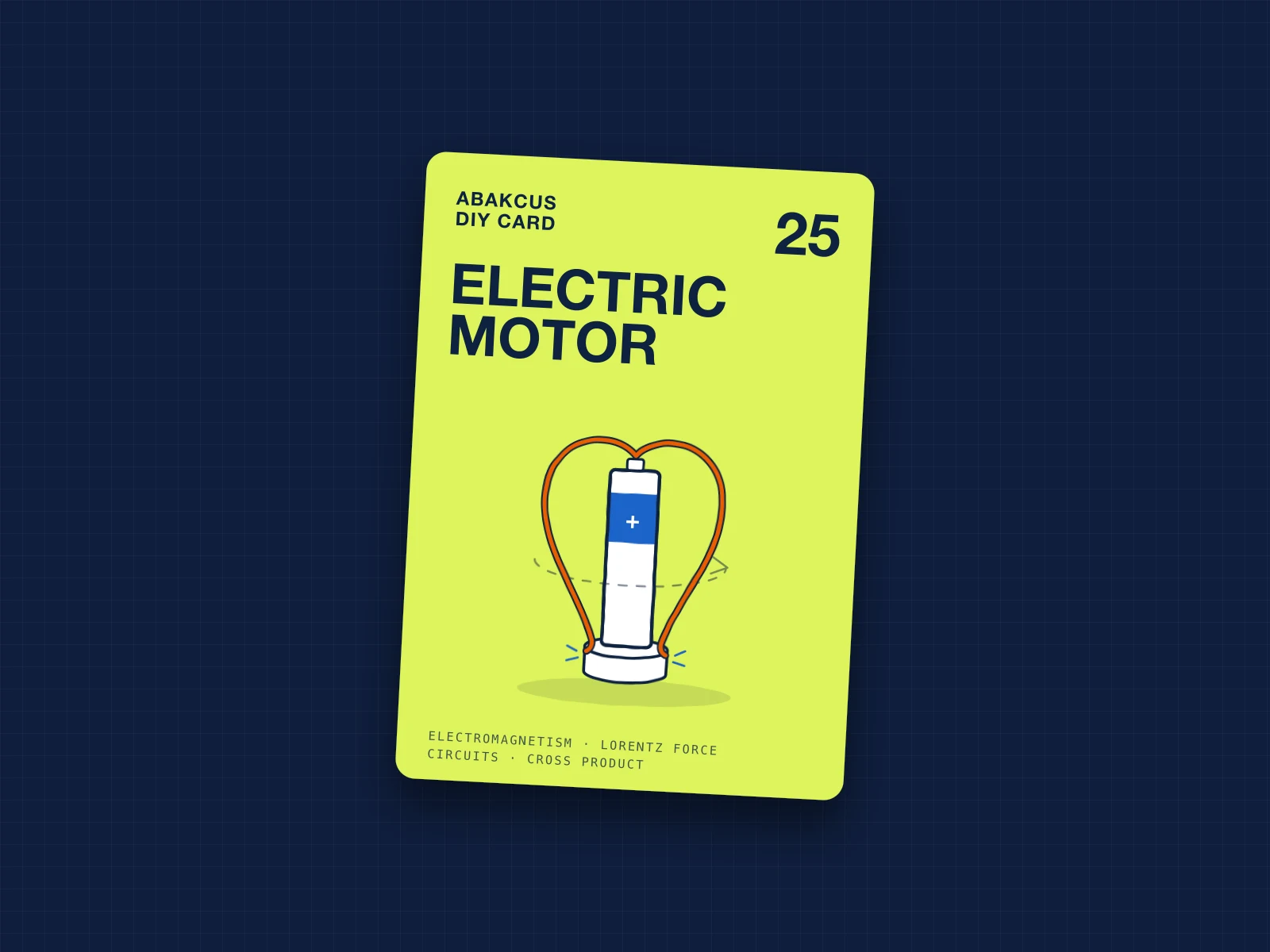
How to Make a Simple Electric Motor (Homopolar Motor)
A battery, a magnet and a bent piece of copper wire: three parts, no coils, and the wire spins on its own. It is the same push that drives every electric motor, found by Faraday in a single afternoon in 1821.
Open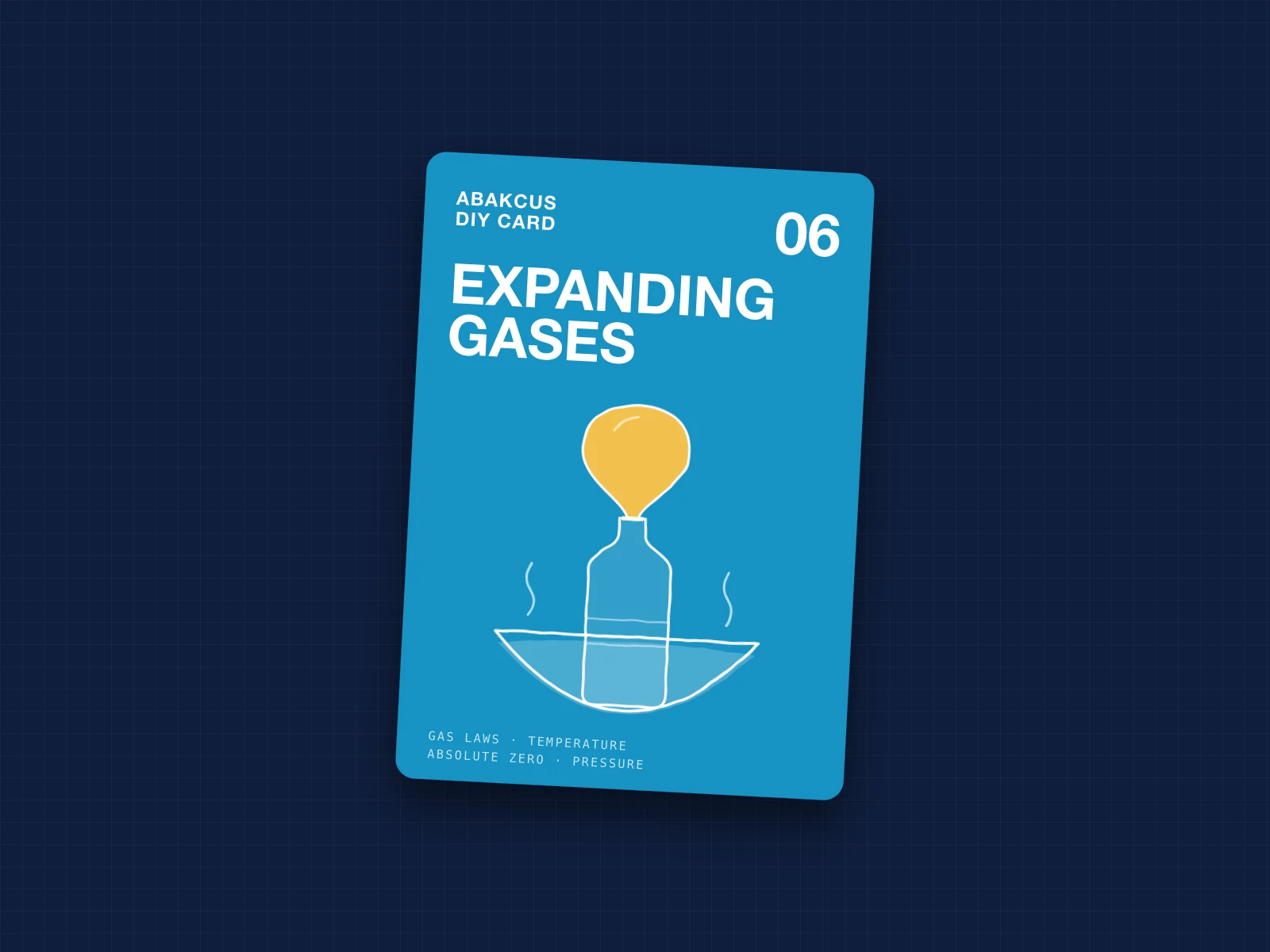
How to Blow Up a Balloon With Hot Water: Charles’s Law
Put a balloon on an empty bottle, stand the bottle in hot water, and the balloon lifts itself up. The air didn’t get any more of itself. It just needs more room, and from that one fact you can find absolute zero.
Open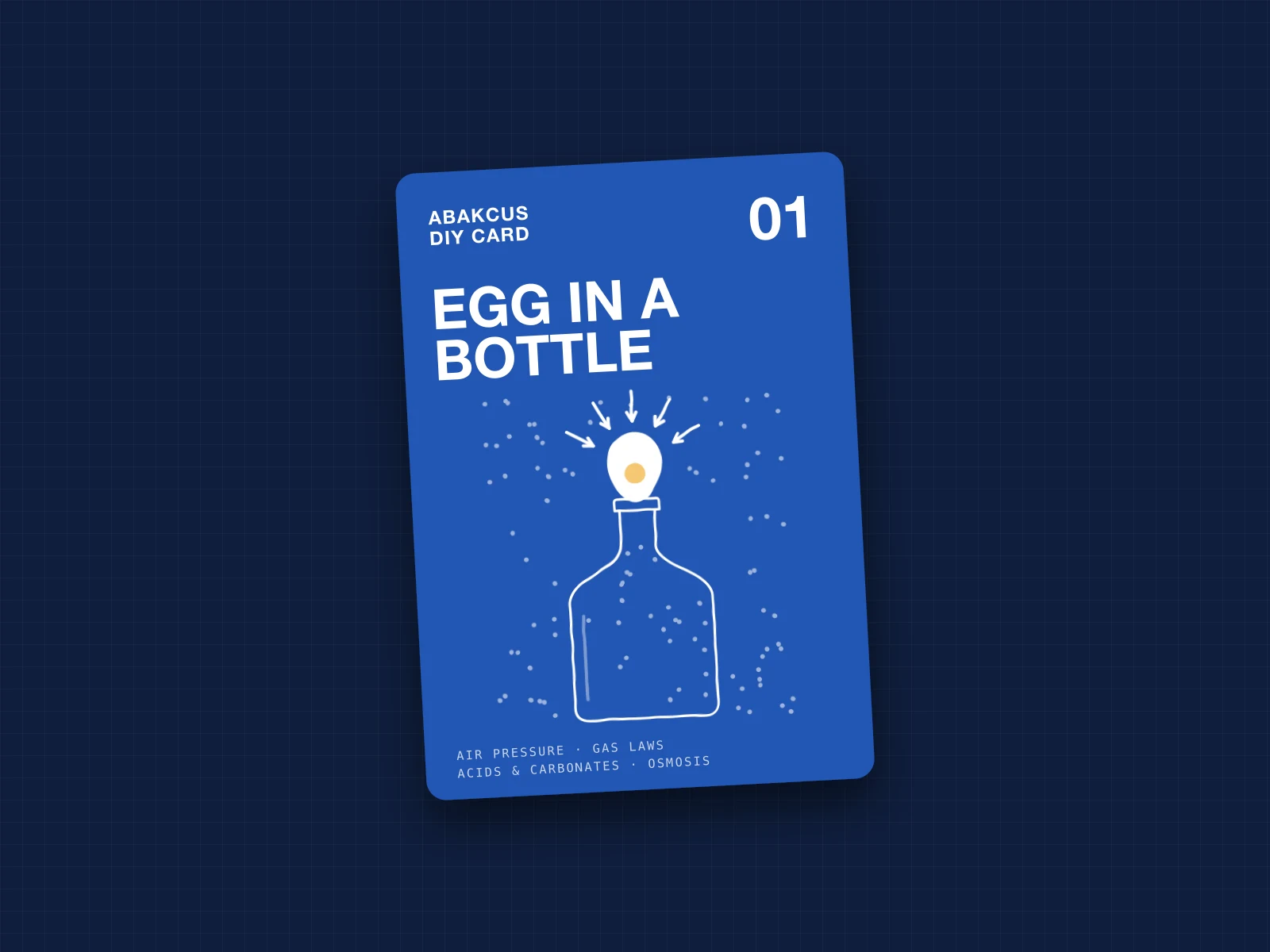
How to Get an Egg Into a Bottle Without Touching It
Two days in vinegar take the shell away, a warm bottle does the rest. The egg goes through a mouth narrower than itself, pushed by ten tonnes of air per square metre.
Open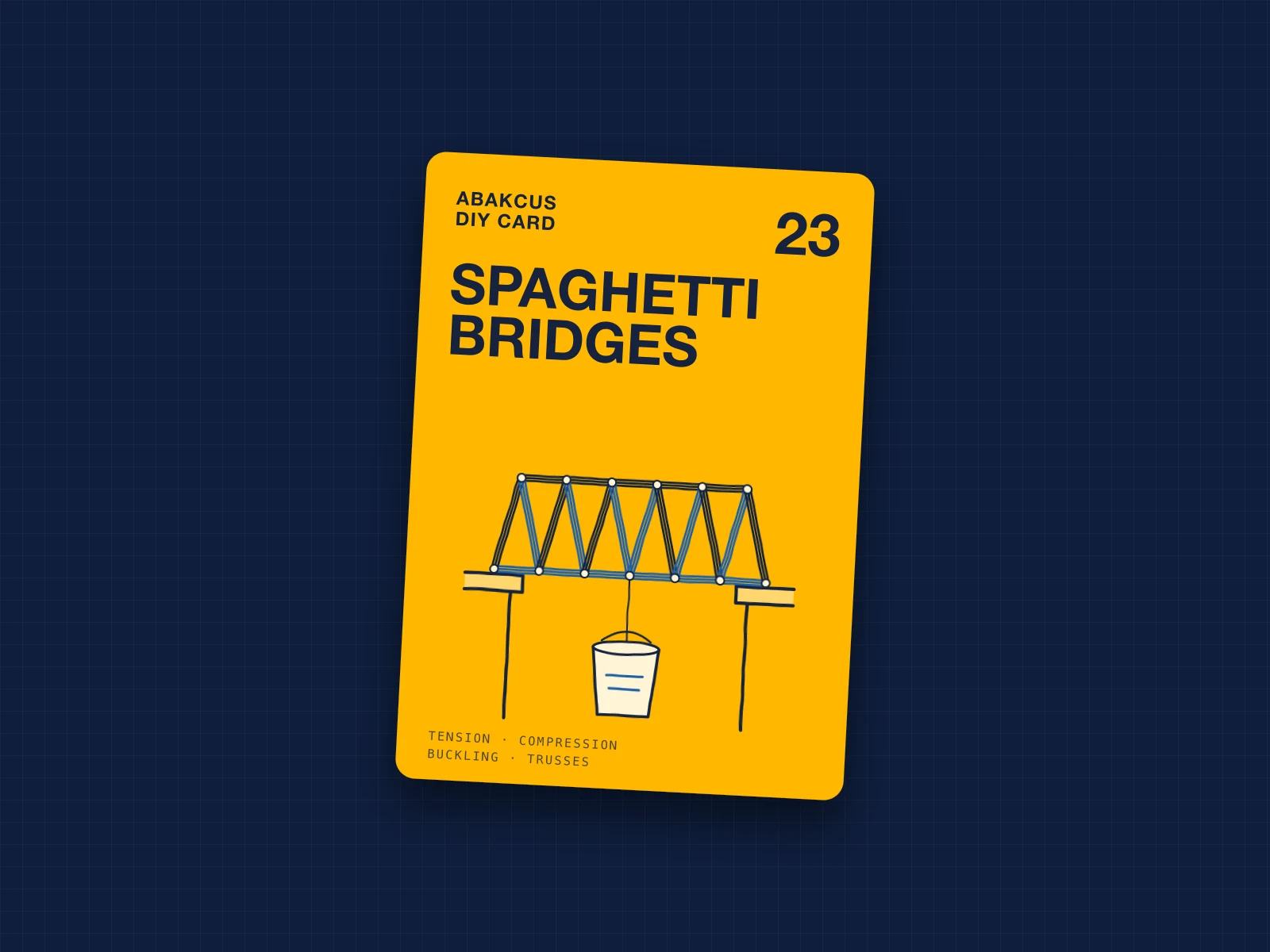
How to Build a Spaghetti Bridge (and Why Pasta Buckles)
One strand of dry spaghetti can hang five kilograms from its end, then buckles under less than two hundred grams pushed along it. A good bridge pulls where pasta is strong and keeps the pushes short.
Open
How to Make a Barometer With a Jar and a Balloon
Stretch a balloon over a jar, glue on a straw, and the straw tips up and down as the air presses harder or softer. It is a real barometer, with one catch every homemade one shares: it is also a surprisingly good thermometer.
Open
How to Make a Ping-Pong Ball Float With a Hair Dryer
Point a hair dryer at the ceiling and a ping-pong ball sits in mid-air, wobbling but never falling out. Most explanations of why are wrong, and the real one is better.
Open