
DIY · Card 61 · Mathematics · Geometry
Thirty squares cut from old boxes, joined only at their corners. Clip them together round rings of three and five and they curl up into a ball a metre across, light enough for the wind to roll.
01The brief
Make a giant ball from flat squares.
30
cardboard squares, joined only at their corners
60
joins, each where two squares, a triangle and a pentagon meet
~1 m
across, from squares 30 cm on a side
A square is about as flat and un-round as a shape can be. Yet join thirty of them corner to corner, leaving triangle and pentagon holes between them, and they bend themselves into a ball as tall as a small child.
This is the windball, a big, kickable model of one of the solids Archimedes described more than two thousand years ago. You need cardboard, a craft knife and sixty fasteners. It sits with the woven paper sphere, which shares its pattern of twelve pentagons, and the geodesic dome.
02Kit
A pile of old boxes and a bag of fasteners.
Tick off what you have
0 of 5 ready
03Method
One rule does all the work: round every hole, either three squares or five.
Step 1 of 8 · Minute 0
You need a stack of large flattened cardboard boxes, a ruler, a pencil, a craft knife and cutting mat for a grown-up, something to punch holes, and 60 fasteners: brass split pins, short nuts and bolts, cable ties or reusable cardboard screws.
The ball won’t close.
Why
A hole somewhere has the wrong number of squares round it.
Fix
Count the squares round every hole: three for a triangle, five for a pentagon. Undo and redo any that are wrong.
It is lumpy.
Why
Squares or holes of different sizes.
Fix
Cut every square from the same template and punch all holes with the same template square.
The joins tear out.
Why
Holes too near the edges, or thin card.
Fix
Move holes 3–4 cm in from the edges, use double-wall cardboard, or add a washer under each fastener.
04The shape
At every join, four things meet: two squares, one triangle hole and one pentagon hole, always in the same order. Shapes like this, made of regular polygons with every corner alike, are called Archimedean solids. This one is the rhombicosidodecahedron, and in a windball its squares are cardboard and its triangles and pentagons are air.
Add squares one by one and watch the ball close:
Squares
30
Pentagon holes
12
Triangle holes
20
Joins
60
Finished: every square touches two pentagons and two triangles, and at every join two squares, one triangle and one pentagon meet. The shape is a rhombicosidodecahedron with its triangles and pentagons left open.
How big will yours be? Choose your square size:
Ball across
107 cm
Distance between joins
24 cm
Cardboard
2.7 m²
Fasteners
60
The ball is about 4.5 times as wide as the distance between two joins on a square. With 30 cm squares and holes 3 cm in from the edges, that is about 107 cm across: big enough to climb into. Double the squares and the ball doubles in width, but needs four times the cardboard.
05The big idea
Flat pieces,
round ball.
No sphere can be made perfectly from flat pieces. But fit enough flat pieces together, at the right angles, and you can get remarkably close. Every corner of the windball sits on the same sphere.
The trick is that the angles round each corner add up to less than a full turn: 90° + 90° + 60° + 108° = 348°. The missing 12° is what bends the surface round. Add up those missing degrees over all 60 corners and you get exactly 720°, two full turns, for every closed polyhedron there is.
06The math
1 · Faces
30 + 20 + 12 = 62
Squares, triangles and pentagons of the full solid.
2 · Euler
60 − 120 + 62 = 2
Corners − edges + faces.
3 · Size
D = a √(11 + 4√5) ≈ 4.47 a
Diameter for an edge a between joins.
Each square has 4 corners, 120 in all, and each join fastens 2 of them: 60 joins. Each pentagon hole is ringed by 5 squares and each triangle by 3: 12 × 5 + 20 × 3 = 120, every square edge accounted for.
With joins 24 cm apart, the ball is 24 × 4.47 ≈ 107 cm across. At each corner, the angles of a square, a triangle, a pentagon and another square add up to 348°; the 12° shortfall, times 60 corners, is 720°, as Descartes’ theorem demands for any closed polyhedron.
07Real life
From ancient geometry books to football design and greenhouses.
Archimedes’ solids
The Greek writer Pappus reports that Archimedes described 13 solids made from two or more kinds of regular polygon, every corner alike. His own book is lost; the windball’s shape is one of the thirteen.
Kepler’s names
In his 1619 book Harmonices Mundi, the astronomer Johannes Kepler rediscovered all thirteen Archimedean solids and gave many of them their names, including the rhombicosidodecahedron, a shortened form of a longer name he first used.
Leonardo’s drawings
For Luca Pacioli’s 1509 book De divina proportione, Leonardo da Vinci drew solids like this one as open skeletons, showing their faces as frames you can see through, very like a windball.
Footballs with fewer panels
Ball makers have played with the same geometry for decades. The 2014 World Cup ball, the Brazuca, was made from just six identical panels, each shaped so they lock together into a sphere.
Domes and greenhouses
The giant greenhouses of the Eden Project in Cornwall, opened in 2001, are built from hexagons and pentagons of steel and plastic, a geodesic cousin of the windball, curving a flat pattern into a dome.
Puzzle cubes
Twisty puzzles come in Archimedean shapes too. The Megaminx, a dodecahedron with 12 pentagonal faces, was a popular cousin of the Rubik’s Cube in the 1980s.
13
Archimedes is said to have found all thirteen solids that can be built from regular polygons of more than one kind, with every corner exactly alike. His book was lost, and for over a thousand years only a brief mention by Pappus of Alexandria survived.
Renaissance artists such as Piero della Francesca and Leonardo da Vinci rediscovered some of them, and in 1619 Johannes Kepler found and named the full set. Your windball is one of those thirteen, built big enough to sit inside.
08Is and isn’t
You can’t make a ball out of squares.
Joined only at their corners, with the right holes between them, 30 flat squares close up into a remarkably round ball.
The holes are mistakes in the build.
They are part of the shape. The triangles and pentagons are the other faces of the rhombicosidodecahedron, left open.
More squares always make a rounder ball.
Only if they are arranged evenly. Thirty squares in this pattern beat many more squares put together carelessly.
A cardboard ball would just crumple.
Each joint is braced by the squares around it. Like a geodesic dome, the curved shape spreads loads around the whole surface.
09Go further
A
A table-top version
Make a mini windball from 30 squares of 6 cm card and split pins. How big does it come out? Check against the size planner.
B
Colour the holes
Stretch coloured tissue across the triangle holes and a different colour across the pentagons. Now it’s a lantern.
C
Count the corners
Check Euler’s formula for the full solid: 60 corners − 120 edges + 62 faces. Does it equal 2?
D
Fewer squares
Try 12 squares joined corner to corner with triangle holes only. What shape do you get?
E
A windball race
On a breezy day, how far does the wind push your ball in a minute? Try with tissue over some holes.
10Questions
Cut 30 cardboard squares, 30 cm a side, and punch a hole near each corner. Join five squares corner to corner round a pentagon-shaped hole, then keep adding squares so that every hole has either three squares round it (a triangle) or five (a pentagon). With all 30 squares and 60 joins in place, the ball closes up about a metre across.
Thirty. Together they leave 12 pentagon holes and 20 triangle holes, joined at 60 corners. That is the pattern of the rhombicosidodecahedron, one of the 13 Archimedean solids, with its triangles and pentagons left open.
A rhombicosidodecahedron: 30 squares, 20 triangles and 12 pentagons, with one triangle, two squares and one pentagon meeting at every corner. In a windball, only the squares are made of card; the triangles and pentagons are the holes.
With holes 3 cm in from the edges, the joins are 24 cm apart along each square. The ball measures about 4.47 times that through the middle, so roughly 1.07 metres across: big enough for a child to sit inside.
Anything that clamps two layers of card through a hole: brass split pins, short nuts and bolts with washers, cable ties, or reusable plastic cardboard screws sold for building with boxes. You need 60.
Safety · A grown-up should do all the cutting with the craft knife. Split pins and bolt ends can be sharp: bend or cover them on the outside of the ball.
All DIY cards →Keep wandering
A few more pieces in the same spirit — math, design, and slow attention.
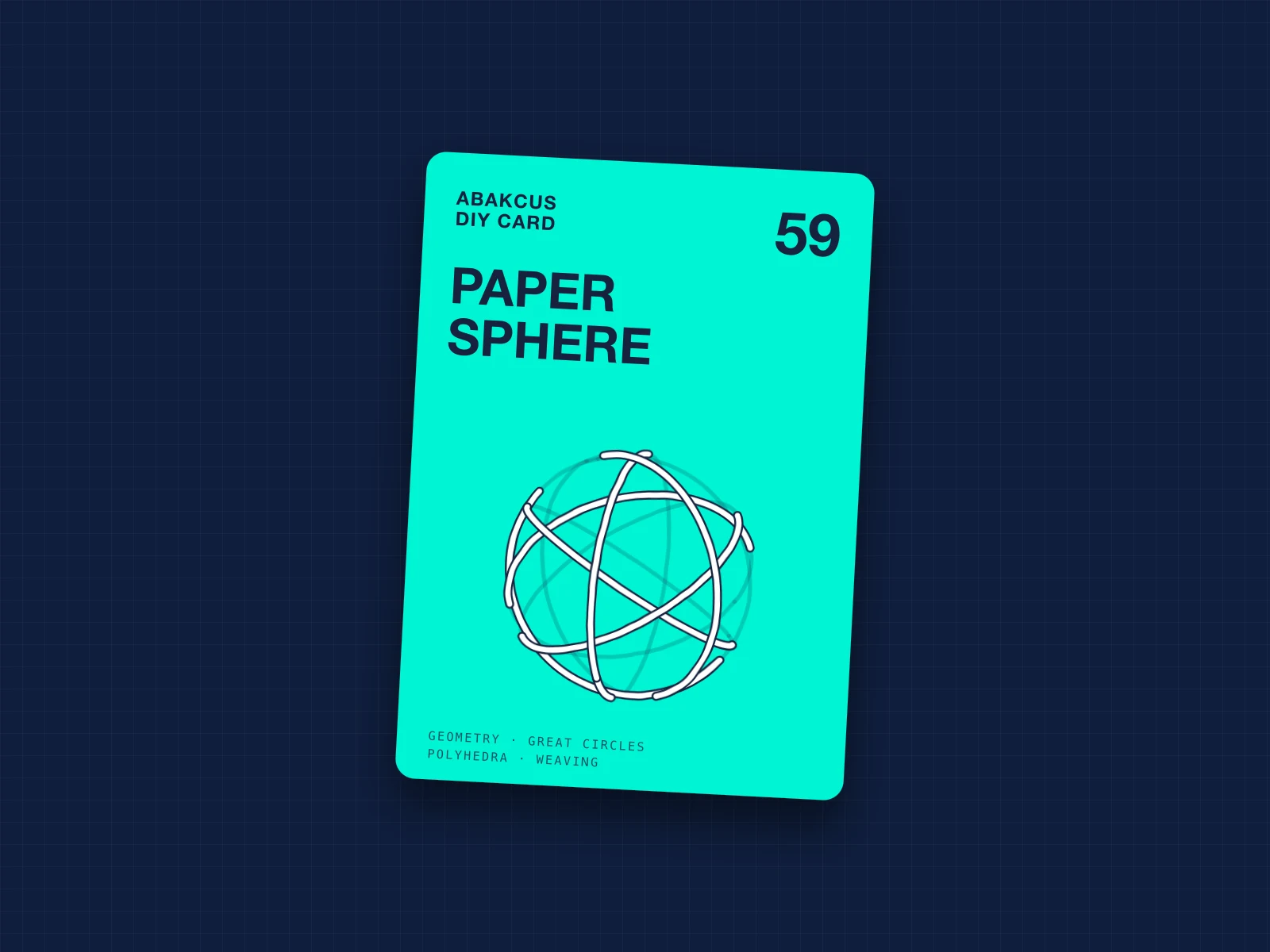
How to Make a Paper Sphere From Six Woven Strips
Six strips of card, ten pencil marks on each and some patience. Weave them together and they close into a springy ball with 12 pentagon holes and 20 triangles.
Open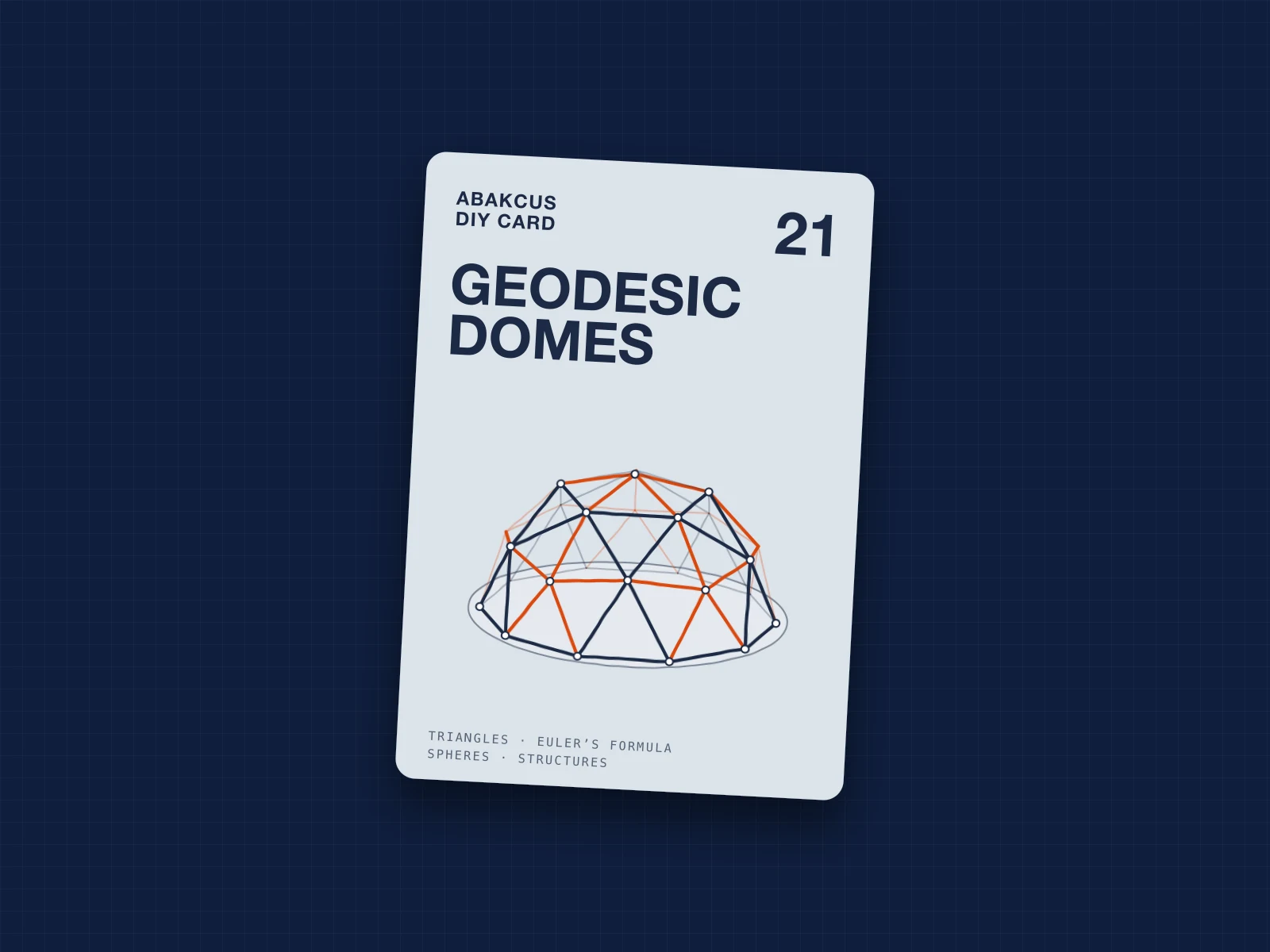
How to Build a Geodesic Dome From Newspaper
Sixty-five rolled-up newspapers, two lengths, a lot of tape: a dome two metres across that you can sit inside. Triangles can’t change shape, and that one fact holds the whole thing up.
Open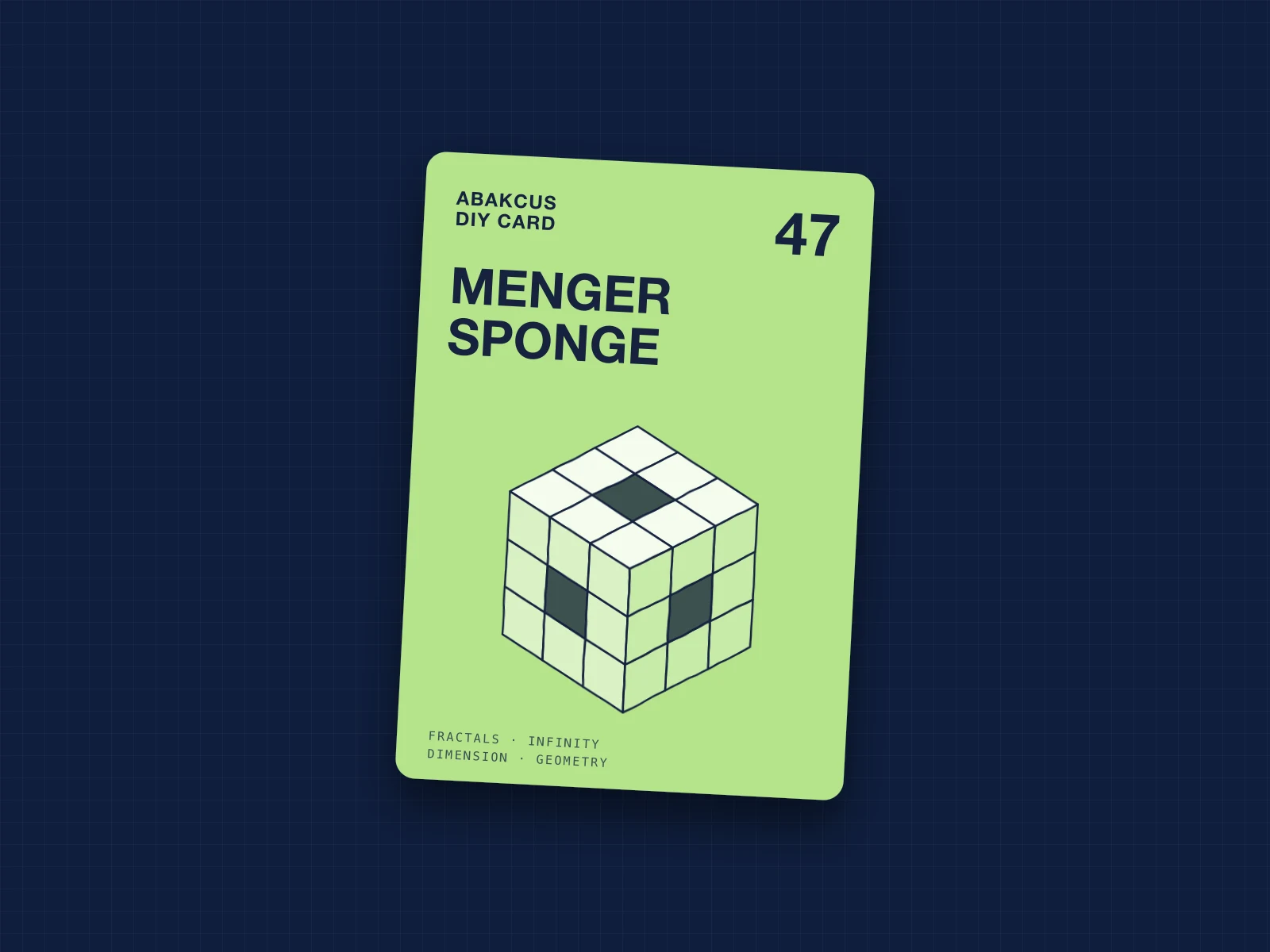
How to Build a Level-One Menger Sponge From Business Cards
A hundred and twenty business cards, folded into twenty cubes and locked together without glue. The first step of a shape with no volume and an infinite surface.
Open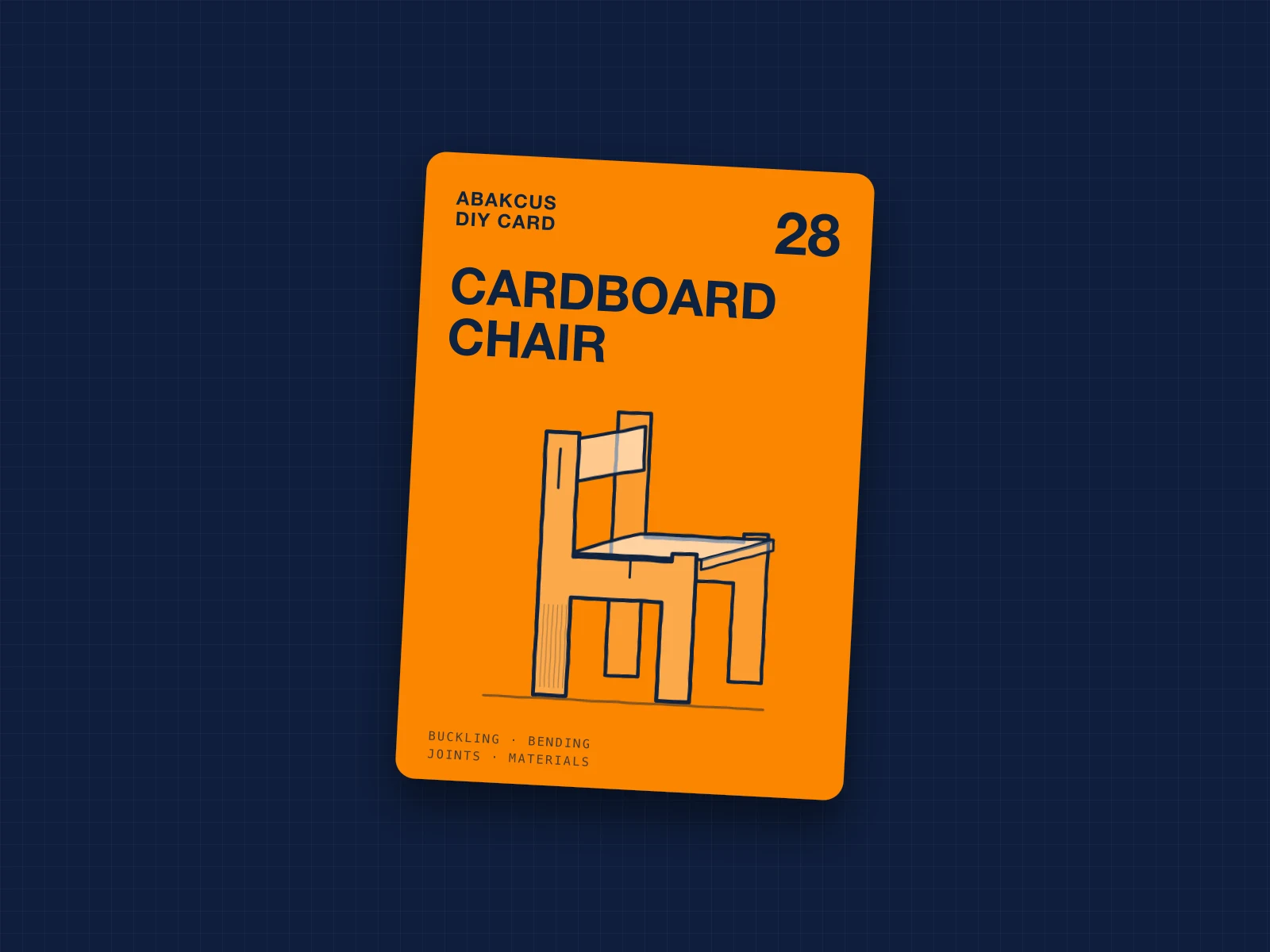
How to Make a Cardboard Chair That Holds Your Weight
Nothing but cardboard: no glue, no tape, no screws. Just slots, folds and the flutes the right way up, and a chair that holds a grown-up.
Open
How to Make a Box Kite That Flies Without a Tail
Eight dowels, eight bits of tube and two bands of sail. Snap them into two open boxes and you have the kite that lifted a man off a beach in 1894.
Open
How to Make the Missing Square Puzzle and Find the Trick
Four pieces of card make a triangle. Swap two of them round and the same pieces make the same triangle, with a square missing. Where did it go?
Open