
DIY · Card 21 · Engineering · Geometry
Sixty-five tubes of rolled-up newspaper, two lengths, and a lot of tape. At the end of the afternoon, a dome big enough to sit inside, held up by nothing but triangles.
01The brief
Build a dome two metres across from newspaper and tape, strong enough to stand on its own.
65
tubes: 35 long and 30 short, the only two lengths you need
40
triangles, and not a single square, in the finished dome
0.618
the long tube’s length as a share of the radius: the golden ratio, upside down
A sheet of newspaper is floppy. Roll it into a tube and it is surprisingly stiff along its length. Tape a few tubes into a square and it folds flat at the first push. Tape three into a triangle and it won’t budge. That is the whole secret of the geodesic dome: a curved shell built entirely of triangles, so that no part of it can change shape.
The geometry does the rest. Start with an icosahedron, the twenty-sided die, split its faces into smaller triangles, and push every corner out onto a sphere. With only two strut lengths you get a dome that looks curved, encloses a lot of space and weighs almost nothing. Unlike the earlier cards, this one is a build, not a quick experiment, so recruit some help.
02Kit
Newspaper, tape, and a long stick to roll round. The only measuring is two lengths, so get those right.
Tick off what you have
0 of 5 ready
03Method
Roll, cut, make the stars, then build from the ground up: base ring, five stars, the joining tubes and the crown.
Step 1 of 8 · Hour 0
Lay two sheets of newspaper on top of each other. Starting at one corner, roll them tightly round a broom handle towards the opposite corner, slide the handle out and tape the end. Make 65.
The dome won’t close at the top.
Why
A long and a short tube have been swapped somewhere, or the lengths aren’t accurate.
Fix
Check every star is all short tubes and every other tube is long. Re-cut any that are more than a centimetre out.
The joints keep sliding apart.
Why
Round tube ends give the tape nothing to grip.
Fix
Flatten the ends, overlap them, and wrap tape all the way round the joint, not just across it.
It sags or bulges sideways.
Why
Floppy tubes, or a joint that isn’t closed into triangles.
Fix
Roll tighter tubes from more sheets, and look for any gap with four or more sides: it needs another tube.
04Engineering
Taped joints are hinges: they hold the tubes together but don’t stop them turning. With hinged corners, a square can lean over into a diamond while all four sides keep their length. Nothing in the square resists it.
A triangle is different. Fix the lengths of its three sides and its angles are fixed too; there is only one triangle with those sides. To change its shape you would have to squash or stretch a tube, and a tube pushed or pulled along its length is very strong. So every load on a triangulated frame ends up as tubes being pushed or pulled end to end, never bent.
Push sideways on the three frames below. The square folds, the triangle doesn’t, and one diagonal brace rescues the square by turning it into two triangles:
With hinged corners, a square has nothing to stop it folding: all four sides keep their length while the angles change. A triangle’s three side lengths fix its angles, so it can only give way by crushing or stretching a tube. One diagonal turns the square into two triangles.
05The big idea
Triangles
don’t fold.
Look at any crane, electricity pylon, roof truss or bicycle frame and you will find triangles. Engineers use them because they turn every load into simple pushes and pulls along straight members, which is the most efficient way to use material.
The geodesic dome takes that idea as far as it goes: a curved surface made of nothing but triangles, with no beams, no columns and no inside supports. The space inside is completely open, and the frame is about as light as a building can be.
06The math
1 · Euler’s formula
V − E + F = 2
For any closed shape without holes made of flat faces: corners minus edges plus faces is always 2.
2 · Geodesic spheres
V = 10n² + 2 · E = 30n² · F = 20n²
For a frequency-n sphere built from an icosahedron, the hubs, struts and triangles grow as n².
3 · Strut lengths
L = R × 0.61803 · R × 0.54653
Each strut is a chord of the sphere: radius times a chord factor. For 2V the long one is 1/φ, the golden ratio upside down.
A 2V sphere has 10 × 4 + 2 = 42 hubs, 30 × 4 = 120 struts and 20 × 4 = 80 triangles, and 42 − 120 + 80 = 2. Cut it at the equator and you get the dome: 26 hubs, 65 struts and 40 triangles. That gives 26 − 65 + 40 = 1, one short because the open base is a missing face.
The long strut’s factor, 0.61803, is exactly 1/φ, where φ = (1 + √5)/2 is the golden ratio. That’s no accident: an icosahedron’s twelve corners sit on three golden rectangles at right angles to each other. For a dome of radius 1 m you need 35 × 61.8 cm and 30 × 54.7 cm, about 38 m of tube in all. Turn the dome, change its size and try other frequencies:
| Strut | Length | How many |
|---|---|---|
| A | 61.8 cm | 35 |
| B | 54.6 cm | 30 |
Hubs V
26
Struts E
65
Triangles F
40
V − E + F
1
About 38 m of tube in all. V − E + F is 1, not 2, because the open base is one face short of a closed shape.
07Real life
From world’s fairs to playgrounds, and from molecules to viruses, the same pattern of triangles on a sphere keeps reappearing.
The Montreal Biosphere
Buckminster Fuller designed the United States pavilion for Expo 67 in Montreal as a vast geodesic sphere of steel struts. It still stands on an island in the St Lawrence River, now a museum about the environment.
The Eden Project
In Cornwall, giant greenhouses called biomes are built from interlocking geodesic domes clad in transparent panels, sheltering a rainforest. Domes are ideal for greenhouses: lots of space and light inside, very little frame.
Radar domes
Radar antennas in harsh places sit inside domes called radomes. Geodesic frames were used for them from the 1950s: light, strong against wind and snow, and quick to put up.
Buckyballs
In 1985 chemists discovered a molecule of 60 carbon atoms joined in a hollow ball of pentagons and hexagons, and named it buckminsterfullerene after the dome builder. Its discoverers shared the 1996 Nobel Prize in Chemistry.
Viruses
Many viruses wrap their genes in a shell built from identical protein pieces arranged with the symmetry of an icosahedron, the same starting shape as a geodesic dome. It is a cheap way to build a strong, closed shell from many copies of one part.
Climbing frames
The dome-shaped climbing frames in playgrounds are geodesic domes. All triangles, they stay rigid with dozens of children hanging off them, and every bar is short enough to grip.
1926
Walther Bauersfeld, chief engineer at the Carl Zeiss optical works in Jena, Germany, needed a large, perfectly curved ceiling onto which his new planetarium projector could throw the night sky. His answer was a lightweight network of iron struts arranged in triangles on a sphere, covered with a thin shell of concrete. The Zeiss Planetarium in Jena opened to the public in 1926 and is still in use.
Two decades later, the American designer Buckminster Fuller worked out the same geometry independently, gave it the name “geodesic”, and received a US patent in 1954. Thousands of his domes followed. Like the balloon kebab, it is a lesson in spreading stress so no single point takes it all.
08Is and isn’t
Buckminster Fuller invented the geodesic dome.
Walther Bauersfeld built one in Jena, Germany, in the 1920s, decades before Fuller. Fuller arrived at the idea independently, named it, patented it in 1954 and made it famous.
It’s strong because it’s round.
A round shape helps spread loads, but a dome of squares would fold up. The strength comes from triangles: each one locks its own shape, and together they lock the whole shell.
A geodesic dome is a perfect sphere.
Every face is flat and every strut straight. Only the corners lie exactly on the sphere. Higher frequencies use more, smaller triangles and get closer to round.
More struts always means a stronger dome.
More struts make it rounder and spread loads more finely, but also add joints, and in a paper or tape dome the joints are the weak points. A well-made 2V dome beats a sloppy 4V one.
09Go further
A
Table-top dome
Build the same 2V dome from drinking straws joined with pipe cleaners, or cocktail sticks and soft sweets. Use the chord factors to set the lengths.
B
Load test
Build a small dome and stack books on a board on top, one at a time. How many before it gives way, and which strut fails first?
C
Squares against triangles
Make a cube and a tetrahedron from straws and pipe cleaners. Push on the corners of each. Then add one diagonal to each face of the cube.
D
Count it
On any closed shape you can find, a die, a football, a box, count corners, edges and faces. Is V − E + F always 2?
E
Go to 3V
Use the viewer above to get the three strut lengths and counts for a 3V sphere. Can you build one from straws?
10Questions
Roll 65 tubes from double sheets of newspaper. For a dome 2 m across, cut 35 to 62 cm and 30 to 55 cm. Tape the short ones into six five-pointed stars, lay a base ring of ten long tubes, stand five stars round it, join everything into triangles with the long tubes, and crown it with the last star.
They are made entirely of triangles, and a triangle can’t change shape without one of its sides changing length. Loads spread through the whole network of struts, each one pushed or pulled along its length, which is the way thin struts are strongest.
The V stands for frequency: how many times each edge of the starting icosahedron is divided. A 2V dome splits each edge in two, giving two strut lengths and 65 struts for a half sphere. Higher frequencies are rounder but need more struts and more different lengths.
The first was built by Walther Bauersfeld, an engineer at the Carl Zeiss company, for a planetarium in Jena, Germany, which opened in 1926. Buckminster Fuller independently developed, named and popularised the idea in the United States, and patented it in 1954.
Multiply the dome’s radius by the chord factors. For a 2V dome they are 0.61803 for the long struts and 0.54653 for the short ones, so a dome of radius 1 m needs struts of about 61.8 cm and 54.7 cm.
Safety · A newspaper dome is a shelter for sitting in, not a climbing frame: don’t climb on it or hang from it. Build it indoors or out of the wind, keep it away from candles and heaters, and take care with scissors.
All DIY cards →Keep wandering
A few more pieces in the same spirit — math, design, and slow attention.
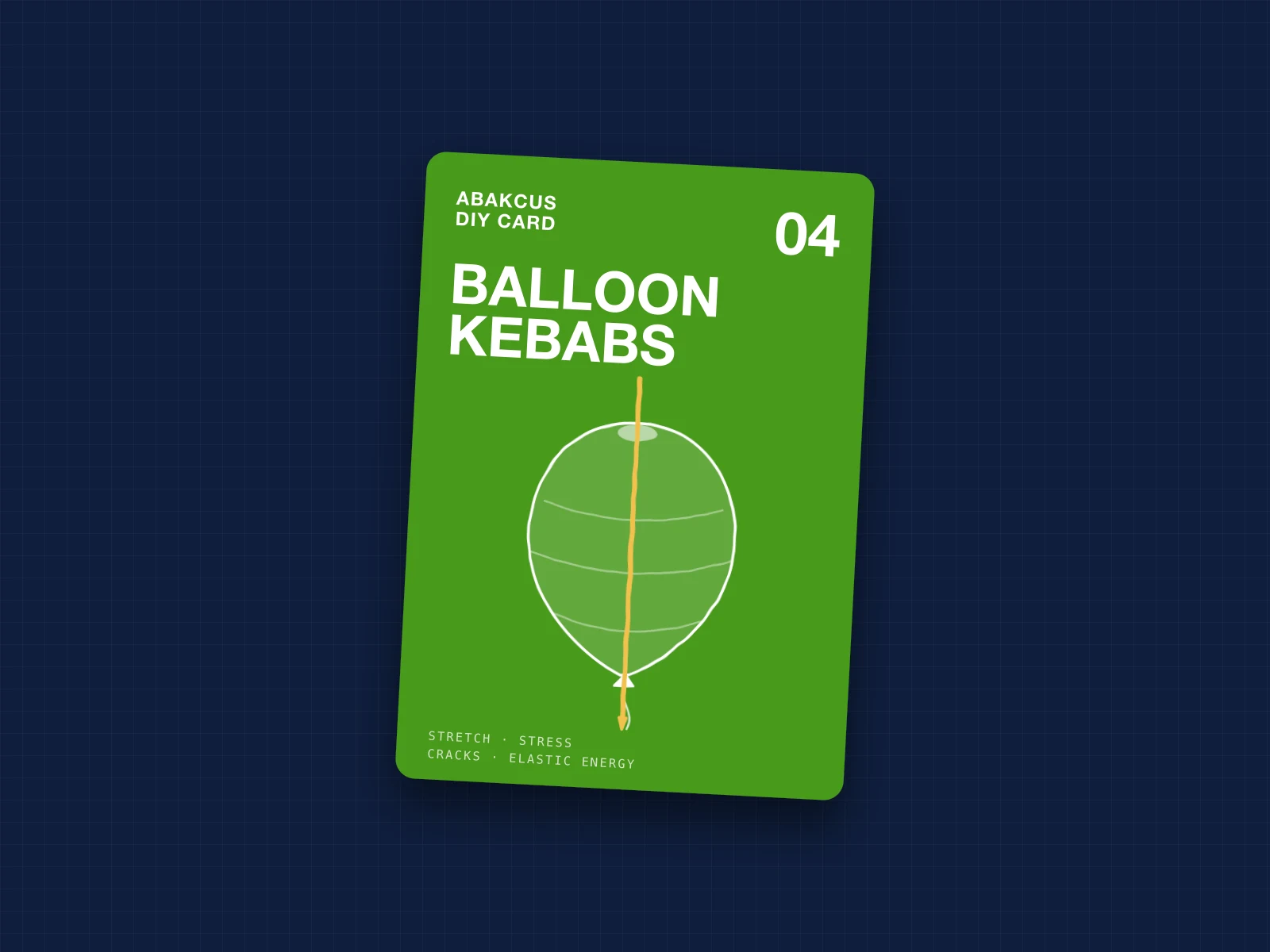
How to Push a Skewer Through a Balloon Without Popping It
A wooden skewer goes in at the top of a balloon and out beside the knot, and the balloon just sits there. The trick is knowing where the rubber is least stretched, and why stretch decides everything.
Open
How to Float a Paper Clip on Water: Surface Tension
Steel is nearly eight times denser than water, and a paper clip still lies on top of it if you put it down gently. The surface bends into a dimple and holds it, like a trampoline, until a drop of soap breaks the spell.
Open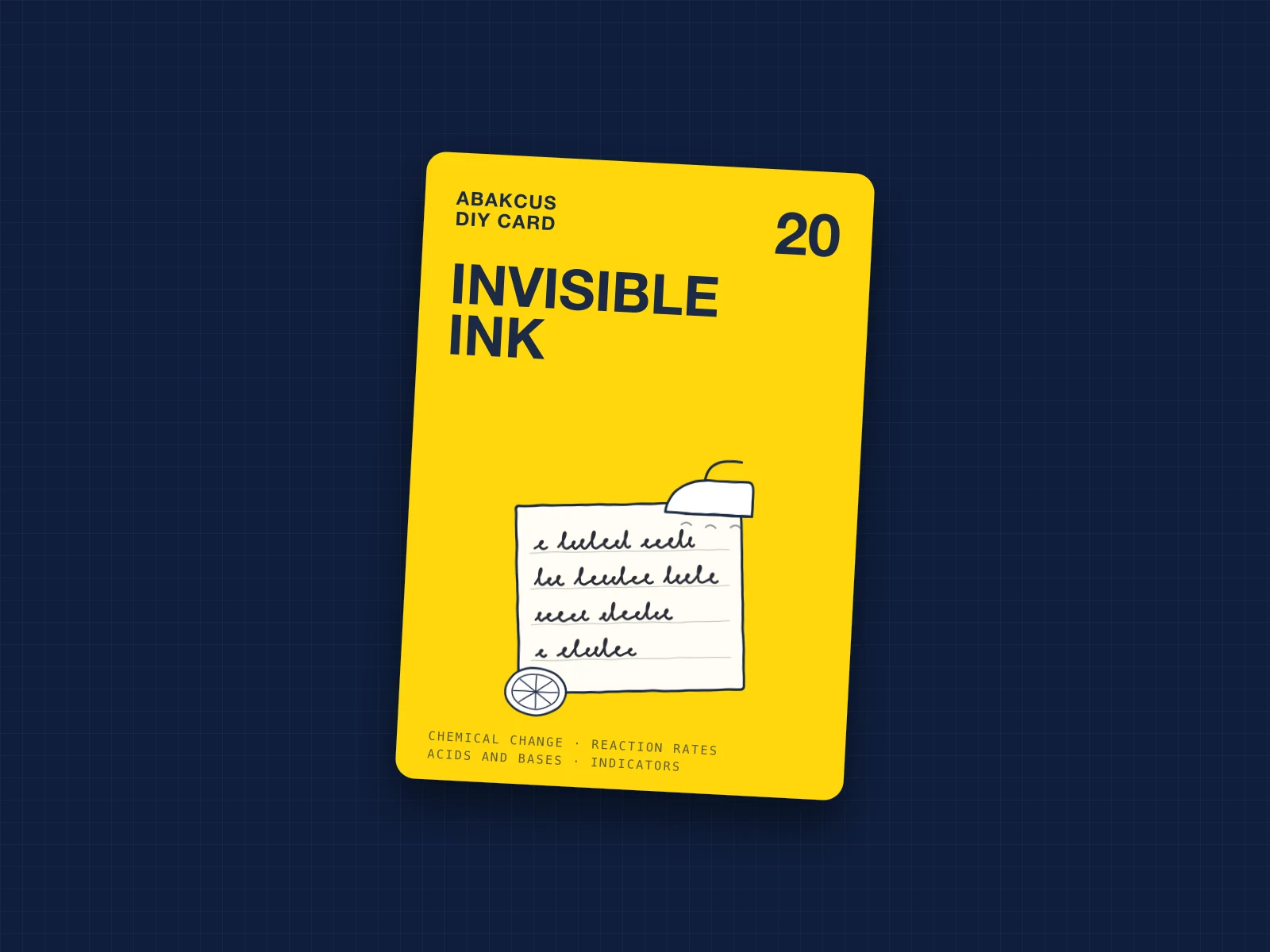
How to Make Invisible Ink With Lemon Juice, and Reveal It
Write with lemon juice, let it dry, and the page looks blank. Warm it and the message darkens into view, because the juice scorches long before the paper does. Spies used the same idea for centuries.
Open
How to Make a Density Tower: Stacking Liquids in a Glass
Honey, washing-up liquid, water, oil and rubbing alcohol, poured one by one into a glass, settle into five sharp layers. Which goes where is decided by one number, and one of them only stays put thanks to the oil.
Open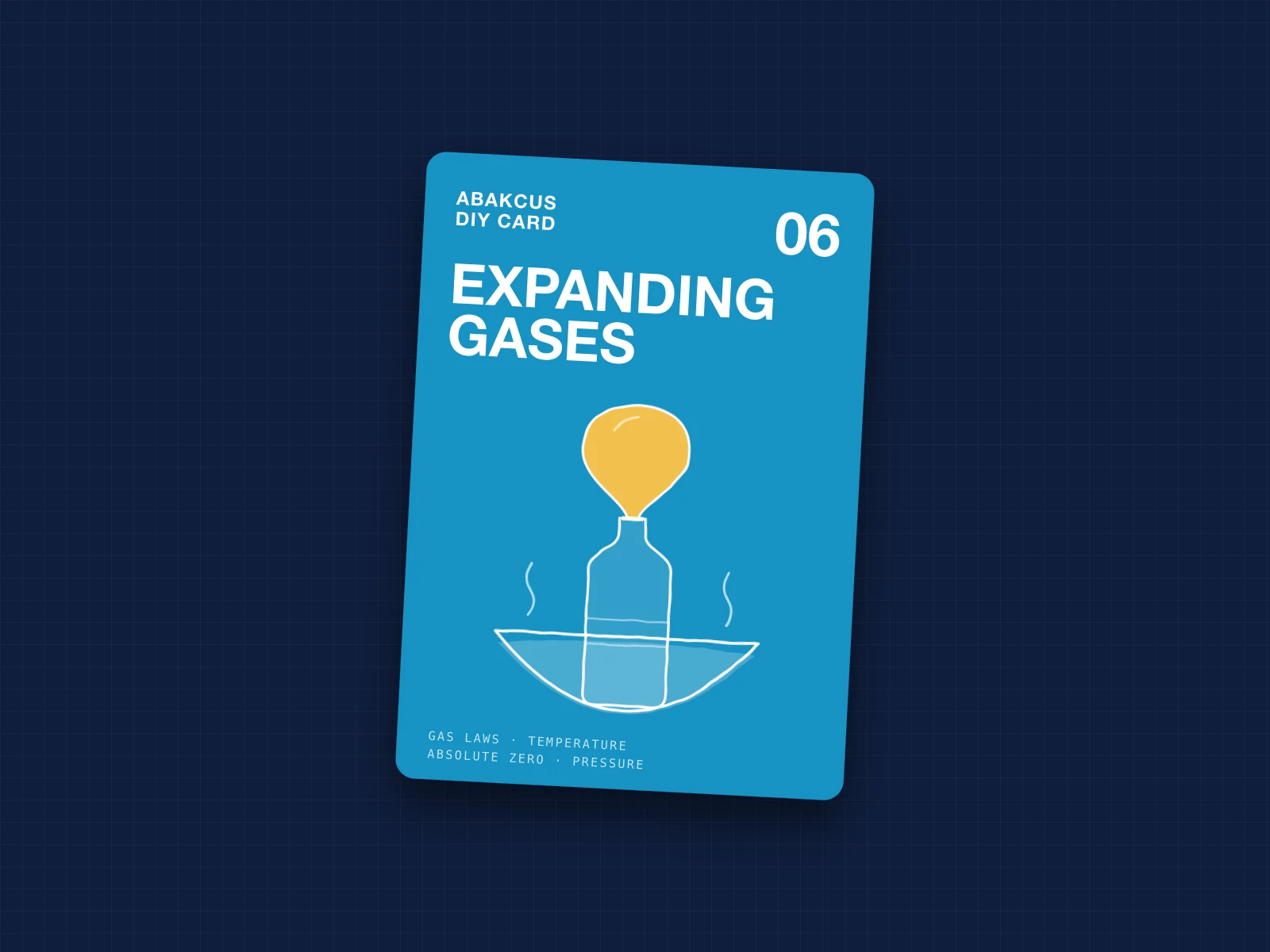
How to Blow Up a Balloon With Hot Water: Charles’s Law
Put a balloon on an empty bottle, stand the bottle in hot water, and the balloon lifts itself up. The air didn’t get any more of itself. It just needs more room, and from that one fact you can find absolute zero.
Open
How to Get an Egg Into a Bottle Without Touching It
Two days in vinegar take the shell away, a warm bottle does the rest. The egg goes through a mouth narrower than itself, pushed by ten tonnes of air per square metre.
Open