
DIY · Card 12 · Physics · Waves
A microwave, a bar of chocolate and a ruler. Twenty seconds of heating, one measurement, one multiplication, and you have the fastest speed in the universe.
01The brief
Measure the speed of light in your kitchen, with a microwave oven, a bar of chocolate and a ruler.
6.1 cm
the gap between melted spots in a typical microwave oven
2.45 GHz
the number on the label: waves per second inside the oven
3 × 10⁸
metres per second: what you get when you multiply them, near enough
The speed of light is the most famous number in physics, and it sounds like something you could only measure with lasers and mirrors miles apart. It took astronomers centuries to pin it down. You can do it before lunch with a bar of chocolate.
The trick is that a microwave oven is full of light, light with a wavelength you can measure with a ruler. Stop the turntable and the oven melts chocolate in a row of spots that betray how long its waves are. The frequency is printed on the back. Multiply the two and the answer comes out within a few percent of 300,000 kilometres a second.
02Kit
A microwave you can stop from turning, something that melts in spots, and a ruler marked in millimetres.
Tick off what you have
0 of 4 ready
03Method
Read a label, stop a turntable, melt, measure, multiply. The hardest part is not eating the chocolate first.
Step 1 of 8 · Minute 0
Find the sticker on the back or inside the door of your microwave and look for its frequency. Almost every home oven says 2450 MHz.
The whole bar melted.
Why
It was heated too long, so the warmth spread from the hot spots across everything.
Fix
Use a fresh bar and stop at 10 to 15 seconds, the moment the first spot goes glossy.
There’s only one melted spot.
Why
The bar is too small, or it lies across the pattern rather than along it.
Fix
Use a bigger bar, or turn it 90 degrees and try again. Marshmallows covering the whole plate show the pattern in two directions.
The answer is way off.
Why
The two spots weren’t neighbours, or the gap was measured edge to edge.
Fix
Measure centre to centre between adjacent spots. Spots two gaps apart give double the answer.
04Physics
Microwaves are light. Not the kind your eyes can see, but the same thing: waves of electric and magnetic field, travelling at the same speed as sunlight. They differ from visible light only in their length. The oven’s waves are about 12 centimetres from crest to crest.
Inside the oven those waves bounce back and forth between the metal walls. Where a wave meets its own reflection, the two add up in some places and cancel in others, and the pattern stops moving along. It just pulses in place: a standing wave. At the nodes the field barely changes; at the crests in between, it surges back and forth 2.45 billion times a second, jiggling the water and fat molecules in whatever sits there.
Those crests are where the chocolate melts first, and neighbouring crests are exactly half a wavelength apart. So the gap you measure with a ruler is half of the oven’s wavelength. Try measuring one:
Your speed of light: 2.84 × 10⁸ m/s
c = 2 × 5.8 cm × 2.450 GHz = 284,200 km/s. That is 5.2 % below the true 299,792 km/s. Slide your gap onto the second spot to land on it.
05The big idea
Every wave is
a ruler and a clock.
A wave carries two numbers with it: how long each wave is, and how many pass by every second. Multiply them and you get how fast it travels. It is true for ripples on a pond, sound in a hall and light from a star.
For light, the speed is the same for every wavelength, from radio to X-rays. So if you can measure the length of any kind of light, and you know how often it wiggles, you have measured the speed of all of it. The chocolate is a ruler for a wave you can’t see; the label on the oven is its clock.
06The math
1 · The wave equation
c = λ · f
Speed equals wavelength times frequency. For light, the speed is c.
2 · Standing waves
d = λ / 2
In a standing wave, the strongest spots are half a wavelength apart. So the gap d between melted spots gives λ = 2d.
3 · Light’s travel time
t = distance / c
How long light takes to cross a distance. At 300,000 km/s, a lot of distance per second.
Say the gap between spots measures 6.1 cm. The wavelength is λ = 2 × 6.1 = 12.2 cm = 0.122 m, and the frequency on the label is 2.45 × 10⁹ per second. Then c = 0.122 × 2.45 × 10⁹ ≈ 2.99 × 10⁸ m/s, which is 299,000 kilometres a second. The true value is 299,792,458 metres a second exactly; since 1983 the metre itself has been defined from it.
The weak point is the ruler. A gap of 6.1 cm read as 6.0 cm puts you 1.6 % low. Measure from the first spot to the fourth instead, about 18 cm, and divide by three: the same one-millimetre slip now costs barely half a percent. Good experimenters spread their errors thin.
Three hundred thousand kilometres a second is hard to picture, so turn it around and ask how long light takes to get places. It is the third formula, and the answers run from a billionth of a second to years:
To the Moon · 384,400 km
Light takes 1.28 seconds
A laser fired at the reflectors Apollo astronauts left on the Moon comes back about 2.5 seconds later. Timing that round trip measures the distance to the Moon to within millimetres.
each step is a much bigger jump than the last
Light’s speed is the c in the most famous equation of all; the story of when Einstein first wrote E = mc² is its own adventure. And for a feel of the distances that light-times describe, nothing beats the Eames film Powers of Ten.
07Real life
The microwave in your kitchen is one corner of a technology that finds planes, guides phones and measures the Moon.
Why the turntable turns
Every microwave oven has the same hot spots you just found. The turntable carries food through them, so no part sits in a dead spot for long. Ovens without one stir the waves instead, with a slowly turning metal fan hidden in the roof.
Wi-Fi that drops when lunch is heating
Ordinary Wi-Fi and Bluetooth share the same band of frequencies as microwave ovens, around 2.4 GHz. A little of the oven’s energy leaks out, and a nearby connection can stutter while the oven runs.
Radar
Microwave ovens grew out of wartime radar, which fires pulses of microwaves and times how long the echo takes to come back. Distance is just half the round-trip time multiplied by the speed of light. Weather radar and speed cameras still work this way.
GPS
Your phone finds itself by timing radio signals from satellites. Light covers about 300 metres in a millionth of a second, so a clock that was off by just one microsecond would put you on the wrong street.
Laser to the Moon
Apollo astronauts left mirrors on the Moon. Observatories still fire lasers at them and time the light’s return, about two and a half seconds later, measuring the distance to the Moon to within millimetres.
Guitar harmonics
A plucked guitar string vibrates in standing waves too, with still points called nodes. Touch the string lightly at its exact middle and pluck: you silence the main wave and hear the one with a node there, an octave higher.
1945
Around 1945, Percy Spencer, an engineer at the American firm Raytheon, was working near a magnetron, the tube that generates radar’s microwaves, when he noticed that a chocolate bar in his pocket had melted. He tried popcorn next, which popped. Raytheon filed a patent that year, and in 1947 sold the first microwave oven, the Radarange: about as tall as a person and weighing over 300 kilograms.
The speed of light itself was first estimated in 1676, when Ole Rømer noticed that Jupiter’s moon Io appeared late in its orbit when Jupiter was far from Earth: the light was taking longer to reach us. Three and a half centuries later, a bar of chocolate does the same job on a kitchen counter.
08Is and isn’t
Microwave ovens run at the frequency water resonates at.
Water soaks up microwaves across a broad range of frequencies, with no sharp resonance at 2.45 GHz. That frequency was picked because it is set aside for household and industrial use, and because it reaches a few centimetres into food.
Microwaves cook food from the inside out.
They heat the outer few centimetres. Anything deeper warms up by heat spreading inward, which is why big dishes need stirring or a rest.
Microwaves aren’t light.
They are light our eyes can’t see. Radio, microwaves, the colours of the rainbow and X-rays are the same kind of wave, all moving at the same speed, with different wavelengths.
Microwaved food becomes radioactive.
Microwaves just make molecules jiggle, which is heat. When the oven switches off, nothing is left behind in the food but the warmth.
09Go further
A
Marshmallow map
Cover a plate with mini marshmallows in a single layer and heat it without the turntable. The puffed ones draw a map of the oven’s hot spots in two dimensions.
B
Measure across three gaps
Measure from the first melted spot to the fourth and divide by three. A one-millimetre slip now costs a third as much.
C
Cheese on toast
Grated cheese spread on bread melts in the same pattern and is easier to read. Then eat the experiment.
D
Try two ovens
If a friend’s oven has a different label frequency, try theirs. The spot spacing should change in the opposite direction to the frequency.
E
Count the nanosecond
Cut a piece of string 30 cm long. That is how far light travels in a billionth of a second. Grace Hopper handed out wires this length to explain why computers can’t be faster than their size allows.
10Questions
Remove the turntable, heat a flat bar of chocolate for about 20 seconds, and measure the distance between two neighbouring melted spots. Double it to get the wavelength, then multiply by the oven’s frequency, usually 2450 MHz, printed on its label. The answer comes out close to 300,000,000 metres per second.
Microwaves bounce between the oven’s metal walls and form a standing wave, with fixed places where the energy is strongest and places where it is almost zero. The chocolate melts first at the strong places, which are half a wavelength apart.
Yes. Microwaves, radio waves, visible light and X-rays are all electromagnetic waves travelling at the same speed. They differ only in wavelength: a microwave oven’s waves are about 12 cm long, visible light less than a thousandth of a millimetre.
No, that is a common myth. Water absorbs microwaves over a wide range of frequencies. 2.45 GHz was chosen because it sits in a band reserved for industrial and household use, and because waves at that frequency reach a few centimetres into food instead of only heating the surface.
Usually within a few percent of the true value, 299,792,458 m/s. The main error is measuring the gap: being off by one millimetre on a six-centimetre gap shifts the answer by almost two percent. Measuring across several spots and dividing helps.
Safety · A grown-up should run the microwave. Never run it empty, never put foil or metal-trimmed plates inside, and heat in short bursts: melted chocolate gets very hot. Let it cool before touching.
All DIY cards →Keep wandering
A few more pieces in the same spirit — math, design, and slow attention.
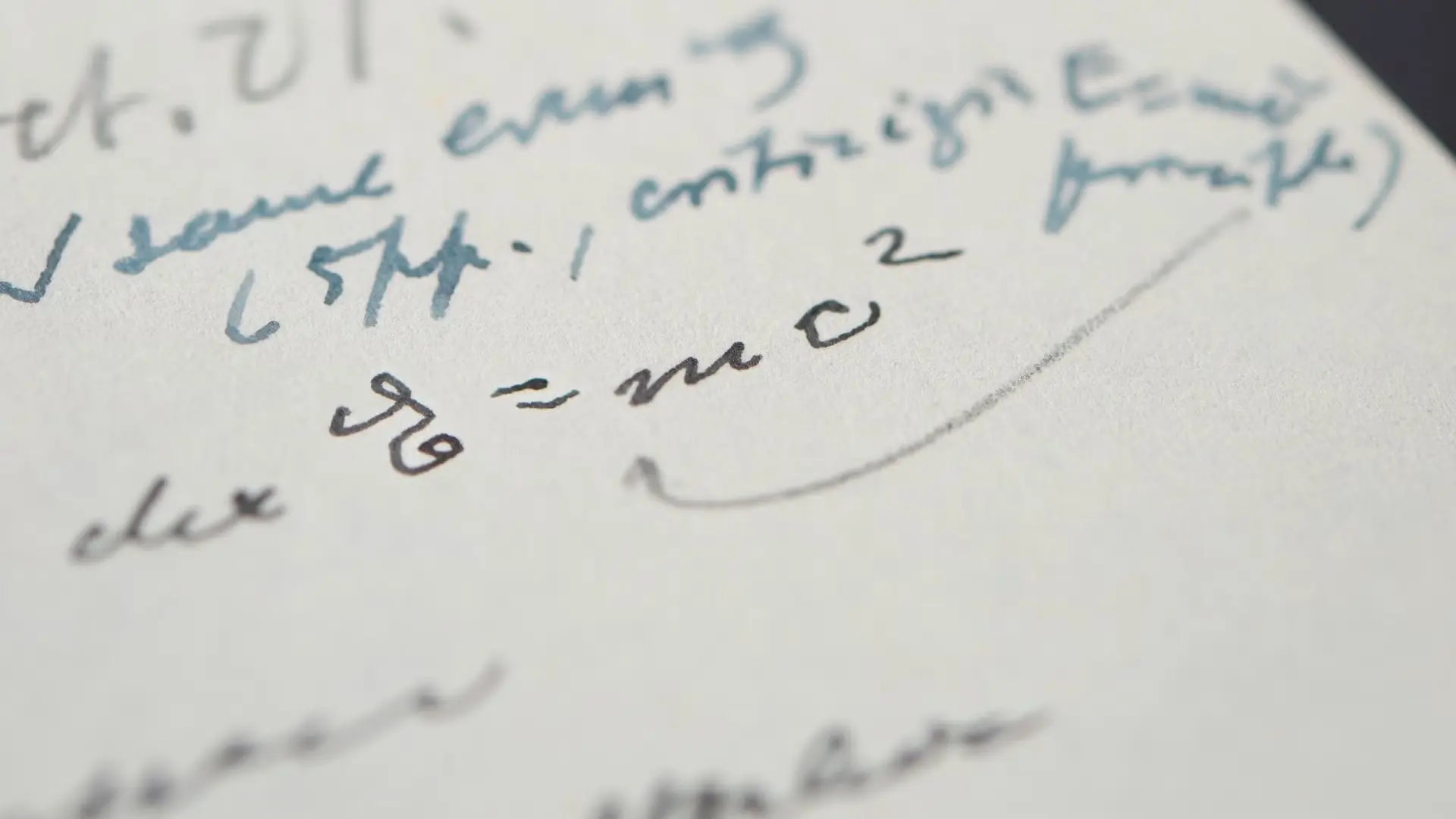
When Did Einstein First Write E = mc²?
The world's most recognized equation did not appear in its familiar form in 1905. The paper trail from Einstein's journal paper to the 1912 manuscript to the 1946 letter.
Open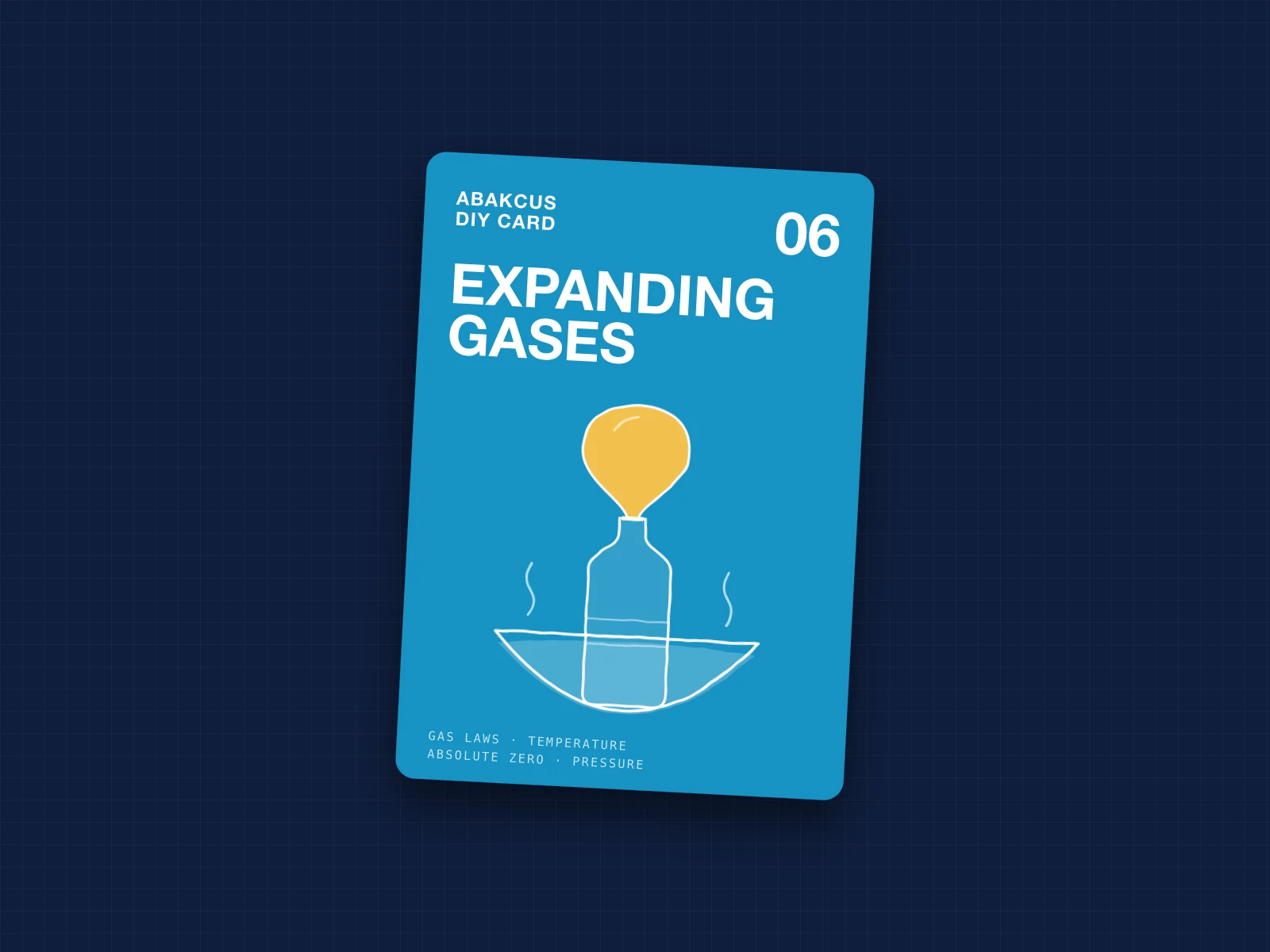
How to Blow Up a Balloon With Hot Water: Charles’s Law
Put a balloon on an empty bottle, stand the bottle in hot water, and the balloon lifts itself up. The air didn’t get any more of itself. It just needs more room, and from that one fact you can find absolute zero.
Open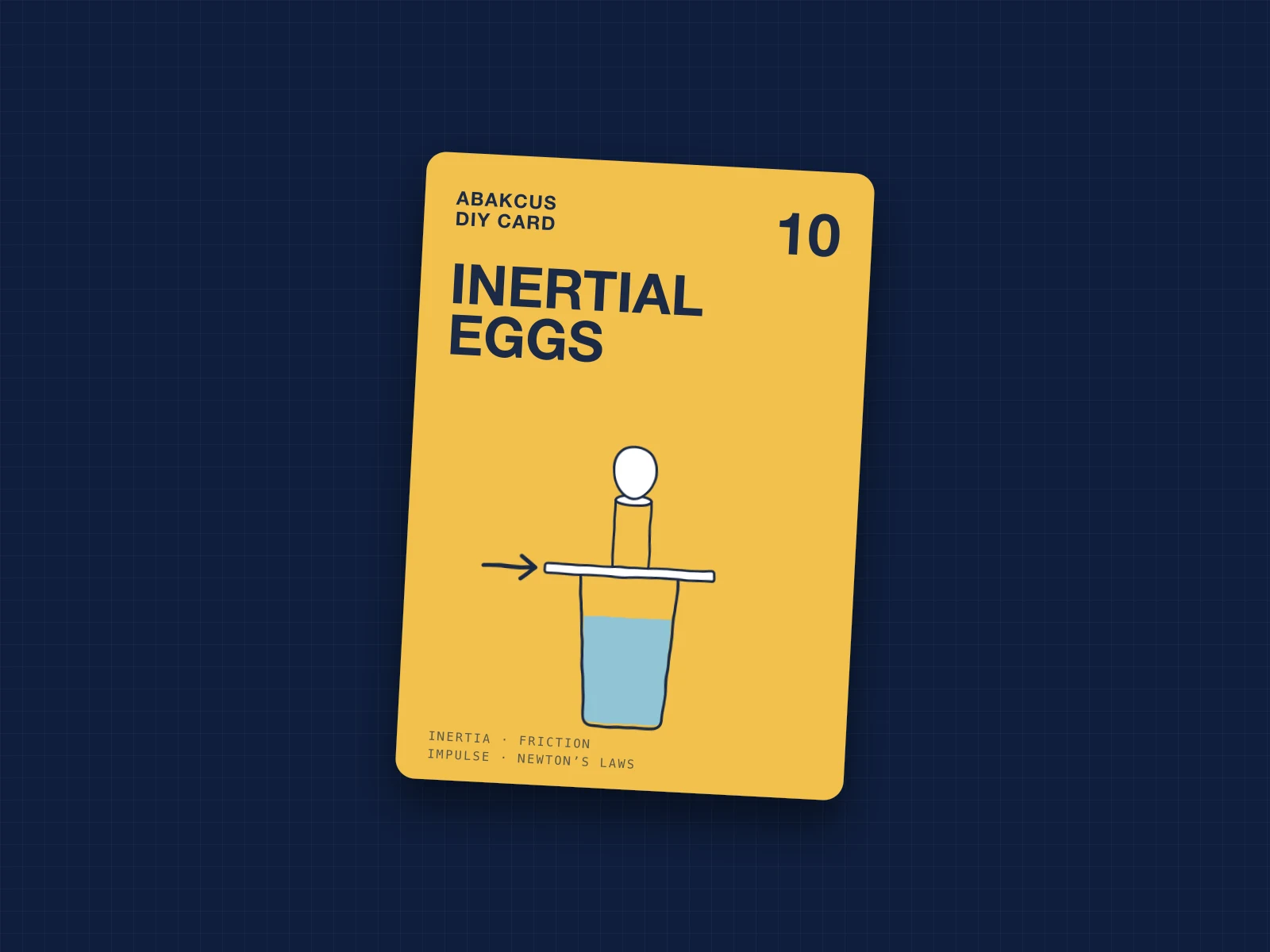
How to Do the Egg Drop Inertia Trick: Newton’s First Law
Knock a tray out from under an egg and the egg drops straight down into a glass of water. The trick is speed, not strength, and the egg’s weight turns out not to matter at all.
Open
How to Make a Tornado in a Bottle: Vortex Science
Swirl an upside-down bottle of water and a funnel of air drills down through the middle. It spins fastest at the centre for the same reason a skater spins faster with arms pulled in, and it has nothing to do with which hemisphere you live in.
Open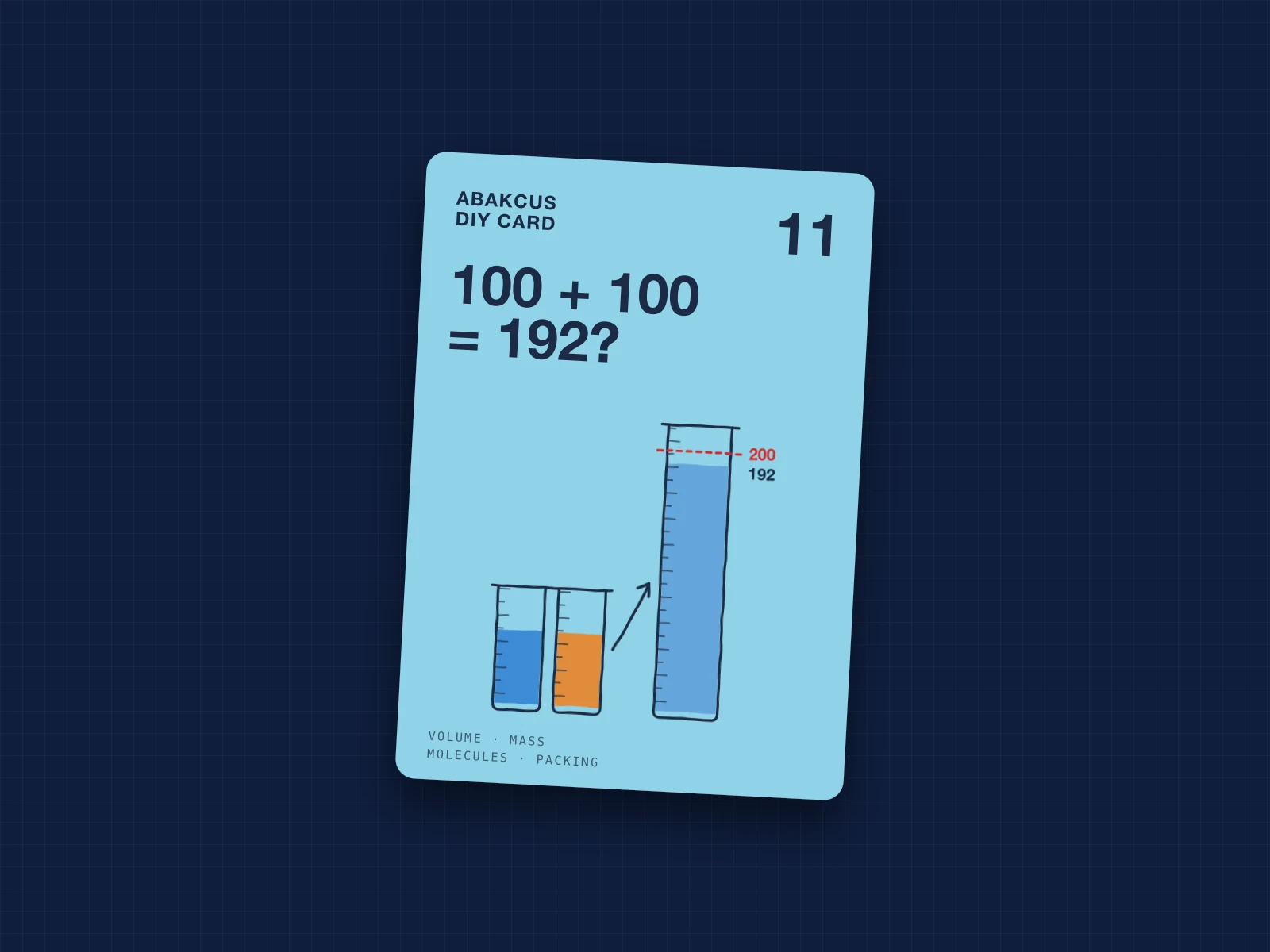
Why 100 ml + 100 ml Makes Less Than 200 ml
Pour 100 ml of alcohol into 100 ml of water and you get about 192 ml. Nothing leaks, nothing evaporates, and the scale says not a gram is missing. The molecules have simply moved in closer together.
Open
How to Make a Ping-Pong Ball Float With a Hair Dryer
Point a hair dryer at the ceiling and a ping-pong ball sits in mid-air, wobbling but never falling out. Most explanations of why are wrong, and the real one is better.
Open