
Physics · Relativity · Movies
Kip Thorne made Christopher Nolan promise that nothing in the film would break the laws of physics. Here is how close they came — from Gargantua and Miller’s planet to the wormhole and the tesseract.
Above: a live black hole, ray-traced in your browser · drag up or down to tilt · by Ali Kaya
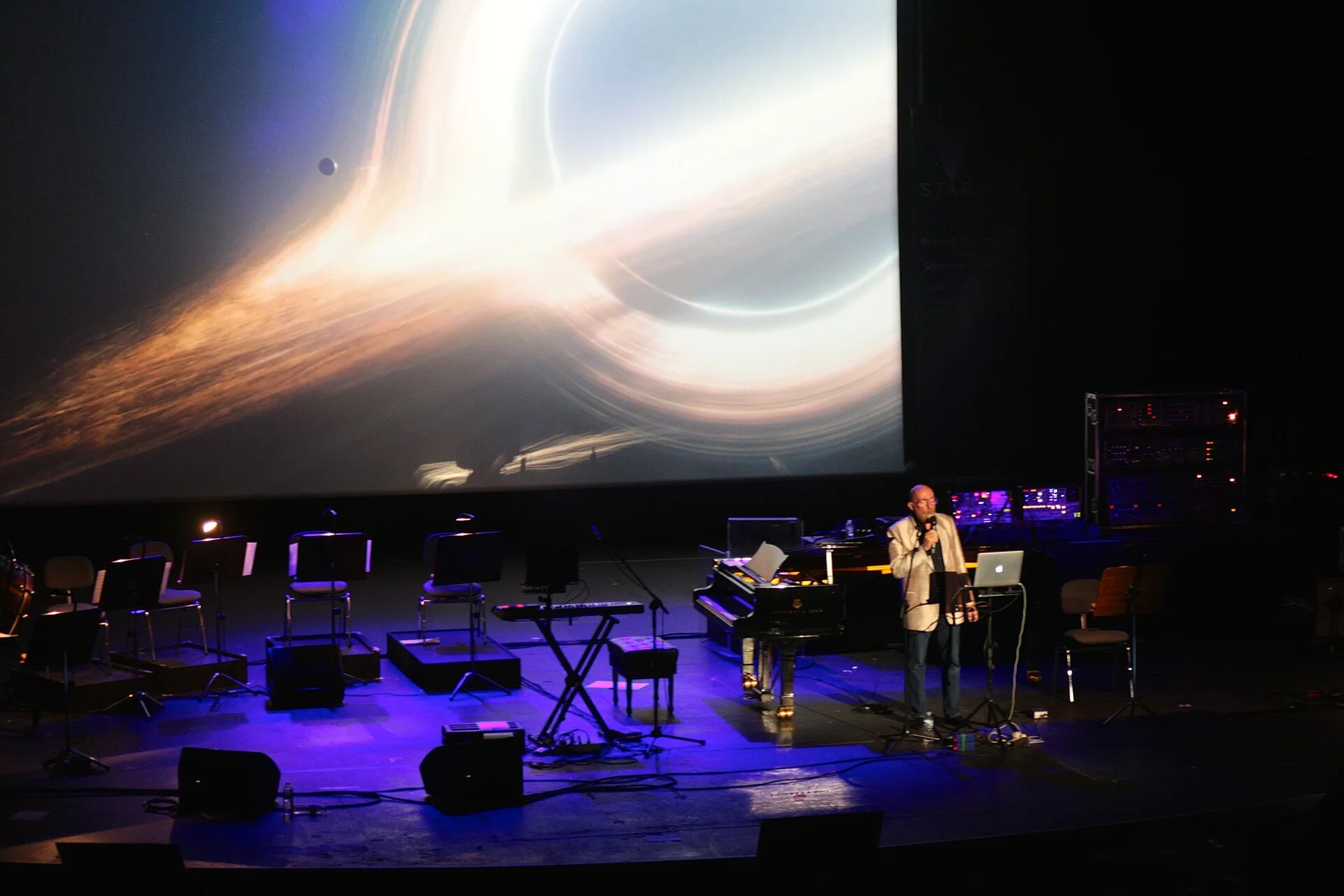
As a mathematician, I was hooked on Interstellar long before I understood it. I read almost every analysis written about the film, usually with Hans Zimmer’s organ playing in the background. Christopher Nolan had made something on the level of his Batman films, and it took its place among the great science-fiction movies. Some people call it pure fantasy; others insist it is physics with a soundtrack. After a lot of reading — and one excellent lecture by Professor Tekin Dereli — I wanted to settle the question for myself: how much of Interstellar is real?
The black hole at the top of this page is not a video. Your browser is drawing it right now, by firing a ray of light backward from every pixel and bending it through the curved spacetime that Einstein’s equations describe — the same idea the film’s effects team used, on a much smaller budget. By the end of this piece you will know why the glowing disk seems to wrap over and under the shadow, and you will have flown the camera yourself.
You don’t need to have seen the film. I focus on the physics rather than the plot, but I tell the story as we go, so consider this your spoiler warning. Keep an eye on the mission clock in the corner of the screen: it tracks how much time has passed for Cooper, and for the people he left behind.
10⁸
Gargantua’s mass, in Suns
61,362×
how much slower clocks run on Miller’s planet
100 h
to render a single frame of the black hole, at worst
2017
the year the film’s adviser won the Nobel Prize
The film’s scientific adviser, Kip Thorne, sorted every idea in it into three bins: truth, things physicists are sure of; educated guesses, things that are probably right; and speculation, things that might be possible but nobody knows. I use the same three labels throughout. Here is where we will end up.
The scorecard
01 · Educated guess
Dust storms swallow the farms
The storms come from the real 1930s Dust Bowl; one blight that kills almost every crop is a stretch.
02 · Truth
Endurance spins to make gravity
A rotating ring pushes everything outward. Engineers have proposed it for over a century.
03 · Speculation
A wormhole appears near Saturn
Allowed by Einstein’s equations, but only if exotic matter exists. Nobody knows that it does.
04 · Truth
Gargantua looks like that
Rendered from the equations for a spinning black hole. It became a research paper.
05 · Truth
One hour on Miller = seven years
Possible if Gargantua spins at almost its maximum rate and Miller hugs the horizon.
06 · Educated guess
Kilometre-high waves on Miller
Thorne worked out that a gently rocking planet could make them. Plausible, unproven.
07 · Educated guess
Cooper survives the plunge
Tidal forces are mild at a giant black hole’s horizon. What waits inside is unknown.
08 · Speculation
The tesseract and the bulk
Extra dimensions are a live idea in physics; a five-dimensional bookshelf is not.
09 · Speculation
Messages sent through gravity
Gravity can carry information, as LIGO proved. Steering it into a watch hand is fiction.
Chapter I · Earth
Interstellar opens on a farm in a world that is quietly ending. Blight has wiped out wheat and okra; corn is the last crop left. Dust storms roll over the fields, settle on dinner plates and fill the lungs of children. The elderly faces telling stories about the dust in the first minutes are not actors: they are survivors of the real 1930s Dust Bowl, interviewed for Ken Burns’s documentary of the same name.
Joseph Cooper, a former NASA test pilot turned farmer, stumbles on what is left of NASA, hidden in a bunker because the public no longer tolerates spending money on space. Professor John Brand, a physicist, tells him the truth: Earth will not feed humanity much longer, and a wormhole has appeared near Saturn, leading to another galaxy. Cooper agrees to fly the ship Endurance through it, with Brand’s daughter Amelia, a biologist; Romilly, a physicist; Doyle, an earth scientist; and two blunt, funny robots called TARS and CASE. He leaves behind his son Tom and his ten-year-old daughter Murph, who is furious with him.
Parts of it already happened. In the 1930s, drought and poor farming turned the southern Great Plains into a dust bowl; storms buried houses and carried soil all the way to the Atlantic. Crop diseases are real too: a single fungus, wheat stem rust strain Ug99, has threatened wheat on three continents since it was found in Uganda in 1999. What is hard to believe is one blight that jumps across every crop species and also eats up the planet’s oxygen. That is the film’s first educated guess, and frankly a generous one.
Before Cooper, NASA had already sent twelve volunteers through the wormhole, one to each promising planet. Each carried a beacon that would ping back if their world could support life. The programme was called the Lazarus missions, and the name is not decoration.
The Bible has two Lazaruses, and the film quietly uses both. In the Gospel of John, Lazarus of Bethany dies and lies in his tomb for four days before Jesus calls him back to life. The Lazarus astronauts are meant to do the same thing: go somewhere no one returns from, and send word back from the other side.
The second Lazarus, in the Gospel of Luke, is a poor beggar covered in sores who lies at a rich man’s gate and is ignored. Both men die. Lazarus is carried to Abraham’s side; the rich man, in torment, begs that Lazarus be sent back to warn his five brothers. The request is refused. In the Middle Ages this Lazarus became the patron saint of lepers, which is why quarantine hospitals were once called lazarettos. A messenger trying to reach his family from beyond, and being told he cannot — keep that in mind for the last chapter.
What separates Interstellar from almost every other science-fiction film is the person in the room. Kip Thorne is one of the world’s leading experts on general relativity. He was a student of John Wheeler, the physicist who made the term “black hole” famous, and he co-wrote Gravitation, the 1,200-page textbook physicists simply call MTW, after its three authors.
The film began with him. Around 2006 Thorne and the producer Lynda Obst, an old friend, wrote a treatment for a film built on real gravitational physics. Steven Spielberg was attached first, with Jonathan Nolan writing the script; when Spielberg moved on, Christopher Nolan took over and rewrote it. Thorne stayed on as executive producer and scientific adviser, with two conditions.
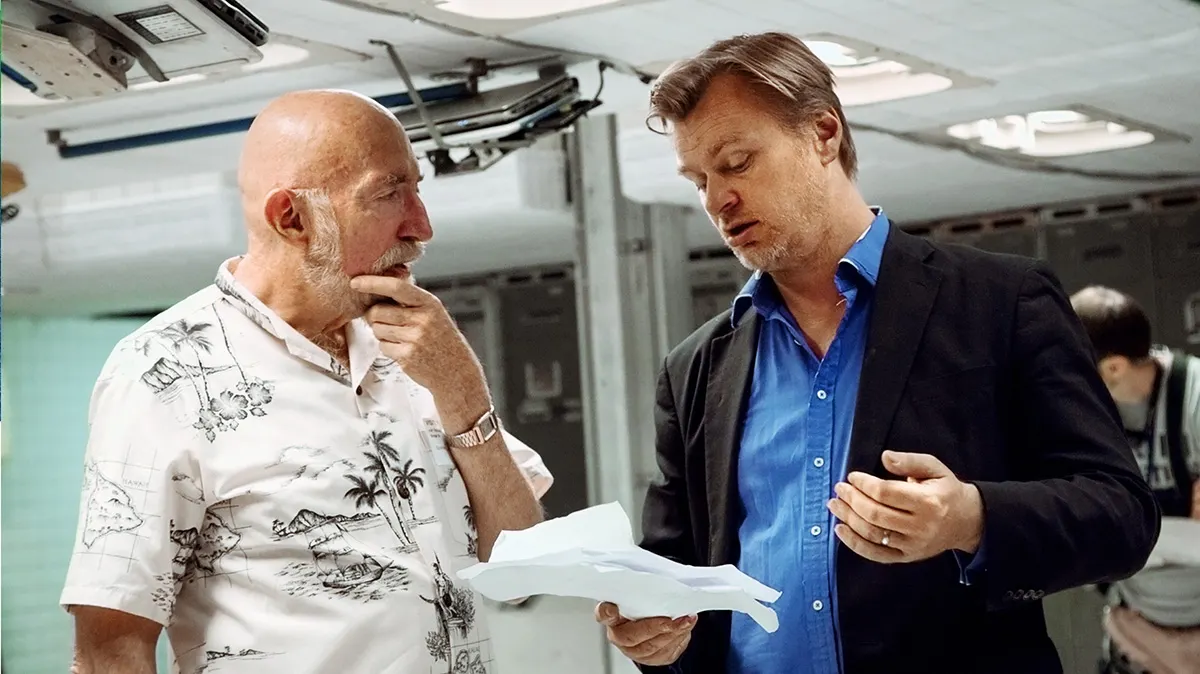
Nothing may break firmly established physics. Every wild speculation must spring from real science.
Kip Thorne’s two rules, paraphrased from The Science of Interstellar
The fiction was Nolan’s; the science was Thorne’s. The film keeps the first rule for most of its length. In the last act it leans on the second rule instead, and we will see exactly where.
One quiet detail deserves credit. Endurance is a ring of twelve modules, and when it spins, the crew walk along the inside of the rim. Anything moving in a circle must be pushed toward the centre, and the floor does the pushing; from the inside, that push feels exactly like weight. The acceleration is ω²r, so a ring 64 metres across would need to turn about once every 11 seconds to give you Earth gravity at the rim. Konstantin Tsiolkovsky and Hermann Noordung sketched stations like this more than a century ago, and Stanley Kubrick put one in 2001. Truth.
Chapter II · Saturn
It takes Endurance two years to reach Saturn, most of it with the crew asleep. To see why the mission needs a wormhole at all, we need two ideas from Albert Einstein: there is a speed limit, and time is not the same for everyone.
When I say travel, I don’t mean the world’s longest flight, Singapore to New York, which takes under nineteen hours. I mean crossing the gaps between stars. Nothing carrying energy or information can move faster than light in a vacuum: 299,792 kilometres, or about 186,282 miles, every second.
Put that next to something familiar. Driving at 90 miles per hour, you cover 132 feet every second. Light covers about 983.6 million feet in the same second. Even a thousandth of the speed of light is 186 miles per second — roughly 670,000 miles per hour. The fastest object people have ever built, NASA’s Parker Solar Probe, touched about 430,000 miles per hour as it skimmed the Sun in December 2024. That is 0.064 percent of light speed. At Voyager 1’s pace, the nearest star is 75,000 years away.
This speed limit is the great wall in front of space exploration. The stars are not just far; they are far in units of human lifetimes. And the obvious fix, living longer, is not on offer.
Time feels like a river that flows one way, at one speed for everybody. Einstein’s special relativity, from 1905, says the second part is wrong. A clock moving fast relative to you runs slow; a ruler moving past you looks shorter along the direction of motion. The traveller notices nothing odd about their own clock or ruler. Each observer measures honestly, and they disagree.
Physics teachers love a version of this with a train. A mile-long train moving at 99.99998 percent of the speed of light shrinks, as seen from the platform, to about a yard. From the platform you could, for an instant, shut it inside a yard-long shed. From the train, the shed is what shrank. Both are right, because the two observers disagree about which events happen “at the same time”.
Move close enough to light and your clock slows by any factor you like, so a trip that takes centuries on Earth can take a few years on board. The catch is that you can never come back to the world you left. Try it:
Try it · Special relativity
4.3 years
pass on Earth
138 days
pass on the ship's clock
γ = 11.27
Lorentz factor: how much slower the ship's clock runs
No acceleration, no braking, no fuel — just the clocks. The crew can reach Andromeda within a lifetime, but everyone they left behind will have been dead for millions of years.
Ten years later, in November 1915, Einstein finished general relativity, and it changed what gravity is. Space and time are woven into a single four-dimensional fabric, spacetime, and mass and energy bend it. Things that seem to be pulled by gravity are really moving as straight as they can through curved spacetime. Wheeler summed it up in one line: matter tells spacetime how to curve, and spacetime tells matter how to move.
Gμν + Λgμν = 8πG⁄c⁴ Tμν
Einstein’s field equations: ten coupled differential equations. The left side is the geometry of spacetime; the right side is the matter and energy in it.
Earth doesn’t orbit the Sun because a rope of force holds it. The Sun curves the spacetime around it, and Earth follows the straightest possible path through that curve, which in space looks like an ellipse. Solve the equations for a given arrangement of matter and you learn how everything nearby will move — and, crucially for Cooper, how fast clocks tick at each place.
Clocks deep in a gravity well run slow compared with clocks higher up. Your phone depends on it. The GPS satellites orbit 20,000 kilometres up, where gravity is weaker, so their clocks gain about 45 microseconds a day; their speed costs them about 7. Engineers correct for the net 38 microseconds every day. Without the correction, your map would drift by roughly ten kilometres a day. This gravitational slowing of time is the engine behind the most famous scene in the film.
General relativity changed what we think about the universe as a whole — though not the way Einstein wanted. He assumed the cosmos was static, and in 1917 added a cosmological constant to his equations to hold it still. Alexander Friedmann showed in 1922 that the equations naturally describe a universe that expands or contracts, and Georges Lemaître argued in 1927 that ours is expanding from a hot, dense beginning. Edwin Hubble’s galaxies, racing away from us, backed him up in 1929. In 1998 two teams found that the expansion is speeding up; three of their leaders shared the 2011 Nobel Prize.
For most of the twentieth century this was mathematics with very little data. Now we live in the age of observational cosmology: telescopes in space, detectors that feel spacetime shiver, and radio dishes linked across the planet into one Earth-sized eye.
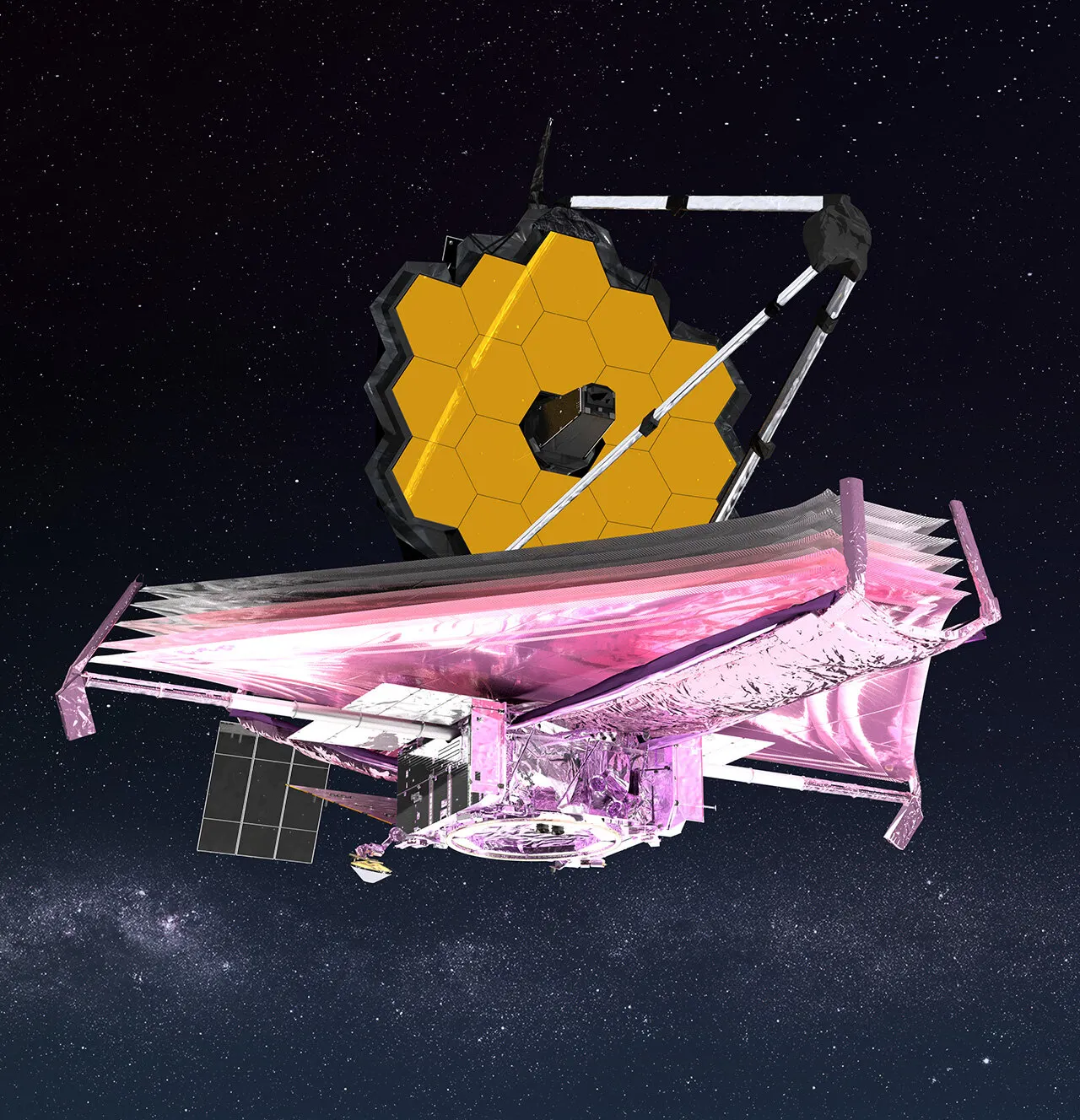
The James Webb Space Telescope launched on Christmas Day 2021 and unfolded itself on the way to its post, 1.5 million kilometres from Earth. Its mirror is 6.5 metres across, made of 18 gold-coated hexagons, and a sunshield the size of a tennis court keeps it cold enough to see the faint infrared glow of the earliest galaxies.
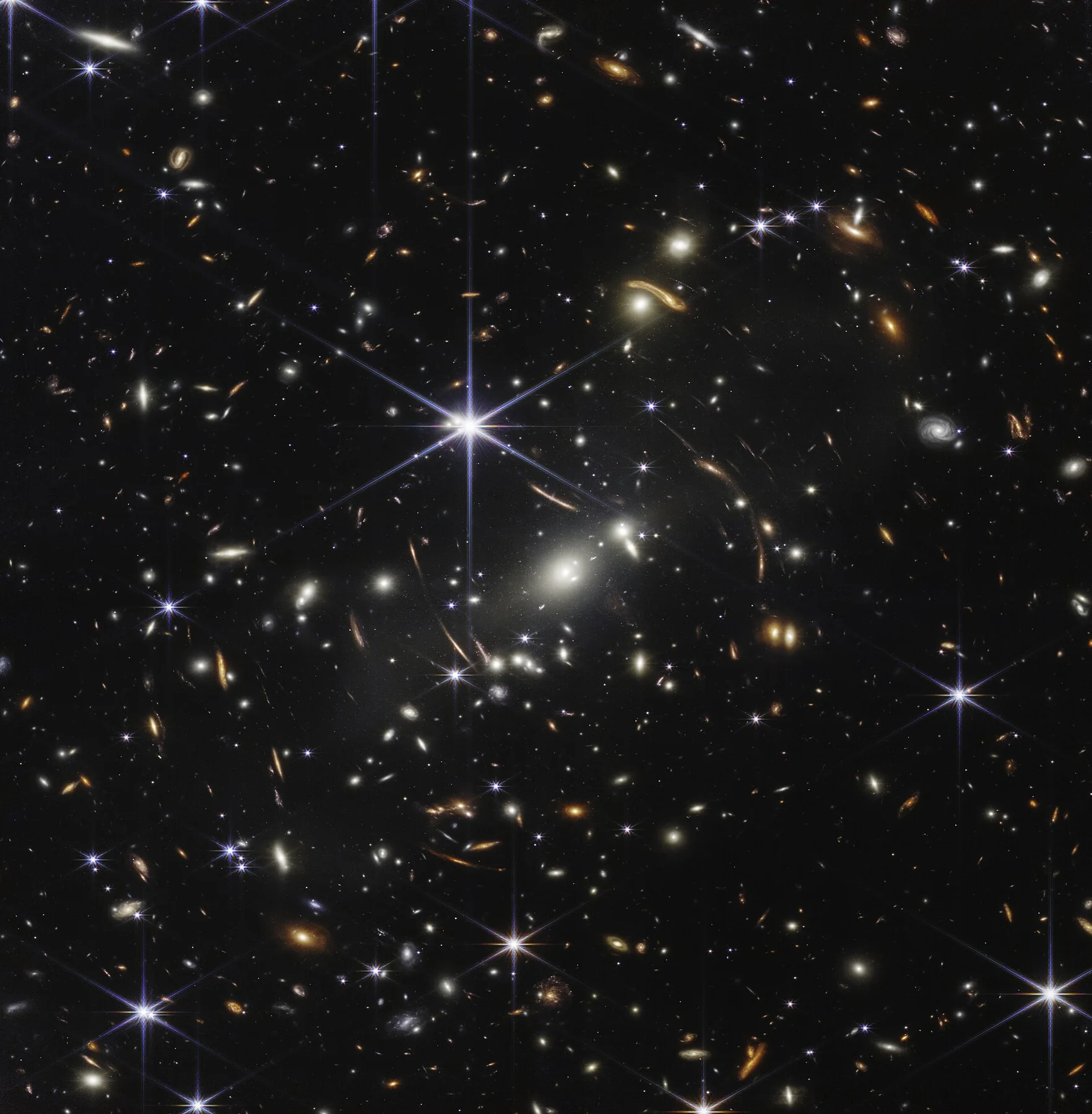
Look closely at the James Webb Space Telescope’s first image and you can see general relativity at work. The smeared arcs are distant galaxies whose light was bent on its way around a massive cluster. Now put a black hole in front of the same galaxies and move it around.
Try it · gravitational lensing
Each pixel shows where its light really came from, using the point-lens equation β = θ − θE²/θ. Galaxies behind the black hole are smeared into arcs, and anything right behind it becomes a ring — the dashed Einstein ring. Every background galaxy also gets a second, flipped image inside the ring. This is what turns Gargantua's flat disk into a halo.
Chapter III · The event horizon
Imagine a star like the Sun, but twenty or thirty times heavier. Fusion in its core turns hydrogen into helium, then into heavier elements, and the heat pushes outward against the star’s own weight. Every star has a fuel budget. When the core is full of iron, fusion stops paying, the outward push fails, and in under a second the core collapses.
For most stars the collapse stops at a white dwarf or a neutron star, where squeezed matter pushes back. But if the collapsing core weighs more than roughly three Suns, nothing known can stop it. Once three Suns’ worth of matter is inside a ball about 9 kilometres (5½ miles) in radius, it has become a black hole. The outer layers are blasted away in a supernova; what remains is a region of spacetime nothing can leave.
The idea is older than relativity. In 1783 the English clergyman John Michell wrote to the Royal Society with a thought experiment. Throw a ball upward and it falls back; throw it fast enough and it escapes for good. For Earth that escape speed is 11.2 kilometres per second. Make a star heavier and denser, and the escape speed rises. Michell realised a star could be so massive that its escape speed would exceed the speed of light, and that such a star would be invisible. Pierre-Simon Laplace reached the same conclusion in 1796.
Here is the lovely part, for anyone who likes algebra.
√(2GM⁄r) = c ⟹ r = 2GM⁄c²
Set the Newtonian escape speed equal to the speed of light and solve for r. Michell’s reasoning was wrong in its physics, yet it lands on exactly the size general relativity gives a black hole.
Michell pictured light as tiny particles that would slow, stop and fall back. General relativity says something stranger. Light never slows down. Near a black hole, spacetime is curved so steeply that every possible future path, even one pointing straight “out”, leads inward. Since nothing can outrun light, nothing at all can get out.
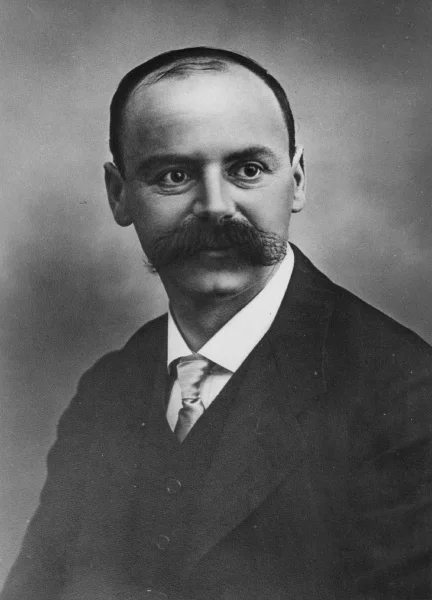
Within weeks of Einstein’s final paper, the astronomer Karl Schwarzschild found the first exact solution to his equations: the spacetime around a single round, non-spinning mass. He did it in late 1915 while serving as an artillery officer on the Russian front, and mailed it to Einstein, who was astonished anybody could solve the equations so quickly. Schwarzschild died a few months later, in May 1916, from an illness caught in the trenches.
Hidden in his solution is the radius r = 2GM/c², now named after him. Squeeze any mass inside it and you have a black hole; the sphere at that radius is the event horizon, the point of no return. Einstein never believed nature would build one, and as late as 1939 argued that it could not. That same year J. Robert Oppenheimer and his student Hartland Snyder showed that a heavy enough dying star would collapse forever — the story behind our piece on what Nolan’s Oppenheimer got right.
Try it · r = 2GM / c²
Squeeze any mass inside its Schwarzschild radius and it becomes a black hole. Pick something to crush.
3 km
Event-horizon radius for Sun: a little smaller than a small town.
Circle sizes are logarithmic — the real range spans more than forty powers of ten.
Two and a half centuries of dark stars
In 1963 the New Zealand mathematician Roy Kerr found the solution for a spinning black hole — the one Gargantua is built on. In 1965 Roger Penrose proved that once a horizon forms, a singularity inside is unavoidable, the kind of idea he worked out in the notebooks we explored in Roger Penrose’s journal. It won him the Nobel Prize in 2020, shared with Reinhard Genzel and Andrea Ghez, whose teams spent decades tracking stars whipping around an invisible four-million-Sun mass at the centre of our galaxy.
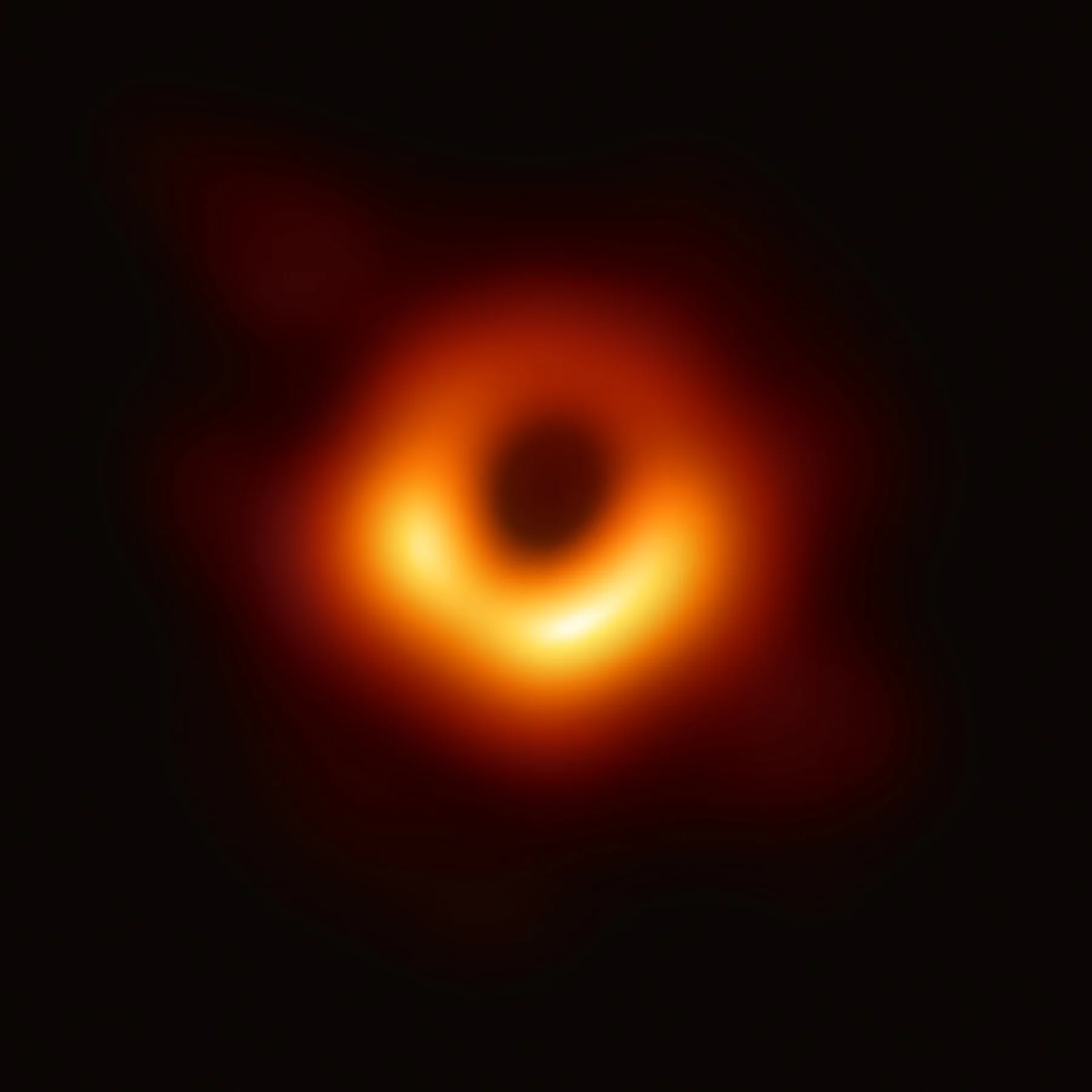
2019 · First photograph
2022 · Our own black hole
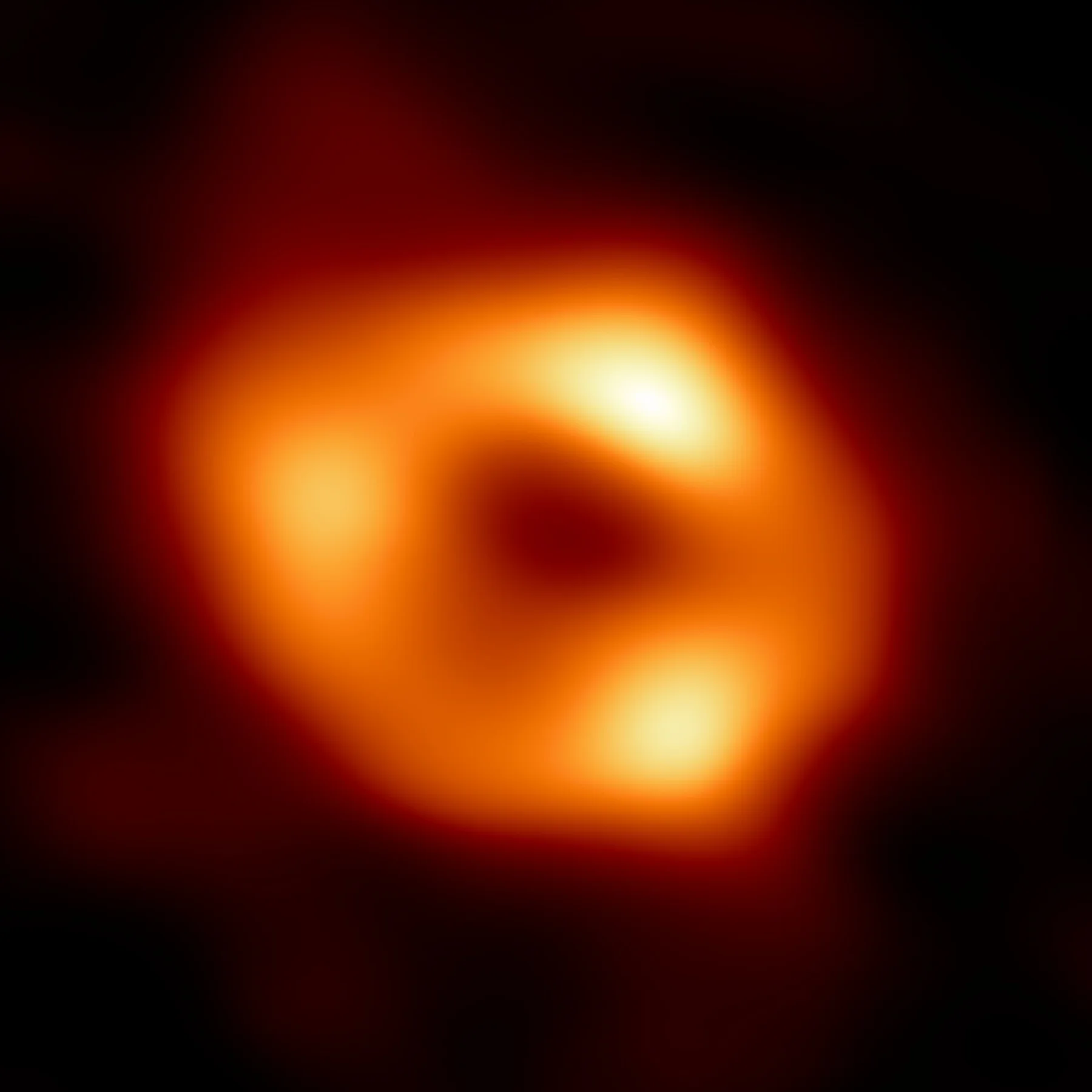
We never see a black hole itself, only what it does to its surroundings. Some are partners in a pair of stars: we watch one star circle a companion we cannot see, and weigh the invisible partner from the orbit. If it is too heavy to be a neutron star, it is a black hole. Gas torn from the visible star swirls into a flat, blazing accretion disk before falling in, and glows in X-rays. The others are the giants at the centres of galaxies, millions or billions of Suns. Since 2015 there is a third way — listening — but that belongs to the last chapter.
Picture two astronauts floating at a safe distance with synchronised watches. One gives the other a push toward the black hole. The faller’s watch flashes once a second, so the friend left behind can follow it.
The friend sees the flashes arrive further and further apart. The light is stretched toward the red and grows dimmer. As the faller nears the horizon, the gaps grow without limit: to the friend, the faller seems to slow, redden and freeze just above the horizon, then fade away. The friend never sees them cross.
For the faller, nothing of the kind happens. Their watch ticks normally, and they cross the horizon in a finite time without noticing any wall. The horizon is not made of anything; it is a place where, in the coordinates the outside friend uses, the mathematics breaks down. Physicists call that a coordinate singularity — a problem with the map, not the territory. The true singularity, where curvature becomes infinite and our equations really fail, lies further in.
Not a message, not a sound, not a cry for help — not even light gets out.
The one rule of the event horizon
Drop an astronaut feet first. Gravity pulls harder on the feet, which are closer, than on the head. The difference — the tidal force — stretches the body along the direction of fall, while the sides, pulled toward the centre along converging lines, are squeezed together. Long and thin: Stephen Hawking’s word for it was spaghettification.
The surprise is that it is worse for small black holes. Tidal stretching at the horizon falls with the square of the mass. A ten-Sun black hole shreds you more than a thousand kilometres out; a hundred- million-Sun giant like Gargantua lets you float through its horizon without a twinge. Slide the mass and see.
Try it · tidal forces
2.1 × 10^7 g
head-to-toe stretch at the horizon (horizon radius 30 km)
Torn apart about 1,756 km from the centre — long before you reach the horizon.
Spin makes things stranger. A rotating black hole drags spacetime around with it, an effect called frame dragging. Close in, in a region called the ergosphere, nothing can stand still; everything is swept along with the rotation. Inside, a spinning black hole has a second, inner horizon, and what happens there is an open research problem. Thorne himself labels what Cooper meets inside Gargantua as speculation.
Chapter IV · The wormhole
Here is the plot problem in one sentence. If no ship can go faster than light, how do you reach a habitable planet in another galaxy within a human life? Interstellar’s answer is a shortcut through spacetime: a wormhole, waiting near Saturn.
To anyone who works in topology, making a wormhole is easy. The surface of a sphere is finite but has no edge: drop an ant on it and it can walk forever without falling off. Now cut two small holes and join them with a tube. You have built a new object — a sphere with a handle, which is the same thing as a torus, the surface of a doughnut. You have turned a watermelon into a doughnut.
Topologists count handles with the genus, and a beautiful formula goes with it. Draw any network of vertices, edges and faces on the surface and compute V − E + F. On a sphere you always get 2; on a torus, always 0. The Euler characteristic χ = 2 − 2g cannot tell a sphere from an egg or a cube, but it always knows when someone has added a handle.
In the film, Romilly explains the wormhole to Cooper by folding a sheet of paper and pushing a pencil through both layers. Fold it yourself:
Try it · Romilly's pencil
478
units along the sheet
478
units straight across
A wormhole is the same handle, one dimension up: a tunnel joining two distant regions of our three-dimensional space. That also explains the most striking design choice in the film. A hole in a two-dimensional surface is a circle; a hole in three-dimensional space is a sphere. Interstellar’s wormhole is a glassy ball hanging near Saturn, with the stars of another galaxy distorted on its face. That is not artistic licence. It is what the geometry says you would see, and the effects team published the calculation.
Mathematics lets you draw a handle; physics has to build one. In 1935 Einstein and Nathan Rosen found that Schwarzschild’s solution, extended fully, contains two sheets of space joined by a “bridge”. Read with time running backward, a black hole becomes a white hole that only spits things out — Einstein’s equations don’t care which way time runs. But in 1962 Wheeler and Robert Fuller showed the Einstein–Rosen bridge pinches shut so fast that not even light gets through. An ordinary black hole is not a door.
In 1988 Thorne and his student Michael Morris turned the question around: what would a wormhole need so that a person could actually travel through? The throat must be threaded with something that pushes outward, against gravity’s urge to crush it: exotic matter, with negative energy density. Ordinary matter can’t do it.
Quantum physics offers a faint hope. Between two metal plates very close together, the vacuum has slightly less energy than empty space outside — the Casimir effect, measured in the lab. So negative energy is not forbidden. Whether nature allows enough of it, in the right shape, is unknown, and most physicists suspect not. In the film, “they” — beings we don’t meet until the end — placed the wormhole there. Speculation.
Chapter V · Gargantua
Endurance drops through the wormhole and comes out near Gargantua, a supermassive black hole with three candidate worlds: Miller’s planet, a world of shallow water; Mann’s planet, a world of ice; and Edmunds’ planet, further out. Two kinds of shuttle, the Rangers and a Lander, take the crew down.
Planets usually orbit stars, not black holes, and a planet in the wrong orbit would be swallowed or torn apart. Thorne worked backward from what the story needed. For Miller’s planet to lose seven years per hour, it must sit extremely close to the horizon, and to orbit there without falling in, the black hole must spin almost as fast as general relativity allows. His numbers: about a hundred million Suns, spinning within roughly one part in a hundred trillion of the maximum. Its horizon is then about as large as Earth’s orbit.
Making it look right was another job. The London effects company Double Negative — Paul Franklin, Oliver James, Eugénie von Tunzelmann — wrote a renderer called DNGR that traced light beams backward from the camera through Kerr’s curved spacetime, using equations Thorne derived for them. Some frames took a hundred hours to compute. The disk seems to arch over and under the shadow because light from the far side of the disk is bent up and over the hole on its way to the camera. The disk is flat; spacetime is what is curved.
The render at the top of this page works the same way. Here it is again, with the controls in your hands.
Live · light rays traced through curved spacetime
Every pixel is a ray of light followed backward through Einstein's geometry. Raise the camera and the disk's far side still shows above and below the shadow; switch on Doppler and the side spinning toward you flares blue-white. Hide the disk to see the star field wrapped into an Einstein ring. (This is a non-spinning black hole; Gargantua's spin would flatten one edge of the shadow.)
Nolan made two deliberate compromises. The real disk, spinning at a large fraction of light speed, would be lopsided: much brighter and bluer on the side moving toward the camera, dim and red on the other. He thought audiences would find it confusing, so the film’s Gargantua is symmetrical — press “Full physics” above to see what he left out. And a real disk feeding a black hole this size would usually blaze with X-rays that would kill an astronaut. Thorne imagines Gargantua’s disk as an old, thin, cool remnant, about as hot as the Sun’s surface. An educated guess.
Nolan’s cut
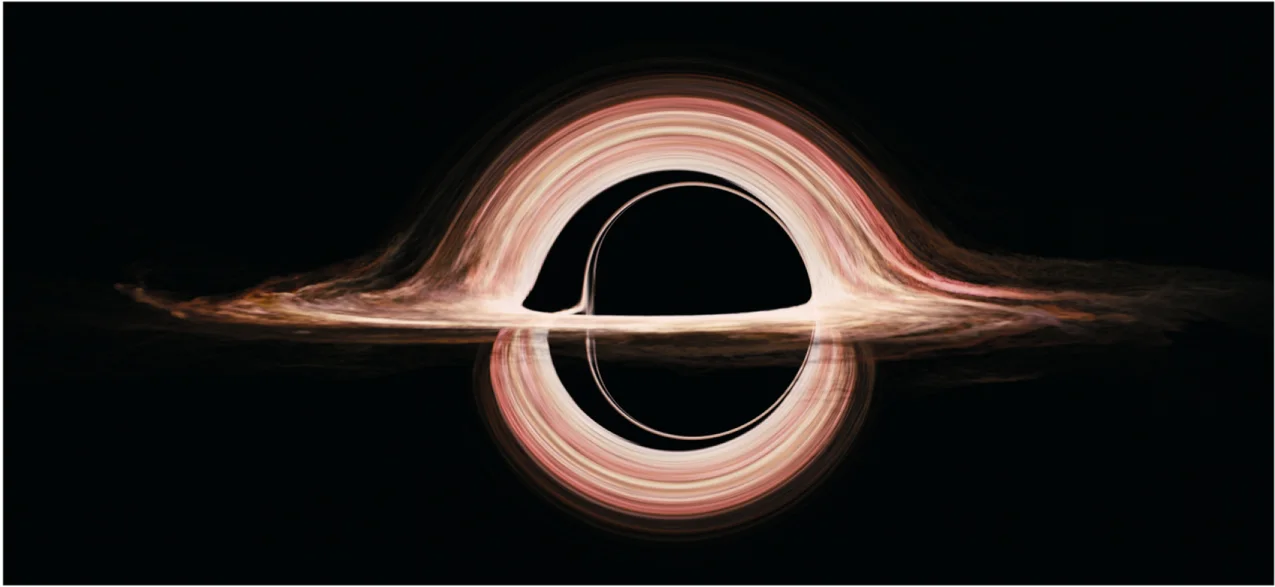
Full physics
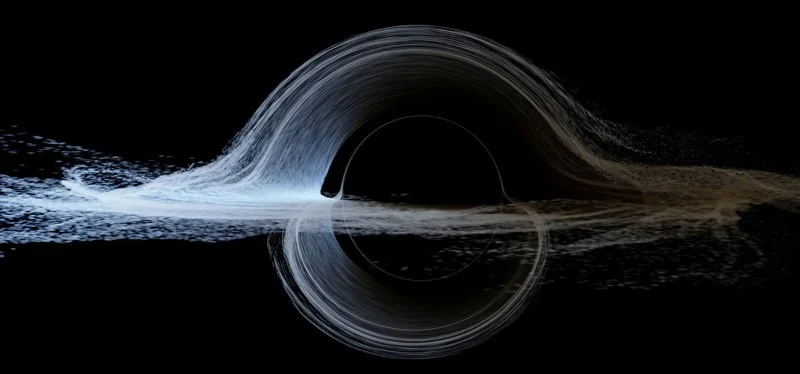
The work didn’t stop at the cinema. In 2015 the team published their method, and new findings about how a spinning black hole lenses the stars behind it, in Classical and Quantum Gravity; a paper on how their wormhole looks appeared in the American Journal of Physics. The film won the Oscar for Best Visual Effects. Few blockbusters have peer-reviewed spin-offs.
This is the scene everyone remembers. Cooper, Amelia Brand and Doyle land on Miller’s planet to find the Lazarus astronaut’s beacon, while Romilly waits on Endurance, further out. The water is knee-deep. Then the mountains on the horizon turn out to be waves. Doyle dies, the Ranger’s engines flood, and by the time they are back in orbit Romilly has waited 23 years, 4 months and 8 days. Two decades of video messages from home are waiting for Cooper, and his children have grown up without him.
Try it · Gravitational time dilation
Press play: each real second is one minute on the planet. The left hand ticks the seconds on Miller; the right hand does a full turn for every year that passes on Earth.
00:00:00
Time on Miller's planet
0 h 0 min
Time back on Earth
The factor is 61,362: one hour on the planet equals seven years far away. It comes from how deep Miller sits in Gargantua's gravity well and how fast it orbits — both effects slow its clocks.
Is that possible? Yes — it is the same slowing of clocks that GPS corrects for, pushed to an absurd extreme. A factor of about 61,000 needs Gargantua’s near-maximal spin; around a slower black hole, a planet that close would simply fall in. Some physicists have pointed out that Miller would also be bathed in starlight blueshifted to dangerous energies. But given Thorne’s Gargantua, the arithmetic of the scene holds.
Why are the waves so tall? Gargantua’s tidal pull stretches Miller’s planet into a slight rugby-ball shape, and normally that would lock one face toward the black hole, with no waves at all. Thorne proposed that the planet rocks back and forth slightly in its locked position. Each rock sloshes the shallow ocean into a moving wall of water about 1.2 kilometres high — a tidal bore, like those that run up some rivers on Earth, scaled up enormously. Plausible physics, never observed.
Mann’s planet is the film’s cold heart, where the celebrated Dr. Mann has faked his data to be rescued. Its clouds are frozen solid, rigid enough for a shuttle to clip one. On Earth, clouds are droplets and ice crystals held up by moving air; no known atmosphere builds a cloud you could crash into. One of the softer spots in the film. To get around Gargantua’s system, Endurance also slingshots around a neutron star and Gargantua itself — the same trick NASA plays with planets, for much higher stakes.
Chapter VI · The tesseract
This is where the plot leaves established physics behind. Professor Brand’s plan to lift humanity off Earth needs a theory uniting gravity with quantum mechanics, and to finish it he needs data from inside a black hole — from the singularity itself, where quantum gravity takes over. Nothing can bring that data out. Brand knew this, and lied to everyone.
Near the end, Cooper and TARS cut their craft loose to shed weight so that Endurance can escape Gargantua with Amelia Brand, and both fall in. Instead of dying, Cooper finds himself inside the tesseract: an enormous lattice, built by “them”, in which every moment of Murph’s bedroom is laid out side by side like rooms in a corridor. He is behind her bookshelf, at every age she has been, including the day he left. The ghost she insisted lived in her bookshelf was him all along.
A tesseract is a four-dimensional cube: a cube is to a square what a tesseract is to a cube. You cannot point in the fourth direction, but you can watch a tesseract’s shadow turn through it.
Try it · four spatial dimensions
This is the shadow of a four-dimensional cube: 16 corners, 32 edges, 8 cubic cells. As it turns through the fourth direction, the small inner cube swells and swallows the outer one. Nothing is bending — like a cube's shadow on a wall, the distortion is only projection. Cooper's tesseract stretches the same trick across time, laying out every moment of Murph's bedroom side by side.
The physics behind the idea is speculation of the serious kind. In 1999 Lisa Randall and Raman Sundrum proposed that our four-dimensional universe — three of space, one of time — could be a thin membrane, a brane, floating in a larger space with an extra dimension, called the bulk. Light and matter are stuck on the brane. Gravity alone can reach into the bulk, which might explain why it is so much weaker than the other forces.
That is why Cooper can only talk to Murph through gravity. He pushes books off her shelf. He makes dust fall in lines that read, in binary, as the coordinates of the secret NASA base. And, guided by TARS, he taps the quantum data from inside Gargantua into the second hand of the watch he gave her, in Morse code. Decades later Murph, now a physicist, recognises the watch, reads the data, finishes the equation, and humanity leaves Earth in vast spinning stations. The one in the final scene is named after her.
How much of this is physics? Extra dimensions are a respectable idea that the Large Hadron Collider has looked for and not found. A future civilisation building a habitable 5-D structure inside a black hole, and gravity strong enough to move a book reaching back across decades, is fiction stretched over a scientific frame. Here Thorne’s second rule is doing all the work.
Remember the second Lazarus. In Luke, the man in torment begs to send a messenger back to his family and is told it cannot be done. Cooper is the messenger who finds a way.
The film’s last idea has a solid core. In 1916 Einstein predicted that violent events — two black holes spiralling together, say — send ripples through spacetime at the speed of light. These gravitational waves stretch and squeeze everything they pass through, by unimaginably small amounts. In 1974 Russell Hulse and Joseph Taylor found a pair of neutron stars, one a pulsar, whose orbit shrinks by exactly the amount Einstein predicts for energy carried off by gravitational waves. They won the 1993 Nobel Prize.
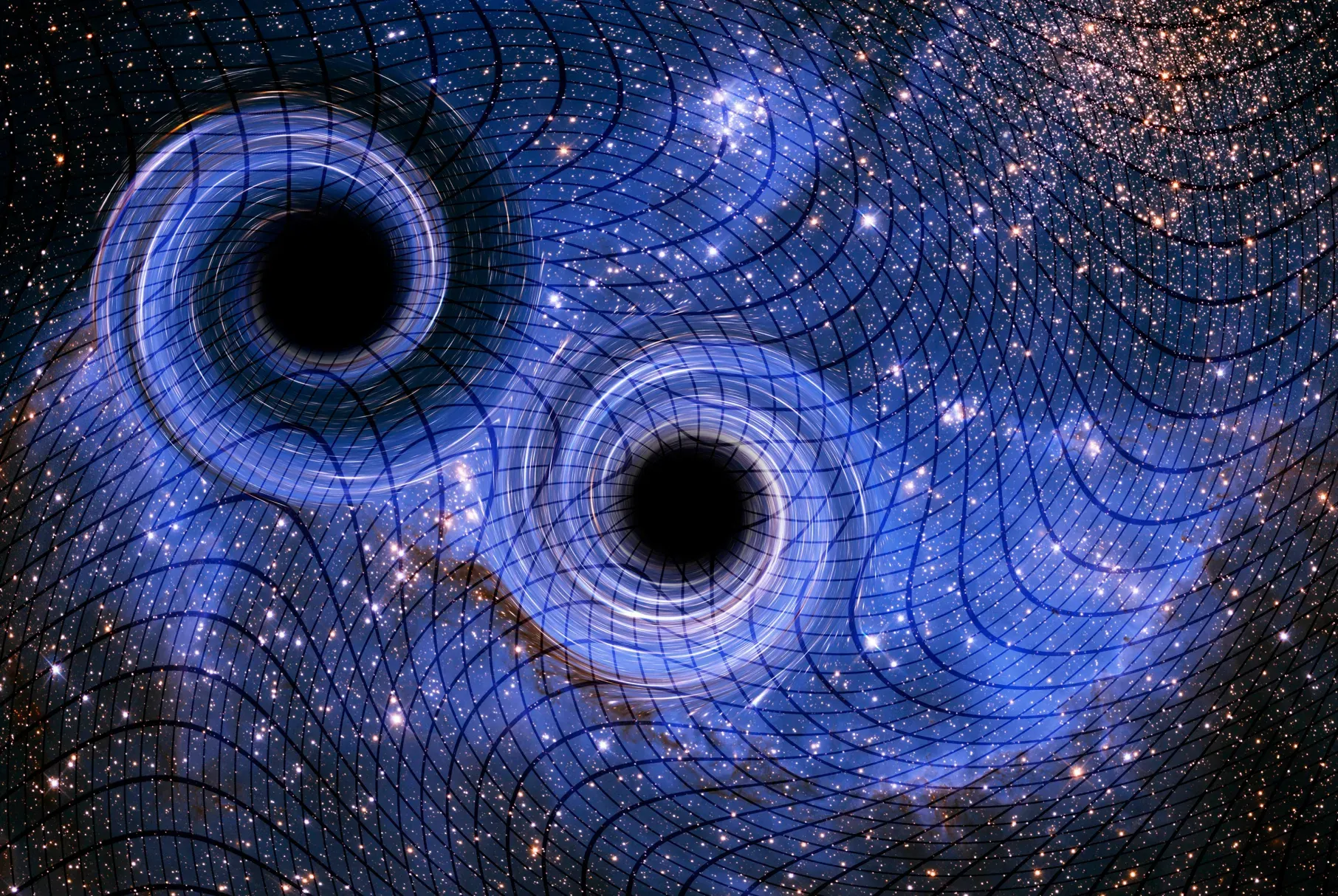
Hearing the waves directly took one of the most sensitive instruments ever built. In 1984 Thorne co-founded LIGO with Rainer Weiss and Ronald Drever: two L-shaped detectors with arms 4 kilometres long, in Louisiana and Washington state. On 14 September 2015 — less than a year after Interstellar opened — both caught two black holes, of about 36 and 29 Suns, merging 1.3 billion light-years away. In a fifth of a second they turned three Suns’ worth of mass into gravitational waves. The stretch in LIGO’s arms was about a thousandth of the width of a proton.
1.3 bn
light-years to the first black-hole merger LIGO heard
3 Suns
of mass turned into gravitational waves in 0.2 seconds
10⁻¹⁸ m
the stretch in LIGO’s 4-kilometre arms
3 years
from Interstellar’s premiere to Thorne’s Nobel
In 2017 Thorne, Weiss and Barry Barish shared the Nobel Prize in Physics. Three years after advising a blockbuster about gravity carrying a message across space, Thorne won the Nobel for hearing exactly that.
Chapter ∞ · Cooper Station
In 2013 there was Gravity; in 2014, Interstellar; in 2015, The Martian took us to Mars. Around them were shows like Cosmos and The Big Bang Theory. These productions did something classrooms struggle to do: they made young people want the mathematics and physics behind them. I keep a running list of these films in mathematics in the movies, and the ones that get the details right are always the ones people remember.
Interstellar is not a documentary. Its ending is a dream built on a scaffold of real equations. But its first two hours teach more general relativity than most people meet in school: that time bends, that light bends, that black holes come in sizes and the biggest are the gentlest. Every time a student writes down r = 2GM/c², or realises that the famous E = mc² is one line of a much larger story, the film has done its job.
Mankind was born on Earth. It was never meant to die here.
Interstellar’s tagline
So, how realistic is Interstellar? Realistic enough that its black hole became a scientific paper, its time dilation is honest arithmetic, and its scientific adviser won a Nobel Prize for proving its central premise — that gravity can carry a message across the universe. Where it is not realistic, it is at least honest about it. That is more than science fiction usually offers, and it is why the film still pulls people in, the way Gargantua pulls in light.
Questions people ask
Sources
Keep wandering
A few more pieces in the same spirit — math, design, and slow attention.
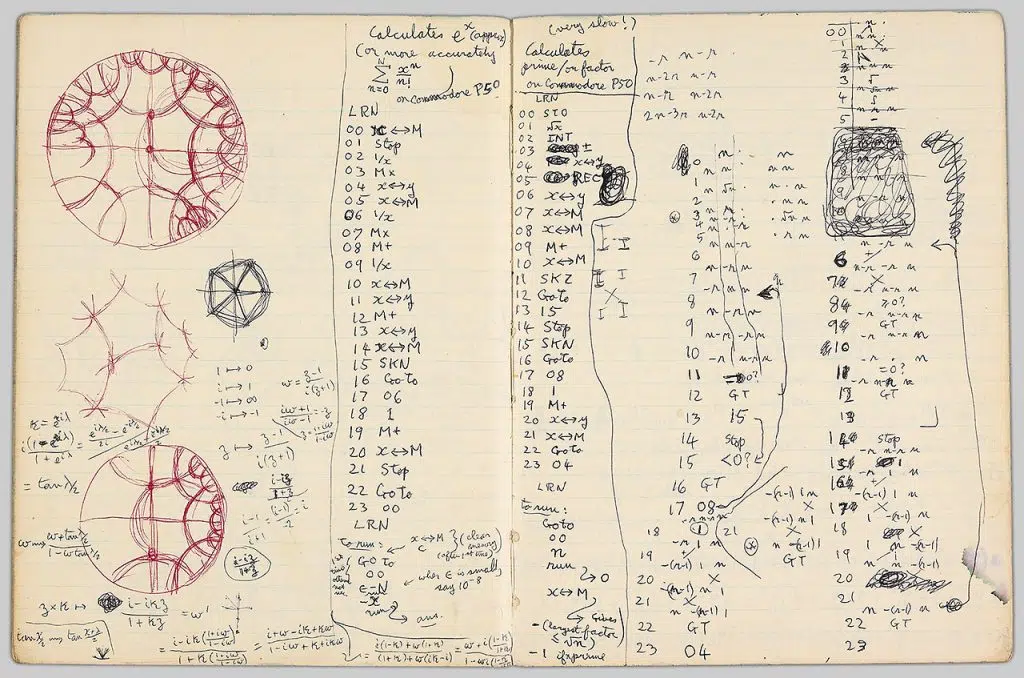
Inside Roger Penrose's notebook
Handwritten pages of spinor algebra, twistor diagrams, Penrose tiling prototypes, and Cayley algebra — alongside programs for a 1978 pocket calculator.
Open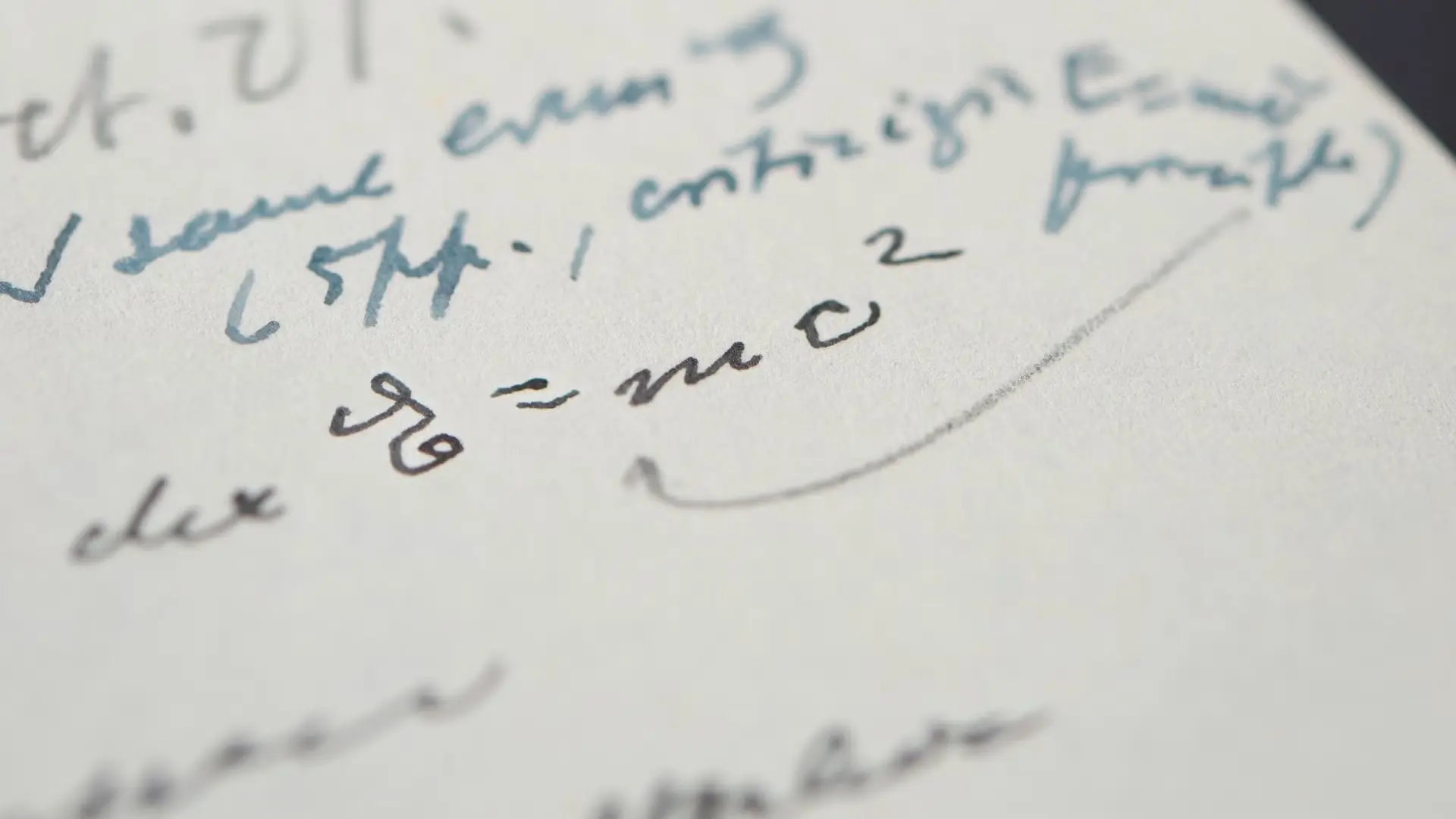
When Did Einstein First Write E = mc²?
The world's most recognized equation did not appear in its familiar form in 1905. The paper trail from Einstein's journal paper to the 1912 manuscript to the 1946 letter.
Open
16 Fascinating Facts About Christopher Nolan's Oppenheimer
A film that builds three hours of tension out of a physicist walking through rooms and arguing with people. What went on behind the screen is every bit as interesting as what ended up on it.
Open
Mathematics in Movies: 30 Scenes Where Math Steals the Show
A theorem on a hallway blackboard, a limit that does not exist, sixteen matches in a baroque hotel: thirty film scenes where the math is real, checked at the board, plus 168 more movies.
Open
When Einstein Walked with Gödel
The biggest questions in math and physics — told like stories worth losing sleep over.
Open
How to Measure the Speed of Light With Chocolate
Take the turntable out of a microwave, heat a bar of chocolate for twenty seconds, and measure the gap between the melted spots. Multiply by the number on the back of the oven and you get the speed of light, give or take a few percent.
Open