
DIY · Card 46 · Science · Light
A strip of card, a glass bead the size of a grain of sand and a slip of sticky tape. Hold it to your eye and an onion skin becomes a wall of living cells.
01The brief
Build a microscope for almost nothing, and see a living cell.
170×
roughly the magnification of a 2 mm glass bead held to your eye
1 μm
about the finest detail a simple bead lens can show: light’s own limit
1676
the year Leeuwenhoek reported tiny living creatures seen through a single lens
Microscopes look like serious, expensive instruments. But the very first great microscopes were nothing more than a single tiny bead of glass held in a metal plate, and with them, in the 1670s, one man discovered a whole living world nobody had ever seen.
You can build the same thing in twenty minutes from a postcard and a glass bead. It works the opposite way to the periscope: it bends light instead of bouncing it off mirrors. And it opens up the same kind of hidden world as coloured carnations, whose dyed water climbs through tubes far too small to see without one.
02Kit
A postcard, a tiny glass bead and some sticky tape. Plus something to look at.
Tick off what you have
0 of 5 ready
03Method
Fix a bead in a pinhole, stick a sample on a slide, hold it to your eye and focus.
Step 1 of 8 · Minute 0
You need a postcard or thin card, a clear glass bead 1 to 3 mm across (sold as a ‘ball lens’ or glass microbead), a pin, clear sticky tape and scissors. No bead? A drop of water on a clear plastic lid will do. For samples: an onion, a hair, a pinch of salt.
All you see is a bright blur.
Why
The sample is out of focus, by far more than you think.
Fix
Move it in tiny steps, a fraction of a millimetre at a time, until it sharpens.
The view is dark.
Why
Not enough light is coming through the sample.
Fix
Point it at a bright window or lamp, and use a thinner sample.
Everything looks smeared.
Why
There is a fingerprint or dust on the bead.
Fix
Clean it gently with the corner of a soft cloth, and handle the card only by its edges.
04Physics
Light slows down when it enters glass, and bends as it does. A curved surface bends light from different points by different amounts, bringing it to a focus. The more tightly curved the surface, the more it bends the light and the closer it focuses. A sphere just a couple of millimetres across is about as tightly curved as a lens can be.
A lens held to your eye magnifies by letting you bring something much closer than your eye could focus on its own. Your eye focuses comfortably at about 25 cm; a lens that focuses at 1.5 mm lets you look from 1.5 mm, which makes things look about 170 times bigger. Try different lenses:
Focal length
1.5 mm
Magnifies
167×
Finest detail
1.3 μm
Halve the bead and you double the magnification. Bacteria, a couple of micrometres across, are right at the edge of what any simple lens can show.
What do you actually see? Only a small circle of the sample, about half as wide as the bead, enormously enlarged. Choose a lens and something to look at:
The circle shows about 1.0 mm of the sample. Onion skin cellss are 150 μm across, so this lens makes one look about 25.0 mm wide, as if held at reading distance.
The lens model uses the ball-lens formula and the usual 250 mm reading distance, with a simple allowance for the blur a single bead adds. The drawings of the specimens are to scale but simplified.
05The big idea
A world
in a drop.
Before the microscope, nobody knew that living things are made of cells, that a drop of pond water is full of creatures, or that many diseases are caused by living things far too small to see.
A single bead of glass changed that. Seeing is not just looking: every instrument that lets us see further, smaller or fainter has changed what we know about the world. And the first of them could be made by hand.
06The math
1 · A ball lens
f = n D ⁄ 4(n − 1)
A sphere of diameter D and refractive index n (about 1.5 for glass, 1.33 for water) focuses at this distance from its centre.
2 · Magnification
M ≈ 250 mm ⁄ f
Held to the eye, compared with looking from 250 mm, the closest most people can focus comfortably.
3 · The limit
d ≈ 0.61 λ ⁄ NA
The smallest detail any lens can show depends on the wavelength λ and how wide a cone of light it gathers, NA.
A glass bead 2 mm across has f = 1.5 × 2 ⁄ (4 × 0.5) = 1.5 mm, so it magnifies about 250 ⁄ 1.5 ≈ 170 times. Halve the bead and the focal length halves: a 1 mm bead magnifies about 330 times, as much as Leeuwenhoek’s finest lenses.
But look at the third line. A bead gathers a cone of light with NA around 0.3, whatever its size, so with green light, λ = 0.55 μm, it can show details down to about 0.61 × 0.55 ⁄ 0.3 ≈ 1 μm. Smaller beads magnify more but don’t see finer. Bacteria, a couple of micrometres long, sit right at that edge.
07Real life
From a 17th-century book of drawings to the glowing lines on a road at night.
The first cells
In 1665 Robert Hooke published Micrographia, a book of drawings made through his microscope. Looking at a thin slice of cork, he saw rows of tiny empty boxes and called them cells, after the small rooms of a monastery. The name stuck.
Field microscopes
A paper Foldscope weighs a few grams, needs no electricity and survives being dropped or stepped on. Health workers and students in places far from any laboratory use folding microscopes like it to look at blood, water and crops.
Electron microscopes
Light can’t show anything much smaller than about a quarter of a micrometre. In 1931 Ernst Ruska and Max Knoll built a microscope that used beams of electrons instead, whose much shorter wavelength lets modern machines see single atoms.
Dewdrops
Look closely at a drop of dew on a leaf and you’ll see the veins underneath magnified. Every clear drop of water is a little lens, which is why a drop on a plastic sheet makes a working microscope.
Phone macro lenses
Clip-on lenses that turn a phone camera into a microscope often use a single tiny ball or half-ball of glass, just like your bead. Held over the camera, it lets the phone photograph cells and crystals.
Road markings
The white lines on roads glow back at your headlights because millions of tiny glass beads are scattered into the paint. Each bead acts as a lens that bends light in, reflects it off the paint behind and sends it straight back towards the driver.
1676
Antonie van Leeuwenhoek was a cloth merchant in Delft with no scientific training. He made his own microscopes: a single tiny lens, ground or blown from glass, held between two small metal plates, with a pin to hold the sample. His best magnified around 270 times.
On 9 October 1676 he sent the Royal Society in London a long letter describing ‘animalcules’ he had seen swimming in a drop of water, creatures so small that thousands would fit in a grain of sand. It was the first report of microscopic life. Your paper microscope is his design, made from a postcard.
08Is and isn’t
More magnification always shows more detail.
Only up to a point. Light itself blurs details smaller than about a micrometre in a simple lens. Past that, magnifying more just makes the blur bigger.
You need an expensive microscope to see cells.
A glass bead in a card does it. The first person to see bacteria, Antonie van Leeuwenhoek, used single lenses he ground and blew himself, set in small metal plates.
A microscope needs two lenses.
A compound microscope uses two, but a single lens is a microscope too. Leeuwenhoek’s single-lens instruments outperformed the compound microscopes of his day.
The bead should be held a little way from your eye, like a magnifying glass.
The opposite: a tiny lens shows only a tiny circle of view, so your eye must be right up against it, or you see nothing at all.
09Go further
A
Cell hunt
Look at onion skin, the inside of your cheek (scraped gently with a cotton bud), a leaf and a petal. Which have the clearest cells?
B
Pond life
Put a tiny drop of pond or puddle water on the tape and look for things that move. You may see what Leeuwenhoek called animalcules.
C
Measure a hair
Lay a hair next to the millimetre marks of a fine ruler under your lens. Can you estimate its width?
D
Bead sizes
Make microscopes with beads of different sizes. Does halving the bead really double the magnification?
E
Crystals
Dissolve salt, then sugar, in a little water, let a drop dry on the tape, and compare the crystals that grow.
10Questions
Make a pinhole in a strip of card and press a clear glass bead 1 to 3 mm across into it. Stick your sample to clear tape over a window in a second strip. Hold the bead right up to your eye, hold the sample just behind it, look towards a bright window, and move the sample a fraction of a millimetre at a time until it comes into focus.
A small sphere of glass bends light very strongly, so it focuses at a tiny distance: a 2 mm bead focuses about 1.5 mm away. The magnification of a lens held to the eye is about 250 mm divided by its focal length, so that bead magnifies roughly 170 times.
Yes. Onion skin cells, about a tenth of a millimetre long, are easy to see with a bead lens, and you can often make out each cell’s nucleus. Blood cells, yeast and pollen are visible too. Bacteria are at the very limit: with a good small bead, they show only as faint dots.
A folding paper microscope designed by Manu Prakash and his team at Stanford, described in 2014. It is printed on card, folded together like origami, and uses a tiny ball lens to magnify about 140 times. It costs around a dollar to make and is used by students and field workers around the world.
Because light itself blurs very small details. No lens using ordinary light can show things much smaller than about half the wavelength of light, roughly a quarter of a micrometre at best, and a simple bead lens manages about a micrometre. Magnifying further just makes the blur bigger.
Safety · Never look at the Sun through any lens: it can blind you instantly. A grown-up should handle the pin. Keep glass beads away from small children, and wash your hands after handling pond water.
All DIY cards →Keep wandering
A few more pieces in the same spirit — math, design, and slow attention.
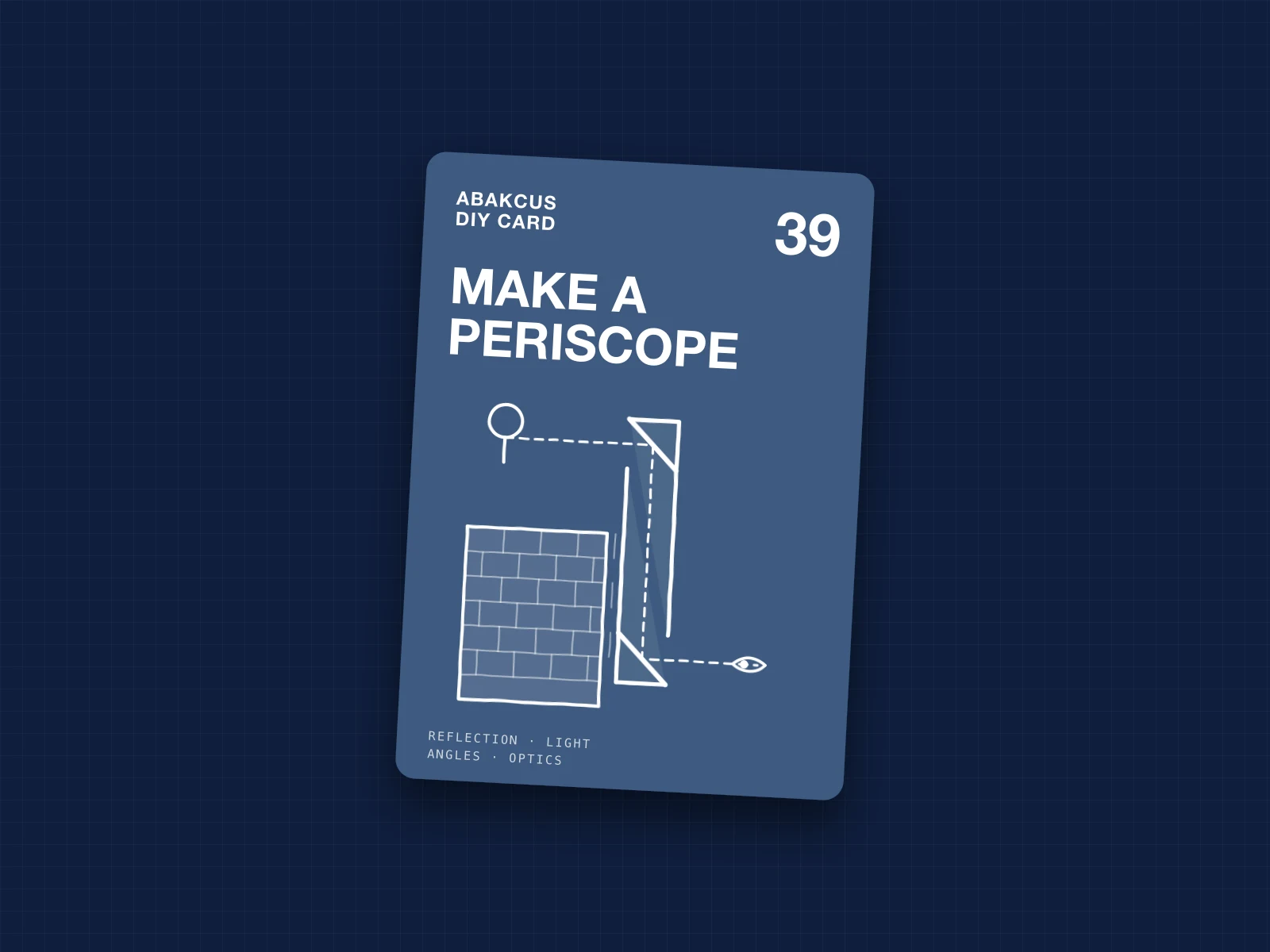
How to Make a Periscope With Two Mirrors and a Box
Two juice cartons and two small mirrors. Set the mirrors at exactly 45° and you can see over walls, round corners and above a crowd, without ever showing your head.
Open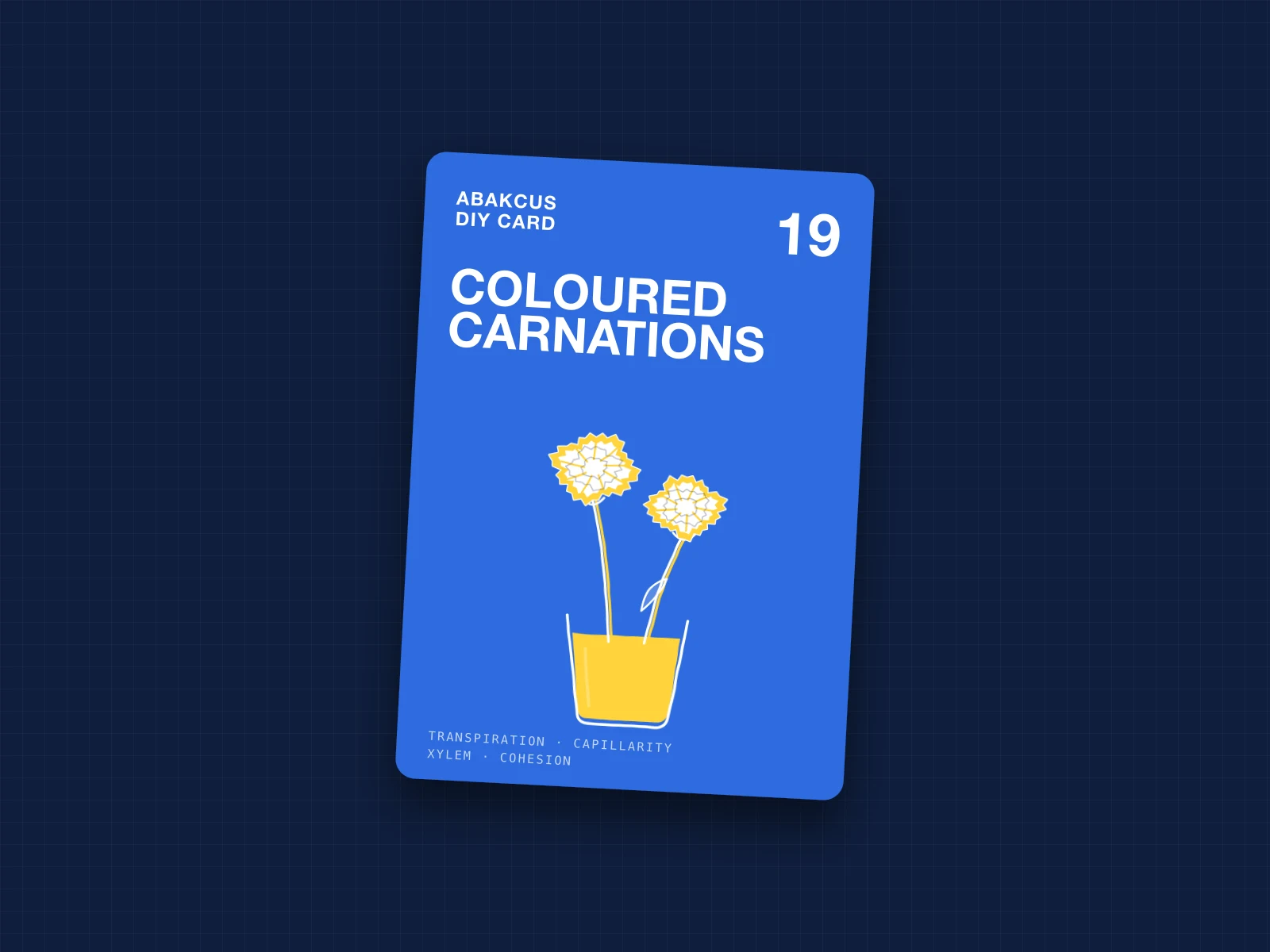
The Coloured Carnations Experiment: How Flowers Drink Water
Stand white carnations in coloured water and by the next day their petals have changed colour. The dye has climbed the stem through tubes thinner than a hair, pulled up by the flower itself.
Open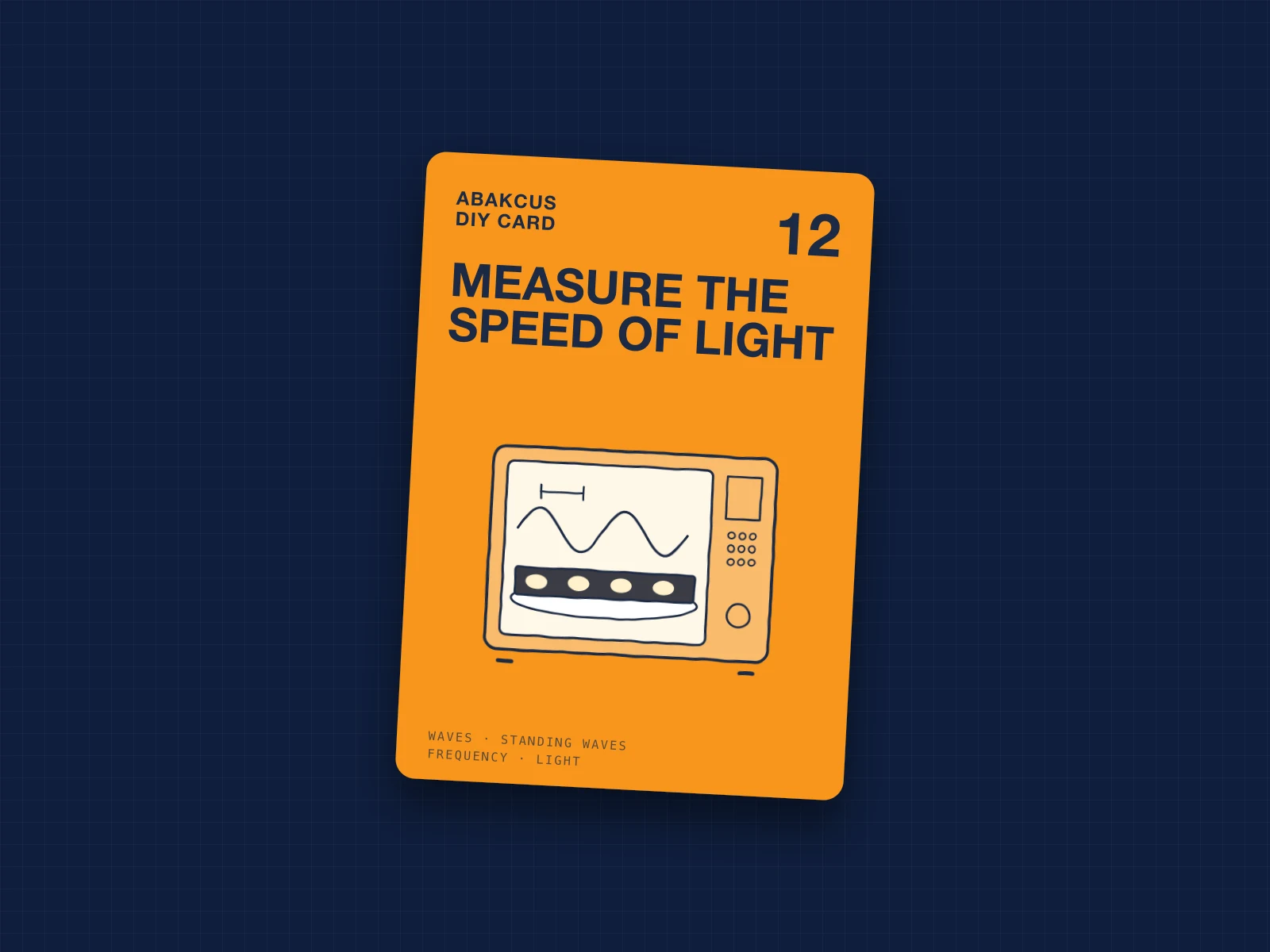
How to Measure the Speed of Light With Chocolate
Take the turntable out of a microwave, heat a bar of chocolate for twenty seconds, and measure the gap between the melted spots. Multiply by the number on the back of the oven and you get the speed of light, give or take a few percent.
Open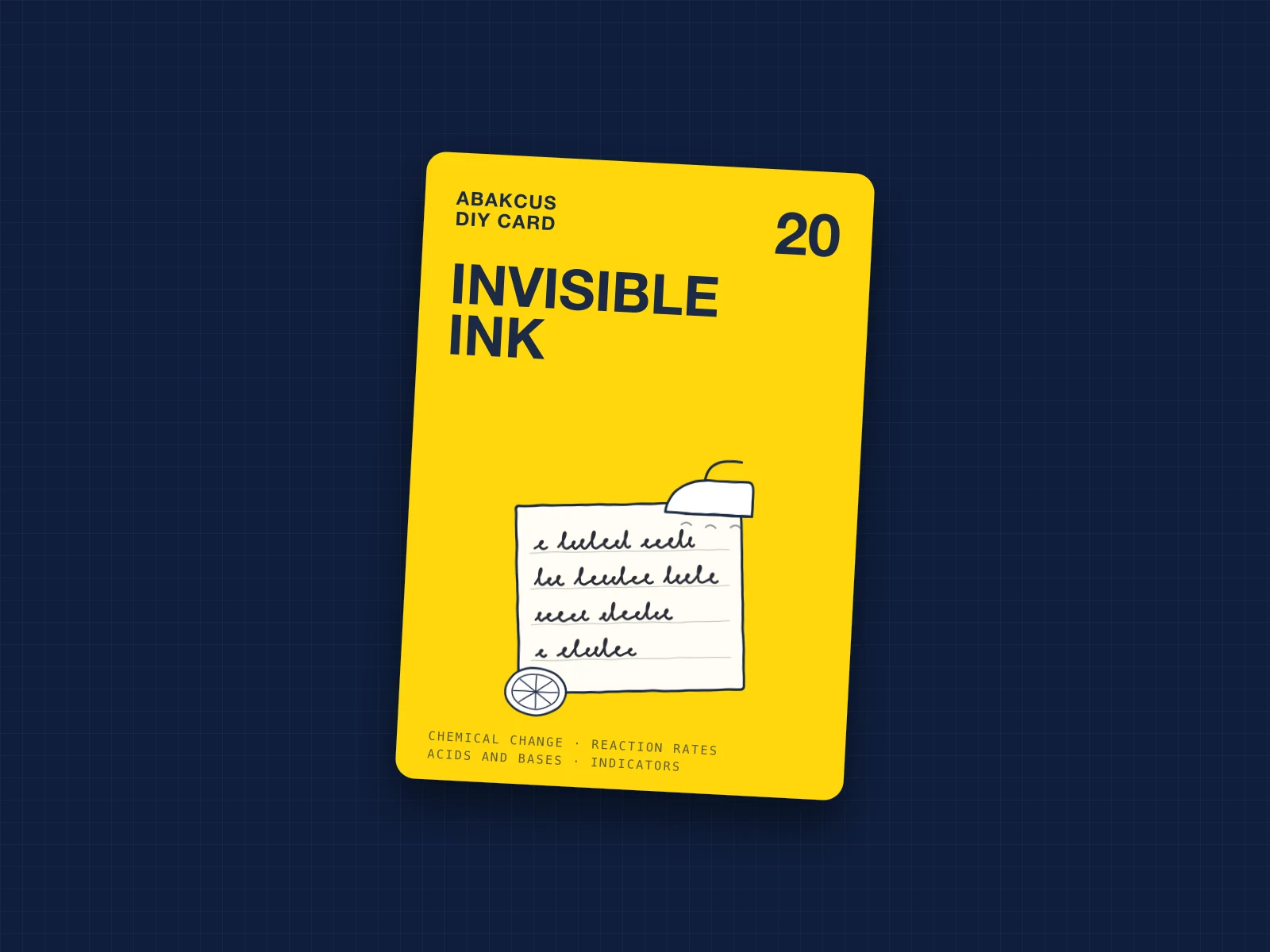
How to Make Invisible Ink With Lemon Juice, and Reveal It
Write with lemon juice, let it dry, and the page looks blank. Warm it and the message darkens into view, because the juice scorches long before the paper does. Spies used the same idea for centuries.
Open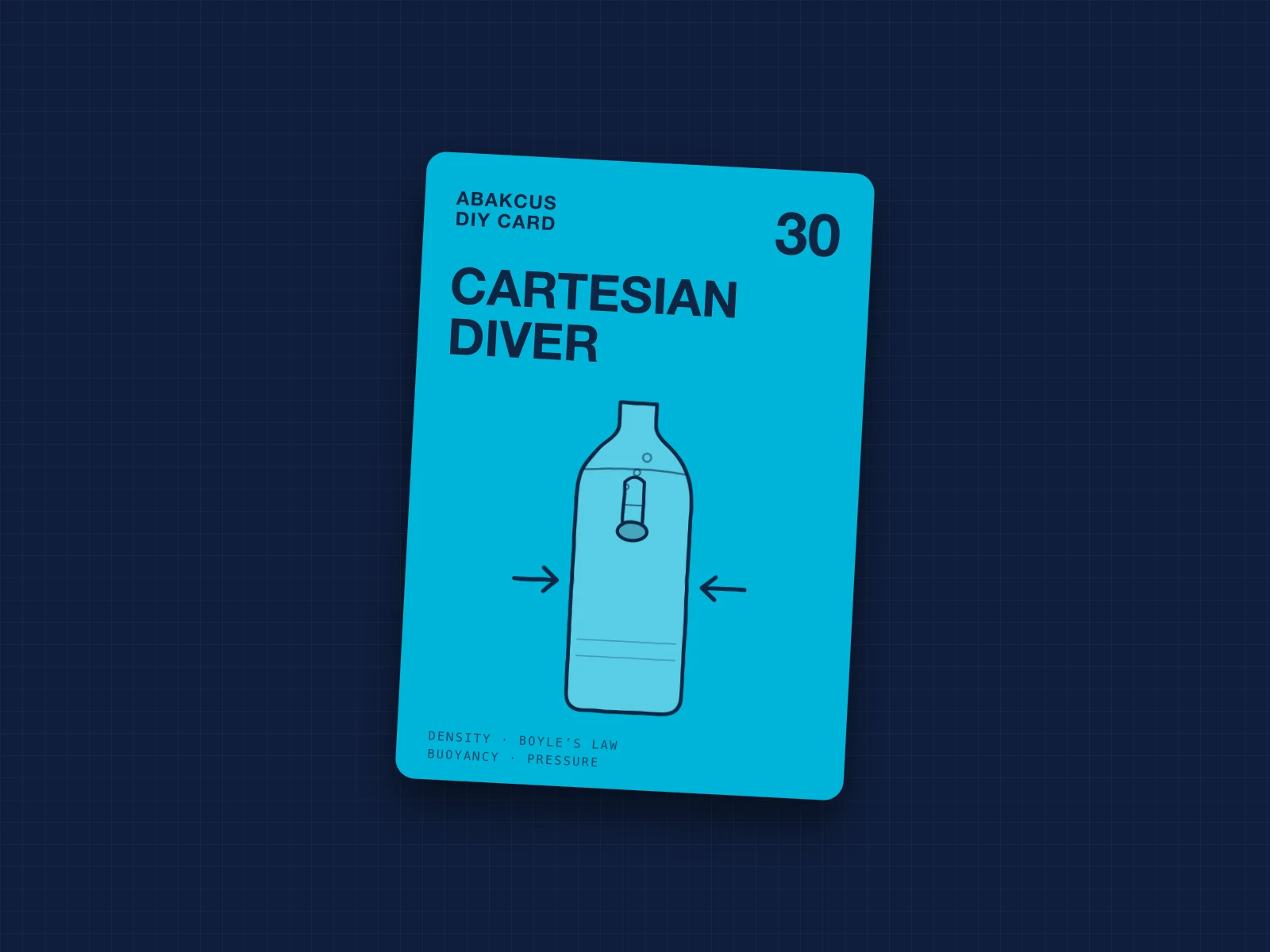
How to Make a Cartesian Diver With a Straw and a Bottle
A scrap of straw, a pinch of plasticine and a bottle of water. Squeeze the bottle and the diver sinks; let go and it floats back up, without ever being touched.
Open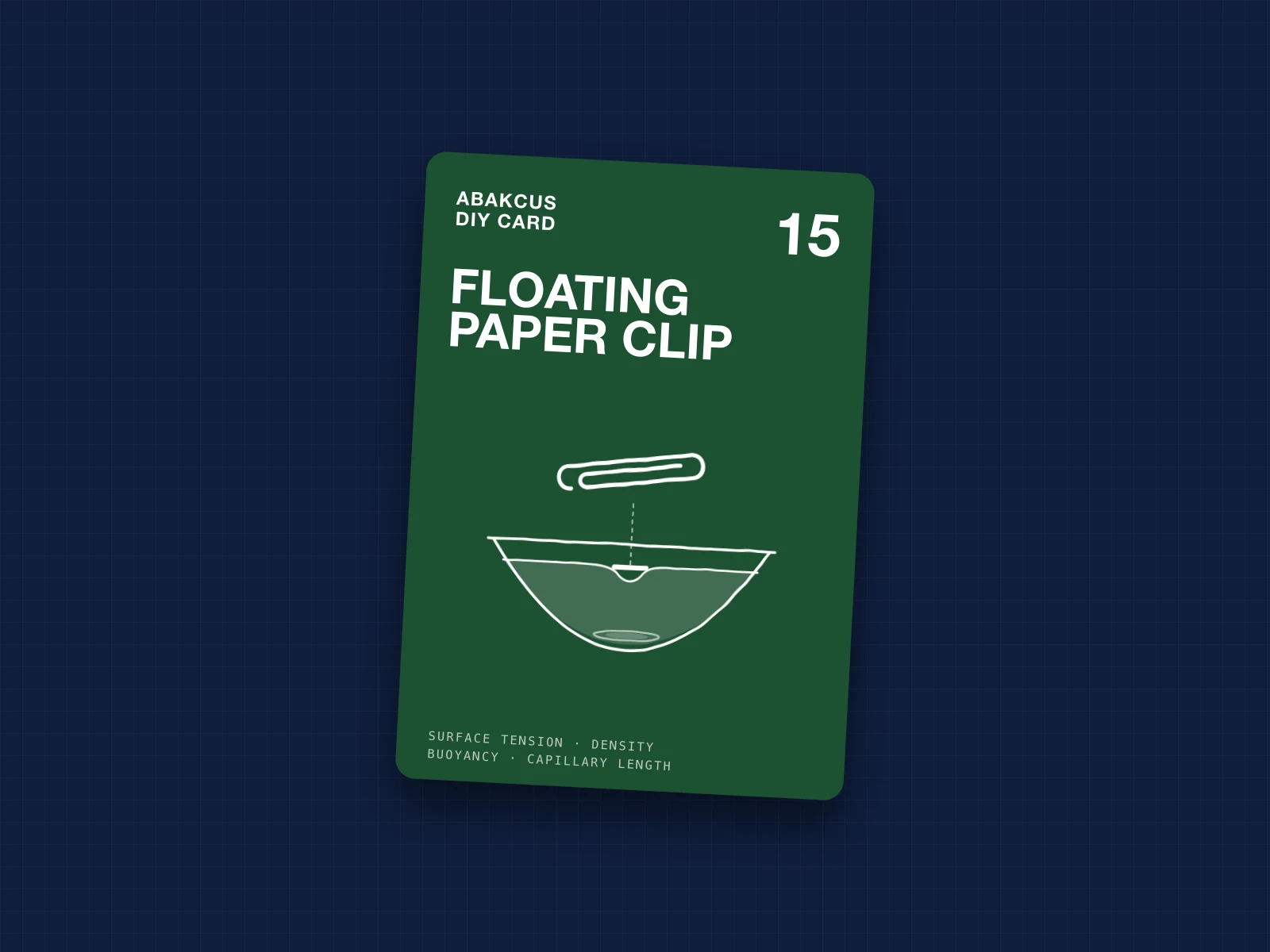
How to Float a Paper Clip on Water: Surface Tension
Steel is nearly eight times denser than water, and a paper clip still lies on top of it if you put it down gently. The surface bends into a dimple and holds it, like a trampoline, until a drop of soap breaks the spell.
Open