
DIY · Card 20 · Chemistry
A blank sheet of paper, a warm iron, and a message that wasn’t there a moment ago. The oldest spy trick there is runs on one fact about heat.
01The brief
Write a message nobody can see, then make it appear, without burning the page.
~30×
how much sooner the lemon writing darkens than the bare paper, in our model
1779
the year George Washington’s spies began using a secret ink
2011
when the US finally declassified its First World War ink recipes
The trick works because two things on the same page react to heat at different temperatures. The paper and the dried juice are both slowly browning all the time, far too slowly to notice. Warm them up, and the juice gets there first.
It is a race, and you set the pace. Too cool and nothing happens; too hot for too long and the whole page darkens. In between is a window, and finding it is the whole experiment. It is the same acid that cleaned the pennies in card 09, doing a very different job.
02Kit
A lemon, paper and something hot. Add baking soda and turmeric for a second ink that needs no heat at all.
Tick off what you have
0 of 4 ready
03Method
Write, dry, heat, read. Then try the heat-free version, and test which other kitchen liquids make good ink.
Step 1 of 8 · Minute 0
Squeeze half a lemon into a small bowl or saucer. Add a few drops of water and stir.
The writing is too faint.
Why
The lines were thin or the juice was too watery.
Fix
Use undiluted juice, write with a well-soaked cotton bud, and go over each letter twice.
The whole page turned dark.
Why
It got too hot for too long, so the paper scorched as well.
Fix
Use a lower setting and keep the iron moving, or shorten the time in the oven.
You can see the writing before heating.
Why
Thick juice left shiny ridges, or the pulp stuck to the paper.
Fix
Strain the juice, add a few drops of water, and write with lighter strokes.
04Chemistry
Lemon juice soaks into the paper and, as it dries, leaves its sugars and citric acid behind among the fibres, the same way the dye was carried into the coloured carnations. In a thin layer they are close to colourless.
Heat makes them react. Sugars break down and darken, as they do when caramel cooks. The acid also attacks the paper fibres it has soaked into, so those fibres scorch sooner than the clean paper around them. Paper scorches too, eventually, but it needs more heat or more time.
The second ink is different chemistry. Baking soda is alkaline, and turmeric is an indicator: its colour depends on how acidic or alkaline its surroundings are. Paint it on and the page turns yellow, except where the soda is, which turns red. Try both, and try lingering too long with the iron:
Message revealed · 0 % · Page scorched · 0 %
Hold down and move over the page. At about 200 °C the juice darkens in seconds; the paper takes minutes.
05The big idea
Hotter isn’t a bit faster.
It’s much faster.
Molecules only react when they bump into each other hard enough, and only a tiny fraction of them have that much energy. Warm them up a little and that tiny fraction grows enormously. A few tens of degrees can turn a reaction that takes weeks into one that takes seconds.
That steepness is why toast burns suddenly, why the fridge keeps milk fresh, and why the lemon wins its race against the paper by such a wide margin. It is also why a hairdryer, only a hundred-odd degrees cooler than an iron, does nothing at all.
06The math
1 · Arrhenius
k = A e−Eₐ / RT
A reaction’s rate k depends exponentially on temperature T, in kelvin. Eₐ is the activation energy, the size of the hill the molecules must climb.
2 · Comparing two temperatures
k₂ / k₁ = e(Eₐ/R)(1/T₁ − 1/T₂)
Divide the rates at two temperatures and the A cancels. This is how much faster the reaction runs at T₂.
3 · Fahrenheit to Celsius
°C = (°F − 32) × 5 / 9
Useful for old recipes, American ovens and one famous novel.
In our model the juice and the paper share an activation energy of about 110 kJ/mol, but the juice darkens at a temperature about 60 °C lower. That gap alone makes the juice about 30 times quicker at any temperature. At 180 °C the writing appears in about half a minute; the paper needs about a quarter of an hour.
Now compare a hairdryer at 60 °C with the oven at 180 °C. In kelvin that is 333 against 453, and e13 230 × (1/333 − 1/453) ≈ 36 000. The same half minute in the oven becomes about 12 days under a hairdryer. And Bradbury’s 451 °F? (451 − 32) × 5/9 ≈ 233 °C, just past the top of the window. Find it yourself:
A good working temperature: the message appears well before the page scorches.
At 190 °C you have about 8 min between the message appearing and the page starting to scorch; the juice always darkens about 30 times sooner. Every 10 °C hotter makes both reactions about 1.8 times faster. A toy model with illustrative numbers: real papers and juices vary.
07Real life
The kitchen, the corner shop and the intelligence services all rely on the same two ideas: reactions that race with temperature, and colours that change on cue.
Toast and caramel
Bread toasts and sugar turns to caramel by the same kind of reactions that reveal the message: sugars and proteins breaking down and darkening with heat. A few seconds too long and toast goes from golden to burnt, because those reactions speed up so sharply with temperature.
The fridge
A fridge works on the same rule in reverse. Cooling food by 15 or 20 degrees slows down the chemistry and the microbes that spoil it so much that milk lasts days instead of hours.
Banknotes under UV
Modern banknotes carry hidden inks that are invisible in daylight and glow under ultraviolet light, so a shopkeeper with a UV lamp can spot a fake. It is invisible ink, revealed with light instead of heat.
pH test strips
The baking soda trick is a chemical indicator at work, a substance that changes colour with acidity. Pool owners, gardeners and chemists use strips soaked in indicators to read a pH at a glance.
Spy letters
For centuries, agents wrote secret messages between the lines of harmless-looking letters. Censors in both world wars brushed suspect letters with chemicals or warmed them to check for hidden writing.
Fahrenheit 451
Ray Bradbury named his novel about book-burning after the temperature, in Fahrenheit, at which he said paper catches fire: about 233 °C. Real paper varies, but the number sits just above the window in which a lemon message appears.
1779
During the American Revolution, George Washington’s spies in British-held New York, the Culper Ring, wrote their reports in a secret ink made by James Jay, a physician and the brother of John Jay. Washington called it the “sympathetic stain” and, in letters, simply “medicine”. A message in it stayed hidden until it was brushed with a second liquid, and Jay never revealed the recipe.
Secret ink stayed secret for a long time. In 2011 the CIA declassified six documents from 1917 and 1918 describing invisible inks and how to open sealed letters undetected. They had been the oldest classified documents held by the US government.
08Is and isn’t
Lemon juice is a special magic ink.
Almost any juice with sugar in it works: apple, orange, milk, onion. Lemon is just the classic. What matters is having something that darkens at a lower temperature than paper.
The heat brings back the colour that was there all along.
The dark writing is new. The heat breaks the sugars and the fibres down into different, darker substances. That is a chemical change, and it can’t be undone.
A hairdryer will reveal it.
A hairdryer blows air at about 50 to 60 °C. At that temperature the reactions are thousands of times slower than at 180 °C, so you would be waiting days.
Invisible ink is just a children’s game.
It was serious spycraft for centuries. The oldest documents the US government kept classified, finally released in 2011, were secret-ink recipes from the First World War.
09Go further
A
The ink test
Write the same word in milk, apple juice, vinegar, onion juice and water. Heat the page. Rank them from darkest to faintest, and work out what the darkest ones have in common.
B
Find the window
With a grown-up, bake identical messages in the oven at 140, 160 and 180 °C and time how long each takes to appear. Does it fit the calculator above?
C
A two-ink letter
Write a fake message in pencil and the real one between the lines in baking soda. Can a friend find it with turmeric water?
D
Fingerprints
Press a slightly lemony fingertip onto paper, let it dry and heat it. Can you see the ridges of your fingerprint?
E
Invent a code
Spies rarely relied on ink alone. Combine invisible writing with a simple substitution cipher, so even a revealed message can’t be read without the key.
10Questions
Dried lemon juice is nearly colourless, so the writing disappears. Its sugars and acid darken with heat at a lower temperature than paper does, so when the page is warmed the writing scorches into view while the rest of the sheet stays pale.
Ask a grown-up to iron the paper on the cotton setting with no steam, keeping the iron moving, or bake it on a tray in an oven at about 180 °C for a few minutes, watching it closely. A hairdryer usually isn’t hot enough.
Yes. The writing that appears is a new, dark substance made by the heat breaking down the sugars and fibres. It can’t be turned back into lemon juice, which is what makes it a chemical change rather than a physical one.
Milk, apple or orange juice, onion juice, vinegar and sugar water all work with heat. Baking soda solution works without heat: paint over it with turmeric water, or grape juice, and the writing changes colour because baking soda is alkaline.
Yes, for centuries. George Washington’s spy network used a secret ink in the American Revolution, and the oldest documents the US government kept classified, declassified in 2011, were First World War recipes for secret ink.
Safety · A grown-up should handle the iron or oven. Never hold paper near a flame, candle or halogen bulb, and never leave a hot iron resting on paper. Turmeric stains fingers and clothes, and lemon juice stings in cuts and eyes.
All DIY cards →Keep wandering
A few more pieces in the same spirit — math, design, and slow attention.

How to Clean a Penny: Cola, Vinegar and Salt Compared
Leave a dull penny in cola overnight and it comes out shining. Drop it in vinegar with a pinch of salt and it shines in seconds. The difference is one ingredient, and the same chemistry turned the Statue of Liberty green.
Open
The Coloured Carnations Experiment: How Flowers Drink Water
Stand white carnations in coloured water and by the next day their petals have changed colour. The dye has climbed the stem through tubes thinner than a hair, pulled up by the flower itself.
Open
How to Blow Up a Balloon With Hot Water: Charles’s Law
Put a balloon on an empty bottle, stand the bottle in hot water, and the balloon lifts itself up. The air didn’t get any more of itself. It just needs more room, and from that one fact you can find absolute zero.
Open
The Ivory Soap Microwave Experiment: Why the Bar Puffs Up
Put a bar of Ivory soap in the microwave and it swells into a cloud several times its size. Hot air alone can’t do that. The water hidden in the soap, turning to steam, can.
Open
How to Get an Egg Into a Bottle Without Touching It
Two days in vinegar take the shell away, a warm bottle does the rest. The egg goes through a mouth narrower than itself, pushed by ten tonnes of air per square metre.
Open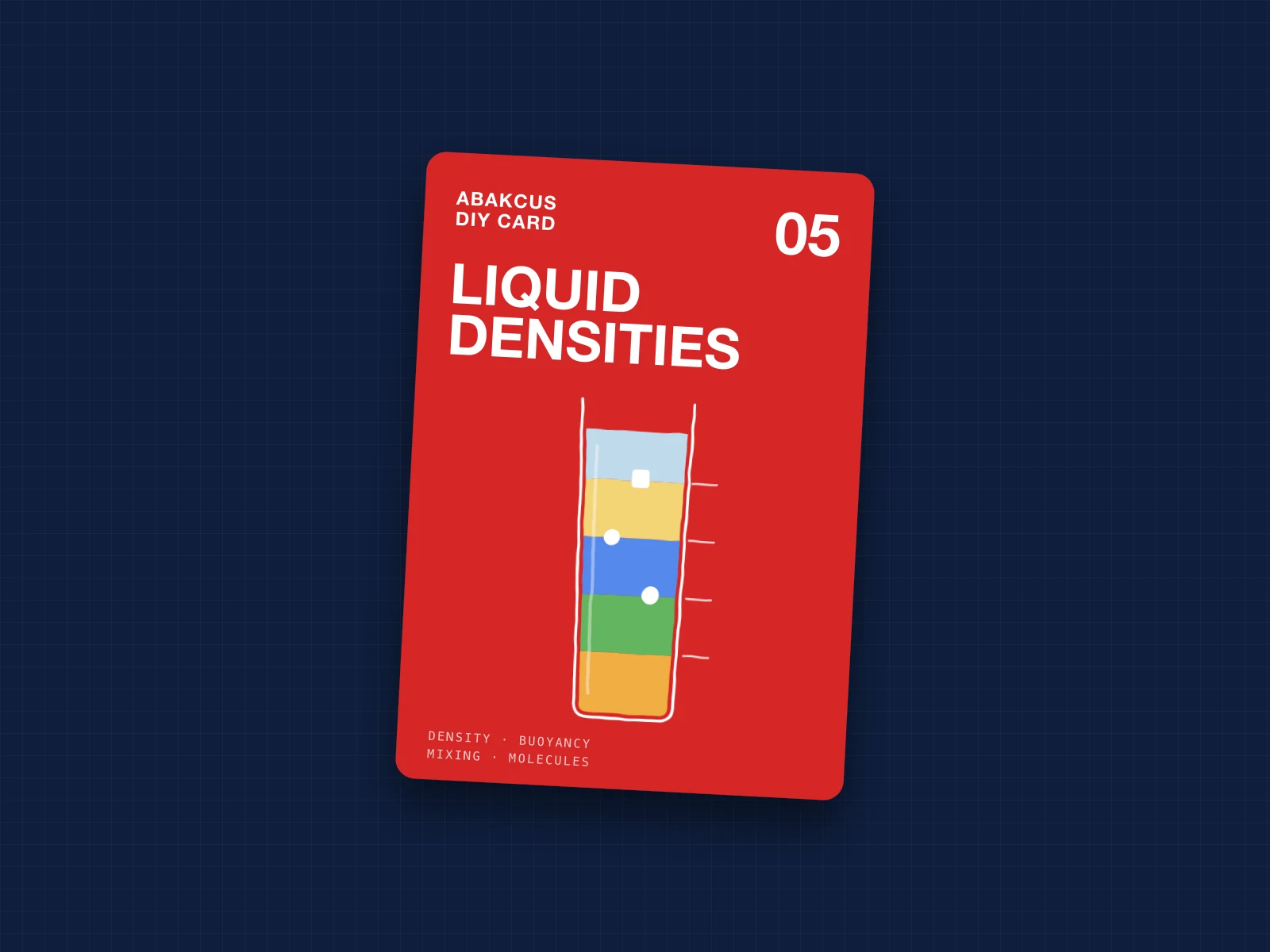
How to Make a Density Tower: Stacking Liquids in a Glass
Honey, washing-up liquid, water, oil and rubbing alcohol, poured one by one into a glass, settle into five sharp layers. Which goes where is decided by one number, and one of them only stays put thanks to the oil.
Open