
DIY · Card 09 · Chemistry
A dull penny in cola comes out bright in the morning. A dull penny in vinegar and salt comes out bright before you can count to ten. One ingredient makes all the difference.
01The brief
Make a dull old penny shine again with cola, then find a way to do it a few thousand times faster.
12 h
for cola to brighten a dull coin, roughly, left overnight
10 s
for vinegar with a pinch of salt to do the same job
⅓ mg
roughly what the whole dull film on a penny weighs
Old copper coins go dark. Leave one in a saucer of cola overnight and in the morning it is noticeably brighter, which is the kind of thing that gets passed around as proof that cola is frighteningly strong stuff. It isn’t. It is about as acidic as lemon juice, and it is actually rather slow at this job.
The interesting part is what happens when you add one more ingredient. Vinegar on its own is no stronger than cola. Stir in a teaspoon of salt and the same dull coin turns bright copper in seconds. Working out why takes you from a saucer on the kitchen table to the green skin of the Statue of Liberty.
02Kit
Two dull coins, so you can run the slow method and the fast one side by side.
Tick off what you have
0 of 5 ready
03Method
The card’s slow version first, then a rematch, then two things you can only do with the leftovers.
Step 1 of 8 · Minute 0
Dig out the oldest, darkest copper coin you can find: a penny, a cent, any copper-coloured coin. Keep a second dull one for later.
The coin barely changed overnight.
Why
Cola is slow, and some coins carry grease or grime over the tarnish.
Fix
Wash the coin with washing-up liquid first, or skip ahead to vinegar and salt.
It came out patchy.
Why
Parts of the coin were touching the dish, or air bubbles sat on it.
Fix
Stand it on its edge against the side, or turn it halfway through.
The nail didn’t change colour.
Why
It was greasy, or galvanised with zinc, or the liquid had too little copper in it.
Fix
Scrub a plain iron nail with soap, and clean a handful of coins in the vinegar first.
04Chemistry
Fresh copper is a bright, warm orange. But copper is only fairly unreactive, not completely. Year after year, the atoms on a coin’s surface combine with oxygen from the air, and the coin grows a skin of copper oxide, dark and dull. It is far thinner than a sheet of paper, a few hundred atoms deep, and it is all you are looking at when you see an old penny.
Acids dissolve that skin. The hydrogen ions an acid carries pull the oxygen out of the oxide to make water, and the copper drifts away into the liquid. Underneath is the same copper the coin was always made of, now uncovered. Cola has acid to do this, mostly phosphoric acid, and given a night it gets most of the way there.
Salt makes the difference because of its chloride. Chloride ions cling to copper and help lift it out of the oxide and into solution, so the acid is never left facing a surface clogged with half-dissolved film. Acid alone is slow; salt alone does nothing; together they are quick. Race them:
pH 2.5
0 % clean
pH 2.6
0 % clean
pH 2.6 · with salt
81 % clean
Rough time to clean, every cleaner
Orange bars have salt in them. Ballpark figures: real coins and brands vary.
05The big idea
A metal’s colour
is skin deep.
Almost every metal you have ever seen has been wearing a coat. Aluminium hides under a clear film of its own oxide; silver under black sulfide; copper under brown-black oxide and, given decades, green patina. What you see is the metal’s reaction with the air, not the metal.
Strip the coat and the metal shines, then starts dressing itself again at once. Whether that coat protects the metal or eats it away, as rust eats iron, decides which things last for thousands of years and which crumble in a lifetime.
06The math
1 · pH
pH = −log₁₀ [H⁺]
pH counts powers of ten. [H⁺] is the concentration of hydrogen ions in moles per litre. One step down the scale is ten times more acid.
2 · The cleaning
CuO + 2H⁺ → Cu²⁺ + H₂O
Copper oxide plus acid gives dissolved copper and water. This is what happens in the cola, slowly, and in vinegar and salt, fast.
3 · The plating
Fe + Cu²⁺ → Fe²⁺ + Cu
Iron gives up electrons more easily than copper, so dissolved copper comes out onto an iron nail while iron dissolves in its place.
Put numbers on the film. A penny is about 19 mm across; take both faces, and say the dark oxide is a tenth of a micrometre thick. That is 2 × π × (0.95 cm)² × 0.00001 cm ≈ 0.00006 cm³ of copper oxide. At a density of 6.3 g/cm³, the whole dull film weighs about 0.36 mg, a third of a milligram.
Dissolving it takes about 0.00001 mol of hydrogen ions. Cola at pH 2.5 holds 10⁻²·⁵ ≈ 0.003 mol of free hydrogen ions per litre, so even a few millilitres of cola has plenty of acid for the job. The amount of acid was never the problem. The speed was, and that is what the salt changes: chemistry is often less about whether a reaction can happen than about how fast it does.
The first formula is where intuition fails. pH 2.5 and pH 1.5 look close; they are ten times apart. Stomach acid and cola, lemon and coffee, bleach and soap: compare any two.
Cola is 32 thousand times more acidic than pure water
pH is a logarithm: it counts powers of ten. A gap of 4.5 on the scale means 10 to the power 4.5, a factor of 32 thousand, in the concentration of hydrogen ions, the active ingredient of every acid. Tap two items to compare them.
07Real life
Tarnish, patina and rust are the same story told by different metals: a reaction with the air that stops at the surface, or doesn’t.
The Statue of Liberty
The statue is a thin copper skin over an iron frame, and when it was unveiled in 1886 it was the colour of a new penny. Over the next few decades the copper turned dark and then green. The green patina is now protecting the copper underneath.
Ketchup on copper pans
Copper-bottomed pans go dark with use, and cooks have long polished them with ketchup or with lemon and salt. It is the vinegar-and-salt trick with a sauce: acid to attack the tarnish, salt to help carry the copper away.
Pickling metal
In factories and jewellers’ workshops, metal parts are dipped into acid baths, called pickle, to strip oxide scale after heating. It is the penny experiment scaled up, and it is how a soldered ring gets its shine back.
Silver, foil and baking soda
Silver goes dark too, with silver sulfide instead of oxide. Lay tarnished silver on aluminium foil in hot water with baking soda and the black film fades in minutes. The aluminium takes the sulfur, in the same give-and-take that plated your nail.
Why iron rusts away and copper doesn’t
Iron’s rust is loose and flaky. It falls off and exposes fresh iron, so rust keeps eating in. Copper’s patina is thin, tight and stable, and it seals the metal under it. That is why ancient bronzes survive and iron nails vanish.
A penny that sticks to a magnet
Since 1992, British 1p and 2p coins have been copper-plated steel, and a fridge magnet picks them up. American cents have been copper-plated zinc since 1982. In both, the copper is a skin, which is exactly the part this experiment works on.
2025
On 12 November 2025, the United States Mint in Philadelphia struck its last penny for circulation, ending a run that began in 1793. By then, a cent cost nearly four cents to make. American pennies had not been solid copper for decades: since 1982 they have been zinc with a thin copper skin, about 2.5 percent of the coin’s weight.
The billions still in circulation are tarnishing in jars all over the country, each one a tiny version of this experiment waiting to be run. Acid against a thin mineral skin is also what took the shell off the egg in the egg in the bottle card, one layer at a time.
08Is and isn’t
Cola cleans coins because it’s a dangerously strong acid.
Cola is about as acidic as lemon juice or vinegar. It cleans slowly precisely because it isn’t especially strong, and it has no salt to speed it up.
If cola can clean a coin, it must eat through your stomach.
Your stomach makes acid around ten times stronger than cola, and its lining is built to cope. The real worry is teeth: frequent sipping can soften enamel over months.
The salt scrubs the coin clean.
Dissolved salt has no grains left to scrub with. It works as chemistry: the chloride helps carry copper off the surface into the liquid.
A cleaned penny stays shiny.
The fresh copper starts reacting with the air straight away. Rinsed and dried, it dulls again over weeks; left wet with salty vinegar, it turns green in an hour.
09Go further
A
Run a cleaner tournament
Line up eight dull coins in eight cups: water, salt water, cola, vinegar, lemon juice, ketchup, lemon with salt, vinegar with salt. Check every five minutes.
B
Salt alone
Try salt water with no acid. Nothing happens. Then try vinegar with no salt. Slow. Then both. The two ingredients only work as a team.
C
Grow a green coin
Leave a vinegar-and-salt coin unrinsed on a paper towel overnight. Compare it with a rinsed one. Patina in a day.
D
The magnet test
Sort a jar of coins with a fridge magnet. In Britain, the ones that stick were made after 1992: copper-plated steel.
E
Write in copper
Paint a word on a clean iron nail or steel spoon with nail varnish, then dip it in the used vinegar and salt. Peel off the varnish: the word is grey on copper.
The same layered liquids from the density tower make a fine test bench: drop a dull coin through honey, washing-up liquid, water and oil and see which layer, if any, brightens it.
10Questions
Put the penny in a shallow dish, cover it with cola and leave it overnight. In the morning, rinse it and dry it. The acid in the cola dissolves the dull copper oxide film and leaves brighter copper underneath.
White vinegar with a teaspoon of salt stirred in. A dull copper coin usually brightens in seconds. Lemon juice with salt and ketchup work quickly too, because they also combine an acid with salt.
The chloride in salt helps pull copper out of the oxide film and into solution, so the acid keeps reaching fresh surface. Vinegar alone works too, but much more slowly. Dissolved salt doesn’t scrub: it is chemistry, not grit.
Copper slowly reacts with oxygen, water, carbon dioxide and sulfur compounds in the air, forming blue-green copper compounds called patina. A coin left wet with vinegar and salt turns green within an hour; the Statue of Liberty took twenty to thirty years.
No. Cola has a pH of about 2.5, similar to lemon juice, while stomach acid is around pH 1.5 to 2, roughly ten times more acidic. Sipping fizzy drinks all day can wear away tooth enamel over months, though, which is why dentists warn about it.
Safety · Don’t drink anything coins have soaked in: it now contains dissolved copper. Wash your hands after handling the coins and the nail, and keep coins away from small children.
All DIY cards →Keep wandering
A few more pieces in the same spirit — math, design, and slow attention.
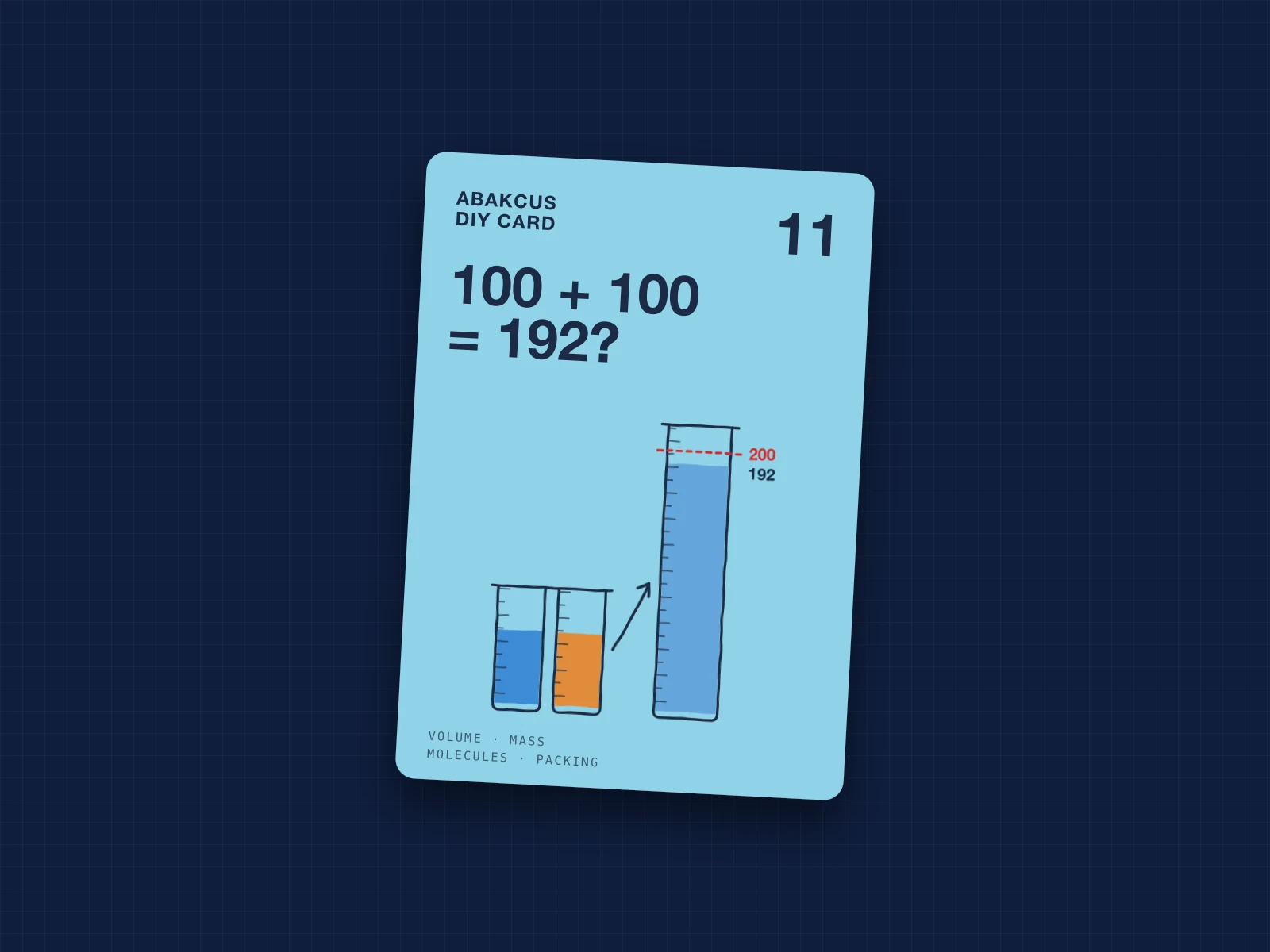
Why 100 ml + 100 ml Makes Less Than 200 ml
Pour 100 ml of alcohol into 100 ml of water and you get about 192 ml. Nothing leaks, nothing evaporates, and the scale says not a gram is missing. The molecules have simply moved in closer together.
Open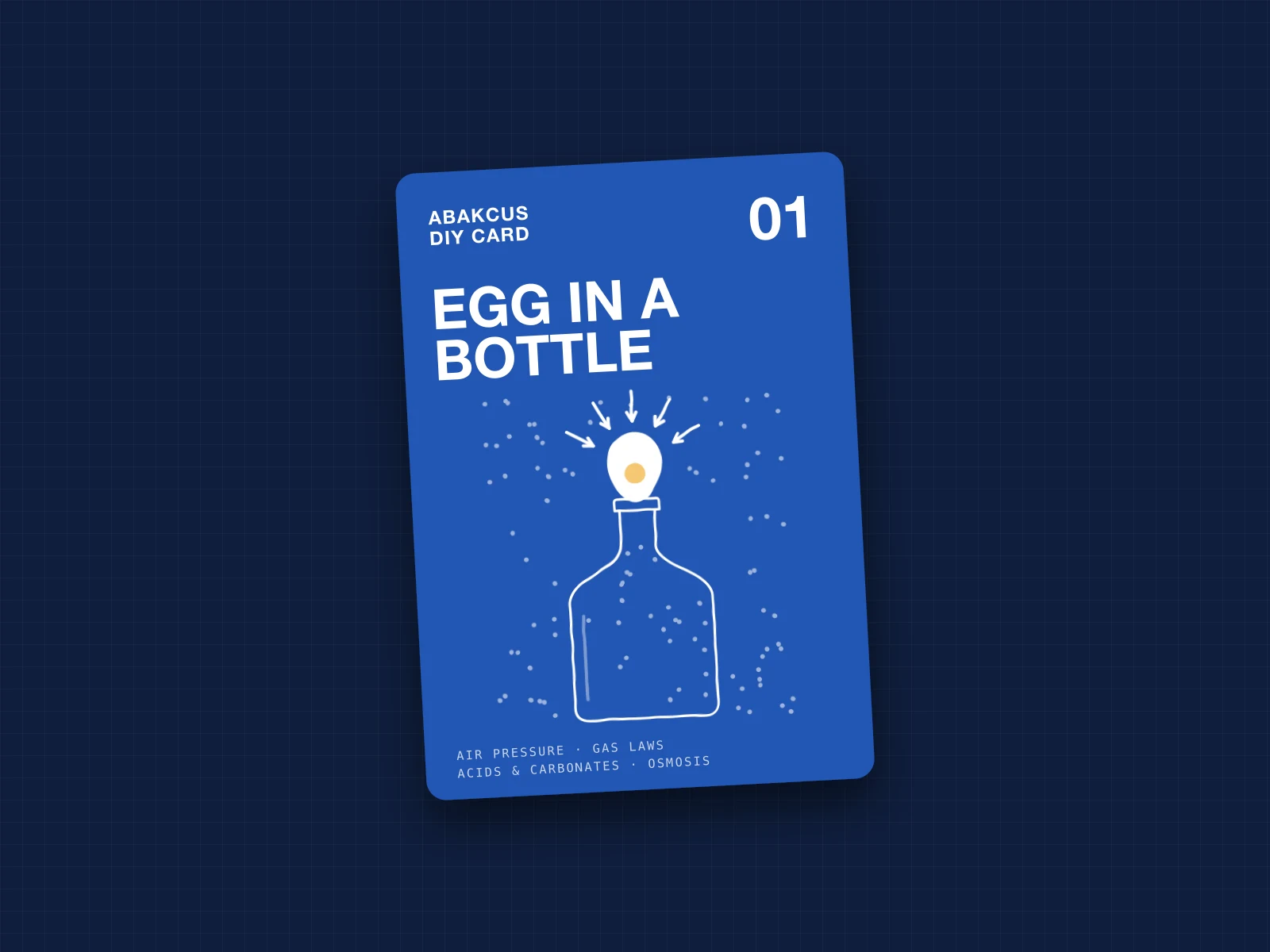
How to Get an Egg Into a Bottle Without Touching It
Two days in vinegar take the shell away, a warm bottle does the rest. The egg goes through a mouth narrower than itself, pushed by ten tonnes of air per square metre.
Open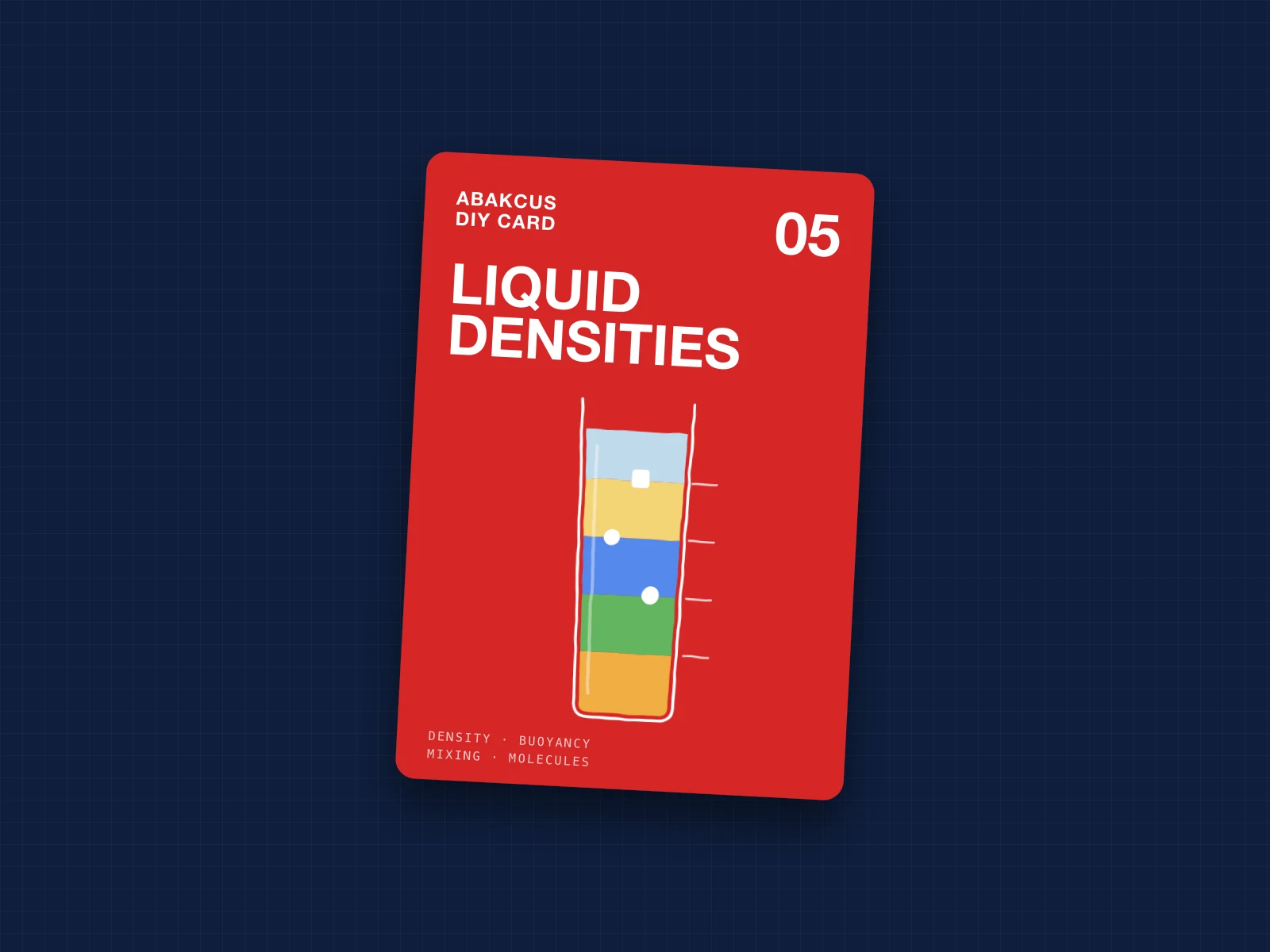
How to Make a Density Tower: Stacking Liquids in a Glass
Honey, washing-up liquid, water, oil and rubbing alcohol, poured one by one into a glass, settle into five sharp layers. Which goes where is decided by one number, and one of them only stays put thanks to the oil.
Open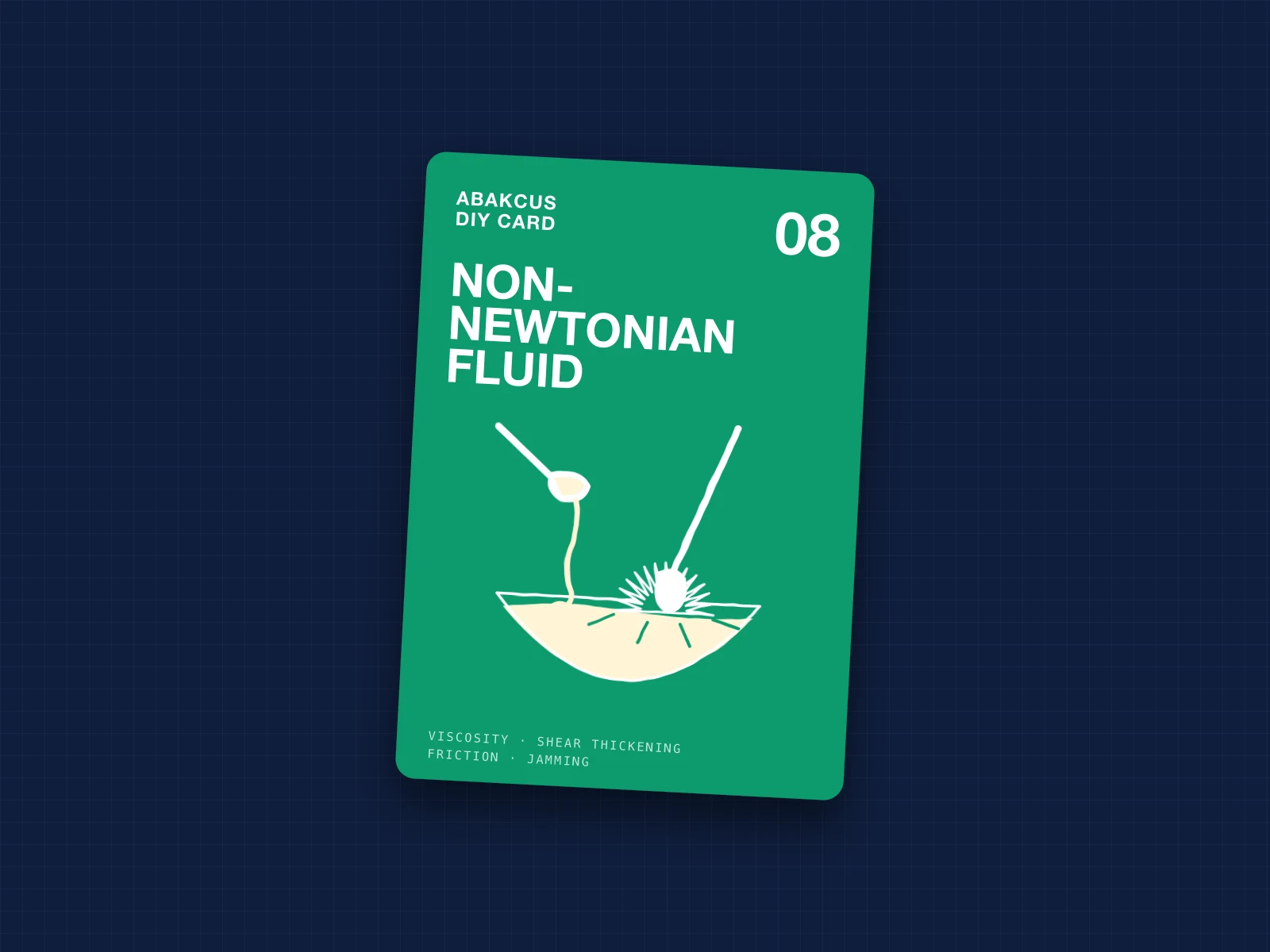
How to Make Oobleck: The Liquid That Turns Solid
Cornflour and water, stirred together in a bowl. Stir slowly and it pours like cream; punch it and it cracks like a brick. The grains inside are doing something physicists only pinned down in the last fifteen years.
Open
How to Make an Underwater Volcano: Convection in a Jar
Hot red water in a salt shaker, lowered into a jar of cold water. It erupts, curls into a mushroom, and lies on the surface like oil, because water one and a half percent lighter has nowhere to go but up.
Open
How to Blow Up a Balloon With Hot Water: Charles’s Law
Put a balloon on an empty bottle, stand the bottle in hot water, and the balloon lifts itself up. The air didn’t get any more of itself. It just needs more room, and from that one fact you can find absolute zero.
Open