
DIY · Card 43 · Science · Electrochemistry
A scrap of steel, a bowl of salt water and a 9 V battery. Draw on the metal, switch on, and twenty minutes later your drawing stands proud of a surface the current has eaten away.
01The brief
Carve a picture into steel without a single tool touching it.
2
electrons pulled from the steel for every atom of iron that dissolves
20 μm
or so etched away from bare steel in ten minutes: thin, but easy to see and feel
1834
the year Faraday published the law that says exactly how much metal a current removes
Steel is hard to scratch and harder to carve. Yet this experiment cuts into it with nothing but a 9 V battery and a bowl of salty water. Wherever your marker pen has been, the steel stays smooth; everywhere else, it quietly dissolves.
It is electricity doing chemistry. The battery pulls electrons out of the steel, and iron atoms that have lost their electrons can’t stay in the metal. It is the same give and take of electrons that powers the potato battery, run the other way, and the same chemistry that makes old coins dull until cleaning a penny brings back the shine.
02Kit
Two scraps of metal, a battery, a bowl of salt water and a marker pen. And an open window.
Tick off what you have
0 of 5 ready
03Method
Make strong brine, draw your design, wire steel to plus and copper to minus, and wait.
Step 1 of 8 · Minute 0
You need a bowl, water and plenty of table salt, a piece of mild steel and a piece of copper or brass sheet, a 9 V battery, two crocodile-clip leads, a permanent marker and some nail polish remover. Work by an open window, with a grown-up.
Nothing seems to happen.
Why
Too little salt, a flat battery, or clips not touching bare metal.
Fix
Dissolve more salt, try a new battery, and clip onto clean, shiny metal.
The design comes out fuzzy.
Why
The marker was thin, or it lifted in the water.
Fix
Draw on clean, dry, degreased steel and go over the design twice.
The copper is etched instead.
Why
The leads are the wrong way round.
Fix
Steel goes to the positive terminal, copper to the negative.
04Chemistry and physics
A metal is a crowd of atoms sharing a sea of loose electrons. The battery’s positive terminal pulls electrons out of the steel plate connected to it. An iron atom that has given up two electrons becomes an iron ion, Fe²⁺, which no longer belongs in the metal and drifts off into the water. Atom by atom, the bare steel is dissolved.
The electrons travel round the circuit to the copper plate, where they join hydrogen from the water, which bubbles off as gas. Between the plates, the salt’s ions carry the current through the water. The more current, the faster the etch. Change the brine, the gap and the time:
Current
0.96 A
Etch depth
20 μm
Iron removed
166 mg
Hydrogen made
71 mL
Every two electrons the battery pulls from the steel take one iron atom with them. 10 minutes removes about 166 mg of iron, a layer around 20 μm deep where the steel is bare, enough to see and feel.
Which plate loses metal depends only on which way round the battery is connected. The plate on the positive side is always the one that dissolves. Swap the leads and see:
The positive end of the battery pulls electrons out of the steel. Each iron atom that loses two electrons breaks free into the water as an ion, so the bare steel is eaten away. At the copper, electrons join hydrogen from the water, which bubbles off.
The etch lab uses typical values for a 9 V battery under heavy load and for salt water’s conductivity, with plates 20 cm² in area. Real batteries fade as they work, so real etches come out a little shallower.
05The big idea
Electricity
does chemistry.
Chemical reactions are electrons moving from one atom to another. A battery uses a reaction to push electrons round a wire. Electrolysis runs it backwards: push electrons with a battery, and you force a reaction that wouldn’t happen on its own.
With that one idea, chemists split water into hydrogen and oxygen, refine copper, make aluminium and chlorine, plate metals with gold and carve parts for jet engines. Your etched steel is a small, slow, very visible piece of it.
06The math
1 · Charge
Q = I t
The charge that flows is the current times the time.
2 · Faraday’s law
m = Q M ⁄ z F
Mass removed: molar mass M, z electrons per atom (2 for iron), F = 96,485 C per mole of electrons.
3 · Depth
d = m ⁄ ρ A
Spread that mass over the bare area A of steel, density ρ = 7.87 g/cm³.
Say 0.7 A flows for 10 minutes: Q = 0.7 × 600 = 420 C. Iron gives up two electrons per atom, so m = 420 × 55.85 ⁄ (2 × 96,485) ≈ 0.12 g of iron dissolves. Spread over 10 cm² of bare steel, that is a layer 0.12 ⁄ (7.87 × 10) ≈ 0.0015 cm, or 15 μm deep: a fifth of a hair’s width.
The same charge makes 420 ⁄ (2 × 96,485) ≈ 0.0022 mol of hydrogen at the copper, about 52 mL of gas, which is why the copper fizzes so steadily. Every quantity in the experiment, metal lost and gas made, is set by one number: the charge that has flowed.
07Real life
From jet engines to phone cases, electricity cuts, coats and makes metals.
Jet engine parts
Some of the hardest metal parts in a jet engine are shaped by electrochemical machining: a shaped tool, a flowing salt solution and a big current dissolve the metal away exactly where it is wanted, without the tool ever touching it.
Electroplating
Run the reaction the other way and metal comes out of the solution onto the cathode. That is electroplating: the gold on electrical connectors, the chrome on taps and the silver on cutlery are all deposited a few atoms at a time by current.
Anodised aluminium
Many phone cases, bike parts and climbing carabiners are aluminium made the anode in an acid bath. Instead of dissolving away, the surface grows a hard, porous layer of oxide that can soak up dye, giving those bright metallic colours.
Making aluminium
Almost all the world’s aluminium is made by electrolysis, a process found in 1886 by Charles Martin Hall and Paul Héroult working separately. Huge currents through molten ore pull out the metal. It uses so much electricity that smelters are built next to power stations.
Rust
Rust is etching nobody asked for. Where steel meets salty water and a different metal, it becomes an accidental battery and slowly dissolves. That is why cars rust faster where roads are salted, and why ships carry blocks of zinc to sacrifice instead.
Marking tools
The logos on knife blades, spanners and surgical instruments are often electro-etched through a stencil, in a few seconds, with a pad soaked in salt solution. It is exactly your experiment, made fast and precise.
1834
In the early 1830s Michael Faraday passed current through all kinds of solutions and weighed what came out. He found that the amount of a substance released depends only on the total charge that flows: twice the current, or twice the time, twice the metal. In 1834 he published it as his laws of electrolysis.
He also needed new words. With the scholar William Whewell he coined electrode, anode, cathode, electrolyte and ion, the very words you use to describe your bowl of salt water. Faraday’s law is still how chemists calculate how much metal a current will plate or etch.
08Is and isn’t
The salt eats the metal.
The salt only lets the water conduct. Without the battery, salt water rusts steel very slowly; with it, the current tears atoms off the anode many times faster. The electricity does the etching.
Both plates get etched.
Only the one on the positive side, the anode. The other plate, the cathode, is protected: electrons arrive there and hydrogen bubbles off. Swap the leads and you swap which metal dissolves.
Any pen will do for the design.
It must be waterproof. Washable ink dissolves in the salt water within minutes, and the steel under it gets etched too.
A bigger voltage would be better.
Much more current makes heat, more gas and a rough, uneven etch, and mains electricity near salt water is deadly. A 9 V battery is slow, safe and gives a clean result.
09Go further
A
Time test
Etch four identical plates for 5, 10, 15 and 20 minutes. Can you see and feel the difference? Does doubling the time double the depth?
B
Salt test
Etch with no salt, a spoonful and as much as will dissolve. How does the amount of salt change the bubbling and the result?
C
Weigh it
If you have kitchen scales that read to 0.01 g, weigh the steel before and after. Does the mass lost match Faraday’s law?
D
Swap the metals
Etch a piece of copper with steel as the partner. Watch the water turn blue-green as copper dissolves.
E
Name tag
Write your name backwards on a scrap of tin, etch it, then press it into modelling clay. Does it print the right way round?
10Questions
Draw a design on a piece of mild steel with permanent marker. Clip the steel to the positive terminal of a 9 V battery and a piece of copper to the negative terminal, then stand both plates apart in strong salt water for 10 to 20 minutes. The bare steel is eaten away, leaving your design raised.
The metal connected to the positive terminal, the anode. The battery pulls electrons out of it, and its atoms break away into the water as ions. The plate on the negative side, the cathode, isn’t etched; hydrogen bubbles off it instead.
Pure water barely conducts electricity. Salt dissolves into sodium and chloride ions, charged particles that can carry current through the water between the plates. More salt means more current and faster etching, up to the point where no more will dissolve.
With a 9 V battery, mild steel and copper, by an open window, it is a gentle experiment for a grown-up and a child together. It makes small amounts of hydrogen and a little chlorine, so don’t do it in a closed box, don’t breathe over the bowl, and never use stainless steel or mains electricity.
Not very: a few tens of micrometres in a typical session, enough to see and feel as a matt, sunken surface. Faraday’s law gives the amount exactly: every two electrons of charge remove one iron atom, so more current or more time etch deeper.
Safety · A grown-up must supervise. Use only a 9 V battery, never mains power or a charger. Work by an open window, don’t cover the bowl or lean over it, and don’t etch stainless or galvanised metal, which can give off harmful compounds. Pour the water away and wash your hands afterwards.
All DIY cards →Keep wandering
A few more pieces in the same spirit — math, design, and slow attention.
How to Make a Potato Battery That Powers a Clock
Two potatoes, two nails and two scraps of copper. Wire them in a row and a clock with no battery starts ticking, powered by metal slowly dissolving inside a vegetable.
Open
How to Clean a Penny: Cola, Vinegar and Salt Compared
Leave a dull penny in cola overnight and it comes out shining. Drop it in vinegar with a pinch of salt and it shines in seconds. The difference is one ingredient, and the same chemistry turned the Statue of Liberty green.
Open
How to Make a Simple Electric Motor (Homopolar Motor)
A battery, a magnet and a bent piece of copper wire: three parts, no coils, and the wire spins on its own. It is the same push that drives every electric motor, found by Faraday in a single afternoon in 1821.
Open
How to Make Invisible Ink With Lemon Juice, and Reveal It
Write with lemon juice, let it dry, and the page looks blank. Warm it and the message darkens into view, because the juice scorches long before the paper does. Spies used the same idea for centuries.
Open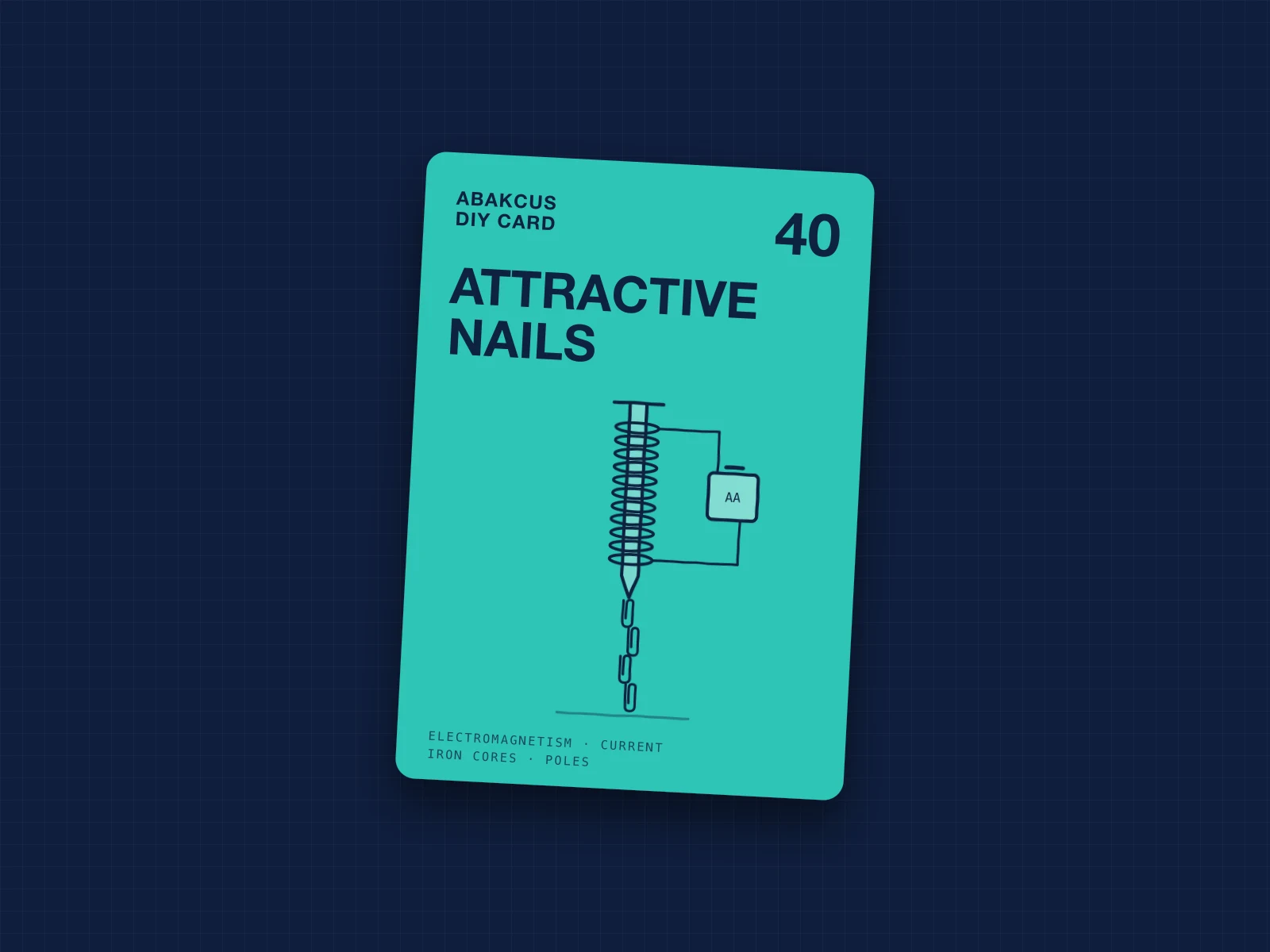
Attractive Nails: How to Make an Electromagnet
A nail, a length of wire and a battery. Wind the wire round the nail and touch it to the battery, and the nail becomes a magnet that picks up paper clips, until you let go.
Open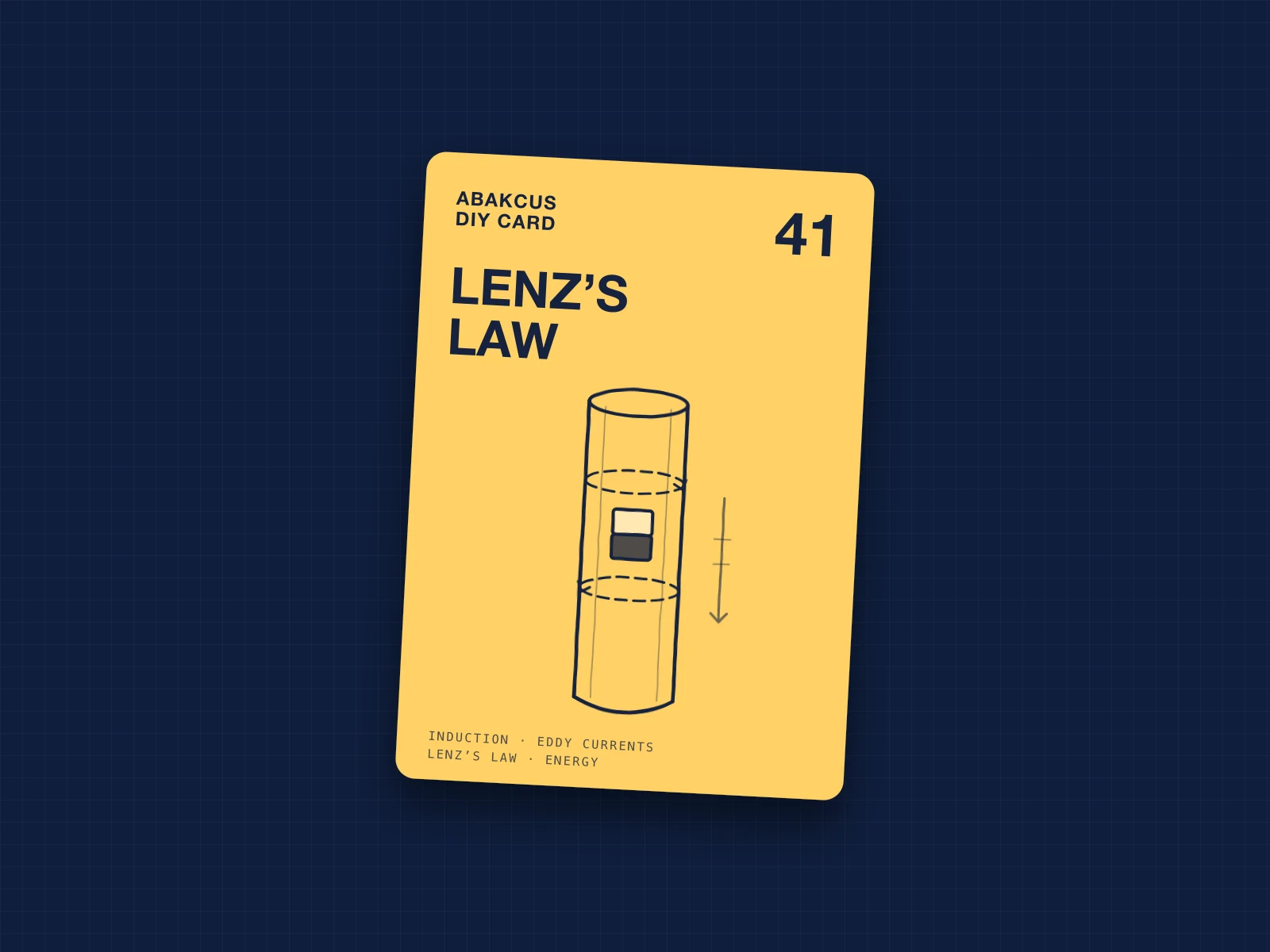
Lenz’s Law: Why a Magnet Falls Slowly Through Copper
Drop a magnet down a plastic tube and it is gone in a blink. Drop it down a copper pipe, which isn’t magnetic at all, and it drifts down as if through honey.
Open