
DIY · Card 41 · Science · Electromagnetism
Drop a magnet down a plastic tube and it is gone in a blink. Drop it down a copper pipe, which isn’t magnetic at all, and it drifts down as if through honey.
01The brief
Make a magnet fall slowly, with nothing touching it.
0.45 s
for a magnet to fall a metre through plastic
15 s
or so for the same magnet down a metre of thick copper pipe
1834
the year Heinrich Lenz explained which way induced currents flow
Copper isn’t magnetic. A magnet slides straight off it. So when you drop a strong magnet into a copper pipe, you expect it to fall straight through. Instead, it hangs in the pipe and drifts down so slowly you can count the seconds.
Nothing is touching it. The pipe is slowing the magnet with electric currents that the magnet itself creates as it falls. It is the same physics, run backwards, as the nail electromagnet, where current makes a magnet; here a moving magnet makes current. And it pushes back, like the motor in the homopolar motor card, by a rule that never fails.
02Kit
A copper pipe, a plastic tube and one strong magnet. The surprise does the rest.
Tick off what you have
0 of 4 ready
03Method
Check the copper isn’t magnetic, drop the magnet through plastic, then through copper, and compare.
Step 1 of 8 · Minute 0
You need a length of copper pipe from a hardware shop, half a metre to a metre long, a strong neodymium magnet that fits inside it with a little room to spare, a plastic tube of about the same size, and a stopwatch. Something soft to land on helps.
The magnet falls straight through.
Why
The magnet is too weak, or the pipe is plastic, steel or very thin.
Fix
Use a strong neodymium magnet and a thick-walled copper or aluminium pipe.
The magnet sticks to the pipe.
Why
The pipe is steel, not copper.
Fix
Copper pipe is reddish orange all through; check it with a magnet in the shop.
The magnet jams halfway down.
Why
It is nearly as wide as the pipe and has turned sideways.
Fix
Use a magnet a few millimetres narrower than the inside of the pipe.
04Physics
In 1831 Michael Faraday discovered that a changing magnetic field makes electric current flow in a conductor nearby. As the magnet falls, the field in each ring of copper below it grows stronger, and in each ring above it grows weaker. Both changes drive currents swirling round the pipe: eddy currents.
Those currents are electromagnets too, and their fields point so as to oppose the change. Below the magnet, the copper repels it; above, it pulls it back. The faster the magnet falls, the stronger the currents, until the braking exactly balances its weight and it falls at a steady crawl. Race it:
Fall time
15.45 s
Top speed
6.5 cm/s
Pipe warms by
0.7 mK
The magnet falls 34 times slower than in plastic. It quickly reaches a steady speed where the push of the eddy currents matches its weight.
The rule is easiest to see with a single ring of metal. Push a magnet towards it and the ring makes a current whose field faces the magnet with a matching pole, pushing it away. Pull the magnet away and the current reverses, pulling it back. The ring always resists whatever the magnet is doing:
Right in the ring, or far from it, the field through the ring is hardly changing at that moment, so almost no current flows. It is change, not the field itself, that makes current. The faster it moves, the bigger the current and the harder the push.
The pipe race uses the standard formula for the braking in a thin-walled pipe, with typical values for a small neodymium magnet and plumbing pipe. Real times depend a lot on the exact magnet and pipe; time yours.
05The big idea
Nature resists
change.
Imagine the currents went the other way, helping the magnet fall. It would speed up, making bigger currents, which would speed it up more: free energy from nothing. That never happens. Lenz’s law is the conservation of energy, written in electricity and magnetism.
It is why a generator is hard to turn, why a spinning motor draws less current than a stalled one, and why a magnet in a copper pipe takes its time. Every induced current is born pushing back against the change that made it.
06The math
1 · Faraday’s law
ε = − dΦ ⁄ dt
The voltage driven round a loop is the rate of change of magnetic flux Φ through it. The minus sign is Lenz’s law.
2 · Magnetic braking
F = k v
Eddy currents make a drag force proportional to speed, with a strength k set by the magnet and the pipe.
3 · Steady fall
v = m g ⁄ k
The magnet stops speeding up when the drag equals its weight.
For a thin-walled pipe, k grows with the copper’s conductivity, the thickness of its wall and the square of the magnet’s strength, and falls steeply, as the fourth power, with the pipe’s radius. For a 10 g neodymium magnet in plumbing pipe 16 mm across, k comes out at about 1.5 N·s/m, so v = 0.01 × 9.8 ⁄ 1.5 ≈ 6.5 cm/s. A metre takes about fifteen seconds.
Where does the energy go? Falling a metre, the magnet gives up m g h = 0.01 × 9.8 × 1 ≈ 0.1 J. Almost all of it heats the pipe. Spread through a third of a kilogram of copper, that warms it by less than a thousandth of a degree: real, but far too small to feel.
07Real life
From theme parks to kitchens to power stations, currents that fight back do useful work.
Roller coaster brakes
Many roller coasters and drop-tower rides stop with fins of copper or aluminium that pass between rows of strong magnets. Eddy currents brake them smoothly, with nothing touching, and since the magnets are permanent, the brakes work even in a power cut.
Induction hobs
Under the glass of an induction hob is a coil carrying a rapidly changing current. Its changing field drives eddy currents in the bottom of the pan, and their heat cooks the food while the glass stays cool.
Recycling sorters
At recycling plants, a spinning drum of magnets at the end of a conveyor whips up eddy currents in aluminium cans. The currents’ field repels the magnets, flinging the cans off the belt into their own bin, while plastic and glass simply drop.
Coin testers
In a vending machine, coins roll past a magnet. Each metal makes eddy currents of a different strength, so each kind of coin is slowed by a different amount, and fakes of the wrong metal land in the reject slot.
Generators
In every power station, magnets spin past coils of wire, or coils past magnets, and the changing field drives current round the coils. Lenz’s law is why it is hard work: the current pushes back on the spinning magnet, and the turbine has to keep pushing.
Regenerative braking
An electric car brakes partly by turning its motor into a generator. Driven by the wheels, it makes current that charges the battery, and Lenz’s law makes that current fight the wheels’ turning, slowing the car down and saving the energy.
1831
On 29 August 1831, Michael Faraday wound two coils of wire on opposite sides of an iron ring. When he connected a battery to one coil, a needle on the other twitched, and when he disconnected it, it twitched the other way. Current flowed only while the magnetism was changing. He had discovered electromagnetic induction.
Three years later, in St Petersburg, Heinrich Lenz worked out the rule for which way the induced current flows: always so as to oppose the change. Faraday’s discovery became the generator and the transformer, and so the whole electricity supply. Lenz’s rule is why every one of them pushes back.
08Is and isn’t
Copper must be a little bit magnetic.
It isn’t. A magnet won’t stick to it, and a magnet standing still inside the pipe feels nothing at all. The force appears only when the magnet moves.
The magnet is rubbing against the sides.
Drop a wooden plug of the same size and it falls straight through. The slowing has nothing to do with friction: it is the push of electric currents in the metal.
The energy disappears.
It turns into heat. The eddy currents warm the copper, very slightly. Energy the magnet would have gained as speed is handed to the pipe instead.
A pipe slit down its length works just as well.
A slit stops the currents from flowing all the way round, so they are much weaker and the magnet falls much faster. The currents need a complete loop of metal.
09Go further
A
Length test
Time the magnet through pipes of different lengths. Is the time proportional to the length? What does that tell you about its speed?
B
Two magnets
Stick two magnets together and drop them. They weigh twice as much, but they are a stronger magnet too. Which wins?
C
Cold copper
Chill the pipe in the freezer, then try again. Cold copper conducts better. Is the fall slower?
D
Pendulum brake
Hang the magnet on a thread and let it swing just over a thick copper or aluminium sheet. How quickly does the swing die away compared with over wood?
E
Feel the push
Push a strong magnet quickly across a flat aluminium sheet, then slowly. Can you feel the difference in drag?
10Questions
As the magnet falls, the magnetic field in each part of the pipe changes, and a changing field makes electric currents swirl round the copper. By Lenz’s law those eddy currents make a magnetic field that opposes the change: it pushes up on the magnet from below and pulls up on it from above, slowing its fall.
Lenz’s law, stated by Heinrich Lenz in 1834, says that a current produced by a changing magnetic field always flows in the direction that opposes the change that made it. It is why induced currents brake moving magnets, and it follows from the conservation of energy.
No. A magnet won’t stick to copper, and copper has no pull on a magnet that is standing still. It only resists a magnet that is moving, because the motion drives currents in it. Stop the magnet, and the currents and the force vanish.
Into heat. The eddy currents flow through the copper’s small resistance and warm it, by a tiny amount. All the energy the magnet would have gained as speed ends up as warmth in the pipe.
Braking without contact, in roller coasters, drop-tower rides and some trains; heating, in induction hobs; sorting, in recycling plants that throw aluminium cans off a conveyor; and testing, in metal detectors and coin slots that check what a coin is made of.
Safety · Neodymium magnets are strong enough to pinch skin and shatter if they snap together. Keep them away from phones, cards and pacemakers, and never let small children have them: swallowed magnets are dangerous.
All DIY cards →Keep wandering
A few more pieces in the same spirit — math, design, and slow attention.
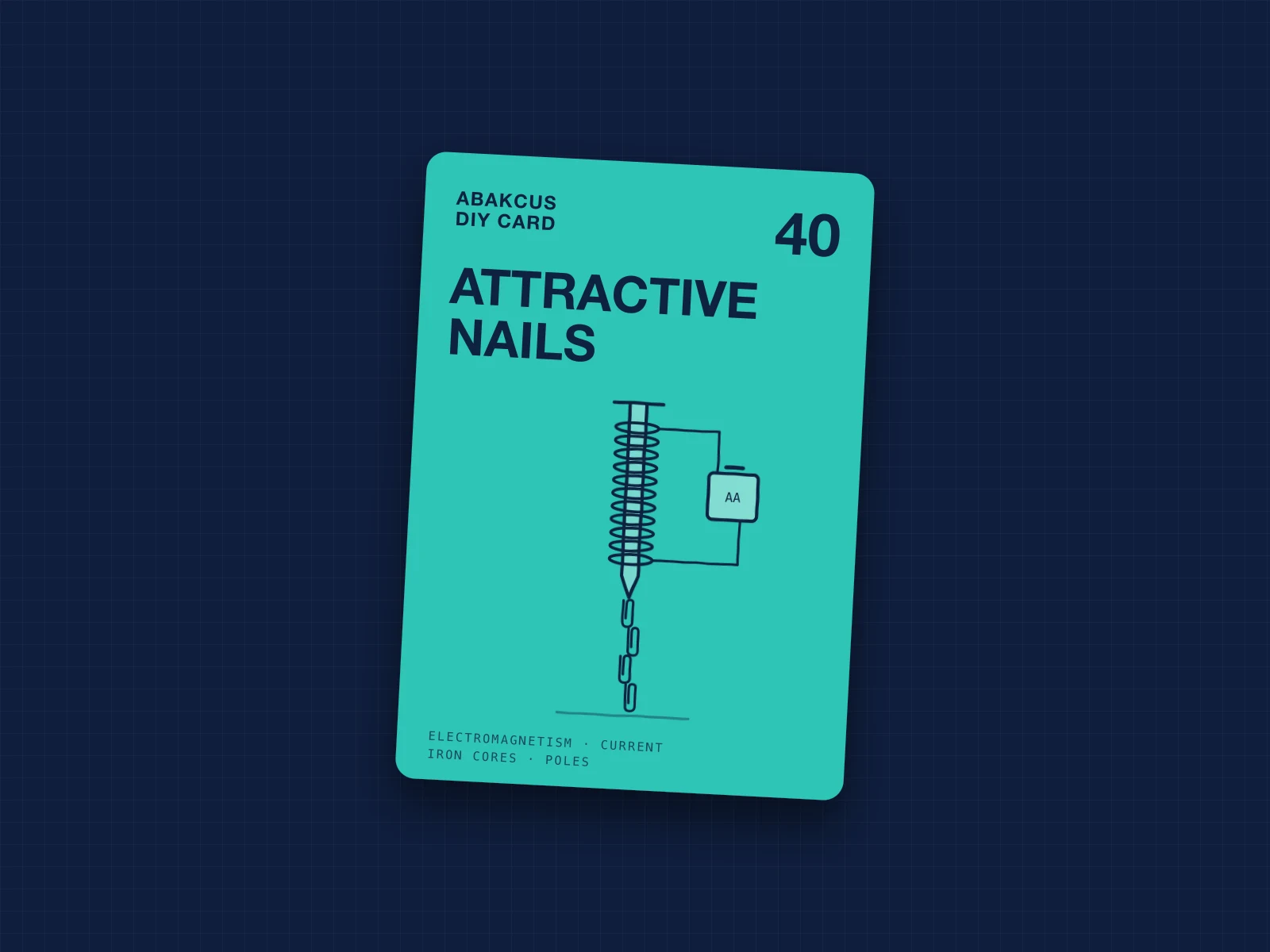
Attractive Nails: How to Make an Electromagnet
A nail, a length of wire and a battery. Wind the wire round the nail and touch it to the battery, and the nail becomes a magnet that picks up paper clips, until you let go.
Open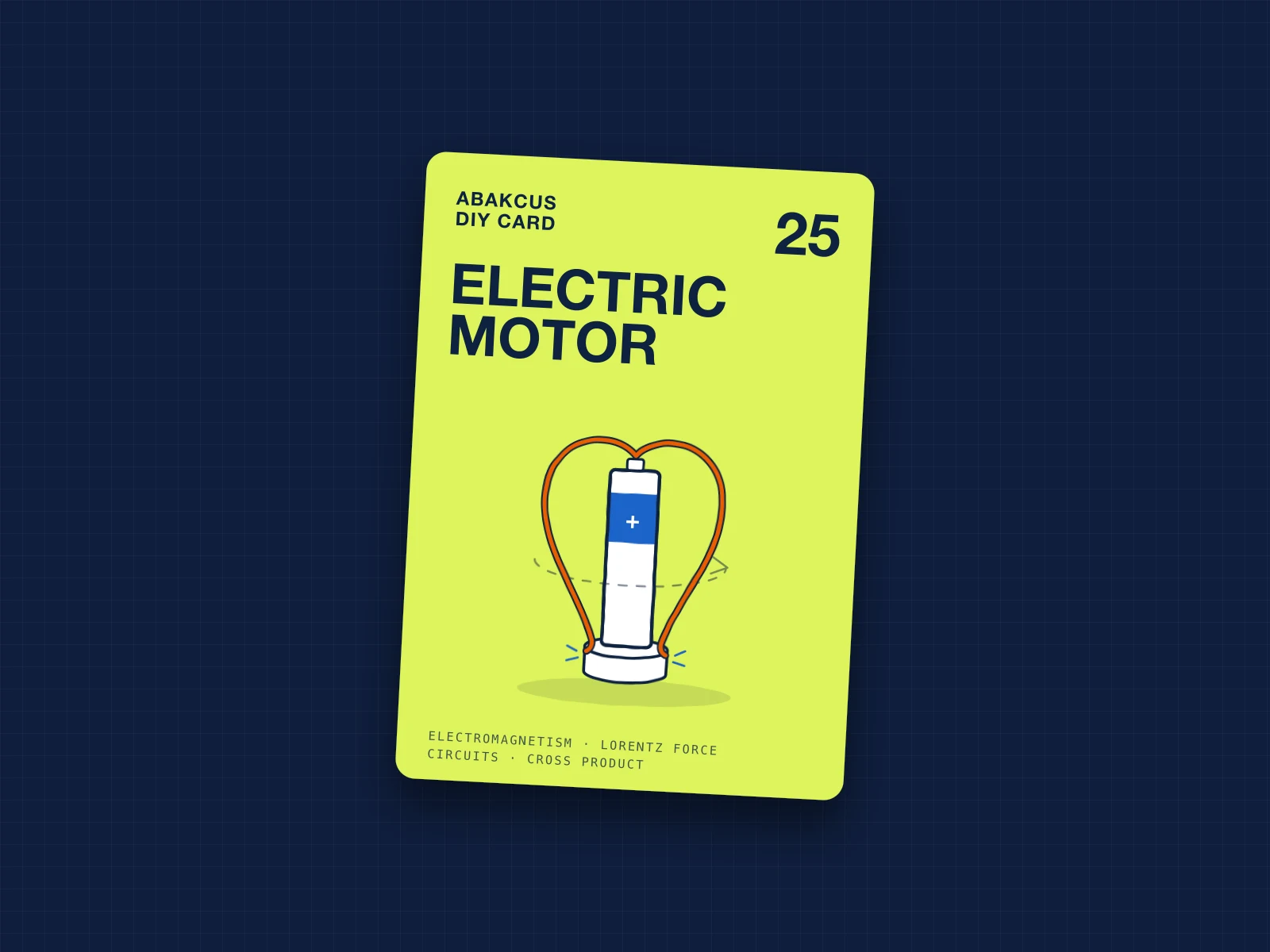
How to Make a Simple Electric Motor (Homopolar Motor)
A battery, a magnet and a bent piece of copper wire: three parts, no coils, and the wire spins on its own. It is the same push that drives every electric motor, found by Faraday in a single afternoon in 1821.
Open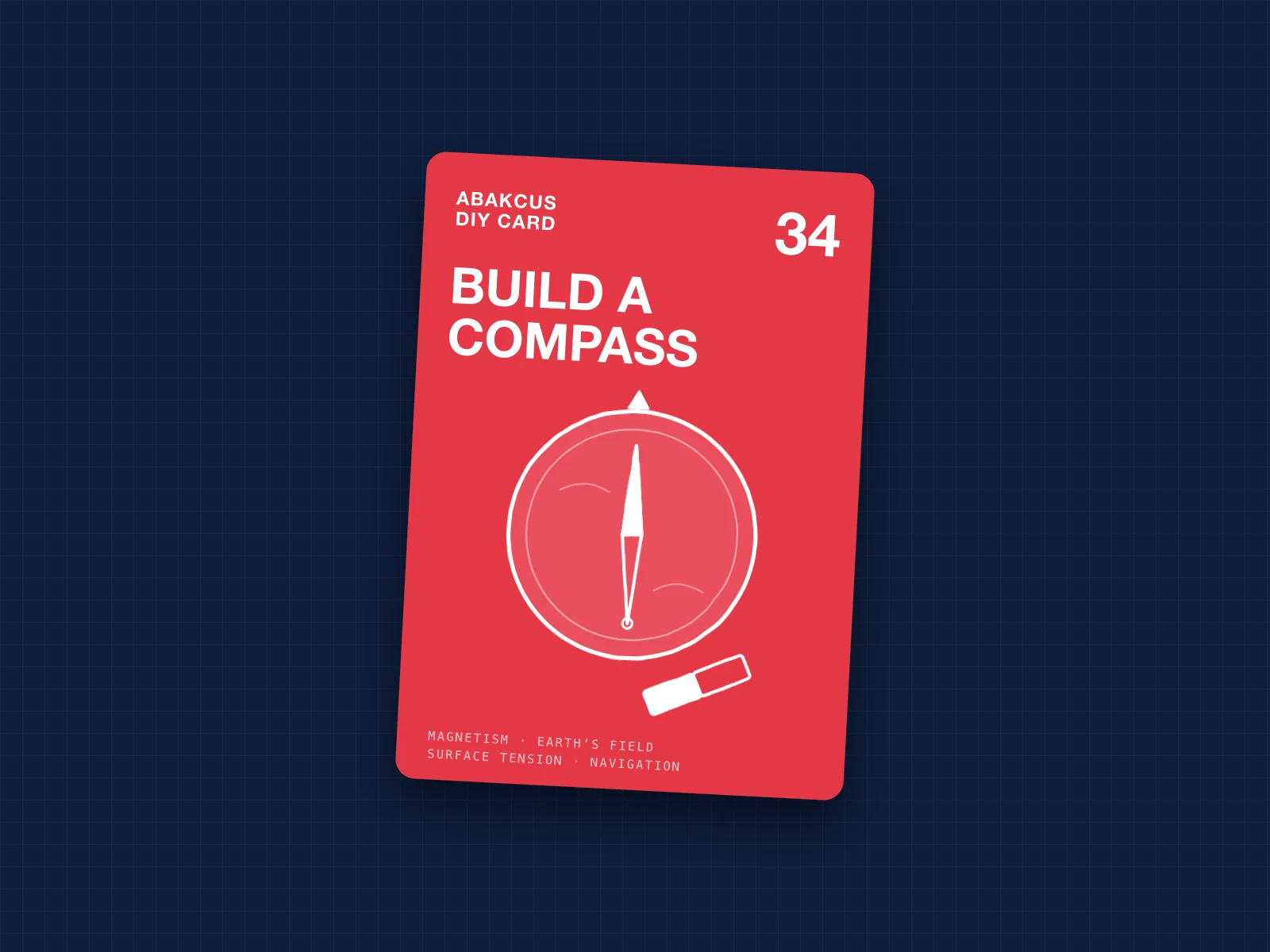
How to Build a Compass With a Needle, a Magnet and Water
A sewing needle, a magnet and a bowl of water. Fifty strokes turn the needle into a magnet, and floated on the water, it swings round to feel the invisible field of the whole Earth.
Open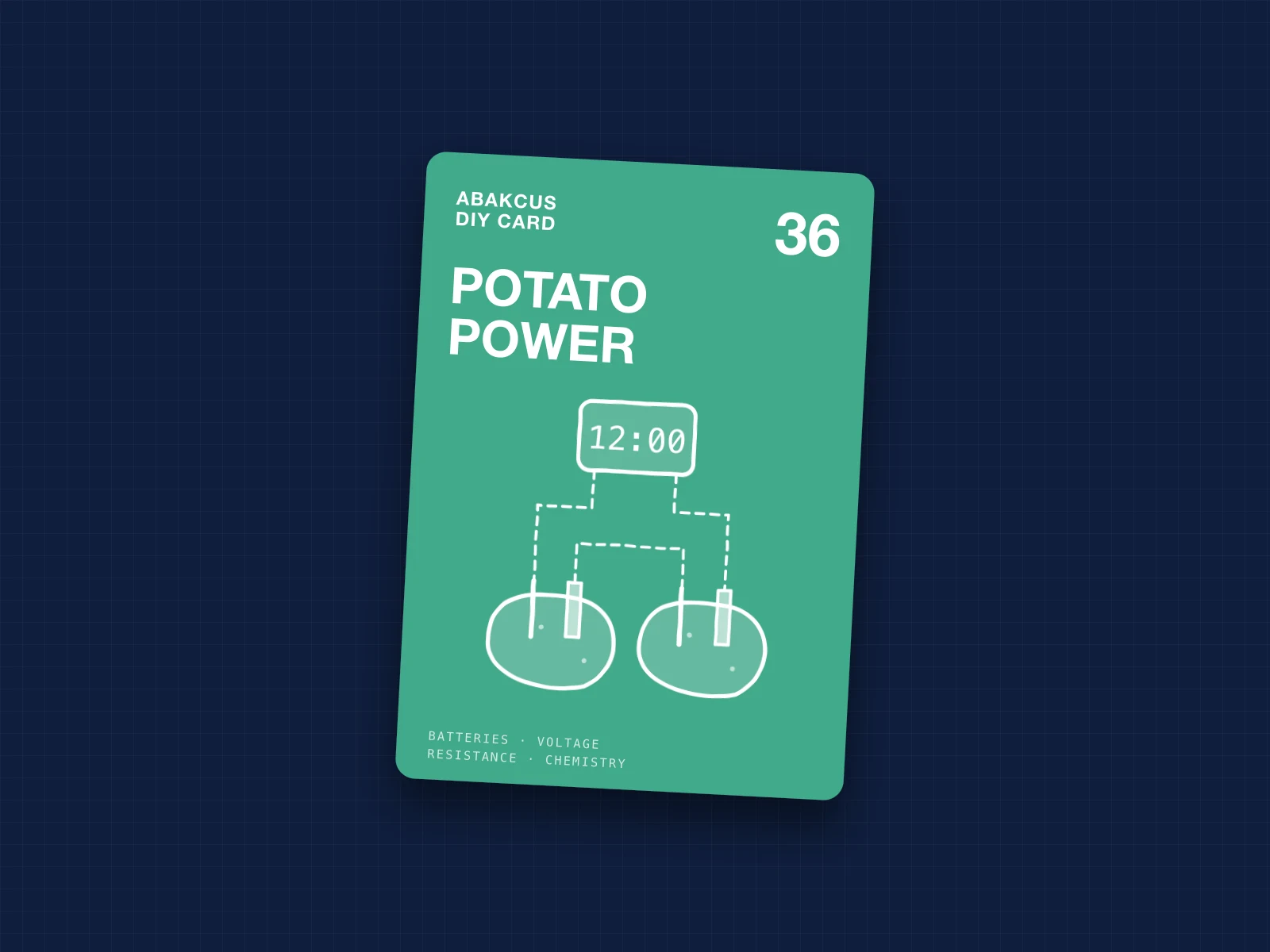
How to Make a Potato Battery That Powers a Clock
Two potatoes, two nails and two scraps of copper. Wire them in a row and a clock with no battery starts ticking, powered by metal slowly dissolving inside a vegetable.
Open
How to Do the Egg Drop Inertia Trick: Newton’s First Law
Knock a tray out from under an egg and the egg drops straight down into a glass of water. The trick is speed, not strength, and the egg’s weight turns out not to matter at all.
Open
How to Measure the Speed of Light With Chocolate
Take the turntable out of a microwave, heat a bar of chocolate for twenty seconds, and measure the gap between the melted spots. Multiply by the number on the back of the oven and you get the speed of light, give or take a few percent.
Open