
DIY · Card 34 · Engineering · Magnetism
A sewing needle, a magnet and a bowl of water. Fifty strokes turn the needle into a magnet, and floated on the water, it swings round to feel the invisible field of the whole Earth.
01The brief
Make a compass that finds north on its own, from things you can find at home.
50
strokes of the magnet, all one way, to turn a sewing needle into a compass needle
25–65 μT
the strength of Earth’s magnetic field at the surface, hundreds of times weaker than a fridge magnet
1088
the year a Chinese scholar described the magnetised needle, and noticed it didn’t point quite true
Earth is wrapped in a magnetic field you can’t see, hear or feel. It is everywhere, all the time, faint and steady, pointing roughly from south to north. A floating needle is enough to reveal it.
The trick is to turn an ordinary needle into a magnet, then give it somewhere to turn freely. Stroke it with a magnet and the steel’s tiny magnetic regions line up. Float it on water and it swings round to line up with Earth. It floats the way the floating paper clip does, and it turns for the same reason as the wire in the homopolar motor: a magnetic field pushing on a magnet.
02Kit
Three things, and somewhere well away from metal.
Tick off what you have
0 of 3 ready
03Method
Magnetise the needle, test it, float it on still water, and let Earth do the rest.
Step 1 of 8 · Minute 0
You need a steel sewing needle, a bar magnet or a strong fridge magnet, a wide bowl of water and, to make floating easy, a small square of tissue or a slice of cork.
The needle doesn’t turn at all.
Why
It isn’t magnetised enough, or it is touching the side of the bowl.
Fix
Give it 30 more strokes, all one way, and float it in the middle of a wide bowl.
It points somewhere other than north.
Why
Something magnetic is nearby: a phone, a speaker, a steel table frame.
Fix
Move the bowl to a wooden or plastic table, away from metal, and try again.
The needle keeps sinking.
Why
It broke through the surface, or the water has soap in it.
Fix
Use clean water, dry the needle, and float it on a scrap of tissue that sinks away.
04Physics
Iron and steel are made of microscopic regions called domains, each one a little magnet. In an ordinary needle they point every which way and cancel out. Stroke the needle with a magnet and you drag more and more of them into line, until the whole needle is a magnet with a north-seeking end and a south-seeking end.
Earth is a magnet too, its field made by molten iron churning in its outer core. A magnet that is free to turn feels a twist, a torque, until it lines up with the field around it. On water, there is almost nothing to stop it, only the water’s gentle drag, which lets it settle instead of swinging for ever. Magnetise it and knock it:
Magnetised
43 %
Swing
7.0 s
Off north
70°
Knock it and it swings past north, back again, and settles: Earth’s field turning it one way, the water slowing it down.
Earth’s field is weak. The field of a small magnet is far stronger close up, but it falls away fast: twice as far, eight times weaker. So near a magnet, a compass points at the magnet, and a little way off it points north again. Drag the magnet around:
Drag the magnet around the table.
Distance
37 cm
Magnet’s field
1.6 μT
Needle off north
1°
Far enough away that the magnet hardly matters. Its field falls with the cube of distance: twice as far, eight times weaker. Earth’s field wins, and the needle points north.
The models use a horizontal Earth field of 25 μT, typical of Europe and Turkey, and fair guesses for the strength of a stroked needle and a small bar magnet.
05The big idea
The planet
is a magnet.
In 1600 the English physician William Gilbert published a book arguing that Earth itself is a great magnet. He carved a small sphere of lodestone, a naturally magnetic rock, and showed that a needle moved over it behaved just as compasses do around the globe.
Your bowl of water does the same experiment in reverse. The needle is a tiny magnet, the planet is the big one, and the needle’s swing tells you about something nearly three thousand kilometres beneath your feet.
06The math
1 · The twist
τ = m B sin θ
A magnet of moment m at an angle θ to a field B feels this torque, turning it to line up.
2 · The swing
T = 2π √(I ⁄ m B)
A needle with moment of inertia I swings about north with this period, if nothing slows it.
3 · A magnet’s reach
B ∝ 1 ⁄ r³
The field of a bar magnet falls with the cube of distance r, along any line from it.
A well-stroked needle might have a moment of about 0.003 A·m². In Earth’s horizontal field of 25 μT, the biggest twist it feels is 0.003 × 0.000025 = 7.5 × 10⁻⁸ N·m: tiny, but a 4 cm needle weighing 0.3 g has a moment of inertia of only 4 × 10⁻⁸ kg·m². So it swings with a period of 2π √(4 ⁄ 7.5) ≈ 4.6 s, slow and stately.
The cube in the third line explains why a magnet across the room does nothing and one beside the bowl takes over. A small bar magnet makes about 12 μT at 20 cm, half of Earth’s field. At 10 cm, eight times that: 100 μT, four times Earth’s. At 40 cm, under 2 μT, and the needle hardly notices.
07Real life
Birds, turtles, sailors and smartphones all read the same invisible field as your needle.
Migrating birds
Experiments since the 1960s have shown that robins and many other migrating birds sense Earth’s magnetic field and use it to find their way. Put a robin in a cage inside an artificial field, and it tries to fly in the direction the false field tells it.
Sea turtles
Loggerhead turtles cross whole oceans and return to the beaches where they hatched. They seem to remember the magnetic signature of their home coast, its particular strength and angle of field, and steer by it like a map.
The mariner’s compass
By about 1100, Chinese sailors were steering by a magnetised needle when clouds hid the sun and stars. Within a century the floating needle had reached Europe, and the compass went on to make the great ocean voyages possible.
Stripes on the sea floor
Every so often, on average every few hundred thousand years, Earth’s field flips. Lava that cools on the sea floor records the field of its day, so the rock either side of a mid-ocean ridge is striped in matching bands. In the 1960s those stripes helped prove that the sea floor spreads and continents drift.
Your phone
Inside every smartphone is a magnetometer, a chip that measures Earth’s magnetic field in three directions. It is why a map app knows which way you are facing, and why it sometimes asks you to wave the phone in a figure of eight to recalibrate.
The northern lights
Earth’s magnetic field shields us from most of the charged particles streaming from the Sun, steering them towards the poles. There they crash into the upper air and make it glow: the aurora, drawn along the same field lines your needle follows.
1088
In 1088, in his Dream Pool Essays, the Chinese scholar and official Shen Kuo described how magicians rubbed a needle on lodestone to make it point south. He tried floating it on water, balancing it on a fingernail and on the rim of a bowl, and found the best way was to hang it from a single thread of new silk, fixed with a dab of wax.
He also noticed something nobody had written down before: the needle didn’t point exactly south, but a little to the east. It was the first known record of magnetic declination, the gap between true north and magnetic north that navigators still correct for today.
08Is and isn’t
A compass points to the North Pole.
It points to magnetic north, which is hundreds of kilometres from the geographic pole and drifts every year. Map readers correct for the difference, called declination.
The north end of the needle is pulled by Earth’s north magnetic pole.
Opposite poles attract, so the place up in the Arctic that pulls the needle’s north-seeking end is, magnetically speaking, a south pole. We call it magnetic north because of where it is.
Stroking back and forth works just as well.
Each stroke the wrong way undoes the last. Only strokes in one direction, with the magnet lifted away between them, line the steel’s domains up together.
The needle floats because steel is light.
Steel is nearly eight times denser than water. The needle floats on water’s surface tension, a skin of molecules pulling on each other. Break the skin and it sinks.
09Go further
A
Count the strokes
Magnetise a needle with 5, 10, 20 and 50 strokes. How strong is each, measured by how many staples it can pick up?
B
Flip it
Stroke the needle the other way, from point to eye. Does the other end now point north?
C
Hang it
Hang a magnetised needle from a thread tied at its middle, as Shen Kuo did. Is it as good a compass as the floating one?
D
Map the magnet
Move your floating compass to different spots round a bar magnet and draw the way the needle points at each. You will draw its field lines.
E
Find the metal
Carry your bowl around the house. Where does the needle stop pointing north? What is hidden there?
10Questions
Stroke a steel sewing needle about 50 times with one end of a magnet, always in the same direction, from eye to point. Float it on a bowl of still water, on a scrap of tissue or by laying it gently on the surface. It turns until it points north–south, away from any metal or magnets.
Because Earth itself is a giant, weak magnet, its field made by molten iron moving in its outer core. A magnetised needle is a tiny magnet, and like any magnet free to turn, it lines up with the field around it, which runs roughly north to south.
It is held up by surface tension, not buoyancy. Water molecules at the surface pull on each other like a stretched skin, and a light, slim needle laid gently on it makes a small dent without breaking through. Push it under and it sinks.
Not exactly. It points to magnetic north, which wanders slowly and is hundreds of kilometres from the geographic North Pole. The angle between true north and where a compass points is called declination, and it changes from place to place and year to year.
Days to weeks, getting gradually weaker. Hard steel holds magnetism better than soft iron. Dropping, banging or heating the needle shakes its magnetic domains out of line and weakens it faster; a few more strokes with the magnet bring it back.
Safety · Needles are sharp: a grown-up should hand them out and collect them. Keep strong magnets away from phones, bank cards, pacemakers and small children, who must never swallow them.
All DIY cards →Keep wandering
A few more pieces in the same spirit — math, design, and slow attention.
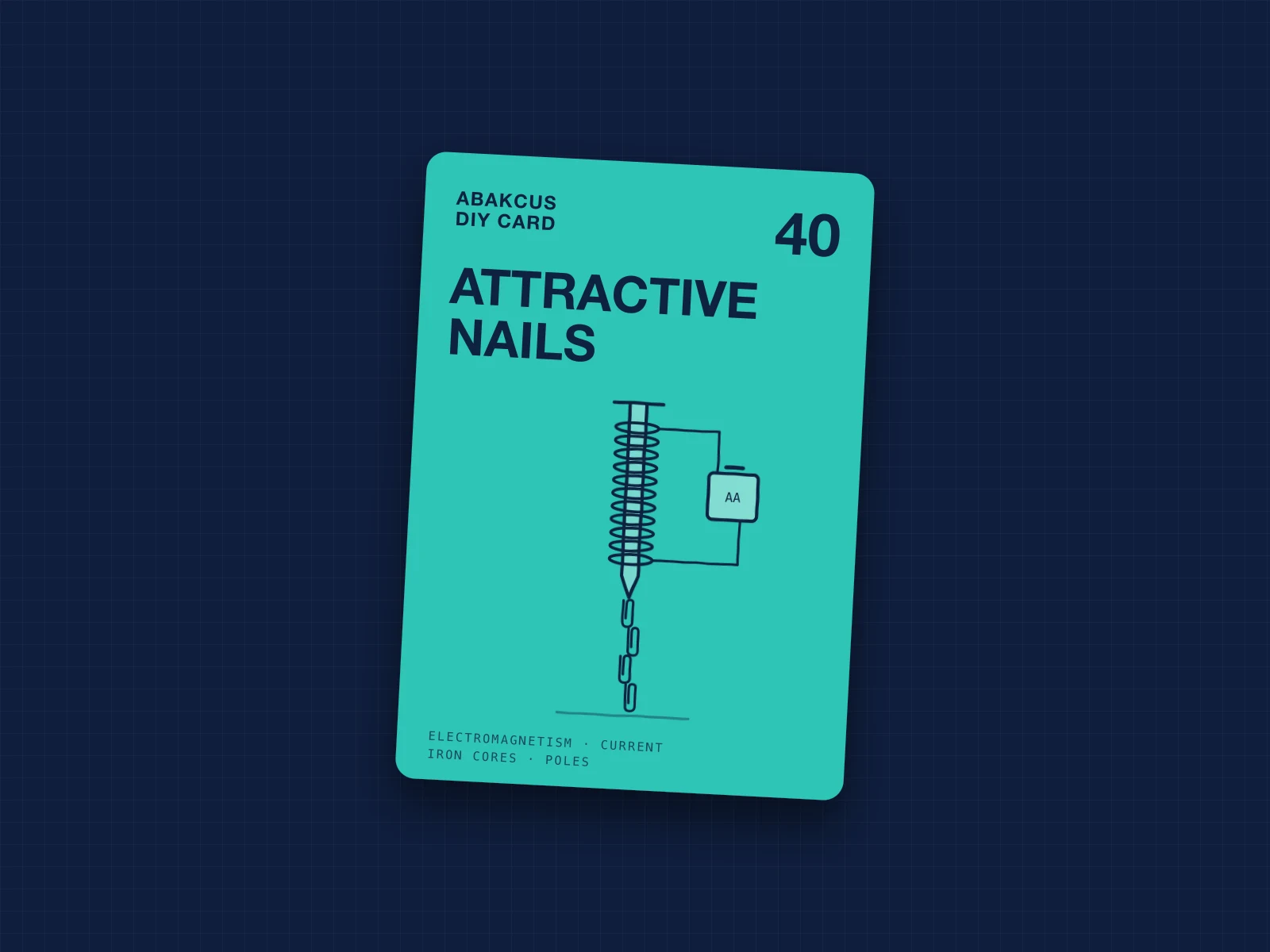
Attractive Nails: How to Make an Electromagnet
A nail, a length of wire and a battery. Wind the wire round the nail and touch it to the battery, and the nail becomes a magnet that picks up paper clips, until you let go.
Open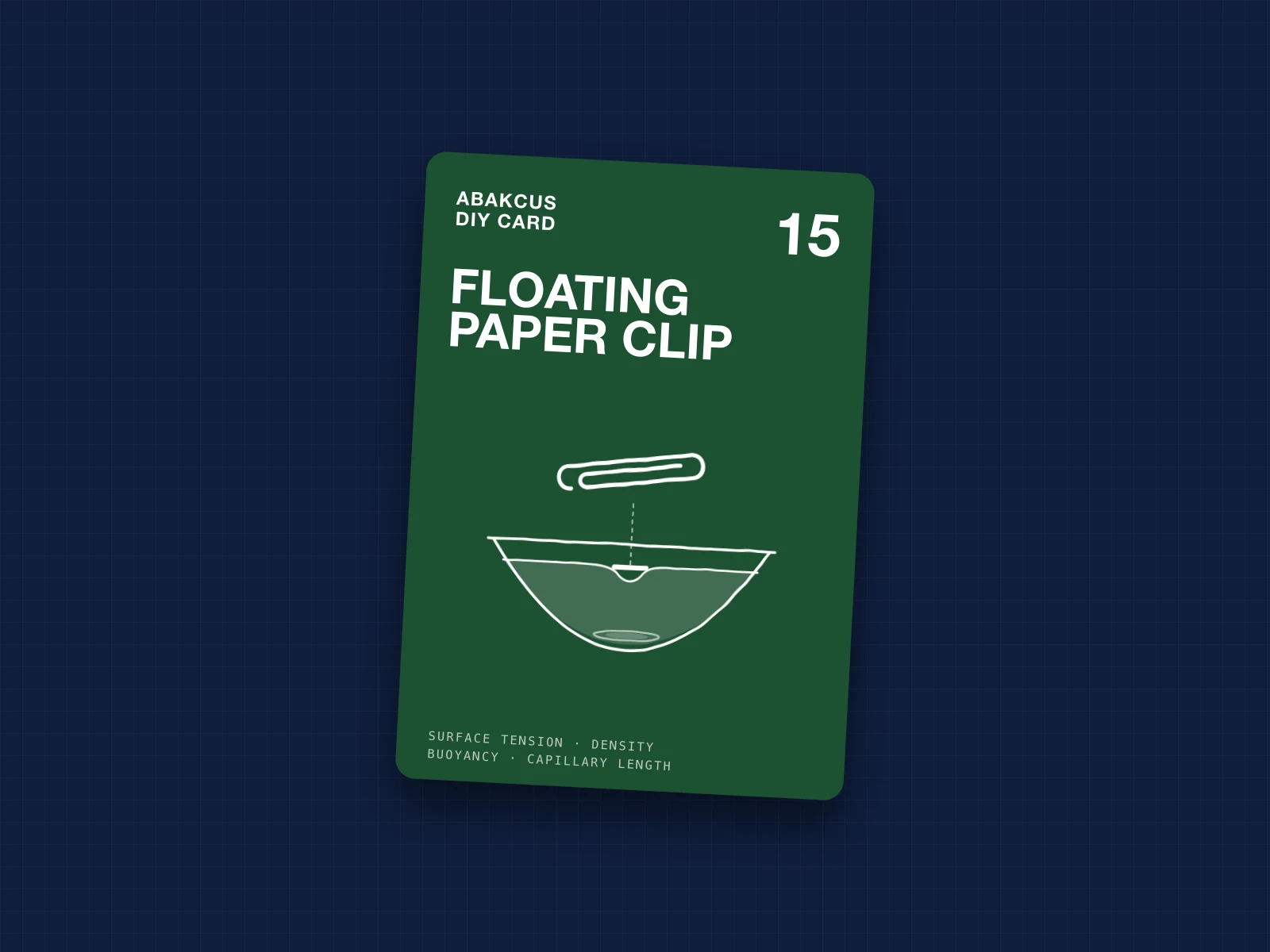
How to Float a Paper Clip on Water: Surface Tension
Steel is nearly eight times denser than water, and a paper clip still lies on top of it if you put it down gently. The surface bends into a dimple and holds it, like a trampoline, until a drop of soap breaks the spell.
Open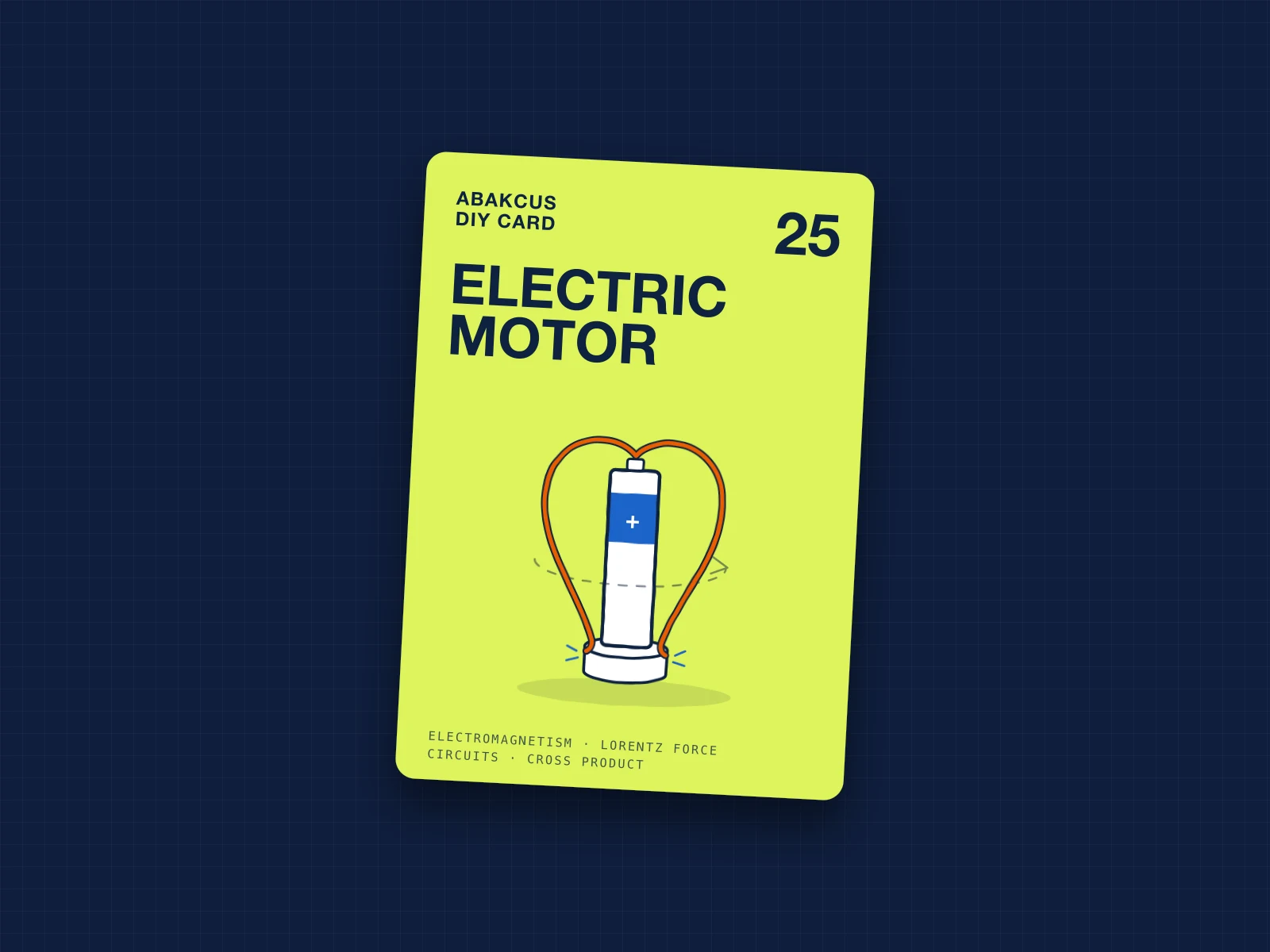
How to Make a Simple Electric Motor (Homopolar Motor)
A battery, a magnet and a bent piece of copper wire: three parts, no coils, and the wire spins on its own. It is the same push that drives every electric motor, found by Faraday in a single afternoon in 1821.
Open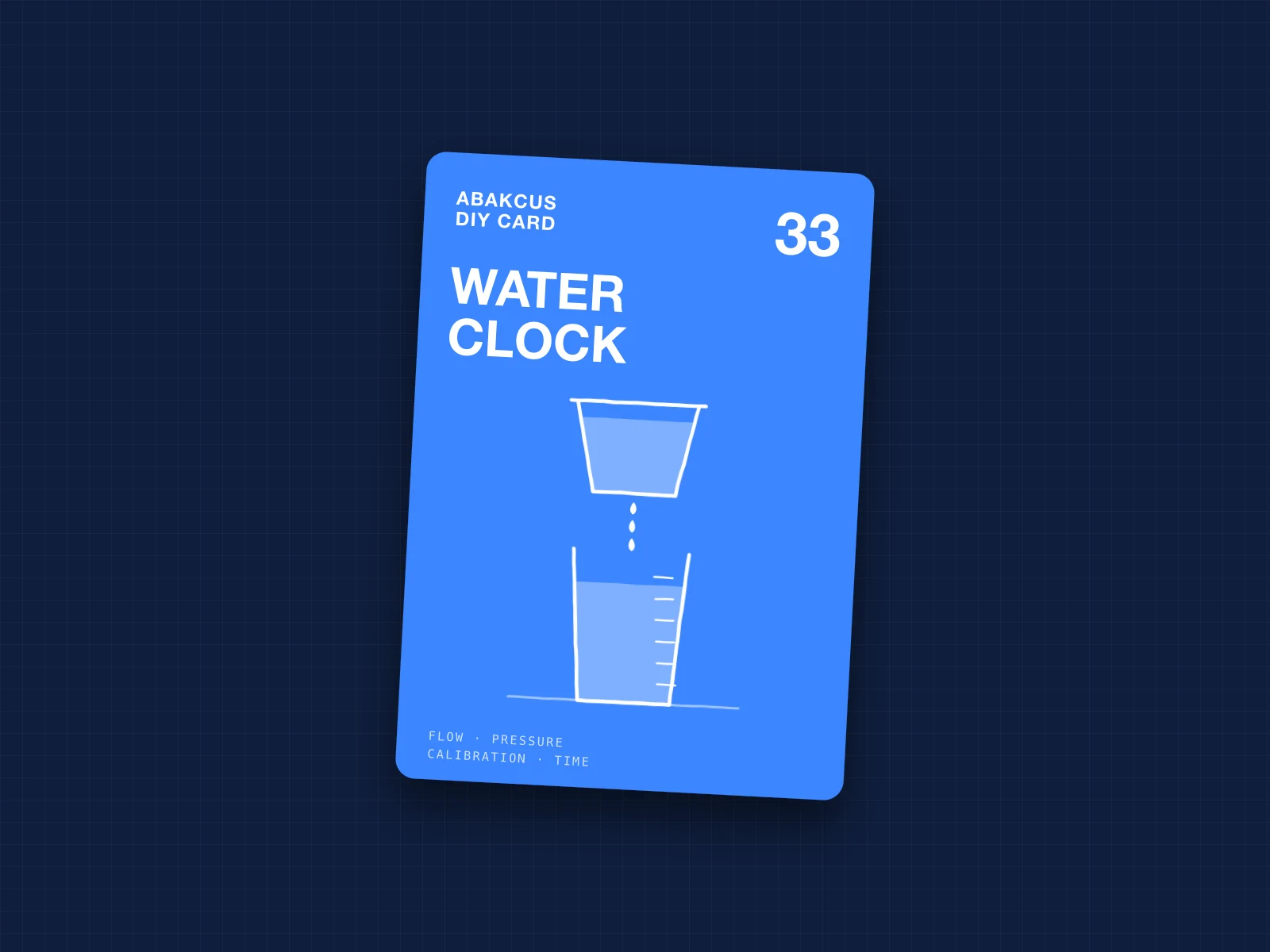
How to Make a Water Clock That Times Exactly One Minute
Two plastic cups, a pinhole and three-quarters of a cup of water. Tune the hole until it runs dry in exactly sixty seconds, and you have built the oldest kind of clock there is.
Open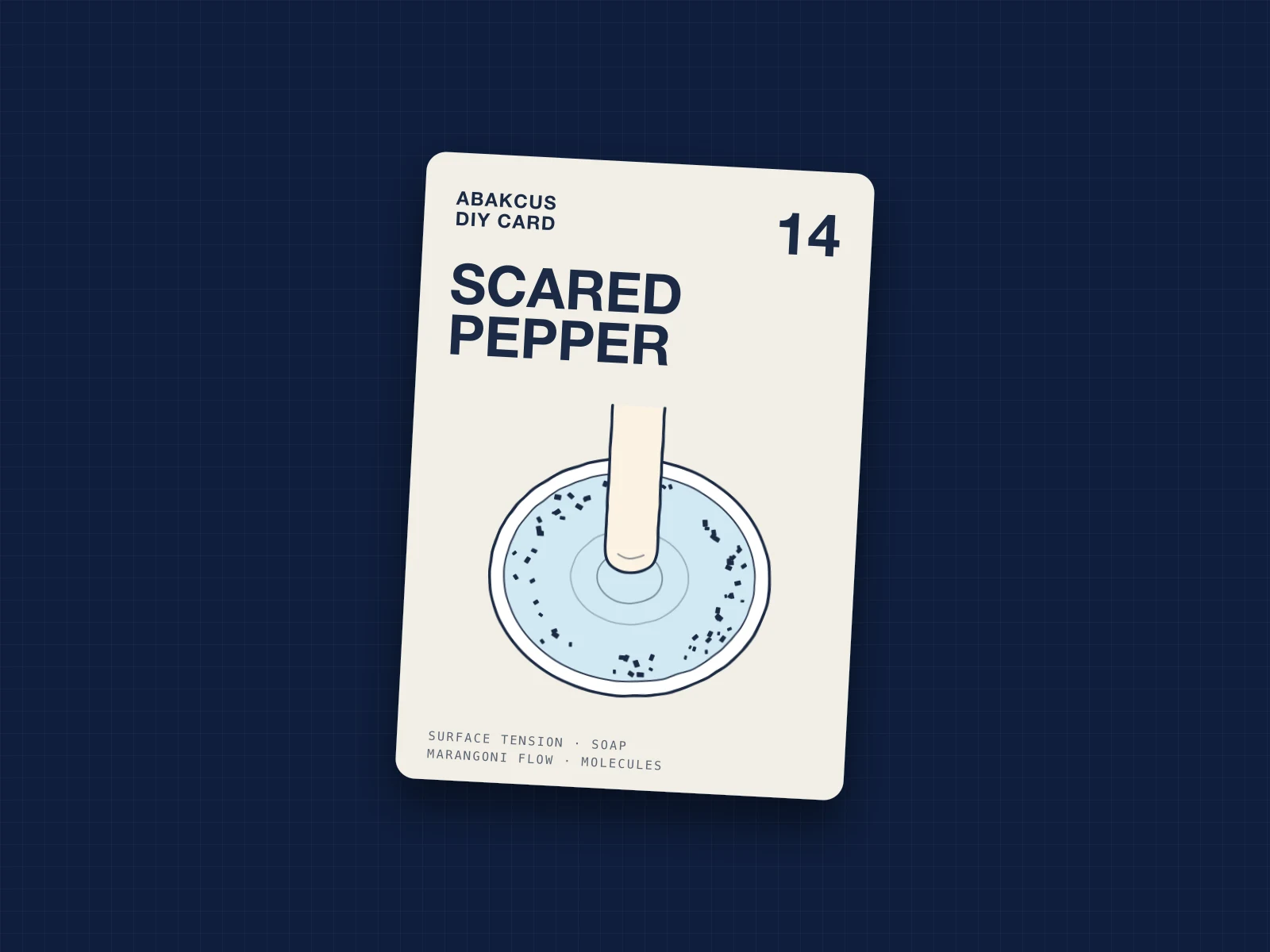
The Pepper and Soap Experiment: Surface Tension Explained
Sprinkle pepper on water, touch the middle with a soapy finger, and the pepper flees to the edge in a split second. It isn’t scared of the soap. The water’s skin is pulling it away.
Open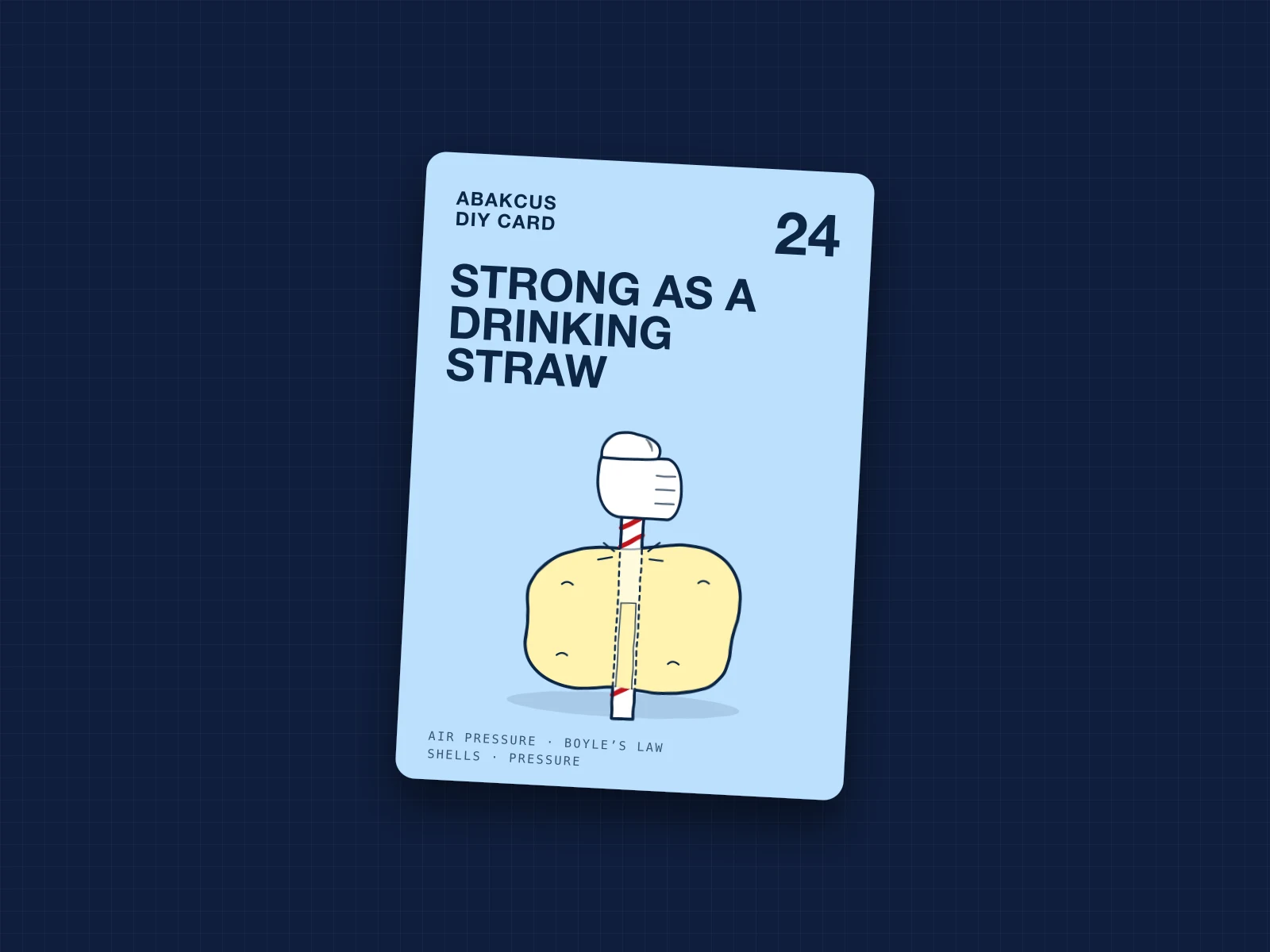
How to Push a Straw Through a Raw Potato
Stab a potato with a plastic straw and the straw crumples. Put your thumb over the top first and it goes straight through. The air trapped inside can’t get out, so the straw can’t cave in.
Open